UNWINDING SATURNS TURNS : PROBING THE FAR ULTRAVIOLET PROPERTIES OF - - PowerPoint PPT Presentation

unwinding saturn s turns probing the far ultraviolet
SMART_READER_LITE
LIVE PREVIEW

UNWINDING SATURNS TURNS : PROBING THE FAR ULTRAVIOLET PROPERTIES OF - - PowerPoint PPT Presentation

UNWINDING SATURNS TURNS : PROBING THE FAR ULTRAVIOLET PROPERTIES OF SATURNS RINGS Based on the paper by Bradley et al. (2010): Far ultraviolet spectral properties of Saturns rings from Cassini UVIS Milena Crnogorevi ASTR630 Term


slide-1
SLIDE 1

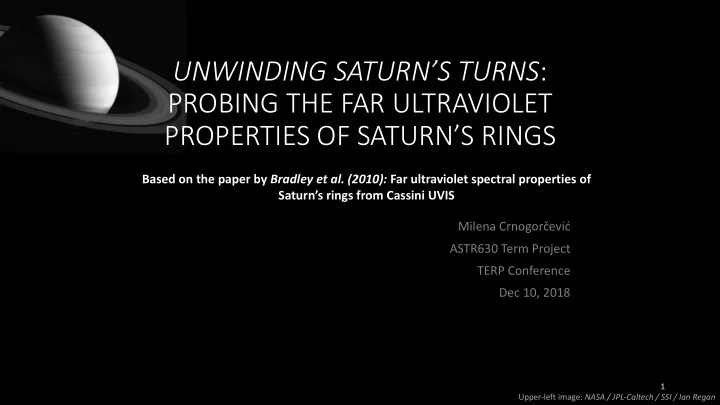
UNWINDING SATURN’S TURNS: PROBING THE FAR ULTRAVIOLET PROPERTIES OF SATURN’S RINGS

Milena Crnogorčević ASTR630 Term Project TERP Conference Dec 10, 2018 Based on the paper by Bradley et al. (2010): Far ultraviolet spectral properties of Saturn’s rings from Cassini UVIS

Upper-left image: NASA / JPL-Caltech / SSI / Ian Regan 1

slide-2
SLIDE 2

Motivation

  • Saturn’s rings composed mostly of water ice (Cuzzi et al. 1984)
  • Decrease in reflectivity shortward of 600 nm à non-icy constituents affecting

the scattering properties of the ring particles

  • Water-ice absorption feature at

around 160 nm

  • its properties depend on the scattering

distance photons travel through water-ice, as well as the absorption properties

  • f the regolith water-ice
  • can use spectral information to

characterize mean free path and the symmetry parameters of the rings

Upper-right image: NASA / JPL-Caltech / SSI

Fig 1. (corresponds to Fig. 2 in the paper) Normalized radiance from four different regions summed over four years of observations. Obvious absorption feature present at ~ 160 nm.

2

slide-3
SLIDE 3

Authors:

C Ring B Ring Cassini division A Ring

  • Considered four years of Cassini data

applying certain selection criteria

  • Data reduction steps accounted for skewed

field of view and other geometry effects

  • Produced I/F spectral plots
  • Fit Hapke and Shkuratov model (water-ice

albedo) to the data

  • Found limits on L (mean free path length), g

(symmetry parameter across the rings), UV slope, and I/F

3

slide-4
SLIDE 4

What did I do?

C Ring B Ring Cassini division A Ring

  • Considered four years of Cassini data

applying certain selection criteria

  • Data reduction steps accounted for skewed

field of view and other geometry effects

  • Produced I/F spectral plots
  • Fit Hapke and Shkuratov model (water-ice

albedo) to the data

  • Found limits on L (mean free path length), g

(symmetry parameter across the rings), UV slope, and I/F

  • Using the selection criteria from the

paper, came up with a list of 760

  • bservations
  • Considered Ring B only (32
  • bservations)
  • Data reduction steps partially

reproduced

  • I/F spectral plot for Ring B partially

reproduced using the limited amount of data

4

slide-5
SLIDE 5
  • Selection criteria:
  • Considering the lit side of Saturn’s

rings, phase angles 5 to 30 deg

  • Slit width: high and low resolution,

no occulation data

  • Considering only the far-UV
  • bservations (111.5 – 191.2 nm)
  • 760 observations (Ring A (3), Ring

B (32), Ring C (18), and the rest combination of two or more, or not mentioned in the paper)

  • Data reduction:
  • Background
  • Flagging the ”evil” pixels
  • Wavelength and flux calibration
  • GEOM routines to account for the

skewed field of view and appropriately binning the data

  • Lyman-alpha forest accounting
  • Calibrating it to the Sun’s flux at

the given time

Fig 2. (analogous to Fig 1) Normalized radiance from Ring B for one of the

  • bservations (FUV2005_230_15_15). Similar absorption feature may be seen,

but more data is necessary to conduct any further analysis.

5

slide-6
SLIDE 6

Paper’s conclusions and its potential extensions

  • Conclusions:
  • retrieved a measure of the

amount of the water ice that UV photons traverse before leaving the ring from the location of the absorption edge in data

  • Mean free path: relatively uniform

from the mid-B ring to the outer A ring, minimum in the inner C ring

  • Lack of correlation between L and

UV slope

  • Potential future work:
  • More data available since 2008
  • Consider more spatial coverage

and include more rings

  • Consider different radiative

transfer models as applied to the rings

6

slide-7
SLIDE 7

Thanks! Questions?

7

slide-8
SLIDE 8

8

…and today…