Why Does Saturn Have Rings? Saturn was discovered by Galileo in - - PowerPoint PPT Presentation

why does saturn have rings
SMART_READER_LITE
LIVE PREVIEW

Why Does Saturn Have Rings? Saturn was discovered by Galileo in - - PowerPoint PPT Presentation

Why Does Saturn Have Rings? Saturn was discovered by Galileo in 1610, but the geometry of its rings was not understood until the work of Christiaan Huygens in 1659. The photograph is a composite made from 165 images taken by the wide-angle camera


slide-1
SLIDE 1

Why Does Saturn Have Rings?

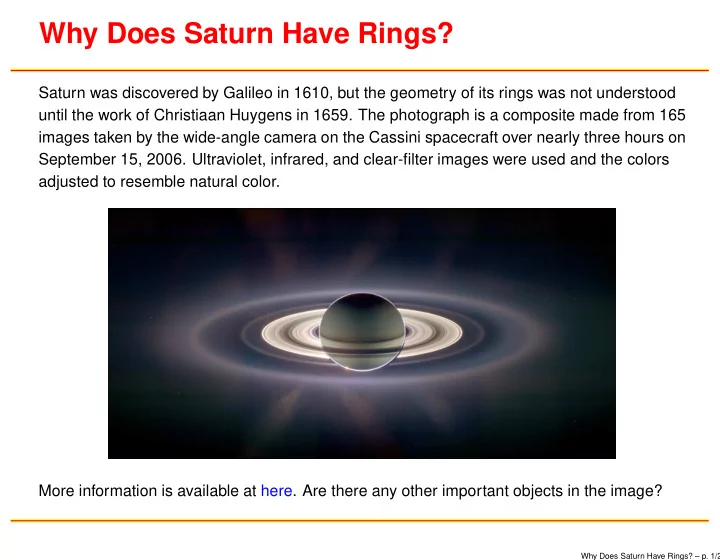
Saturn was discovered by Galileo in 1610, but the geometry of its rings was not understood until the work of Christiaan Huygens in 1659. The photograph is a composite made from 165 images taken by the wide-angle camera on the Cassini spacecraft over nearly three hours on September 15, 2006. Ultraviolet, infrared, and clear-filter images were used and the colors adjusted to resemble natural color.

Earth

More information is available at here. Are there any other important objects in the image?

Why Does Saturn Have Rings? – p. 1/2

slide-2
SLIDE 2

Why Does Saturn Have Rings?

Saturn was discovered by Galileo in 1610, but the geometry of its rings was not understood until the work of Christiaan Huygens in 1659. The photograph is a composite made from 165 images taken by the wide-angle camera on the Cassini spacecraft over nearly three hours on September 15, 2006. Ultraviolet, infrared, and clear-filter images were used and the colors adjusted to resemble natural color.

Earth

More information is available at here.

Why Does Saturn Have Rings? – p. 2/2

slide-3
SLIDE 3

Roche’s Limit - The Data

The figure shows the position of Saturn’s rings and the orbital radii of some of Saturn’s

  • satellites. The sizes of Saturn and the satellites are not to scale, but the distances from the

center of Saturn are to scale. Roche’s limit is a calculation performed in the mid-nineteenth century by a French physicist Edward Roche to explain the structure of Saturn’s rings and

  • moons. Is Roche’s limit correct?

Titan Rhea Dione Tethys Enceladus Saturn

Saturn’s Rings and Moons

Rings Janus

The shadow cast by Titan can be seen on the image of Saturn. The image of Saturn is from the Hubble Space Telescope. More on recent research about Saturn’s rings can be found here.

Why Does Saturn Have Rings? – p. 3/2

slide-4
SLIDE 4

Newton’s Laws

  • 1. Consider a body with no net force

acting on it. If it is at rest it will remain at rest. If it is moving with a constant velocity it will continue to move at that velocity.

  • 2. For all the different forces acting on a

body Σ Fi = m a .

  • 3. For every action there is an equal

and opposite reaction.

  • FAB = −

FBA

Why Does Saturn Have Rings? – p. 4/2

slide-5
SLIDE 5

Newton’s Laws - An Example

Two blocks are connected by a rope draped over a pulley as shown

  • below. The masses are m1 = 1.0 kg and m2 = 4.0 kg. What is the

acceleration of both masses?

m m

1 2

Why Does Saturn Have Rings? – p. 5/2

slide-6
SLIDE 6

Force and Motion 1

NOT constant acceleration!!

Why Does Saturn Have Rings? – p. 6/2

slide-7
SLIDE 7

Force and Motion 1

NOT constant acceleration!!

Clean the tracks!!

Why Does Saturn Have Rings? – p. 6/2

slide-8
SLIDE 8

Combining Forces On A Falling Balloon

A hot-air balloon of mass M is descend- ing vertically with a downward accelera- tion a as shown below. How much ballast mb must be thrown out to give the balloon the same magnitude acceleration in the

  • pposite direction (up)? Assume the up-

ward force of the hot air does not change as ballast is dropped and express your answer as an equation in M, a, and any necessary constants.

Why Does Saturn Have Rings? – p. 7/2

slide-9
SLIDE 9

Liberal Arts!!

You are an engineer who has to hang a kinetic sculpture (a mobile) by the famed artist Alexander Calder from the crossbeams of the hall of an art gallery. Consider the two cables used to hold up the mobile of mass m = 80 kg from a ceiling as shown below. They are attached at two seperate points on the ceiling as shown. What is the tension in each cable?

ALEXANDER CALDER (American, 1898-1976) The Star, 1960 Polychrome sheet metal and steel wire 35-3/4 x 53-3/4 x 17-5/8”

28 47

  • Why Does Saturn Have Rings? – p. 8/2
slide-10
SLIDE 10

The Rotor

The Rotor is an amusement park ride in which a room shaped like a cylinder is spun rapidly forcing the occupants to lean against the wall. When a minimum rotational frequency is reached the floor of the room is suddenly dropped. Of course, the riders remain safely pinned to the walls

  • f the spinning room.

What is the minimum rotational frequency for this ride to work prop- erly? The radius of the room is r = 2.1 m and the coefficient of friction between the walls and the backs of the riders is µ = 0.4.

Why Does Saturn Have Rings? – p. 9/2

slide-11
SLIDE 11

Coefficients of Friction

Materials µs µk Steel on steel 0.74 0.57 Aluminum on steel 0.61 0.47 Copper on steel 0.53 0.36 Rubber on concrete 1.0 0.8 Wood on wood 0.25-0.5 0.2 Glass on glass 0.94 0.4 Waxed wood on wet snow 0.14 0.1 Waxed wood on dry snow

  • 0.04

Ice on ice 0.1 0.03 Teflon on Teflon 0.04 0.04 Human synovial joints 0.01 0.003

Why Does Saturn Have Rings? – p. 10/2

slide-12
SLIDE 12

The Rotor

The Anaconda is a popular roller coaster at the King’s Dominion amusement part north of Richmond. It contains a loop in it’s track like the

  • ne shown below. If the radius of the loop is R = 6.3 m, then what is the

minimum speed at the top of the loop that is necessary to prevent someone from falling out?

Why Does Saturn Have Rings? – p. 11/2

slide-13
SLIDE 13

Newton’s Third Law

A farm worker pulls a cart with a force

  • Ff. Newton’s third law states

that the wagon exerts and equal and opposite force on the worker −

  • Ff. Hence, the wagon remains stationary.

Is this statement correct? Explain.

Why Does Saturn Have Rings? – p. 12/2

slide-14
SLIDE 14

Newton’s Third Law

A farm worker pulls a cart with a force

  • Ff. Newton’s third law states

that the wagon exerts and equal and opposite force on the worker −

  • Ff. Hence, the wagon remains stationary.

Is this statement correct? Explain. That Professor Goddard with his ‘chair’ in Clark College and the countenancing of the Smithsonian Institution does not know the relation of action to reaction, and of the need to have something better than a vacuum to react against - to say that would be absurd. Of course, he only seems to lack the knowledge ladled out daily in the high schools. editorial in the New York Times January 13, 1920

Why Does Saturn Have Rings? – p. 12/2

slide-15
SLIDE 15

EEEEKKKKK!!!!!

In January, 1942 a Soviet Ilyushin 4 flown by Lieutenant I.M.Chisov was badly damaged by German gunfire. At an altitude of 21,980 feet Lieutenant Chisov fell from the plane. Unfortunately, he did not have a parachute on when he fell. He landed on the slopes of a snow-covered ravine and slid to the bottom. He suffered a fractured pelvis and severe spinal damage, but lived. By 1974 he had become Lieutenant Colonel Chisov. How fast was Lieutenant Chisov moving when he hit the ravine? Use the information listed

  • below. Estimate the minimum time for his fall.

m = 75 kg A = 0.70 m2 D = 0.5 ρ = 1.2 kg/m3

Why Does Saturn Have Rings? – p. 13/2

slide-16
SLIDE 16

The Drag Force - 1

2007-12-13 17:51:17

(m/s)

t

v 0.5 1 1.5 2 2.5 3 3.5 4 Resistive Force (N) 0.02 0.04 0.06 0.08 0.1 0.12 0.14 0.16 0.18

/ ndf

2

χ 0.0001598 / 10 p0 ± p1 ± p2 0.0002145 ± 0.01589 / ndf

2

χ 0.0001598 / 10 p0 ± p1 ± p2 0.0002145 ± 0.01589

Resistive Force on Coffee Filters

Why Does Saturn Have Rings? – p. 14/2

slide-17
SLIDE 17

The Drag Force - 2

Aerodynamic forces acting on an artillery shell. The force W is the drag or air resistive force,

  • La is the lift,

Fg is gravity, and the point D is the center of pressure. Note the change in the air resistive force at the speed of sound.

Why Does Saturn Have Rings? – p. 15/2

slide-18
SLIDE 18

The Drag Force - 3

FD = 1 2DρAv2 D - drag coefficient. ρ - density of resistive medium. A - cross sectional area of falling object. v - speed. Table of terminal velocities vT for different objects. Object vT (m/s) Skydiver 59 16-lb shot 145 Baseball 42 Raindrop (1.5 mm radius) 7 Ping-Pong ball 9 Tennis ball 31 Parachutist 5

Why Does Saturn Have Rings? – p. 16/2

slide-19
SLIDE 19

Airplanes on a String

Consider the model airplane hanging from a string and flying in a circle as shown in the

  • figure. The velocity of the plane is v = 1.2 m/s. What is the tension in the string?

Some useful information Mass (m) 0.2 kg Vertical Angle(θ) 25◦ String length(R) 0.7 m Pivot height(h) 1.3 m

Airplane Side View Top View Pivot Propeller Radius Pivot R θ h

Why Does Saturn Have Rings? – p. 17/2

slide-20
SLIDE 20

Roche’s Limit - A Model of the Rings

Two, identical, spherical dust grains of mass md are orbiting Saturn just touching one another and aligned along a radius from the planet’s center (see figure). If each dust grain moves in a circular orbit, will they maintain the alignment shown in the figure as they orbit Saturn? Ignore any attraction between the dust grains.

D Saturn (M ) d Dust grains (m )

d S

Why Does Saturn Have Rings? – p. 18/2

slide-21
SLIDE 21

Roche’s Limit - Tidal Force

Two, identical, spherical dust grains of mass md are orbiting Saturn just touching one another and aligned along a radius from the planet’s center (see figure).

  • 1. What happens to the separation of the grains if they are released from rest?
  • 2. What is this difference between the forces on each dust grain in terms of the constants

shown in the figure and any other necessary ones?

  • 3. Show that if d ≫ D then

∆F = Ftidal = 2GMsmdD d3 .

D Saturn (M ) d Dust grains (m )

d S

Why Does Saturn Have Rings? – p. 19/2

slide-22
SLIDE 22

Roche’s Limit for Saturn

Suppose our dust grains are now held together by their mutual, gravitational attraction.

  • 1. For what range of d will this gravitational attraction overcome the tidal force that

separates the dust grains? Get your answer in terms of MS, md, and D. This is Roche’s limit.

  • 2. Rewrite the answer above using the definition of the density of the dust grains ρ = md

Vd

where Vd is the volume of our dust sphere. How does Roche’s limit depend on the grain size D?

  • 3. What is Roche’s limit for Saturn if MS = 5.68 × 1026 kg and ρ = 2 × 10³ kg/m3?

How does this result compare with observation?

D Saturn (M ) d Dust grains (m )

d S

Why Does Saturn Have Rings? – p. 20/2

slide-23
SLIDE 23

Roche’s Limit - Does It Work?

The figure shows the position of Saturn’s rings and the orbital radii of some of Saturn’s

  • satellites. The sizes of Saturn and the satellites are not to scale, but the distances from the

center of Saturn are to scale. Is Roche’s limit correct?

Titan Rhea Dione Tethys Enceladus Saturn

Saturn’s Rings and Moons

Rings Janus

The shadow cast by Titan can be seen on the image of Saturn. The image of Saturn is from the Hubble Space Telescope.

Why Does Saturn Have Rings? – p. 21/2

slide-24
SLIDE 24

Roche’s Limit - Does It Work?

The figure shows the position of Saturn’s rings and the orbital radii of some of Saturn’s

  • satellites. The sizes of Saturn and the satellites are not to scale, but the distances from the

center of Saturn are to scale. Is Roche’s limit correct?

Titan Rhea Dione Tethys Enceladus Saturn

Saturn’s Rings and Moons

Rings Janus Roche Limit

The shadow cast by Titan can be seen on the image of Saturn. The image of Saturn is from the Hubble Space Telescope.

Why Does Saturn Have Rings? – p. 22/2

slide-25
SLIDE 25

Roche’s Limit - More Data

Planet Roche Limit (m) Distance to Nearest Satellite (m) Roche Period (s) Orbital Period

  • f Nearest

Satellite (s) Earth 2.3 × 10⁷ 38 × 107 8.1 × 10³ 2500 × 103 Mars 1.1 × 10⁷ 0.94 × 10⁷ 3.9 × 10³ 28 × 103 Jupiter 1.5 × 10⁸ 1.3 × 10⁸ 5.6 × 10⁴ 2.5 × 10⁴ Saturn 1.1 × 10⁸ 1.4 × 10⁸ 3.7 × 10⁴ 5.0 × 10⁴ Uranus 5.5 × 10⁷ 5.0 × 10⁷ 1.9 × 10⁴ 2.9 × 10⁴ Neptune 5.8 × 10⁷ 3.6 × 10⁷ 1.9 × 10⁴ 2.5 × 10⁴ Pluto 3.0 × 10⁶ 48 × 106 1.1 × 10³ 550 × 103

Why Does Saturn Have Rings? – p. 23/2

slide-26
SLIDE 26

Hints for the Centripetal Force lab

  • 1. Align the camera, string, and the plane in the center of the camera’s field of view.
  • 2. Use the distance from the hole in the post the string passes through, along the string,

to the center of the airplane.

  • 3. The distance in Number 2 should not exceed 45 cm.
  • 4. Let the airplane run for about one minute before taking data to let any oscillations die
  • ut.
  • 5. Weigh the plane on the scale.
  • 6. Measure the diameter along the horizontal and vertical axes of your Excel plot. If they

are significantly different, consult your instructor.

Why Does Saturn Have Rings? – p. 24/2

slide-27
SLIDE 27

Some cool pictures

From just beneath the ringplane, Cassini stares at Janus (181 kilometers across) on the near side of the rings and Prometheus (102 kilometers across) on the far side. A cryovolcanic eruption on Enceladus, a moon of Saturn, can be seen in this Cassini image along with the diffuse ring produced by these eruptions.

Why Does Saturn Have Rings? – p. 25/2