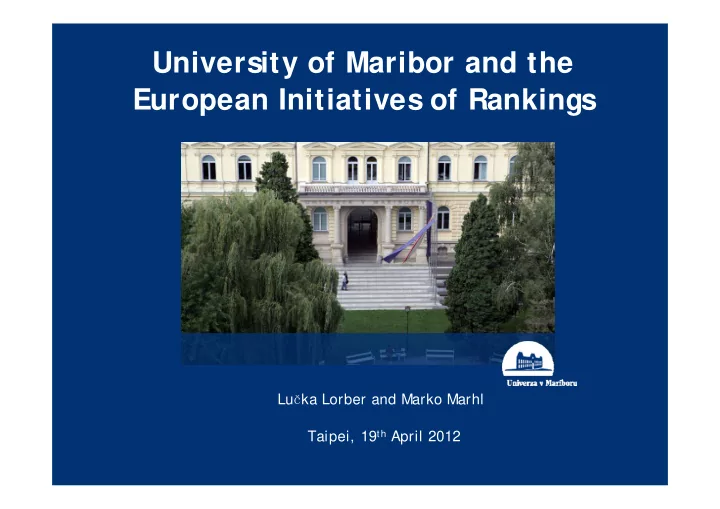
University of Maribor and the European Initiatives of Rankings Lu - - PowerPoint PPT Presentation
University of Maribor and the European Initiatives of Rankings Lu ka Lorber and Marko Marhl Taipei, 19 th April 2012 Overview University of Maribor high level of diversity Quality Development our approach Open Questions
Overview
- University of Maribor – high level of diversity
- Quality Development – our approach
- Open Questions – how to asses quality in different fields
New vision – according to the European initiative and the projects U-Multirank and E3M.
MARIBOR
- 1859 – the b e g inning o f hig he r
e duc a tio n in Ma rib o r (a hig he r re lig io us sc ho o l)
- 1961 - the Asso c ia tio n o f
I nstitutio ns o f Hig he r E duc a tio n in Ma rib o r
- 1975 – Unive rsity o f Ma rib o r
- T
- da y we ha ve 17 fa c ultie s
- Mo re tha n 20,000
unde rg ra dua te a nd po st- g ra dua te stude nts
Unive rsity of Ma ribor, Slove nia
F a c ultie s
F a c ulty o f E le c tric a l E ng ine e ring a nd Co mpute r Sc ie nc e – F
E ECS
F a c ulty o f Che mistry a nd Che mic a l E ng ine e ring – F
CCE
F a c ulty o f Na tura l Sc ie nc e s a nd Ma the ma tic s – F
NSM
F a c ulty o f Crimina l Justic e a nd Se c urity – F
CJS
F a c ulty o f E c o no mic s a nd Busine ss – F
E B
F a c ulty o f Me c ha nic a l E ng ine e ring – F
ME
F a c ulty o f Org a niza tio n Sc ie nc e – F
OS
F a c ulty o f Civil E ng ine e ring – F
CE
F a c ulty o f He a lth Sc ie nc e s – F
HS
F a c ulty o f E ne rg e tic s – F
E N
F a c ulty o f E duc a tio n –
F E
F a c ulty o f Ag ric ulture – F
AG
F a c ulty o f Me dic ine – F
M
F a c ulty o f L
- g istic s – F
L O
F a c ulty o f T
- urism– F
T
F a c ulty o f L a w – F
L
F a c ulty o f Arts – F
A
Quality Development – Vision
The autonomy of the University is based on quality development in terms of teacher and student performance as well as the establishment of a higher education institutional system enabling creativity and innovation in order to increase economic efficiency, improve the quality of life and promote sustainable development. Raising awareness of quality culture is of primary importance.
Purpose of Quality Development
The University of Maribor must develop an effective system, methods and tools assuring institutional and programme quality, which will be based on the autonomy of teachers, students and other employees. Development Guidelines:
- monitoring the development of undergraduate and postgraduate
degree programmes as well as scientific research and artistic activity,
- monitoring management and decision-making policy,
- encouraging internationalisation,
- cooperating with the economy and the broader social environment,
- encouraging the upgrading of infrastructure for the development of
higher education,
- ensuring professional support in internal and external institutional
and programme evaluations and the introduction of improvements,
- raising awareness of quality culture.
Starting Points
The development of a quality assurance programme at the University
- f Maribor is based on strategic guidelines of the Research and
Innovation Strategy of Slovenia 2011 – 2020 and the objectives of the National Higher Education Programme of the Republic of Slovenia 2011 – 2020 in accordance with EU directives on the development of higher education and competitiveness in the global environment (Education and Training, ET, 2020). These documents define key long-term objectives: ensuring life-long learning and mobility promoting fairness, social cohesion and active citizenship encouraging creativity and innovation, including entrepreneurship improving the quality and effectiveness of education 1 4 2 3
QUALITY DEVELOPMENT AT UM
quality assurance and improvement
communication cooperation trust approach QUALITY MANAGEMENT
technocratic elements (management strategy at all levels)
QUALITY IMPLEMENTATION cultural elements (teachers, students, other employees) tools and mechanisms for quality measurement, assessment, assurance and implementation
Individual level: personal contributions to quality improvement Institutional level: related personal contributions – public interest
top-down bottom-up
Institutional Model
Scientific Research and Art Activity
Guidelines:
- developing research-oriented doctoral programmes,
- monitoring and encouraging the integration of postgraduate
degree programmes,
- evaluating findings of early-stage researchers,
- evaluating the effects of research groups and the national
research programme on the quality of research excellence at the University of Maribor (early-stage researchers, publications, citations, patents, innovations),
- evaluating the competitiveness of researchers of the University
- f Maribor in the European and wider international research
community (analysis of projects proposals and approved projects, results),
- monitoring the quality of research equipment and infrastructure,
- evaluating artistic achievements and excellence,
- monitoring library and information services as well as other
professional activity,
- supporting project/research work of students/entrepreneurship
and self-employment,
- evaluating the effects of scientific research for the needs of the
economy and the broader environment.
Quality Development in Education
Guidelines:
- monitoring the development of undergraduate degree programmes (even after
graduates take up employment) and systematic analysis of programme effectiveness,
- developing joint degree programmes that would correspond to study and
employment interests (interdisciplinary character),
- evaluating joint international degree programmes (quality of partner
institutions, recognition of qualifications),
- internationalization of higher education (mobility, joint programmes, summer
schools),
- monitoring active cooperation with municipal and regional institutions,
- examining teaching and learning methods, encouraging proactive
behaviour and creativity in students (project work, international exchange, tutors ...) in order to increase the number of students satisfying course requirements, decrease the number of dropouts, enhance the quality of knowledge and increase competence,
- internalization of the teaching process (visiting professors, foreign
students),
- cultivating Slovene as a second/foreign language; English as a
mandatory foreign language,
- introducing measures for students with special needs,
- monitoring and evaluating student activities.
Efforts to Assure Quality Teaching
TEACHERS
- introducing new teaching tools,
- combining practical training, methods and tools with
global teaching trends,
- cooperating in the development and implementation
- f degree programmes,
- taking into account individual efforts to build a
professional career …
BASIS FOR QUALITY TEACHING
- ensuring that institutional policy for quality teaching
is being correctly implemented,
- disseminating quality culture, promoting cooperation
and immediate notification,
- connecting scientific research and the teaching
profession (examples of good practice),
- openness towards suggestions and initiatives of
teachers and students.
INSTITUTIONAL MANAGEMENT
- supporting high-quality teaching,
- motivating leadership,
- combining and balancing top-down and
bottom-up approaches,
- including professional/ administrative
staff and students,
- ensuring relevant international,
standards (teacher/ students).
STUDENTS
- active cooperation with teachers and
management in the development of initiatives and concepts related to quality teaching, effective mutual cooperation in the teaching process and the creation of a supportive learning environment (equipment, access to literature … ).
- joint implementation of support activities
(tutor system, career centres … ).
INCLUDED INTO THE PROCESS
Staff Development
Guidelines:
- ensuring international comparability of criteria and procedures for the
appointment of faculty ranks with regard to specific features of scientific disciplines,
- monitoring staff structure at the University of Maribor,
- formulating a staff development plan with the purpose of establishing a
support system for early-stage researchers, teaching assistants and assistant professors,
- evaluating degree programmes with regard to available human
resources and actual needs,
- taking into account EU directives for the free movement of workers.
Priority Policy 2012 – 2015
- 1. Focusing on knowledge quality for the needs of the labour
market
- 2. Developing a strong quality culture within the university system
- 3. Taking into account international quality mechanisms
Quality Development – Conclusion
The quality development system needs to be managed and organized in such a manner as to achieve strategic development goals of the University of Maribor, while at the same time promoting humanistic values, academic freedom and the spirit of professional ethics.
The problem
Comprehensive Universities have to be evaluated/assessed by specific criteria in different fields... How to achieve this goal?
European Initiatives
- Project U-Multirank (Multi-dimensional
Global Ranking of Universities)
- Project E3M (European Indicators and
Ranking Methodology for University Third Mission)
The Project U-Multirank
- Multi-dimensional
- Multi-level
- User-driven
Addresses the needs of various stakeholders and is field specific.
2 1 3 4 6 5 7 8 10 9
Coordinator
E3M (European Indicators and Ranking Methodology for University Third Mission)
22
Contracted research
Consultancy
Licensing Start-ups
Spin-offs
Companies
Business incubators Technology parks
Cooperation
Non-academic organizations Sharing of space Facilities Shared laboratories
Mobility of people
Sponsoring of education
Collaborative research projects
Continuing Education Technology Transfer & Innovation Community Engagement
Patents
e-Learning Programs Fee management Teaching Educational activities Life Long Learning Grants Sponsorship Business opportunities Seminars
Access to libraries
Volunteering Membership of Community boards Political participation Community service projects International cooperation Cultural events Senior populations
What is the 3rd mission?
The Project E3M – the Key Dimensions:
- Continuing Education
- Technology Transfer & Innovation
- Social Engagement
Emphasises University 3rd Mission Activities in addition to Research and Education.
… …
DIMENSION PROCESSES POSSIBLE INDICATORS RELEVANT INDICATORS FEASIBLE INDICATORS Continuing Education Technology Transfer & Innovation Community Engagement
METHODOLOGY
Green Paper
www.e3mproject.eu
Conclusions
University World Rankings, European Initiatives, and the University of Maribor on its way of Quality Development:
- Specific field-oriented quality assessment
(habilitations, research projects, etc.)
- Third Mission Activities also needs to be evaluated