SLIDE 1 DRAFT 5/16/18
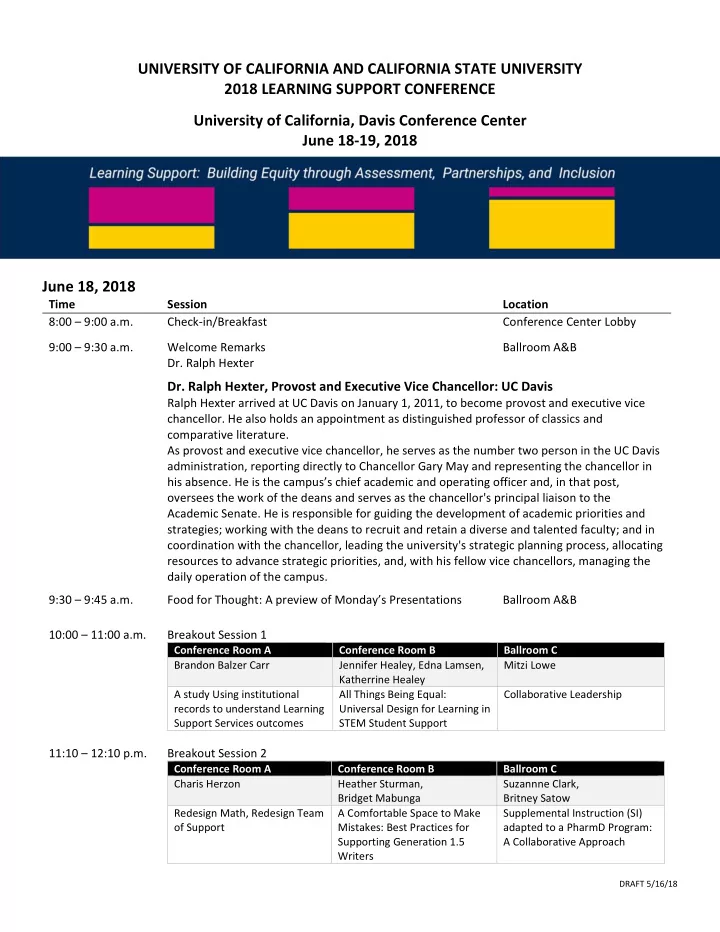
UNIVERSITY OF CALIFORNIA AND CALIFORNIA STATE UNIVERSITY 2018 LEARNING SUPPORT CONFERENCE University of California, Davis Conference Center June 18‐19, 2018 June 18, 2018
Time Session Location 8:00 – 9:00 a.m. Check‐in/Breakfast Conference Center Lobby 9:00 – 9:30 a.m. Welcome Remarks
Ballroom A&B
- Dr. Ralph Hexter, Provost and Executive Vice Chancellor: UC Davis
Ralph Hexter arrived at UC Davis on January 1, 2011, to become provost and executive vice
- chancellor. He also holds an appointment as distinguished professor of classics and
comparative literature. As provost and executive vice chancellor, he serves as the number two person in the UC Davis administration, reporting directly to Chancellor Gary May and representing the chancellor in his absence. He is the campus’s chief academic and operating officer and, in that post,
- versees the work of the deans and serves as the chancellor's principal liaison to the
Academic Senate. He is responsible for guiding the development of academic priorities and strategies; working with the deans to recruit and retain a diverse and talented faculty; and in coordination with the chancellor, leading the university's strategic planning process, allocating resources to advance strategic priorities, and, with his fellow vice chancellors, managing the daily operation of the campus. 9:30 – 9:45 a.m. Food for Thought: A preview of Monday’s Presentations Ballroom A&B 10:00 – 11:00 a.m. Breakout Session 1
Conference Room A Conference Room B Ballroom C Brandon Balzer Carr Jennifer Healey, Edna Lamsen, Katherrine Healey Mitzi Lowe A study Using institutional records to understand Learning Support Services outcomes All Things Being Equal: Universal Design for Learning in STEM Student Support Collaborative Leadership
11:10 – 12:10 p.m. Breakout Session 2
Conference Room A Conference Room B Ballroom C Charis Herzon Heather Sturman, Bridget Mabunga Suzannne Clark, Britney Satow Redesign Math, Redesign Team
A Comfortable Space to Make Mistakes: Best Practices for Supporting Generation 1.5 Writers Supplemental Instruction (SI) adapted to a PharmD Program: A Collaborative Approach
SLIDE 2 DRAFT 5/16/18
Time Session Location 12:15 – 1:15 p.m. Lunch Ballroom A&B 12:45 – 1:15 p.m. President Robert S. Nelson Ballroom A&B
President Robert S. Nelson: California State University, Sacramento
Robert S. Nelsen, who became Sacramento State’s eighth permanent president on July 1, 2015, grew up on a Montana cattle ranch. As the first in his family to attend college, he earned his bachelor’s and master’s degrees in political science from BYU, where he also met his wife, Jody Hawkins. After finishing graduate school in 1979, he was accepted at the University of Chicago’s John U. Nef Committee on Social Thought. After earning his doctorate in 1989, he got a job as a lecturer at the University of Illinois at Chicago. In 1990 he moved on to the University of Texas – Dallas where he founded the creative writing program, was a professor of Literary and Aesthetic Studies, and served as vice provost. In 2008, Jody Nelsen, was hired as the vice president of Business Affairs at Texas A&M University‐Corpus Christi. Nelsen followed his wife and was a professor of English and the associate vice president for Academic Affairs. A year later, Dr. Nelsen was named president of the University of Texas‐Pan
- American. At Sacramento State, he is committed to ensuring that Sacramento State’s students
graduate with less debt and have jobs waiting when they finish school. He wants them to become lifelong learners and critical thinkers, and have an inclusive, safe, and healthy experience on campus. 1:20 – 2:20 p.m. Breakout Session 3
Conference Room A Conference Room B Ballroom C Kimberly Samaniego, Susan Rinaldi Maureen Scharberg Jaqueline Morales A Collaboration Promoting the Understanding of Students’ Mathematical Preparation to Inform and Enact Student Success Interventions from Algebra to Calculus Re‐inventing Assessment for More Purposeful Partnerships and Aligned Processes Peer Mentorship Program: Improving My Academic Progress
2:30 – 3:20 p.m. Lightning Round: 10‐minute presentations with moderated Q&A
Conference Room A Conference Room B Ballroom C Tiffany Lynn Wong Jonathan Balderrama Erika I‐Tremblay Strategies for "Low‐Stakes" Formative Assessment for Equity in First‐Year College Composition Courses Summer Prep Program for Incoming STEM Transfers Literate Histories ‐ A Concept for Tutor Training Emily Merrifield Ashley Bratrude Jessica Fielder The Signature Assignment: Collaboration to Support and Assess FYE Learning Outcomes ACE: Collaboration to Community SI Leader Training: A Mini‐ conference Model Nasheli Hau‐Gutierrez Supporting Student's Writing in a Research Institution
3:30 – 4:30 p.m. Breakout Session 4
Conference Room A Conference Room B Ballroom C Peggy Ozaki, Maricruz Macz Sharon Castro Annalisa Teixeira How to Use a Themed Staff Meeting to Develop Team Building and Reflection Opportunities For Assessment and Training Improvement Training, Evaluating, and Creating Meaningful Relationships with Academic Tutors The myth of the learning style, the power of the learning preference
SLIDE 3 DRAFT 5/16/18
June 19, 2018
Time Session Location 8:00 – 9:00 a.m. Breakfast Ballroom A&B 9:00 – 10:15 a.m.
Ballroom A&B
- Dr. Rebecca Covarrubias‐ University of California, Santa Cruz
- Dr. Rebecca Covarrubias is an Assistant Professor of Social Psychology at the University of
California, Santa Cruz. She examines how delegitimizing and mismatching learning contexts undermine educational, social, and mental health outcomes for marginalized students. She then explores how to reverse these effects through culturally‐informed approaches, including drawing attention to students’ cultural strengths and to the importance of family and
- community. To engage in and promote equity work, Dr. Covarrubias collaborates with campus
community partners. With UCSC’s Learning Support Services team, she devised a large‐scale intervention aimed at promoting help‐seeking and success of marginalized students in a gateway STEM course and has facilitated research‐informed trainings for learning assistants. As a faculty consultant and researcher for UCSC’s Hispanic Serving Institution (HSI) Sense of Belonging Team, Dr. Covarrubias uses research tools to inform and evaluate various grant activities that directly serve and promote the inclusion of low‐income, first‐generation college, and/or students of color. With her research team of amazing undergraduate and graduate students in the Culture and Achievement Collaborative, Dr. Covarrubias engages in continuous learning and assessment of strategies that work to improve the daily experiences of diverse students. 10:15 – 10:30 a.m. Food for Thought: A Preview of Tuesday’s Presentations Ballroom A&B 10:45 – 11:45 Breakout Session 5
Conference Room A Conference Room B Ballroom C Suzanne McEvoy, Melisa Hendrata, Eyob Demeke, Maria Molinda Kevin Sitz James W.G. Barnes The Power of Partnerships and Supplemental Instruction in Enhancing Student Success in First‐Year Math Course A space for innovation and collaboration: The new University of California, Davis Writing Studio Time Management: An Investment in You
12:00 – 1:00 p.m. Lunch Ballroom A&B 1:00 – 1:30 p.m. Chancellor Gary S. May Ballroom A&B
Chancellor Gary S. May: University of California, Davis
An accomplished scholar and engineer, May came to UC Davis from the Georgia Institute of Technology in Atlanta, where he had been for nearly three decades, most recently as dean of the institute’s College of Engineering — the largest and most diverse school of its kind in the
- nation. Prior to being dean, May was the Steve W. Chaddick Chair of Georgia Tech’s School of
Electrical and Computer Engineering and, previous to that, he was the executive assistant to then‐Georgia Tech President G. Wayne Clough. May is known as a dynamic leader with a passion for helping others succeed. He believes success is best judged by how we enhance the lives of others. Throughout his career, he has championed diversity in both higher education and the workplace. He developed and led programs to attract, mentor and retain underrepresented women and ethnic minorities in the STEM fields of science, technology, engineering and math.
SLIDE 4 DRAFT 5/16/18
Time Session Location 1:45 – 2:45 p.m. Breakout Session 6
Conference Room A Conference Room B Ballroom C Charis Herzon Rena Burton, Andonia Carter Stacey Sirois, Inez Anders Logic Models: What are they? How they are useful? Enhancing Student Success: Uniting Life Skills Development and Academic Support Best Practices for Online Tutoring to Increase Inclusivity
3:00 – 4:00 p.m. Breakout Session 7
Conference Room A Conference Room B Lauren Reagan Tina Jordan‐Brown All the places writing lives: peer‐to‐peer writing tutoring within the learning center Supplemental Instruction
4:00 – 4:30 p.m. Farewell Ballroom A&B Presenter List, Alphabetical by Last Name Presenter
Title Institution Presentation
Director Tutoring Services University of California, Davis Best Practices for Online Tutoring to Increase Inclusivity
Jonathan Balderrama
STEM Learning Skills Coordinator University of California, Santa Cruz Summer Prep Program for Incoming STEM Transfers
Brandon Balzer Carr
PhD candidate University of California, Santa Cruz A study using institutional records to understand Learning Support Services
James W.G. Barnes
Associate Director, Calvin E. Bright Success Center University of California, Merced Time Management: An Investment in You
Willie Blackmon
Assistant Director University of California, Riverside Enhancing Student Success: Uniting Life Skills Development and Academic Support
Ashley Bratrude
Academic Excellence (ACE) Program Coordinator University of California, Santa Cruz ACE: Collaboration to Community
Rena Burton
Director University of California, Riverside Enhancing Student Success: Uniting Life Skills Development and Academic Support
Andonia Carter
Assistant Director University of California, Riverside Enhancing Student Success: Uniting Life Skills Development and Academic Support
Sharon Castro
Assistant Director, Lead Modified Supplemental Instruction (MSI) Program Coordinator University of California, Santa Cruz Training, Evaluating, and Creating Meaningful Relationships with Academic Tutors
SLIDE 5
DRAFT 5/16/18
Presenter
Title Institution Presentation
Suzanne Clark
Associate Professor of Pharmacology, Co‐ Director of the Center for Teaching and Learning California Northstate University College of Pharmacy Supplemental Instruction (SI) adapted to a PharmD Program: A Collaborative Approach
Eyob Demeke, Ph.D.
Assistant Prof of Math, Director of Developmental Math California State University, Los Angeles The Power of Partnerships and Supplemental Instruction in Enhancing Student Success in First‐Year Math Courses
Jessica Fielder
Supplemental Instruction Program Director San Francisco State University SI Leader Training: A Mini‐conference Model
Nasheli Hau‐ Gutierrez
MSI/Tutor Coordinator University of California, Santa Cruz Supporting Student's Writing in a Research Institution
Jennifer Healey
Math Specialist University of California, Davis All Things Being Equal: Universal Design for Learning in STEM Student Support
Katherrine Healey
PhD Candidate Yale, Center for Teaching and Learning All Things Being Equal: Universal Design for Learning in STEM Student Support
Melisa Hendrata, Ph.D.
Associate Prof of Math, SI Coordinator California State University, Los Angeles The Power of Partnerships and Supplemental Instruction in Enhancing Student Success in First‐Year Math Courses
Charis Herzon
Director Learning Support Services, Director HSI Initiatives University of California, Santa Cruz Logic Models: What are they? How they are useful
Charis Herzon
Director Learning Support Services, HSI Initiatives University of California Santa Cruz Redesign Math, Redesign Team of Support
Erika I‐Tremblay
Literate Histories ‐ A concept for tutor training University of California, Davis Literate Histories ‐ A Concept for Tutor Training
Edna Lamsen
Chemistry Specialist University of California, Davis All Things Being Equal: Universal Design for Learning in STEM Student Support
Mitzi Lowe
Interim Assistant Dean, College of Health & Human Services CSU Fresno Collaborative Leadership
Bridget Mabunga, M.A.
Writing Specialist University of California, Davis A Comfortable Space to Make Mistakes: Best Practices for Supporting Generation 1.5 Writers
Maricruz Macz
Assistant SI Coordinator California State University, Dominguez Hills How to Use a Themed Staff Meeting to Develop Team Building and Reflection Opportunities For Assessment and Training Improvement
Suzanne McEvoy, Ph.D.
Director, Smart Start for Student Success California State University, Los Angeles The Power of Partnerships and Supplemental Instruction in Enhancing Student Success in First‐Year Math Courses
Emily Merrifield
Undergraduate Experience Librarian Sacramento State The Signature Assignment: Collaboration to Support and Assess FYE Learning Outcomes
Maria Molina, M.P.A.
Coordinator, Smart Start California State University, Los Angeles The Power of Partnerships and Supplemental Instruction in Enhancing Student Success in First‐Year Math Courses
Jaqueline Morales
MSI/Tutor Coordinator at Learning Support Services: Peer Mentor Program Coordinator University of California, Santa Cruz Peer Mentorship Program: Improving My Academic Progress
SLIDE 6 DRAFT 5/16/18
Presenter
Title Institution Presentation
Peggy Ozaki
Senior Coordinator California State University, Dominguez Hills How to Use a Themed Staff Meeting to Develop Team Building and Reflection Opportunities For Assessment and Training Improvement
Lauren Reagan
Lead MSI & Tutor Coordinator University of California, Santa Cruz All the places writing lives: peer‐to‐peer writing tutoring within the learning center
Susan Rinaldi, M.A.
Director, Triton Achievement Partners
Learning Commons University of California, San Diego A Collaboration Promoting the Understanding
- f Students’ Mathematical Preparation to
Inform and Enact Student Success Interventions from Algebra to Calculus
Kimberly Samaniego, Ed.D.
Director Mathematics Diagnostic Testing Project and Director Math Testing and Placement University of California, San Diego A Collaboration Promoting the Understanding
- f Students’ Mathematical Preparation to
Inform and Enact Student Success Interventions from Algebra to Calculus
Maureen Scharberg
Dean of Academic Programs and Services Cal State University, East Bay Re‐inventing Assessment for More Purposeful Partnerships and Aligned Processes
Stacey E.F. Sirois
Director of Campus Relations Tutor Matching Service Best Practices for Online Tutoring to Increase Inclusivity
Kevin Sitz
Director, Writing Support Center University of California, Davis A space for innovation and collaboration: The new University of California, Davis Writing Studio
Julie Stein
Educational Effectiveness Project Manager Cal State University, East Bay Re‐inventing Assessment for More Purposeful Partnerships and Aligned Processes
Heather Sturman, Ph.D.
ELL Specialist University of California, Davis A Comfortable Space to Make Mistakes: Best Practices for Supporting Generation 1.5 Writers
Annalisa Teixeira, Ph.D.
Coordinator, Study Skills and Success Coaching Program University of California, Davis The myth of the learning style, the power of the learning preference
Tiffany Lynn Wong
Writing Program Lecturer University of California, Santa Cruz Strategies for "Low‐Stakes" Formative Assessment for Equity in First‐Year College Composition Courses