
SLIDE 1
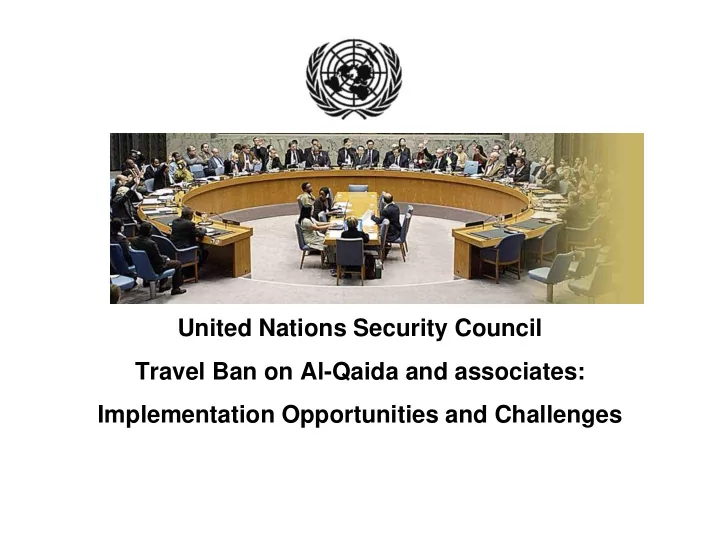
United Nations Security Council Travel Ban on Al-Qaida and - - PowerPoint PPT Presentation
United Nations Security Council Travel Ban on Al-Qaida and associates: Implementation Opportunities and Challenges UN Counter-Terrorism Al-Qaida Monitoring Sanctions Security List Team Committee Council List 1988 Lists Sanctions
Other Sanctions Committees
Counter- Terrorism Committee Al-Qaida Sanctions Committee 1988 Sanctions Committee List List Lists Panels of Experts Monitoring Team CTED
CTITF (UNCCT)
Welcomed the efforts of the International Civil Aviation Organization to prevent travel documents from being made available to Al-Qaida terrorists and their associates Security Council resolution 1735 (2006) Requested the Secretary General to take the necessary steps to increase cooperation between the United Nations and relevant international and regional organisations, including Interpol, ICAO, IATA, and the WCO, in order to provide the Committee with better tools to fulfil its mandate more effectively and to give Member States better tools to implement the measures
“Prevent the entry into or transit through their territories of these [the listed] individuals, provided that nothing in this paragraph shall oblige any State to deny entry or require the departure from its territories of its own nationals and this paragraph shall not apply where entry or transit is necessary for the fulfilment of a judicial process or the [Al-Qaida] Committee determines on a case-by-case basis only that entry or transit is justified".
“Freeze without delay the funds and other financial assets or economic resources of these individuals, groups, undertakings and entities, including funds derived from property owned or controlled directly or indirectly, by them
neither these nor any other funds, financial assets or economic resources are made available, directly or indirectly for such persons’ benefit, by their nationals or by persons within their territory“.
funds, financial assets or economic resources that may be made available, directly or indirectly, to or for the benefit of listed individuals in connection with their travel, including costs incurred with respect to transportation and lodging, and that such travel-related funds, other financial assets or economic resources may only be provided in accordance with the exemption procedures set out in paragraphs 1 and 2 of resolution 1452 (2002), as amended by resolution 1735 (2006), and in paragraphs 10,74 and 75 below”.
Travel document issue Ticket purchase, issue
www.un.org/sc/suborg/en/sanctions/1267/aq_sanctions_list www.un.org/sc/suborg/en/sanctions/1267/press-releases
www.un.org/sc/suborg/sites/www.un.org.sc.suborg/files/1267.htm
www.un.org/sc/suborg/en/sanctions/un-sc-consolidated-list
https://www.un.org/sc/suborg/en/sanctions/1267/aq_sanctions_list/summaries
The ISIL/Al-Qaida Sanctions Committee makes accessible a narrative summary of reasons for the listing for individuals, groups, undertakings and entities included in the Al-Qaida Sanctions List. QDi.006 AIMAN MUHAMMED RABI AL-ZAWAHIRI Date on which the narrative summary became available on the Committee's website: 10 January 2011 Date(s) on which the narrative summary was updated: 07 November 2013, 22 May 2015 Reason for listing: Aiman Muhammed Rabi al-Zawahiri was listed on 25 January 2001 pursuant to paragraph 8(c) of resolution 1333 (2000) as being associated with Al-Qaida, Usama bin Laden or the Taliban for “participating in the financing, planning, facilitating, preparing or perpetrating of acts or activities by, in conjunction with, under the name of, on behalf or in support of”, “supplying, selling or transferring arms and related materiel to” or “otherwise supporting acts or activities of” Al-Qaida (QDe.004), Usama bin Laden and the Taliban. Additional information: Aiman Muhammed Rabi al-Zawahiri was a co-founder and military leader of the Egyptian Islamic Jihad (QDe.003), which opposes the Egyptian Government and seeks its overthrow through violent means.Al- Zawahiri assisted in the formation of Al-Qaida (QDe.004) between 1988 and 1989. He served as an advisor to Usama bin Laden (deceased) and was described as the second in command of the organization. Al- Zawahiri frequently issues statements and tapes in support of Al-Qaida and its activities. Al-Zawahiri led some members of the Egyptian Islamic Jihad to join Al-Qaida in June 2001 and encouraged others to do so, including Nasr Fahmi Nasr Hassannein (deceased), Tariq Anwar el Sayed Ahmed (QDi.014) and Sobhi Abdel Aziz Moahmed el Gohary Abu Sinna (deceased), also known as Abu Hafs al Masri. Al-Zawahiri has been indicted in the United States for his alleged role in the 7 August 1998 bombings of the US Embassies in Dar es Salam, Tanzania, and Nairobi, Kenya. These embassy bombings killed 224 civilians and wounded about 5,000 others. He is accused of the murder of US nationals outside the United States; conspiracy to murder US nationals outside the United States; and attacking a federal facility resulting in death.
http://www.interpol.int/INTERPOL-expertise/Notices/Special-Notices
i24/7) and other biometrics (i24/7)
summary biographical data
data is known, it is included on INTERPOL stolen and lost travel document (SLTD) database
UNB+UNOA:4+API123+NZCS+080708:0545+000000011' UNG+PAXLST+123 AIRLINES+ NZCS+080708:0545+11+UN+D:05B' UNH+PAX11+PAXLST:D:05B:UN:IATA' BGM+745' RFF+TN:BART34567890:::1’ NAD+MS+++A123 CUSTOMER SVC’ COM+043 555 1212:TE+043 555 4545:FX' TDT+20+QQ827+++QQ' LOC+125+CDG' DTM+189:0808080900:201' LOC+87+AKL DTM+232:0808081445:201' NAD+FL+++BARRET:TODD:CHARLES' (Reflects PNR name – may include middle name) ATT+2++M' (if known from name) ATT+2’ if gender not known DTM+329' (if date of birth not known) MEA+CR++:2’ (number checked bags – not a RU requirement so not included) GEI+4+173’ (information verified is not required in RU program) FTX+BAG+++BA987654’ (Tag Number – not required at -24) LOC+22+AKL’LOC+178+CDG’ (itinerary detail at passenger level) LOC+179+AKL’LOC+174+FRA (itinerary detail at passenger level) COM+514 874 0202:TE+514 874 1779:FX’ (not required in RU program) NAT+2’ (Nationality unknown) RFF+AVF:GJIO3R’ (PNR Record Locator – not required at -24 but available) RFF+ABO:UUI34T543’ (Unique Passenger Ref – not required at -24 but system could generate) DOC’ (passport number unknown) DTM+36’ (Date of Travel Document Expiration – where not known) LOC+91' (state issuing passport – if unknown) CNT+42:1 (Trailer segment Passengers included in the API manifest (42) UNT+29+PAX11' (trailer segment) UNE+1+11' (trailer segment ) UNZ+1+000000011' (trailer segment)
3.8 Advance Passenger Information (API) involves the capture of a passenger's biographic data and other flight details by the carrier prior to departure and the transmission of the details by electronic means to the Border Control Agencies in the destination country. API can also act as a decision making tool that Border Control Agencies can employ before a passenger is permitted to board an aircraft. Once passengers are cleared for boarding, details are then sent to the Border Control Agencies for screening against additional databases and can identify passengers and crew of interest including those subject to United Nations Security Council sanctions list s and travel bans. While this technique is beginning to be used by more and more Border Control Agencies it has been used by a number of countries for some time. API has the potential to considerably reduce inconvenience and delays experienced by passengers as a result of necessary border processing. It also provides a system which carriers can use to comply with relevant legislation of the countries they fly to including legislation implementing travel bans against those on United Nations Security Council sanctions lists. 6.9.2 The use of automated alert lists is particularly effective in taking preventive measures in case of travel by individuals against whom there are legally sanctioned UN travel restrictions or prohibitions. Border Control Authorities and Carriers may use publicly available lists of individuals who are subject to travel bans.
3. Possible recommended practice #1 Source: Security Council resolution 2253, paragraph 7 Member States are required to freeze without delay and to prevent provision of “funds, financial assets or economic resources that may be made available, directly or indirectly, to or for the benefit of listed individuals in connection with their travel, including costs incurred with respect to transportation and lodging” 4. Possible recommended practice #2 Source: Security Council resolution 2253, paragraph 30 Security Council encourages Member States that issue travel documents to listed individuals to note, as appropriate, that the bearer is subject to the travel ban and corresponding exemption procedures;
5. Possible recommended practice #3 Source: Security Council 1267 Committee Note Verbale SCA/2/13 (36), 22 November 2013 Member States are requested to include the ISIL and Al-Qaida Sanctions List and the related travel ban sanctions measures in their national guidelines for inadmissible passengers, in accordance with their national legislations. 6. Possible recommended practise #4 Source: Security Council 1267 Committee Note Verbale SCA/2/13 (36), 22 November 2013 Member States would contribute to an effective implementation of the travel ban by requesting their aviation authorities to inform the relevant institutions (such as ICAO and IATA, including TIMATIC) that not being subject to the travel ban, by virtue of not being listed or being subject to an exemption or an exception, is a necessary entry requirement for an individual.
www.un.org/sc/suborg/en/sanctions/1267/monitoring-team/work-and-mandate