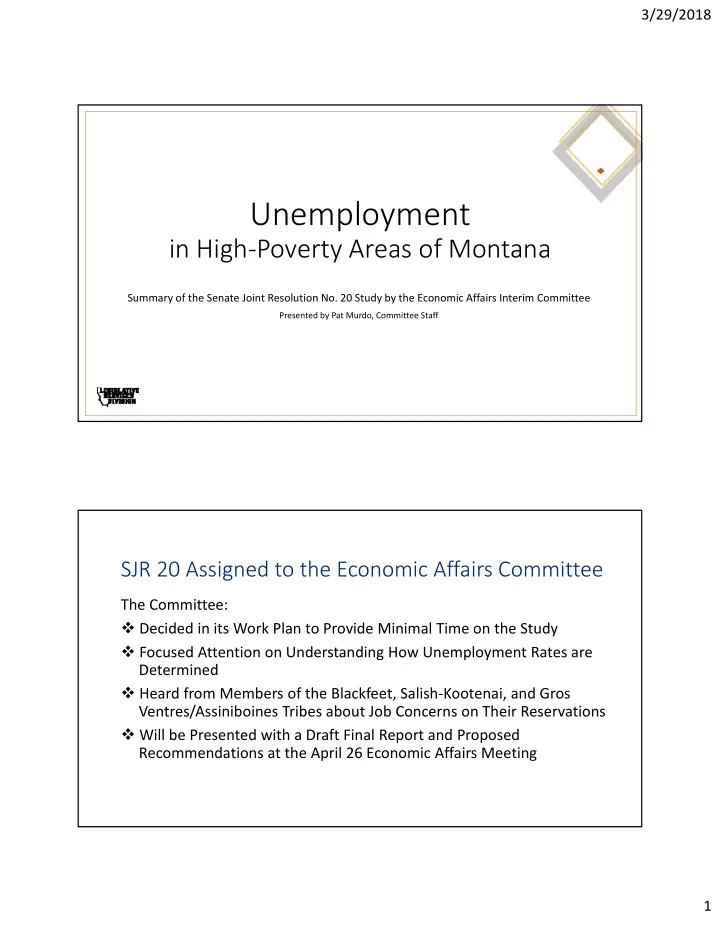
Unemployment in High Poverty Areas of Montana Summary of the Senate - - PDF document

unemployment
SMART_READER_LITE
LIVE PREVIEW

Unemployment in High Poverty Areas of Montana Summary of the Senate - - PDF document

3/29/2018 Unemployment in High Poverty Areas of Montana Summary of the Senate Joint Resolution No. 20 Study by the Economic Affairs Interim Committee Presented by Pat Murdo, Committee Staff SJR 20 Assigned to the Economic Affairs Committee The


slide-1
SLIDE 1

3/29/2018 1

Unemployment

in High‐Poverty Areas of Montana

Summary of the Senate Joint Resolution No. 20 Study by the Economic Affairs Interim Committee

Presented by Pat Murdo, Committee Staff

SJR 20 Assigned to the Economic Affairs Committee

The Committee:  Decided in its Work Plan to Provide Minimal Time on the Study  Focused Attention on Understanding How Unemployment Rates are Determined  Heard from Members of the Blackfeet, Salish‐Kootenai, and Gros Ventres/Assiniboines Tribes about Job Concerns on Their Reservations  Will be Presented with a Draft Final Report and Proposed Recommendations at the April 26 Economic Affairs Meeting

slide-2
SLIDE 2

3/29/2018 2

Wher Where ar are Mo Montana’ ana’s Hi High gh‐Po Poverty Coun Countie ties?

County Poverty Levels 2017

– 10.6%

  • r below

– 10.7% to 13.1% ‐‐ 13.1% to 15.5% ‐‐ 15.6% to 18.3% ‐‐ 18.4% to 28.3%

U.S. Bureau of the Census

The Study Asked: How is Unemployment Measured?

  • Standard Bureau of Labor Statistic Measurements
  • Some based on surveys (low population in Montana limits specifics)
  • Some based on sampling

U‐1 U‐2 U‐3 The Standard U‐4 U‐5 U‐6 Measures those unemployed for 15 weeks or more Measures those who recently lost a job or completed a temporary job Measures those actively seeking work as a percent of the civilian labor force Includes discouraged workers + those actively seeking work represented by U‐3 Includes the marginally attached workers + discouraged workers + those actively seeking work represented by U‐3 Includes those working part‐ time for economic reasons + the marginally attached + discouraged workers + those actively seeking

slide-3
SLIDE 3

3/29/2018 3

The The Study Study Ask Asked: d: Wh What Fa Factors In Influ fluence Access Access to to Job Jobs?

  • Job Availability – Matched with Skill Sets
  • Good Wages – Benefits
  • Transportation Availability
  • Child Care or Elder Care Availability
  • Work Places that Help Provide Appropriate

Accommodations for Those with Disabilities

Training Transportation

No strings tying a person to home

Good Health

Jobs

Tr Tribal Concern Concerns Expr Expressed essed in in Fe February Me Meet eting

  • Difficulty of Travel to Job

Service Offices

  • Interested in Mobile Vans
  • Need for More Information

about Apprenticeships

  • Need for Funding/Grants
  • Need to Help with Substance

Abuse

  • Need help for applicants with

learning disabilities

  • Need Help with Travel Concerns
  • Distance to Travel for People to

Take the General Equivalency Exams to get Their GEDs

  • Difficulty in Accessing Driver’s

License Stations

  • Need Help with Child Care and

Elder Care

  • Need to Address Homelessness
slide-4
SLIDE 4

3/29/2018 4

Econom

  • nomic

ic Af Affair irs Com Committee ee Ask Asked Tr Tribes

  • To Assess What Is Most Needed to Help Tribal Employment
  • To Determine What Actual Unemployment Numbers Are

Example of Unemployment Numbers That Committee Wants Explained

Reservation State‐Based Unemployment Number December 2017 Tribe‐Provided Number Based on BIA and State Numbers (not a standard calculation) 2005 Blackfeet 11.0% 72% Crow 16.0% 50% Flathead 5% 36% Fort Belknap 11.5% 72% Fort Peck 5.4% 57% Northern Cheyenne 14.0% 62% Rocky Boy’s 11.3% 76%

CSKT Study: Finding Answers

The Confederated Salish Kootenai Tribes in 2014:

  • Paid $55,662 for a study by the University of Montana Bureau of Business and

Economic Research for a profile of job and training needs

  • Included a survey of tribal members ages 18‐60 that asked about barriers to

employment + job, education, and training interests Top 5 Barriers Listed:

  • 1. No gas money (39.0%)
  • 3. No reliable vehicle (25.8%) 5. Lack of child care

(22.9%)

  • 2. Discrimination (26.2%)
  • 4. Poor health (24.5%)