SLIDE 1
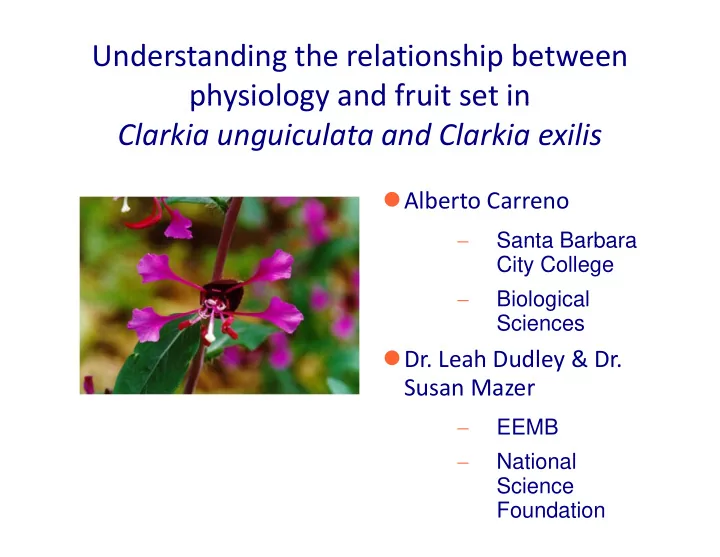
Understanding the relationship between physiology and fruit set in physiology and fruit set in Clarkia unguiculata and Clarkia exilis
Alberto Carreno
Santa Barbara Santa Barbara City College Biological Sciences
Dr. Leah Dudley & Dr. S M Susan Mazer
EEMB N i l National Science Foundation
SLIDE 2
Clarkia unguiculata Clarkia exilis
SLIDE 3
Clarkia unguiculata:Outcrosser Clarkia unguiculata:Outcrosser
SLIDE 4
Clarkia exilis:Selfer Clarkia exilis:Selfer
SLIDE 5 Clarkia unguiculata:Outcrosser Clarkia exilis:Selfer
SLIDE 6
SLIDE 7
What we know What we know
These plants are regularly exposed to
High temperatures High temperatures YEARLY DROUGHT!!!
Outcrossers flower in early summer Outcrossers flower in early summer
Water is a limiting factor
Selfing plants flower sooner than outcrossers
Water is NOT a limiting factor g
SLIDE 8
Hypothesis
Outcrossers will exhibit increased reproductive Selfers will exhibit increased reproductive fitness with high water‐ use efficiency fitness with low water‐ use efficiency
SLIDE 9
Physiological Rates
Water Use Efficiency= Photosynthetic Rate T i i R
Physiological Rates
Transpiration Rate Photosynthesis = Process by which carbon is gained Photosynthesis Process by which carbon is gained Transpiration = Plant water loss
SLIDE 10
Reproductive Fitness= capability of producing fertile offspring
Fruit Set= # Fruits # Flowers # Flowers
SLIDE 11
Populations
SLIDE 12 Field Work
- Visited 4 sites containing C.unguiculata
and 2 sites containing C.exilis
Gather physiological data of plants (before – Gather physiological data of plants (before flowering and after flowering)
- Measured carbon gain and water loss
- Measured carbon gain and water loss
- Measured 90 pre-flowering and 90 flowering
plants per population p p p p
– Collect “pre-flowering” and “flowering” plants
- 60 out of 90 plants were measured for fitness
60 out of 90 plants were measured for fitness per population
SLIDE 13
SLIDE 14 Lab Work Lab Work
– Count # of fruits present in plants
- Mature well formed fruits
- Mature well formed fruits
- Aborted fruits
Count # of nodes present in plants – Count # of nodes present in plants
SLIDE 15 Lab Work Lab Work
– In order to correct the physiological data In order to correct the physiological data
SLIDE 16 1)
2 way ANOVA Taxa P=0.0001 Stage P=0.0287
r‐1 plant‐1 s flower ure fruit et (#matu Fruit se
Flowering stage Plant phenological stage
Taxon
SLIDE 17 )
ANCOVA Taxa(Photo) P=0.05 Ce Fruit set=0.79+0.0002(Photo) Cu Fruit set=0.73‐0.002(Photo)
1 plant‐1)
s flower‐ ure fruits t (#matu Fruit set
C unguiculata outcrosser
- C. unguiculata‐outcrosser
Photosynthetic residuals (μmol CO2 m‐2 sec‐1)
SLIDE 18 ANCOVA Taxa(Trans)(Stage) P=0.0575 CeP Fruit set= 0.78‐3.3(Trans) CeF Fruit set‐0.79+1.07(Trans) CuP Fruit set=0.70‐16.8(Trans)
ant‐1)
CuF Fruit set=0.75+1.08(Trans)
wer‐1 pla fruits flo mature f it set (#m
- C. exilis‐selfer
- C. unguiculata‐outcrosser
Fru
- C. unguiculata outcrosser
Transpiration residuals (mol H2O m‐2 sec‐1)
SLIDE 19 ANCOVA Taxa(WUE) P=0.05 Ce Fruit set=0.79+0.03(WUE) Cu Fruit set=0.73‐0.16(WUE)
1 plant‐1)
flower‐1 re fruits t (#matu Fruit set
- C. exilis‐selfer
- C. unguiculata‐outcrosser
Water use efficiency residuals (mol CO2 mmol‐1 H2O)
SLIDE 20 Discussion Discussion
F C ili f i ff d b
- For C. exilis, fruit set was affected by
transpiration in pre‐flowering plants
- Factors other than water‐use efficiency are
affecting fruit set g
- Microhabitats may be affecting results
- Results could change if only measuring total
number of fruits
SLIDE 21 Acknowledgments Acknowledgments
S M
- Susan Mazer
- Leah Dudley
- Alisa Hove
- Jens‐Uwe Kuhn
- Nicholas Arnold
- Arica Lubin
SLIDE 22
SLIDE 23
SLIDE 24