UMBC A B M A L T F O U M B C I M Y O R T 1 - - PowerPoint PPT Presentation

umbc
SMART_READER_LITE
LIVE PREVIEW

UMBC A B M A L T F O U M B C I M Y O R T 1 - - PowerPoint PPT Presentation

Advanced VLSI Design Sequential Logic Design II CMPE 640 Smaller Static Flip-Flops Positive feedback is not the only means to implement a memory function. A capacitor can act as a memory element as well. In this case, a periodic refresh is


slide-1
SLIDE 1

Advanced VLSI Design Sequential Logic Design II CMPE 640 1 (12/6/04)

UMBC

U M B C U N I V E R S I T Y O F M A R Y L A N D B A L T I M O R E C O U N T Y 1 9 6 6

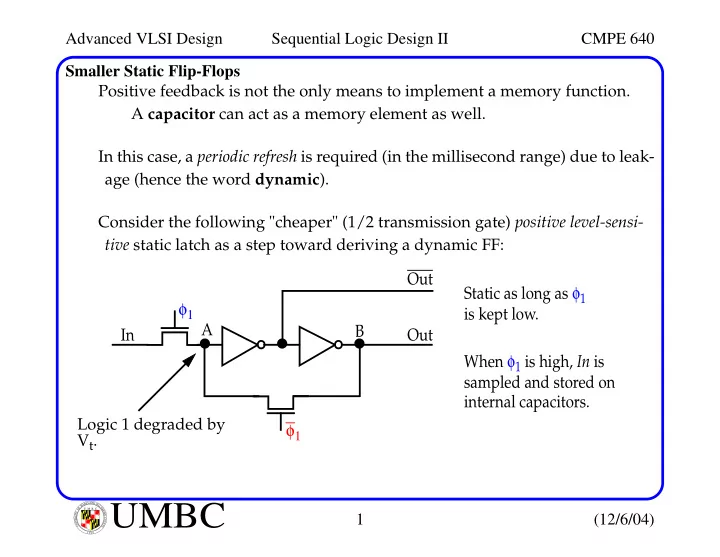
Smaller Static Flip-Flops Positive feedback is not the only means to implement a memory function. A capacitor can act as a memory element as well. In this case, a periodic refresh is required (in the millisecond range) due to leak- age (hence the word dynamic). Consider the following "cheaper" (1/2 transmission gate) positive level-sensi- tive static latch as a step toward deriving a dynamic FF: φ1 φ1 Out Static as long as φ1 is kept low. When φ1 is high, In is Out In sampled and stored on internal capacitors. A B Logic 1 degraded by Vt.

slide-2
SLIDE 2

Advanced VLSI Design Sequential Logic Design II CMPE 640 2 (12/6/04)

UMBC

U M B C U N I V E R S I T Y O F M A R Y L A N D B A L T I M O R E C O U N T Y 1 9 6 6

Smaller Static Flip-Flops A master-slave FF is created by cascading two of these latches and reversing the clocks. The problem with this latch is that φ1 and φ1 might overlap, which may cause two types of failures:

  • Node A can become undefined as it is driven by both D and B when φ1 and

φ1 are both high.

  • D can propagate through both the master and slave if both φ1 and φ1 are

high simultaneously for a long enough period (race condition). φ1 φ1 QM D φ1 φ1 Q A N1 N2 A B

slide-3
SLIDE 3

Advanced VLSI Design Sequential Logic Design II CMPE 640 3 (12/6/04)

UMBC

U M B C U N I V E R S I T Y O F M A R Y L A N D B A L T I M O R E C O U N T Y 1 9 6 6

Single Phase Clock Skew/Slew Clock skew causes conflicts and transparency. Clock slew (slow rise and fall times) can also cause transparency: Clock skew is a dominant problem in current high performance designs. φ1 φ1 Both n transistors are "on". φ1 φ1

slide-4
SLIDE 4

Advanced VLSI Design Sequential Logic Design II CMPE 640 4 (12/6/04)

UMBC

U M B C U N I V E R S I T Y O F M A R Y L A N D B A L T I M O R E C O U N T Y 1 9 6 6

Pseudo-Static Two-Phase Flip-Flops The fix is to use two non-overlapping clocks φ1 and φ2: A large tφ-12 allows proper operation even in the presence of clock skew. Note that node A floats (dynamic) during the time period tφ-12 but is driven during tφ-1 and tφ-2 (static). Hence, the name pseudostatic. φ2 φ1 QM D φ1 φ2 Q A A φ1 φ2 tφ12 tφ1 tφ2

slide-5
SLIDE 5

Advanced VLSI Design Sequential Logic Design II CMPE 640 5 (12/6/04)

UMBC

U M B C U N I V E R S I T Y O F M A R Y L A N D B A L T I M O R E C O U N T Y 1 9 6 6

CMOS Dynamic Two-Phase Flip-Flops This version is simplier (6 trans) and is often used in pipelined datapaths for microprocessors and signal processors. Disadv: 2 non-overlapping clocks required (4 if transmission gates are used). These implementations MUST be simulated at all process corners (under worst-case conditions). φ1 D φ2 Q Degraded ’1’ values may increase static current if below Vtp. φ1 D φ2 Q VDD VDD p leakers p leakers provide fully restored logic levels.

slide-6
SLIDE 6

Advanced VLSI Design Sequential Logic Design II CMPE 640 6 (12/6/04)

UMBC

U M B C U N I V E R S I T Y O F M A R Y L A N D B A L T I M O R E C O U N T Y 1 9 6 6

Two-Phase Clocking Clock skew/slew: φ1 logic large delay φ1 φ2 logic small delay φ2 Both n-transistors Nonoverlapping clocks: become transparent! Overlap! Slew Skew φ1 φ2 Excessive loads can increase rise/fall times.

slide-7
SLIDE 7

Advanced VLSI Design Sequential Logic Design II CMPE 640 7 (12/6/04)

UMBC

U M B C U N I V E R S I T Y O F M A R Y L A N D B A L T I M O R E C O U N T Y 1 9 6 6

C2MOS Register C2MOS: A clever method which is insensitive to clock skew: VDD D φ1 φ1 VDD Q φ1 VDD φ1 GND D Q Note: Dual phase version is identical except φ2 and φ2 are used to drive the n/p-trans in the right inverter. φ1 φ1 φ1 φ1

slide-8
SLIDE 8

Advanced VLSI Design Sequential Logic Design II CMPE 640 8 (12/6/04)

UMBC

U M B C U N I V E R S I T Y O F M A R Y L A N D B A L T I M O R E C O U N T Y 1 9 6 6

C2MOS Register C2MOS is insensitive to overlap as long as the rise and fall times of the clk edges (clock slew) are sufficiently small:

VDD

D φ1 φ1

VDD

Q φ1 φ1

VDD

D

VDD

Q

VDD

D

VDD

Q 1-1 overlap 0-0 overlap 1 1 No race is possible! In order for D to race to the Q, a pull-up followed by a pull-down must be enabled. Acts as a negative edge-triggered master-slave D FF.

slide-9
SLIDE 9

Advanced VLSI Design Sequential Logic Design II CMPE 640 9 (12/6/04)

UMBC

U M B C U N I V E R S I T Y O F M A R Y L A N D B A L T I M O R E C O U N T Y 1 9 6 6

C2MOS Register Races are just not possible since the overlaps activate either the pull-up or the pull-down networks but never both simultaneously. The inverters force 0-1 and 1-0 propagation modes only. However, if the rise and fall times of the clock are slow, there exists a time slot in which both n- and p-transistors are conducting simultaneously. Correct operation requires the clock rise/fall times be smaller than about 5 times the propagation delay through the FF. This is not hard to meet in practical designs, making C2MOS especially attractive in high speed designs where avoiding clock overlap is hard.

slide-10
SLIDE 10

Advanced VLSI Design Sequential Logic Design II CMPE 640 10 (12/6/04)

UMBC

U M B C U N I V E R S I T Y O F M A R Y L A N D B A L T I M O R E C O U N T Y 1 9 6 6

Pipelining The minimum allowed clock for the pipelined system is: Implementation using pass-transistor based D latches As indicated, races can occur when φ and φ overlap. Reg Reg a b abs log Reg

  • ut

+ Reg Reg a b abs log Reg

  • ut

+ Tmin tq max td,add td,abs td,log , , ( ) ts + + = φ In φ C1 C2 F G φ C3 Out

slide-11
SLIDE 11

Advanced VLSI Design Sequential Logic Design II CMPE 640 11 (12/6/04)

UMBC

U M B C U N I V E R S I T Y O F M A R Y L A N D B A L T I M O R E C O U N T Y 1 9 6 6

Pipelining C2MOS latches can be used instead, but ONLY if the logic functions, F, imple- mented between the latches are non-inverting. If F is inverting, and φ and φ overlap (1-1), then C2 is discharged as shown above. NORA-CMOS (NO-RAce) targets the implementation of fast pipelined data- paths by combining C2MOS with np-CMOS dynamic function blocks. φ In φ C1 C2 F G Out φ φ φ C3 φ 1 1

slide-12
SLIDE 12

Advanced VLSI Design Sequential Logic Design II CMPE 640 12 (12/6/04)

UMBC

U M B C U N I V E R S I T Y O F M A R Y L A N D B A L T I M O R E C O U N T Y 1 9 6 6

Pipelining with NORA-CMOS PDN In1 In2 In3 φ φ PUN φ φ Out φ φ φ-module Combo Latch PDN In1 In2 In3 φ φ Out φ φ φ-module In4 In4 Evaluating when φ is 1.

slide-13
SLIDE 13

Advanced VLSI Design Sequential Logic Design II CMPE 640 13 (12/6/04)

UMBC

U M B C U N I V E R S I T Y O F M A R Y L A N D B A L T I M O R E C O U N T Y 1 9 6 6

Pipelining with NORA-CMOS The NORA datapath consists of a chain of alternating φ and φ modules. While one class of modules is precharging with its output latch in hold mode, the other class is evaluating. Note that dynamic and static logic can be mixed freely. Rule: # of static inversions between C2MOS latches should be even. When dynamic gates are present, the # of static inverters between a latch and dynamic gate and between the last dynamic gate and latch should be even. PDN In1 In2 φ φ Out φ φ 0-0 clock overlap This implementation is problematic

slide-14
SLIDE 14

Advanced VLSI Design Sequential Logic Design II CMPE 640 14 (12/6/04)

UMBC

U M B C U N I V E R S I T Y O F M A R Y L A N D B A L T I M O R E C O U N T Y 1 9 6 6

True Single-Phase Clocked Logic (TSPCL) The NORA design style can be simplified so that a single clock is sufficient. For the doubled n-C2MOS latch, when φ = 1, the latch is in the transparent evaluate mode and corresponds to 2 cascaded inverters (non-inverting). When φ = 0, both inverters are disabled (hold mode) -- only the pull-up net- work is still active. The dual stage approach completely eliminates races. This style combines the advantages of C2MOS and eliminates all constraints. Out φ Doubled n-C2MOS latch φ φ Doubled p-C2MOS latch φ Out In In

slide-15
SLIDE 15

Advanced VLSI Design Sequential Logic Design II CMPE 640 15 (12/6/04)

UMBC

U M B C U N I V E R S I T Y O F M A R Y L A N D B A L T I M O R E C O U N T Y 1 9 6 6

True Single-Phase Clocked Logic (TSPCL) The one disadvantage is that 6 transistors (vs. 4) are needed per latch. A further simplification is to control only the first inverter with the clock. φ φ In PUN PDN Include logic in the latch Static logic φ φ Out Out φ In φ-latch φ-latch Out φ In

slide-16
SLIDE 16

Advanced VLSI Design Sequential Logic Design II CMPE 640 16 (12/6/04)

UMBC

U M B C U N I V E R S I T Y O F M A R Y L A N D B A L T I M O R E C O U N T Y 1 9 6 6

True Single-Phase Clock Logic (TSPC) This reduces the number of transistors and the clock load is reduced in half. Problem: not all node voltages experience the full logic swing. Node A (for Vin = 0V) maximally reaches VDD - VTn. This results in a reduced drive for the output NMOS transistor and a loss in performance. This design methodology is called True Single-Phase Clock Logic (TSPC). It allows for the implementation of dynamic sequential circuits with a single clock. Out φ In φ-latch A

slide-17
SLIDE 17

Advanced VLSI Design Sequential Logic Design II CMPE 640 17 (12/6/04)

UMBC

U M B C U N I V E R S I T Y O F M A R Y L A N D B A L T I M O R E C O U N T Y 1 9 6 6

True Single-Phase Clock Logic (TSPC) Edge-triggered FFs: Split-output version reduces clock load in half, while performing well. φ φ D Positive edge-triggered φ Q φ φ φ D Negative edge-triggered φ φ Q φ φ D Positive edge-triggered Q Double latch versions Split-output latch

slide-18
SLIDE 18

Advanced VLSI Design Sequential Logic Design II CMPE 640 18 (12/6/04)

UMBC

U M B C U N I V E R S I T Y O F M A R Y L A N D B A L T I M O R E C O U N T Y 1 9 6 6

Monostable Sequential Circuits A circuit that generates a pulse of a predetermined width every time the circuit is triggered by a pulse or transition event (one-shot). The circuit has only one stable state -- the quiescent state. The trigger causes the circuit to go temporarily into a quasi-stable state. It returns to its quiescent state after a time period determined by the cir- cuit parameters. Useful for address transition detection (ATD) to generate timing in static memo- ries for subsequent operations. We’ve seen this version in edge-triggered FFs. DELAY td Out In td

slide-19
SLIDE 19

Advanced VLSI Design Sequential Logic Design II CMPE 640 19 (12/6/04)

UMBC

U M B C U N I V E R S I T Y O F M A R Y L A N D B A L T I M O R E C O U N T Y 1 9 6 6

Monostable Sequential Circuits A second class uses feedback combined with an RC timing network to gener- ate a pulse of fixed width. Initially, In and Out are low and therefore A is high. B is high via resistor R. Pulsing In high causes A to go low, pulling node B with it. Node B gets pulled high again with time constant RC. Out goes low when B reaches VM, which causes A to go high again (note In has already gone low again). The width (t2 - t1) is determined by the time-constant RC and VM. Unfortunately, VM is relatively sensitive to process variations. C A Out In B In B t1 t2 Out R

slide-20
SLIDE 20

Advanced VLSI Design Sequential Logic Design II CMPE 640 20 (12/6/04)

UMBC

U M B C U N I V E R S I T Y O F M A R Y L A N D B A L T I M O R E C O U N T Y 1 9 6 6

Astable Sequential Circuits A circuit with no stable states. The output oscillates back and forth between two quasi-stable states with a period determined by circuit parameters. The main application of such a circuit is on-chip clock generation. We already looked at the ring oscillator as an example. The period T of the oscillation is: where tp is the propagation delay of the composing gates. v0 v1 v2 v3 v4 Ring oscillator T 2 tp N × × = where N is the # of inverters in the chain.

slide-21
SLIDE 21

Advanced VLSI Design Sequential Logic Design II CMPE 640 21 (12/6/04)

UMBC

U M B C U N I V E R S I T Y O F M A R Y L A N D B A L T I M O R E C O U N T Y 1 9 6 6

Astable Sequential Circuits By tapping the ring oscillator at different stages, a wide range of clock signals with different duty-cycles and phases can be derived. It is often desirable to tune the frequency of oscillation. An example is a Voltage-controlled Oscillator (VCO), whose frequency is proportional to the value of a control voltage. 1 2 N-1 Out Iref M5 M3 M1 Iref M2 M4 M6 In Vctrl Current stared inverters Current sources Controls value of Iref Lowering the value of Vctrl reduces the discharge current and hence tpHL. Polarity correcting inverter Sharpens rise and fall times

slide-22
SLIDE 22

Advanced VLSI Design Sequential Logic Design II CMPE 640 22 (12/6/04)

UMBC

U M B C U N I V E R S I T Y O F M A R Y L A N D B A L T I M O R E C O U N T Y 1 9 6 6

Astable Sequential Circuits Charging current is controlled via M5. Iref is translated into a charging current through the current mirror M6 - M4. Here, M6 acts as a diode and sets a bias voltage VGS6, that is controlled by Iref. With VGS4 = VGS6 and both devices operating in saturation, IDS4 = IDS6 = Iref. Since both M3 and M5 operate in saturation, a quadratic relation exists between Vctrl and Iref (and tp). This allows the frequency of the VCO to be controlled over a large range. A Schmitt trigger is used to sharpen the weakened rise and fall times of the current-stared inverter. Note that transistors M5 and M6 can be shared over all inverters in the chain.