UMBC A B M A L T F O U M B C I M Y O R T 1 (April - - PowerPoint PPT Presentation

umbc
SMART_READER_LITE
LIVE PREVIEW

UMBC A B M A L T F O U M B C I M Y O R T 1 (April - - PowerPoint PPT Presentation

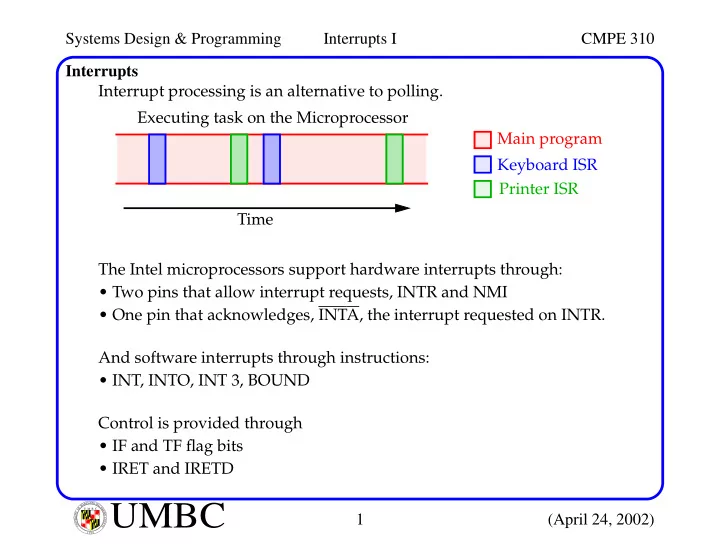
Systems Design & Programming Interrupts I CMPE 310 Interrupts Interrupt processing is an alternative to polling. Executing task on the Microprocessor Main program Keyboard ISR Printer ISR Time The Intel microprocessors support hardware


slide-1
SLIDE 1

Systems Design & Programming Interrupts I CMPE 310 1 (April 24, 2002)

UMBC

U M B C U N I V E R S I T Y O F M A R Y L A N D B A L T I M O R E C O U N T Y 1 9 6 6

Interrupts Interrupt processing is an alternative to polling. The Intel microprocessors support hardware interrupts through:

  • Two pins that allow interrupt requests, INTR and NMI
  • One pin that acknowledges, INTA, the interrupt requested on INTR.

And software interrupts through instructions:

  • INT, INTO, INT 3, BOUND

Control is provided through

  • IF and TF flag bits
  • IRET and IRETD

Time Executing task on the Microprocessor Main program Keyboard ISR Printer ISR

slide-2
SLIDE 2

Systems Design & Programming Interrupts I CMPE 310 2 (April 24, 2002)

UMBC

U M B C U N I V E R S I T Y O F M A R Y L A N D B A L T I M O R E C O U N T Y 1 9 6 6

Interrupt Vector Table INT and INT3 behave in a similar way. INT n: Calls ISR located at vector n (n*4). The INT instruction requires two bytes of memory, opcode plus n. BOUND and INTO are both conditional. BOUND: AX is compared with DATA and DATA+1, if less than an interrupt

  • ccurs.

AX is compared with DATA+2 and DATA+3, if greater than an inter- rupt occurs. INTO: Checks the overflow flag (OF). If OF=1, the ISR is called. IRET removes 6 bytes from the stack, 2 for IP, 2 for CS and 2 for FLAGS. BOUND AX, DATA ;Compares AX with DATA

slide-3
SLIDE 3

Systems Design & Programming Interrupts I CMPE 310 3 (April 24, 2002)

UMBC

U M B C U N I V E R S I T Y O F M A R Y L A N D B A L T I M O R E C O U N T Y 1 9 6 6

Interrupt Vector Table

Divide error Single-step NMI pin 1-byte breakpoint Overflow (INTO) Bound Undefined Opcode Coprocessor not avail Double fault Coproc seg overrun Invalid task state seg Segment not present Stack seg overrun General protection Page fault Unassigned Coprocessor error

000H 004H 008H 00CH 010H 014H 018H 01CH 020H 024H 028H 02CH 030H 034H 038H 03CH 040H

14-31 Reserved 32-255 User defined

080H Seg high Seg low Offset high Offset low Byte 3 Byte 2 Byte 1 Byte 0 The interrupt vector table is located in the first 1024 bytes of memory at addresses 000000H through 0003FFH. There are 256 4-byte entries (segment and offset in real mode). 1 2 3 4 5 6 7 8 9 10 11 12 13 14 15 16

slide-4
SLIDE 4

Systems Design & Programming Interrupts I CMPE 310 4 (April 24, 2002)

UMBC

U M B C U N I V E R S I T Y O F M A R Y L A N D B A L T I M O R E C O U N T Y 1 9 6 6

Real Mode Interrupts After the execution of each instruction, the microprocessor determines whether an interrupt is active by checking, in order: Other instruction executions Single-step NMI Coprocessor segment overrun INTR INT If one or more of these conditions are present, then: FLAGS is pushed onto the stack Both the interrupt (IF) and trap (TF) fl ags ar e cleared, which disables the INTR pin and the trap or single-step feature. The CS and IP are pushed onto the stack. The interrupt vector contents are fetched and loaded into CS and IP and execution resumes in the ISR. On IRET, CS, IP and FLAGS are popped. IF and TF are set to the state prior to the interrupt.

slide-5
SLIDE 5

Systems Design & Programming Interrupts I CMPE 310 5 (April 24, 2002)

UMBC

U M B C U N I V E R S I T Y O F M A R Y L A N D B A L T I M O R E C O U N T Y 1 9 6 6

Real and Protected Mode Interrupts The return address (CS/IP) is pushed onto the stack during the interrupt. The return address can point to: The next instruction. The offending (current) instruction. The latter case occurs for interrupts 0, 5, 6, 7, 8, 10, 11, 12 and 13. This makes it possible to try the instruction again. Protected Mode: The same interrupt assignments are made and the same sequence of opera- tions occurs in protected mode but the interrupt table is different. Instead, 256 interrupt descriptors are used in the interrupt descriptor table (IDT). Offset (A31-A16) PDPL 01110 00H 1 2 3 4 5 6 7 Segment Selector Offset (A15-A0) Present

slide-6
SLIDE 6

Systems Design & Programming Interrupts I CMPE 310 6 (April 24, 2002)

UMBC

U M B C U N I V E R S I T Y O F M A R Y L A N D B A L T I M O R E C O U N T Y 1 9 6 6

Hardware Interrupts The INTR pin must be externally decoded to select a vector. Any vector is possible, but the interrupt vectors between 20H and FFH are usually used (Intel reserves vectors between 00H and 1FH). INTA is an output of the microprocessor to signal the external decoder to place the interrupt number on data bus connections D7-D0. The INTR pin is set by an external device (8259A) and cleared in the ISR. The input is automatically disabled by the microprocessor once it is rec-

  • gnized and re-enabled by IRET or IRETD instruction.

Timing diagram of the handshake. INTR LOCK INTA D7-D0 Vector number

slide-7
SLIDE 7

Systems Design & Programming Interrupts I CMPE 310 7 (April 24, 2002)

UMBC

U M B C U N I V E R S I T Y O F M A R Y L A N D B A L T I M O R E C O U N T Y 1 9 6 6

Hardware Interrupts Simpliest method of generating an interrupt vector: D0 D1 D6 D5 D4 D3 D2 D7

VCC

INTA no connection Low data bus 27K Always generates interrupt vector FFH in response to INTR.

slide-8
SLIDE 8

Systems Design & Programming Interrupts I CMPE 310 8 (April 24, 2002)

UMBC

U M B C U N I V E R S I T Y O F M A R Y L A N D B A L T I M O R E C O U N T Y 1 9 6 6

Tri-state Buffer for Generating the Interrupt Vector D0 D1 D6 D5 D4 D3 D2 D7 INTA Low data bus VCC 74ALS244 Y1 ... A1... GG Applies interrupt vector 80H in response to INTA.

slide-9
SLIDE 9

Systems Design & Programming Interrupts I CMPE 310 9 (April 24, 2002)

UMBC

U M B C U N I V E R S I T Y O F M A R Y L A N D B A L T I M O R E C O U N T Y 1 9 6 6

An Example 82C55 Interrupt Configuration STB

D0 D7

Keyboard

DAV

ASCII 82C55 D0 D7 A0 A7 B7 B0 C7 C0 CS D7 -- D0 8 IORC Wait2 RD WR A0 A1 Reset A0 A1 Reset 16L8 A3 A4 A5 A7 A8 A6 A9 A10 I1 I10 O1 O8 A0 IOWC A11 A13 A14 A12 A15 Y1 ... A1... GG INTR INTA

slide-10
SLIDE 10

Systems Design & Programming Interrupts I CMPE 310 10 (April 24, 2002)

UMBC

U M B C U N I V E R S I T Y O F M A R Y L A N D B A L T I M O R E C O U N T Y 1 9 6 6

Handling more than 1 IRQ If any of IRQx goes low, the NAND goes low requesting an interrupt. Note that if more than one IRQ goes low, a unique interrupt vector is gener- ated and an interrupt priority needs to be defined. The Interrupt Vector table must be expanded to accommodate this. D0 D1 D6 D5 D4 D3 D2 D7 INTA VCC 74ALS244 Y1 ... A1... GG INTR IRQ0 IRQ6 6 5 4 3 2 1 Vect IRQs 1 1 1 1 1 1 FEH 1 1 1 1 1 1 FDH 1 1 1 1 1 1 FBH 1 1 1 1 1 1 F7H 1 1 1 1 1 1 EFH 1 1 1 1 1 1 DFH 1 1 1 1 1 1 BFH

slide-11
SLIDE 11

Systems Design & Programming Interrupts I CMPE 310 11 (April 24, 2002)

UMBC

U M B C U N I V E R S I T Y O F M A R Y L A N D B A L T I M O R E C O U N T Y 1 9 6 6

Daisy-Chained Mechanism for Multiple IRQs 82C55 D0 D7 A0 A7 B7 B0 C7 C0 CS RD WR A0 A1 Reset 82C55 D0 D7 A0 A7 B7 B0 C7 C0 CS RD WR A0 A1 Reset 74ALS32 74ALS32 Only one interrupt vector required. Priority is determined in the ISR through polling The scheme given earlier that pulls the bus high (FFH) can be used as the vector. the individual 82C55s.

slide-12
SLIDE 12

Systems Design & Programming Interrupts I CMPE 310 12 (April 24, 2002)

UMBC

U M B C U N I V E R S I T Y O F M A R Y L A N D B A L T I M O R E C O U N T Y 1 9 6 6

8259A Programmable Interrupt Controller The 8259A adds 8 vectored priority encoded interrupts to the microprocessor. It can be expanded to 64 interrupt requests by using one master 8259A and 8 slave units. CS and WR must be decoded. Other connections are direct to micro. 8259A D0 D1 D2 D3 D4 D5 D6 D7 A0 CS RD WR SP/EN INT INTA IR0 IR1 IR2 IR3 IR4 IR5 IR6 IR7 CAS0 CAS1 CAS2 Connect to any 8-bit bank. Bidirectional. Connect either to devices

  • r to upstream slave 8259As
slide-13
SLIDE 13

Systems Design & Programming Interrupts I CMPE 310 13 (April 24, 2002)

UMBC

U M B C U N I V E R S I T Y O F M A R Y L A N D B A L T I M O R E C O U N T Y 1 9 6 6

8259A Programmable Interrupt Controller The meaning of the other connections: WR Connects to a write strobe signal (one of 8 for the Pentium). RD Connects to the IORC signal. INT Connects to the INTR pin on the microprocessor. INTA Connects to the INTA pin on the microprocessor. A0 Selects different command words in the 8259A. CS Chip select - enables the 8259A for programming and control. SP/EN Slave Program (1 for master, 0 for slave)/Enable Buffer (controls the data bus transievers when in buffered mode). CAS2-CAS0 Used as outputs from the master to the slaves in cascaded systems.

slide-14
SLIDE 14

Systems Design & Programming Interrupts I CMPE 310 14 (April 24, 2002)

UMBC

U M B C U N I V E R S I T Y O F M A R Y L A N D B A L T I M O R E C O U N T Y 1 9 6 6

8259A Programmable Interrupt Controller A single 8259A connected in the 8086. D0 D1 D2 D3 D4 D5 D6 D7 A0 CS RD WR SP/EN INT INTA IR0 IR1 IR2 IR3 IR4 IR5 IR6 IR7 CAS0 CAS1 CAS2 I1 I2 I3 I4 I5 I6 I7 I8 I9 I10 16L8 O1 O2 I16 I15 I14 I13 I12 I11 M/IO A0 A2 A3 A4 A5 A6 A7 A8 A9 D7-D0 A1 WAIT2 A10 A11 A12 A13 A14 A15 IORC IOWC 10K VCC High indicates master mode. INTR INTA Write the program to decode the 8259A at ports 0400H and 0402H.

slide-15
SLIDE 15

Systems Design & Programming Interrupts I CMPE 310 15 (April 24, 2002)

UMBC

U M B C U N I V E R S I T Y O F M A R Y L A N D B A L T I M O R E C O U N T Y 1 9 6 6

8259A Programmable Interrupt Controller D0 D7 A0 CS RD WR SP/EN INT INTA IR0 IR7 CAS0 CAS1 CAS2 I1 I2 I3 I4 I5 I6 I7 I8 I9 I10 16L8 O1 O2 I16 I15 I14 I13 I12 O3 M/IO A0 A2 A3 A4 A5 A6 A7 A8 A9 A1 WAIT2 A10 A11 A12 A13 A14 A15 RD WR INTR INTA D0 D7 A0 CS RD WR SP/EN INT INTA IR0 IR7 CAS0 CAS1 CAS2 IR2 G Dir 74LS245 G Dir 74LS245 D7-D0 Devices Devices Buffer Buffer

slide-16
SLIDE 16

Systems Design & Programming Interrupts I CMPE 310 16 (April 24, 2002)

UMBC

U M B C U N I V E R S I T Y O F M A R Y L A N D B A L T I M O R E C O U N T Y 1 9 6 6

Programming the 8259A Programmed by Initialization (ICWs) and Operation (OCWs) Command Words. There are 4 ICWs. At power-up, ICW1, ICW2 and ICW4 must be sent. If ICW1 indicates cascade mode, then ICW3 must also be sent. ICW1: LTIM indicates if IRQ lines are positive edge-triggered or level-trig- gered. D1 D0 D3 D2 D5 D4 D7 D6 A0 IC4 SNGL X LTIM 1 1 = ICW4 Needed 0 = No ICW4 Needed 1 = Single 0 = Cascade Mode 1 = Level Triggered Mode 0 = Edge Triggered Mode X X X

slide-17
SLIDE 17

Systems Design & Programming Interrupts I CMPE 310 17 (April 24, 2002)

UMBC

U M B C U N I V E R S I T Y O F M A R Y L A N D B A L T I M O R E C O U N T Y 1 9 6 6

Programming the 8259A ICW2: These bits determine the vector numbers used with the IRQ inputs. For example, if programmed to generate vectors 08H-0FH, 08H is placed into these bit positions. ICW3: D1 D0 D3 D2 D5 D4 D7 D6 A0 1 T7 T5 T6 T4 T3 T7-T3 of Interrupt Vector Address (8086/8088 Mode) X X X Low order bits are 0 since there are 8 interrupts. D1 D0 D3 D2 D5 D4 D7 D6 A0 1 S7 S5 S6 S4 S3 S2 S1 S0 1 = IR Input does not have a slave 0 = IR Input has a slave This register is treated as a mask, with 1’s indicating the IRQ channels connected to master/slave 8259As.

slide-18
SLIDE 18

Systems Design & Programming Interrupts I CMPE 310 18 (April 24, 2002)

UMBC

U M B C U N I V E R S I T Y O F M A R Y L A N D B A L T I M O R E C O U N T Y 1 9 6 6

Programming the 8259A ICW4: Fully nested mode allows the highest-priority interrupt request from a slave to be recognized by the master while it is processing another inter- rupt from a slave. AEOI, if 1, indicates that an interrupt automatically resets the interrupt request bit, otherwise OCW2 is consulted for EOI processing. D1 D0 D3 D2 D5 D4 D7 D6 A0 1 SFNM BUF M/S AEOI 1 1 = AUTO EOI 0 = NORMAL EOI X 1 1 1 Non-Buffered Mode Buffered Mode:Slave Buffered Mode:Master 1 = Special Fully Nested Mode 0 = Not Special Fully Nested Mode

slide-19
SLIDE 19

Systems Design & Programming Interrupts I CMPE 310 19 (April 24, 2002)

UMBC

U M B C U N I V E R S I T Y O F M A R Y L A N D B A L T I M O R E C O U N T Y 1 9 6 6

Programming the 8259A The Operation Command Words (OCWs) are used to direct the operation of the 8259A. OCW1: OCW1 is used to read or set the interrupt mask register. If a bit is set, it will turn off (mask) the corresponding interrupt input. OCW2: Only programmed when the AEOI mode in ICW4 is 0. Allows you to control priorities after each interrupt is processed. D1 D0 D3 D2 D5 D4 D7 D6 A0 1 M7 M5 M6 M4 M3 M2 M1 M0 1 = Mask Set INTERRUPT MASK 0 = Mask Reset D1 D0 D3 D2 D5 D4 D7 D6 A0 R EOI SL L2 L1 L0

slide-20
SLIDE 20

Systems Design & Programming Interrupts I CMPE 310 20 (April 24, 2002)

UMBC

U M B C U N I V E R S I T Y O F M A R Y L A N D B A L T I M O R E C O U N T Y 1 9 6 6

Programming the 8259A OCW2: Non-specific EOI: Here, the ISR sets this bit to indicate EOI. The 8259A automatically determines which interrupt was active and re-enables it and lower priority interrupts. Specific EOI: ISR resets a specific interrupt request given by L2-L0. Rotate commands cause priority to be rotated w.r.t. the current one being processed. Set priority: allows the setting of the lowest priority interrupt (L2-L0). D1 D0 D3 D2 D5 D4 D7 D6 A0 R EOI SL L2 L1 L0 0 0 1 0 1 1 1 0 1 1 0 0 0 0 0 1 1 1 1 1 0 0 1 0 Non-Specific EOI Command Rotate on Non-Specific EOI Command *Specific EOI Command Rotate on Automatic EOI Mode (Set) Rotate on Automatic EOI Mode (Clear) *Rotate on Specific EOI Command *Set Priority Command No Operation *L0-L2 are used

}

}

}

End of Interrupt Automatic Rotation Specific Rotation

slide-21
SLIDE 21

Systems Design & Programming Interrupts I CMPE 310 21 (April 24, 2002)

UMBC

U M B C U N I V E R S I T Y O F M A R Y L A N D B A L T I M O R E C O U N T Y 1 9 6 6

Programming the 8259A OCW3: If polling is set, the next read operation will read the poll word. If the leftmost bit is set in the poll word, the rightmost 3 bits indicate the active interrupt request with highest priority. Allows ISR to service highest priority interrupt. There are three status registers, Interrupt Request Register (IRR), In-Ser- vice Register (ISR) and Interrupt Mask Register (IMR). IRR: Indicates which interrupt request lines are active. ISR: Level of the interrupt being serviced. IMR: A mask that indicates which interrupts are on/off. D1 D0 D3 D2 D5 D4 D7 D6 A0 SMM ESMM 1 RR RIS P 1 = Poll Command 0 = No Poll Command status register, IRR or ISR, is to be read. Operation of special mask register Indicates which

slide-22
SLIDE 22

Systems Design & Programming Interrupts I CMPE 310 22 (April 24, 2002)

UMBC

U M B C U N I V E R S I T Y O F M A R Y L A N D B A L T I M O R E C O U N T Y 1 9 6 6

Programming the 8259A ISR update procedure with rotating priority configured. IS1 IS0 IS3 IS2 IS5 IS4 IS7 IS6 ISR STATUS PRIORITY Before IR4 accepted Lowest Priority Highest Priority 1 1 7 6 4 2 1 3 5 IS1 IS0 IS3 IS2 IS5 IS4 IS7 IS6 ISR STATUS PRIORITY After IR4 accepted Lowest Priority Highest Priority 1 2 1 7 5 3 4 6 Process IR4

slide-23
SLIDE 23

Systems Design & Programming Interrupts I CMPE 310 23 (April 24, 2002)

UMBC

U M B C U N I V E R S I T Y O F M A R Y L A N D B A L T I M O R E C O U N T Y 1 9 6 6

Interfacing 16550 UART using 8259A In the following configuration the 16550 is connected to the 8259A through IR0. An interrupt is generated, if enabled through the interrupt control register, when either: The transmitter is ready to send another character. The receiver has received a character. An error is detected while receiving data. A modem interrupt occurs. The16550 is decoded at 40H and 47H. The 8259A is decoded at 48H and 49H. Program in text shows the steps involved in programming both devices. Since the 16550 generates only one interrupt request for each of the above interrupts, the 16550 must be polled. Remember the interrupt identification register of the 16550?

slide-24
SLIDE 24

Systems Design & Programming Interrupts I CMPE 310 24 (April 24, 2002)

UMBC

U M B C U N I V E R S I T Y O F M A R Y L A N D B A L T I M O R E C O U N T Y 1 9 6 6

Interfacing 16550 UART using 8259A Data Bus (D0-D7)

A0 D7 D0 D7 SIN SOUT

Serial Data

BAUDOUT RCLK RTS CTS DTR DSR DCD RI OUT1 OUT2 D0 A1 A2 CS0 CS1 CS2 10K VCC MR RD RD A0 Reset WR WR ADS XIN XOUT INTR IR0 IR7 CAS0 CAS1 CAS2 Other Interrupts RD WR A0 CS RD WR SP/EN INT INTA INTA INTR 10K VCC A1 A2 A3 A4 A5 A6 A8 A9 A10 A7 A11 A12 A13 A14 A15 IO/M 40H-47H

16550 8259A 16L8

48H-49H

18.432 MHz

slide-25
SLIDE 25

Systems Design & Programming Interrupts I CMPE 310 25 (April 24, 2002)

UMBC

U M B C U N I V E R S I T Y O F M A R Y L A N D B A L T I M O R E C O U N T Y 1 9 6 6

16550 UART Interrupts Text gives ISR programming examples that show initialization and operation. 1 2 3 4 5 6 7 ER ET EL EM PN ID ID ID Enable Reciever Interrupt Enable Transmitter Interrupt Enable Line Interrupt Enable Modem Interrupt 0 = disabled 1 2 3 4 5 6 7 Interrupt Identification Register Interrupt Pending 0 = interrupt pending 1 = no interrupt Interrupt Identification bits (defined in text) Interrupt Control Register 1 = enabled 0 = disabled 1 = enabled 0 = disabled 1 = enabled 0 = disabled 1 = enabled