UCC Articles 8 and 9 and the Hague Securities Convention: Investment - - PowerPoint PPT Presentation

ucc articles 8 and 9 and the hague securities convention
SMART_READER_LITE
LIVE PREVIEW

UCC Articles 8 and 9 and the Hague Securities Convention: Investment - - PowerPoint PPT Presentation

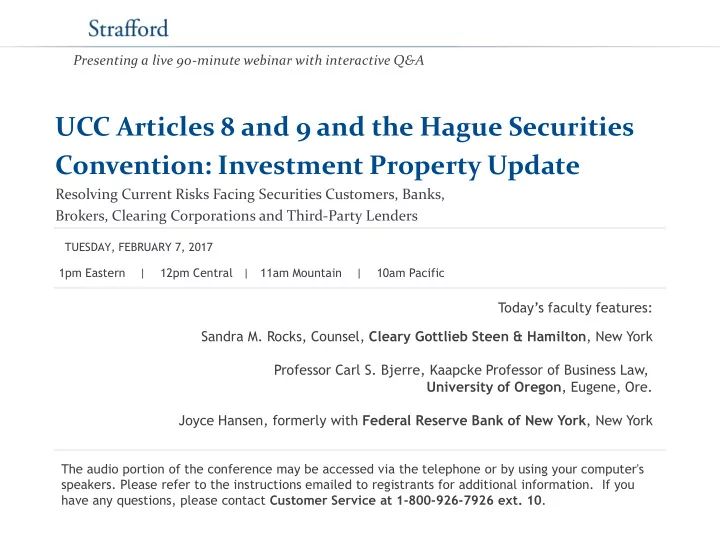
Presenting a live 90-minute webinar with interactive Q&A UCC Articles 8 and 9 and the Hague Securities Convention: Investment Property Update Resolving Current Risks Facing Securities Customers, Banks, Brokers, Clearing Corporations and


slide-1
SLIDE 1

The audio portion of the conference may be accessed via the telephone or by using your computer's

  • speakers. Please refer to the instructions emailed to registrants for additional information. If you

have any questions, please contact Customer Service at 1-800-926-7926 ext. 10.

Presenting a live 90-minute webinar with interactive Q&A

UCC Articles 8 and 9 and the Hague Securities Convention: Investment Property Update

Resolving Current Risks Facing Securities Customers, Banks, Brokers, Clearing Corporations and Third-Party Lenders

Today’s faculty features:

1pm Eastern | 12pm Central | 11am Mountain | 10am Pacific TUESDAY, FEBRUARY 7, 2017

Sandra M. Rocks, Counsel, Cleary Gottlieb Steen & Hamilton, New York Professor Carl S. Bjerre, Kaapcke Professor of Business Law, University of Oregon, Eugene, Ore. Joyce Hansen, formerly with Federal Reserve Bank of New York, New York

slide-2
SLIDE 2

Tips for Optimal Quality

Sound Quality If you are listening via your computer speakers, please note that the quality

  • f your sound will vary depending on the speed and quality of your internet

connection. If the sound quality is not satisfactory, you may listen via the phone: dial 1-866-873-1442 and enter your PIN when prompted. Otherwise, please send us a chat or e-mail sound@straffordpub.com immediately so we can address the problem. If you dialed in and have any difficulties during the call, press *0 for assistance. Viewing Quality To maximize your screen, press the F11 key on your keyboard. To exit full screen, press the F11 key again.

FOR LIVE EVENT ONLY

slide-3
SLIDE 3

Continuing Education Credits

In order for us to process your continuing education credit, you must confirm your participation in this webinar by completing and submitting the Attendance Affirmation/Evaluation after the webinar. A link to the Attendance Affirmation/Evaluation will be in the thank you email that you will receive immediately following the program. For additional information about continuing education, call us at 1-800-926-7926

  • ext. 35.

FOR LIVE EVENT ONLY

slide-4
SLIDE 4

Program Materials

If you have not printed the conference materials for this program, please complete the following steps:

  • Click on the ^ symbol next to “Conference Materials” in the middle of the left-

hand column on your screen.

  • Click on the tab labeled “Handouts” that appears, and there you will see a

PDF of the slides for today's program.

  • Double click on the PDF and a separate page will open.
  • Print the slides by clicking on the printer icon.

FOR LIVE EVENT ONLY

slide-5
SLIDE 5

UCC ARTICLES 8 AND 9 AND THE HAGUE SECURITIES CONVENTION: INVESTMENT PROPERTY UPDATE

Carl S. Bjerre, University of Oregon School of Law Joyce M. Hansen, former Deputy General Counsel and Senior Vice President, Federal Reserve Bank of New York Sandra M. Rocks, Cleary Gottlieb Steen & Hamilton LLP February 7, 2017

slide-6
SLIDE 6

ISSUER Broker Dealer Bank Broker Dealer Central Securities Depository

Bank Broker Dealer

Overview of Securities Holding Patterns

Direct Holding

Investor Direct Investor

Indirect Holding

6

slide-7
SLIDE 7
  • Legal recognition of new holding patterns
  • Clear and market-sensitive choice-of-law rules

Experience under U.S. law applicable to the “indirect holding system” suggested certain critical areas required attention, including (among others):

Background

7

slide-8
SLIDE 8

U.S. Response: Uniform Commercial Code Articles 8 and 9

  • Recognition of holding patterns:

– Direct: those having a direct relationship with an issuer of securities (certificated or uncertificated) – Indirect: those not having a direct relationship with an issuer of securities or other financial assets, e.g.

  • Securities issued by the issuer to a clearing corporation or to the

name of the clearing corporation

  • Clearing corporation maintains accounts for bank or broker
  • Customer maintains an account at bank or broker

(underlying securities may be certificated or uncertificated)

8

slide-9
SLIDE 9

Selected Direct Holding Issues

  • Clarifying the definition of “security”

– § 8-102(a)(13)(ii) and (15)(i): transfer “may be registered upon books maintained for that purpose by or

  • n behalf of the issuer”

– New York Court of Appeals in Highland Capital case: promissory notes were securities for purpose of old § 1- 206(1) statute of frauds – Official Comment 13 to § 8-102 disapproves of the case in 2010; see also PEB Commentary No. 18 (July 2014)

9

slide-10
SLIDE 10

Selected Direct Holding Issues (2)

  • Non-uniform NY UCC § 8-103(h):
  • obligation, share, etc. “does not satisfy section 8-

102(a)(13)(ii) or 8-102(a)(15)(i) merely because the issuer or a person acting on its behalf: (1) maintains records of the

  • wner thereof for a purpose other than registration of

transfer; or (2) could, but does not, maintain books for the purpose of registration of transfer.”

10

slide-11
SLIDE 11

Selected Indirect Holding Issues (1)

  • Article 8’s flexible definition of “financial asset”
  • §8-102(a)(9)(iii), “any property” held in securities

account if intermediary has expressly agreed with customer to treat the property as such

– “cash” (credit balances) – cleared swaps – virtual currency

11

slide-12
SLIDE 12

Selected Indirect Holding Issues (2)

  • Redirection of payment by “account debtor”

– § 9-406(a), notification by assignor or assignee – person obligated on “account, chattel paper or general intangible”

  • Forest Capital, LLC v. BlackRock, Inc., 658

Fed.Appx. 675 (4th Cir. 2016) (unpublished)

– Securities intermediary is not an account debtor – Securities intermediary’s duty is only to its entitlement holder, in the absence of legal process, etc.

12

slide-13
SLIDE 13

Selected Indirect Holding Issues (3)

  • § 8-115’s general immunity from conduit liability

– Exception for acting “in collusion with the wrongdoer in violating the rights of the adverse claimant” – Collusion exception is “akin to the tort rules for aiding and abetting”

  • Actual knowledge
  • Contrast to willful blindness

13

slide-14
SLIDE 14

Selected Indirect Holding Issues (4) – Amegy Bank N.A. v. Deutsche Bank Alex.Brown, 619 Fed. Appx. 923 (11th Cir. 2015) (unpublished)

  • Bank sues Broker for conversion of proceeds of its

collateral and obtains jury verdict

  • Majority opinion upholds finding of collusion
  • Dissenting opinion:

– Report did not list collateral, and no evidence Broker saw financing statement – § 8-105(e): Filing of financing statement is not (even) notice

  • f adverse claim

– Broker being “responsive to his client’s needs”

14

slide-15
SLIDE 15

Selected Indirect Holding Issues (5)

  • Enforcement of intermediary’s duties
  • Harris v. TD Ameritrade, Inc., 805 F.3d 664 (6th Cir. 2015)

– Clearing corporation imposed “global lock” on issuer’s stock because of fraudulent activity – Customer with security entitlement sought certificate from broker

  • § 8-508 generally requires broker to comply
  • Court found no private right of action; cf. SEC’s Rule 15c3-3
  • Ruling neglects § 1-305(b): “any right or obligation” under

Code is “enforceable by action” – Possibly reach same result on sounder grounds through interpretation of the account agreement

15

slide-16
SLIDE 16

Conflicts Rules for the Indirect Holding System

  • UCC rules since 1994
  • “Securities intermediary’s jurisdiction”

– Governing law clause, § 8-110(e)(2) – Separate designation clause, § 8-110(e)(1) – Fallback rules, § 8-110(e)(3), (4), (5)

  • Determines issues in §§ 8-110(b) and 9-305(a)(3)

– Rights and duties of intermediary and entitlement holder – Perfection, effect of perfection and priority – Exception for perfection by filing, § 9-305(c)(1)

16

slide-17
SLIDE 17

Going Global

Swiss Bank New York Bank Swedish Investor

VPC

Local Sub- Custodian

Sweden

CDS

Canada

Indeval

Mexico

Local Sub- Custodian

DTC

Local Sub- Custodian

US

Euro- clear

Belgium

Clear- stream

Germany

Local Sub- Custodian

JASDEC

Japan Securities (NY Law Pledge) Cash

17

slide-18
SLIDE 18
  • Promulgated in 2006 by the Hague Conference on Private

International Law

  • Signed by the U.S. in 2006
  • U.S. Senate advice and consent given in September 2016
  • Instrument of ratification was submitted to the Netherlands
  • n December 15, 2016
  • On the first business day after the three-month period

following submission of the instrument of ratification by the third adopting country, the Convention will go into effect in the U.S. and other adopting countries – currently Mauritius and Switzerland

– Other countries expected to follow

Convention will become effective in the U.S. on April 1, 2017

The Hague Securities Convention Background and Status

18

slide-19
SLIDE 19
  • The Convention is available on the website of the Hague

Conference on Private International Law,

https://www.hcch.net/en/instruments/conventions/full-text/?cid=72.

  • Hague Securities Convention Explanatory Report by

Roy Goode, Hideki Kanda and Karl Kreuzer, with the assistance of Christoph Bernasconi (2005)

https://assets.hcch.net/upload/expl36en.pdf

  • Forthcoming PEB Commentary, including amendments to

UCC Official Comments, https://www.ali.org/permanent-editorial-board-ucc/

The Hague Securities Convention Background and Status cont’d

19

slide-20
SLIDE 20

The Hague Securities Convention provides ONLY CHOICE OF LAW RULES, not substantive law. The Hague Securities Convention applies only to securities credited to a securities account held with an intermediary.

  • No applicability to rights or obligations of

issuers The Hague Securities Convention Overview

20

slide-21
SLIDE 21
  • Convention by its terms “applies in all cases involving a choice
  • f law between the laws of different States” [State = nation]
  • Examples: When any of the following are located in a different

nation the choice-of-law rules of the Convention are likely to be implicated:

— The account holder — An issuer of any of the securities — Any party to a transfer of securities — Any intermediary — Location of security certificates — Any adverse claimant

  • Transacting parties should always consider the possibility that

the Convention will apply

The Hague Securities Convention Overview

21

slide-22
SLIDE 22

The Hague Securities Convention Overview

Related Applicability Provisions

  • Article 9 of the Hague Convention makes clear that it

applies whether or not the applicable law is that of a jurisdiction that has adopted the Convention

  • Article 10 of the Hague Convention disapplies choice-of-law

rules (renvoi) – akin to the UCC’s reference to “local law”

  • f the securities intermediary’s jurisdiction.

22

slide-23
SLIDE 23

The Hague Securities Convention uses the terms:

  • “securities” -- any shares, bonds or other financial

instruments or financial assets (other than cash) or any interest therein

  • “securities held with an intermediary” -- the rights of an

account holder resulting from a credit of securities to a securities account

  • “intermediary” -- a person that in the course of a business or
  • ther regular activity maintains securities accounts for others
  • r both for others and for its own account and is acting in that

capacity.

(Note that under the Hague Securities Convention the definition of intermediary includes a person that maintains securities accounts for itself – accommodates a title transfer arrangement common in the London market.)

The Hague Securities Convention Overview

23

slide-24
SLIDE 24

The Hague Securities Convention Scope

Article 2(1) of the Hague Convention lays out the issues as to which its choice-of-law rules determine applicable law

  • These issues involve

– The nature of the rights acquired in securities held with an

intermediary

– The nature and effects against third parties of a disposition

  • f, or the creation or transfer of an interest in, securities held

with an intermediary (including perfection, priority and duties of an intermediary to third parties asserting an interest in securities held with that intermediary).

24

slide-25
SLIDE 25

The Hague Securities Convention Scope cont’d

  • These issues largely coincide with the issues set forth in

UCC § 8-110(b) and UCC § 9-305(a)(3) that are governed by the “local law of the securities intermediary’s jurisdiction” as defined in UCC § 8-110(e)

– The rights acquired in respect of securities held with an

intermediary

– Issues involving perfection, the effect of perfection or non-

perfection and the priority of a security interest in securities held with an intermediary

25

slide-26
SLIDE 26

The Hague Securities Convention Article 4(1) Primary Rule

  • “The law applicable to all the issues specified in Article 2(1)

(Scope) is the law in force in the State expressly agreed in the account agreement as the State whose law governs the account agreement or, if the account agreement expressly provides that another law is applicable to all such issues, that other law.”

  • Very similar to choosing the “securities intermediary’s”

jurisdiction” under UCC § 8-110(e)(1) and (2)

– (e)(1): jurisdiction can differ from general governing law clause – (e)(2): general governing law clause itself chooses the jurisdiction

(But note: Convention’s use of “in the account agreement” vs. UCC § 8-110 “an agreement . . . governing the securities account”)

STAND BY FOR IMPORTANT CONDITION

26

slide-27
SLIDE 27

The Hague Securities Convention Article 4(1) Primary Rule cont’d

  • Suggested language to select the applicable law under the

Convention (which must be part of the account agreement itself)

– “New York law governs all issues referred to in Article 2(1) of the

Hague Securities Convention.”

  • Suggested language to select both UCC Articles 8 and 9 and

the Convention:

– “The State of New York is the securities intermediary’s

jurisdiction for purposes of the Uniform Commercial Code, and the law in force in the State of New York is applicable to all issues specified in Article 2(1) of the Hague Securities Convention.”

(Note that unless you are certain the securities account has only “securities” covered by the Convention, the appropriate UCC language should always be included.)

27

slide-28
SLIDE 28

The Hague Securities Convention Article 4(1) Primary Rule cont’d

– Alternatively, the following simple formulation works for the

Convention and the UCC

  • “The [Account Agreement] is governed by New York law.”

28

slide-29
SLIDE 29

The Hague Securities Convention Qualifying Office Test

The law designated in accordance with the primary rule applies only if the relevant intermediary has, at the time of the agreement, an

  • ffice in that State, which –

a) alone or together with other offices of the relevant intermediary or with other persons acting for the relevant intermediary in that or another State – i) effects or monitors entries to securities accounts ii) administers payments or corporate actions relating to securities held with the intermediary; or iii) is otherwise engaged in a business or other regular activity of maintaining securities accounts; or b) is identified by an account number, bank code, or other specific means of identification as maintaining securities accounts in that State

29

slide-30
SLIDE 30

The Hague Securities Convention Qualifying Office Test cont’d

The Uniform Commercial Code has no counterpart.

  • Qualifying Office Test – as applied in the U.S.

– Test satisfied for a multi-unit country like the U.S. (Article 12(1))

  • The intermediary need only have an office in the country, not the

particular unit whose law is chosen

  • e.g., if a securities intermediary has its sole office in Atlanta and

the account agreement chooses the law of New York, the test is satisfied

30

slide-31
SLIDE 31

The Hague Securities Convention General Recognition of Article 9 Filing Rules

  • New York law account agreement; perfection is by filing

– Assume debtor is located in U.S. under UCC Article 9-307’s rules

  • e.g., individual residing in New Jersey
  • e.g., Texas registered organization

—Suppose litigation in a New York forum

  • Result: NYUCC § 9-301(1)’s place-of-filing rule is still good

Convention Article 12(2)(b): “if the law in force in a territorial unit of a Multi-unit State [here New York] designates the law of another territorial unit of that State [here New Jersey or Texas] to govern perfection by public filing, recording or registration, the law of that other territorial unit governs that issue.” Note that under UCC § 9-305 the “securities intermediary’s jurisdiction” – not the debtor’s location – always determines the effect of perfection or non-perfection and priority of a security interest in a security entitlement or securities account.

31

slide-32
SLIDE 32

The Hague Securities Convention Limits to Recognition of Article 9 Filing Rules (1) Non-U.S. Account Agreement

  • English law account agreement (qualifying office test met);

debtor is Texas corporation

– Under UCC, § 9-307(e) says debtor is located in Texas

  • Result under UCC: file in Texas per UCC § 9-305(c)(1)

– Under Convention, we start with Article 4(1): English law applies

  • Result: U.S. forum looks to English law on where to file
  • not to any jurisdiction’s Article 9 rules

32

slide-33
SLIDE 33

The Hague Securities Convention Limits to Recognition of Article 9 Filing Rules (2) Non-U.S. Debtor

  • New York law account agreement (qualifying office test met);

debtor is Ontario, Canada corporation with chief executive

  • ffice in Toronto

– Under UCC, § 9-307(e) is not applicable; § 9-307(b) and (c) say debtor is located in Ontario

  • Result under UCC: file in Ontario per § 9-305(c)(1)

– Under Convention, we start with Article 4(1): New York law applies

  • NYUCC §§ 9-307 and 9-305 say to file in Ontario, but Convention

Article 12(2)(b) accommodates this only “if the law in force in a territorial unit of a Multi-unit State [here New York] designates the law of another territorial unit of that State [which Ontario is not] to govern perfection by public filing . . .”

  • Result: NYUCC § 9-501(a)(2) – filing with New York Secretary
  • f State

33

slide-34
SLIDE 34

The Hague Securities Convention Article 9 Filing Rules Are Recognized When Debtor Deemed To Be Located in U.S.

  • New York law account agreement (qualifying office test met);

debtor is organized under German law (German law does not “generally require[]” filing for perfection)

– Under UCC, §§ 9-307(c) and 9-301(1) say to file in District of Columbia – Under Convention, we start with Article 4(1): New York law applies

and

– Under Convention Article 12(2)(b), D.C. is “another territorial unit of

[the same] State [as New York]”

  • Result: District of Columbia filing is recognized
  • Similarly for

– Registered organization organized under United States law,

UCC § 9-307(f)

– Branches or agencies of banks not organized under United States or

State law, UCC § 9-307(f) and (i)

– Foreign air carriers, if process agent is in U.S., § 9-307(j)

34

slide-35
SLIDE 35

The Hague Securities Convention Treasuries, Fannies, Freddies, Etc.

  • Issuers’ regulations have their own choice-of-law and

perfection-by-filing rules; e.g., 31 C.F.R. pt. 357.11

  • Generally mirror UCC §§ 8-110(e) and 9-305(a)(3) and (c)(1),

but does the Convention affect the regulations as it does UCC Article 9?

  • Convention is later in time and self-executing
  • Whitney v. Robertson, 124 U.S. 190, 194 (1888)
  • See also Congressional Research Service, International Law

and Agreements: Their Effect upon U.S. Law at 15 (Feb. 18, 2015)

35

slide-36
SLIDE 36

The Hague Securities Convention Fallback Rules

If the applicable law is not determined by the “primary rule”, a series of “fallback rules” — largely similar to UCC § 8-110(e)(3), (4) and (5) — come into play.

36

slide-37
SLIDE 37

The Hague Securities Convention Application in Insolvency Proceeding

  • Convention law applies notwithstanding the opening of an

insolvency proceeding, w/r/t any event that occurred before the opening of the proceeding. Conv. art. 8.

– Proceeding against any party – “insolvency proceeding” broadly defined as a “collective judicial or administrative proceeding” involving control by “court or other competent authority” for purpose of “reorganisation or liquidation”. Conv. art. 1(1)(k).

  • Relevant insolvency law is separately determined, and those

substantive or procedural provisions are not affected by the Convention

– E.g. stay of enforcement – E.g. avoidance of preferential or fraudulent transfer

37

slide-38
SLIDE 38

The Hague Securities Convention Transition Issues and Non-Issues

  • Convention applies immediately, even to pre-Convention deals

– Convention Article 16(1) – Alternative would be lack of certainty

  • Convention preserves pre-April 1 account agreement

designations

– Convention Article 16(3)

  • Convention preserves UCC Article 9 place-of-filing rules for

filings within the U.S.

– Convention Article 12(2)(b)

But the devil may be in the details

38

slide-39
SLIDE 39

The Hague Securities Convention Transition Non-Issues – Control (1)

  • Perfection is by control; pre-April 1 account agreement

designates New York

– Under either UCC § 8-110(e)(1) or (e)(2) – Assume Qualifying Office in U.S. – No need to amend the agreement

  • Even if UCC § 8-110(e)(1) formulation was used instead of

“Article 2(1) issues”

  • Convention Article 16(3) preserves “terms of an account

agreement which would have the effect, under the rules of the State whose law governs that agreement [here, New York], that the law in force in a particular State [here, New York]” is the applicable commercial law

– If no Qualifying Office in U.S., Article 16(3) is inapplicable by

its own terms

  • Fall-back rules would apply

39

slide-40
SLIDE 40

The Hague Securities Convention Transition Non-Issues – Control (2)

  • Perfection is by control; pre-April 1 account agreement

designates non-U.S. law under UCC § 8-110(e)(1)

– But the governing law clause provides for U.S. law

  • e. g., “Securities intermediary’s jurisdiction” is England, but New

York is otherwise governing law. Result: the non-U.S. choice of

law is preserved

  • Convention Article 16(3) preserves “terms of an account agreement

which would have the effect, under the rules of the State whose law governs that agreement [here, New York] that the law in force in a particular State [here, England]” is the applicable commercial law

40

slide-41
SLIDE 41

The Hague Securities Convention Transition Issue – Control

  • Perfection is by control; pre-April 1 account agreement

designates non-U.S. law, e.g. English law, under UCC § 8- 110(e)(2)

– But New York is designated as the “securities intermediary’s

jurisdiction” under UCC § 8-110(e)(1) clause

– Assume Qualifying Office in the non-U.S. jurisdiction [here,

England]

– Result: in a U.S. forum after April 1, the non-U.S. choice of law

will be determinative – it’s a question of English law in this case – we don’t know the answer!

  • Convention Article 16(3) preserves only “terms of an account

agreement which would have the effect, under the rules of the State whose law governs that agreement [here, England], that the law in force in a particular State [here, New York]” is the applicable commercial

  • law. (emphasis added)

41

slide-42
SLIDE 42

The Hague Securities Convention Transition Non-Issue – Filing

  • Account agreement chooses U.S. law; pre-April 1 perfection

is by filing

– Assume debtor is located in U.S. under UCC Section 9-307’s

rules

  • e.g., Individual residing in New Jersey
  • e.g., Texas registered organization
  • e.g., German entity deemed located in District of Columbia

– Suppose litigation in a New York forum – Result: the familiar Article 9 filing continues to be recognized

  • Convention Article 12(2)(b): “if the law in force in a territorial

unit of a Multi-unit State [here, New York] designates the law of another territorial unit of that State [here, New Jersey or Texas

  • r D.C.] to govern perfection by public filing, recording or

registration, the law of that other territorial unit governs that issue.”

42

slide-43
SLIDE 43

The Hague Securities Convention Transition Issues – Filing (1) Non-U.S. Account Agreement

  • English law account agreement; debtor is Texas corporation

– Suppose that before April 1, secured party correctly filed in

Texas per UCC § 9-305(c)(1)

– Does secured party continue to be protected on and after

April 1, as evaluated by a U.S. forum?

  • Start with Convention Article 4(1): U.S. forum looks to English

law

  • Secured party’s status vis-à-vis a post-April 1 competing

claimant is evaluated under English law

  • Convention Article 16(3) applies to pre-April 1 agreements

but likely not filings

43

slide-44
SLIDE 44

The Hague Securities Convention Transition Issues – Filing (1) Non-U.S. Account Agreement cont’d

  • Convention Article 15: “In a Contracting State [i.e. the

U.S.], the law applicable under this Convention [i.e. English law] determines whether a person’s interest in securities held with an intermediary acquired after this Convention entered into force for that State [i.e. the post-April 1 competing claimant] extinguishes or has priority over another person’s [i.e. secured party’s] interest acquired before this Convention entered into force for that State.”

– Result: Article 9 provisions are likely not directly relevant; U.S. parties will likely want English law advice on practical steps to take before April 1

44

slide-45
SLIDE 45

The Hague Securities Convention Transition Issues – Filing (2) Non-U.S. Debtor

  • New York law account agreement; debtor is Ontario,

Canada corporation with chief executive office in Toronto

– Suppose that before April 1, secured party correctly filed in

Ontario per § 9-307(b) and (c)

– Does secured party continue to be protected after April 1, as

evaluated by a U.S. forum?

  • Start with Convention Article 4(1): New York law applies
  • Next, Convention Article12(2)(b) accommodates the existing

Ontario filing only “if the law in force in a territorial unit of a Multi-unit State [here, New York] designates the law of another territorial unit of that State [which Ontario is not] to govern perfection by public filing . . .”

45

slide-46
SLIDE 46

The Hague Securities Convention Transition Issues – Filing (2) Non-U.S. Debtor cont’d

  • Secured party’s status vis-à-vis a competing claimant is

evaluated under New York law

  • here too Convention Article 16(3) applies to pre-April 1

agreements but likely not filings

  • Convention Article 15 again

– Result: New York law on continuity of perfection and

priority applies

  • For perfection, should one borrow the 4-month grace periods

under NYUCC § 9-316(a)(2) and(f)?

  • For priority, NYUCC § 9-322(a), should one sometimes borrow

NYUCC § 9-325?

  • Filing in New York before April 1 is likely advisable

46

slide-47
SLIDE 47

The Hague Securities Convention Opinions

  • Any choice of law comfort post April 1, 2017 will need to

take the Hague Convention into account

  • References to Federal law will include the Hague

Convention post April 1, 2017

  • Consideration should be given to whether the effect of the

Hague Convention could render a particular UCC-limited

  • pinion misleading (e.g. providing a perfection by filing
  • pinion under a clearly inapplicable UCC jurisdiction’s

law)

  • Qualifying Office assumption, and/or representation from

intermediary

  • Tri-Bar Opinion Committee report

47

slide-48
SLIDE 48

48

Thank You

Carl S. Bjerre University of Oregon School of Law cbjerre@uoregon.edu Joyce M. Hansen Federal Reserve Bank of New York joycemhansen74@gmail.com Sandra M. Rocks Cleary Gottlieb Steen & Hamilton LLP srocks@cgsh.com