U.S. National U.S. National Why are we talking about Cybersecurity - - PDF document

u s national u s national
SMART_READER_LITE
LIVE PREVIEW

U.S. National U.S. National Why are we talking about Cybersecurity - - PDF document

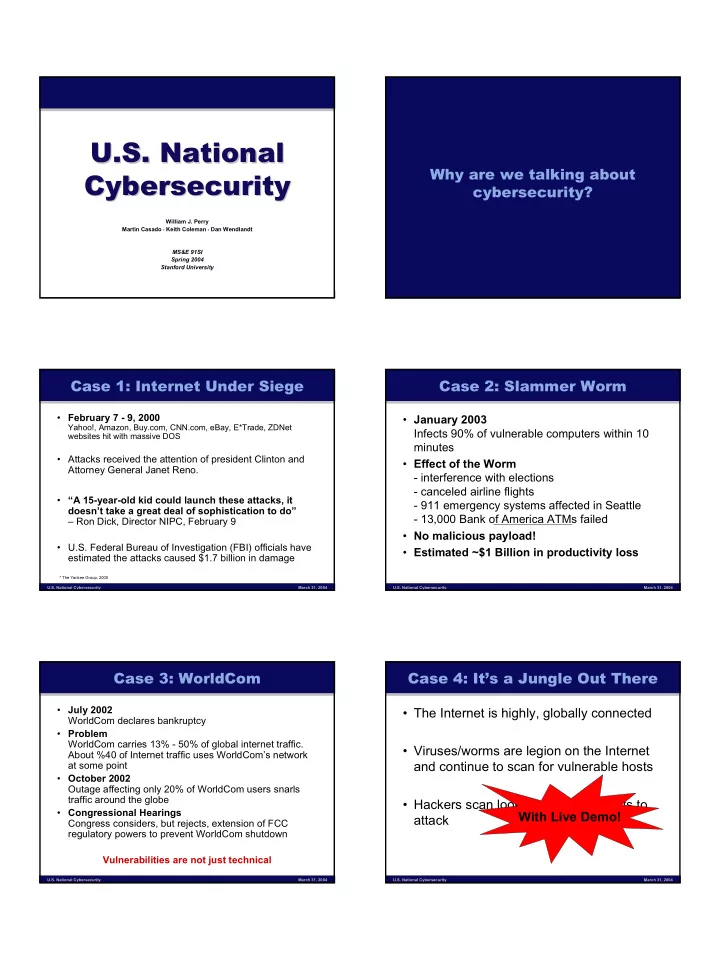
U.S. National U.S. National Why are we talking about Cybersecurity Cybersecurity cybersecurity? William J. Perry Martin Casado Keith Coleman Dan Wendlandt MS&E 91SI Spring 2004 Stanford University U.S. National Cybersecurity


slide-1
SLIDE 1

1

U.S. National Cybersecurity March 31, 2004

U.S. National U.S. National Cybersecurity Cybersecurity

William J. Perry Martin Casado • Keith Coleman • Dan Wendlandt MS&E 91SI Spring 2004 Stanford University

Why are we talking about cybersecurity?

U.S. National Cybersecurity March 31, 2004

Case 1: Internet Under Siege

  • February 7 - 9, 2000

Yahoo!, Amazon, Buy.com, CNN.com, eBay, E*Trade, ZDNet websites hit with massive DOS

  • Attacks received the attention of president Clinton and

Attorney General Janet Reno.

  • “A 15-year-old kid could launch these attacks, it

doesn’t take a great deal of sophistication to do” – Ron Dick, Director NIPC, February 9

  • U.S. Federal Bureau of Investigation (FBI) officials have

estimated the attacks caused $1.7 billion in damage

* The Yankee Group, 2000 U.S. National Cybersecurity March 31, 2004

Case 2: Slammer Worm

  • January 2003

Infects 90% of vulnerable computers within 10 minutes

  • Effect of the Worm
  • interference with elections
  • canceled airline flights
  • 911 emergency systems affected in Seattle
  • 13,000 Bank of America ATMs failed
  • No malicious payload!
  • Estimated ~$1 Billion in productivity loss

U.S. National Cybersecurity March 31, 2004

Case 3: WorldCom

  • July 2002

WorldCom declares bankruptcy

  • Problem

WorldCom carries 13% - 50% of global internet traffic. About %40 of Internet traffic uses WorldCom’s network at some point

  • October 2002

Outage affecting only 20% of WorldCom users snarls traffic around the globe

  • Congressional Hearings

Congress considers, but rejects, extension of FCC regulatory powers to prevent WorldCom shutdown Vulnerabilities are not just technical

U.S. National Cybersecurity March 31, 2004

Case 4: It’s a Jungle Out There

  • The Internet is highly, globally connected
  • Viruses/worms are legion on the Internet

and continue to scan for vulnerable hosts

  • Hackers scan looking for easy targets to

attack With Live Demo!

slide-2
SLIDE 2

2

What’s really going on here

U.S. National Cybersecurity March 31, 2004

Increasing Dependence

We are increasingly dependent on the Internet: Directly

– Communication (Email, IM, VoIP) – Commerce (business, banking, e-commerce, etc) – Control systems (public utilities, etc) – Information and entertainment – Sensitive data stored on the Internet

Indirectly

– Biz, Edu, Gov have permanently replaced physical/manual processes with Internet-based processes

* Based on slides by David Alderson, CalTech U.S. National Cybersecurity March 31, 2004

Security Not A Priority

Other design priorities often trump security: Cost Speed Convenience Open Architecture Backwards Compatibility

U.S. National Cybersecurity March 31, 2004

An Achilles Heel?

Combination of dependence and vulnerability make the Internet a target for asymmetric attack Cyberwarfare Cyberterrorism Cyberhooliganism* and a weak spot for accidents and failures

* Coined by Bruce Schneier, Counterpane U.S. National Cybersecurity March 31, 2004

Hard to Manage Security

  • No metrics to measure (in)security
  • Internet is inherently international
  • Private sector owns most of the

infrastructure

  • Cost/incentive disconnect?

– Businesses will pay to meet business imperatives – Who’s going to pay to meet national security imperatives?

U.S. National Cybersecurity March 31, 2004

The Challenge

A solution to this problem requires both the right technology and the right public policy. This is the cybersecurity challenge.

slide-3
SLIDE 3

3

What is “cybersecurity?”

U.S. National Cybersecurity March 31, 2004

According to the U.S. Dept of Commerce:

  • n. cybersecurity:

Some Definitions

  • n. information security: The protection of information

against unauthorized disclosure, transfer, modification,

  • r destruction, whether accidental or intentional.

See “information security”

U.S. National Cybersecurity March 31, 2004

Some Definitions

According to H.R. 4246 “Cyber Security Information Act”:

cybersecurity: “The vulnerability of any computing system, software program, or critical infrastructure to, or their ability to resist, intentional interference, compromise, or incapacitation through the misuse of, or by unauthorized means of, the Internet, public or private telecommunications systems or other similar conduct that violates Federal, State, or international law, that harms interstate commerce of the United States, or that threatens public health or safety.”

U.S. National Cybersecurity March 31, 2004

Some Definitions

According to S.I. 1901 “Cybersecurity Research and Education Act of 2002”:

cybersecurity: “information assurance, including scientific, technical, management,

  • r any other relevant disciplines required to ensure computer and network security,

including, but not limited to, a discipline related to the following functions:

(A) Secure System and network administration and operations. (B) Systems security engineering. (C) Information assurance systems and product acquisition. (D) Cryptography. (E) Threat and vulnerability assessment, including risk management. (F) Web security. (G) Operations of computer emergency response teams. (H) Cybersecurity training, education, and management. (I) Computer forensics. (J) Defensive information operations.

U.S. National Cybersecurity March 31, 2004

Some Definitions

According to S.I. 1900 “Cyberterrorism Preparedness Act of 2002 ”:

cybersecurity: “information assurance, including information security, information technology disaster recovery, and information privacy.”

U.S. National Cybersecurity March 31, 2004

One way to think about it

cybersecurity = security of cyberspace

slide-4
SLIDE 4

4

U.S. National Cybersecurity March 31, 2004

One way to think about it

cybersecurity = security of cyberspace information systems and networks

U.S. National Cybersecurity March 31, 2004

One way to think about it

cybersecurity = security of information systems and networks

U.S. National Cybersecurity March 31, 2004

One way to think about it

cybersecurity = security of information systems and networks security in the face of attacks, accidents and failures

U.S. National Cybersecurity March 31, 2004

One way to think about it

cybersecurity = security of information systems and networks in the face of attacks, accidents and failures

U.S. National Cybersecurity March 31, 2004

One way to think about it

cybersecurity = security of information systems and networks in the face of attacks, accidents and failures security and reliability

U.S. National Cybersecurity March 31, 2004

One way to think about it

cybersecurity = security and reliability of information systems and networks in the face of attacks, accidents and failures

(Still a work in progress.)

slide-5
SLIDE 5

5

U.S. National Cybersecurity March 31, 2004

In Context

corporate cybersecurity = security and reliability of corporate information systems and networks in the face of attacks, accidents and failures national cybersecurity = security and reliability of the nation’s information systems and networks in the face of attacks, accidents and failures

U.S. National Cybersecurity March 31, 2004

Cybersecurity as a Discipline

Now we have our goal. How do we achieve it? Must understand the four factors that play into the cybersecurity equation: – Technology – Public Policy – Economics (of stakeholders and incentives) – Social Influences (e.g. Big Brother fears)

What This Class is All About

U.S. National Cybersecurity March 31, 2004

Goal of the Class

Answer the question: Is today’s Internet is an appropriate platform

  • n which to operate critical infrastructure

services that affect U.S. national security?

U.S. National Cybersecurity March 31, 2004

How We’ll Get There

  • Understand threats to today’s Internet

infrastructure

  • Develop a framework for analyzing the

factors in the Cybersecurity equations

  • Explore and analyze not only the technical
  • ptions for securing the Internet but also

consider political, legal, and economic means able to combat the problem

U.S. National Cybersecurity March 31, 2004

What You Will Come Away With

  • Working knowledge of how the Internet

infrastructure operates and who the major cybersecurity policy actors are.

  • Frameworks within which to understand

and analyze cybersecurity issues.

  • Knowledge about current salient issues in

cybersecurity.

  • Connections and resources to help you in

cybersecurity related research.

slide-6
SLIDE 6

6

U.S. National Cybersecurity March 31, 2004

The Bottom Line

We need people who can do both policy and technology

U.S. National Cybersecurity March 31, 2004

What This Class is Not

  • This class is not…

– “How the Internet works”

  • Take CS244A Networks, or CS193i Internet Systems

– “How to hack”

  • Take CS155 Computer Security

– “Cryptography and privacy”

  • Take CS255 Intro to Cryptography

– “File sharing and music piracy”

U.S. National Cybersecurity March 31, 2004

What This Class Is

  • This class is…

– A look at the bigger picture – A chance to consider all the factors that play into cybersecurity

  • Technology
  • Policy
  • Law
  • Economics

U.S. National Cybersecurity March 31, 2004

The Stanford Cybersecurity Center

U.S. National Cybersecurity March 31, 2004

Stanford Cybersecurity Center

  • What it is:

An interdisciplinary research center designed to bring together the minds and ideas of Stanford's leading experts in Technology, Public Policy, Business and Law to address the cybersecurity challenge

  • Goal:

Foster the development of both the technology and the public policy needed to meet the cybersecurity challenge

  • What we do:

Education: Create and sponsor courses like this one Research: Foster collaborative research between disciplines (and launch new projects) Outreach: Collaborate with the Silicon Valley and Washington, DC communities

  • Who it is:

Students, faculty, researchers from CS, EE, MS&E, CISAC, Stanford Law School, etc…

  • How to get involved:

Research opportunities, discussion forums, lecture series, courses… Visit http://cybersecurity.stanford.edu or speak with us after class.

Course Logistics

slide-7
SLIDE 7

7

U.S. National Cybersecurity March 31, 2004

Basics

  • Course website will have latest content &

updates: http://msande91si.stanford.edu

  • 2 units, S/NC
  • No prerequisites
  • Location: TBD

U.S. National Cybersecurity March 31, 2004

Course Format & Grading

Class Format:

  • Pre-class readings and discussion questions

posted to class forum.

  • In class discussion of readings
  • Lecture by expert guest speaker
  • Q & A discussion for more in depth discussion

about the speaker’s topic. Expectations:

  • Attend every session, do all readings and discussion

questions.

  • Final short explorative talk on a topic of personal interest

in cybersecurity.

U.S. National Cybersecurity March 31, 2004

Schedule & Syllabus

March 31 Introduction Overview of the Cybersecurity Challenge April 7 Technology 101: Background on Networks, the Internet, Hacking and Cyber Attacks April 14 Policy 101: Background on U.S. Cybersecurity Policy April 21 Enforcing Cybersecurity Guest Speaker: Mary Rundle, Stanford Law School April 28 Bad Things Can Happen On (or To) the Internet Guest Speaker: Dan Geer, Verdasys May 5 Information Warfare and Defense Guest Speaker: Chris Eagle, Lieutenant Commander, U.S. Navy May 12 Crypto: What it Can and Can't Do Guest Speaker: Dan Boneh, Computer Science May 19 A Problem of Incentives? Guest Speaker: Kevin Soo Hoo, Sygate May 26 What Features Do We Want in a Critical Infrastructure Platform? Guest Speaker: David Alderson, CalTech June 3 Presentations & Wrap up

U.S. National Cybersecurity March 31, 2004

Enrollment

  • Limited to 20 students
  • Student Info Questionnaire
  • This course may be offered again in

Autumn 2004

U.S. National Cybersecurity March 31, 2004

Thank You

  • Contact

– Website: http://msande91si.stanford.edu – Instructors: cybersecurity@stanford.edu

  • Office Hours

– By request (send email) – Individual questions after class

Thank You