U.S.-Canada Corporate Tax Challenges With Surge in Cross Border - - PowerPoint PPT Presentation

u s canada corporate tax challenges with surge in cross
SMART_READER_LITE
LIVE PREVIEW

U.S.-Canada Corporate Tax Challenges With Surge in Cross Border - - PowerPoint PPT Presentation

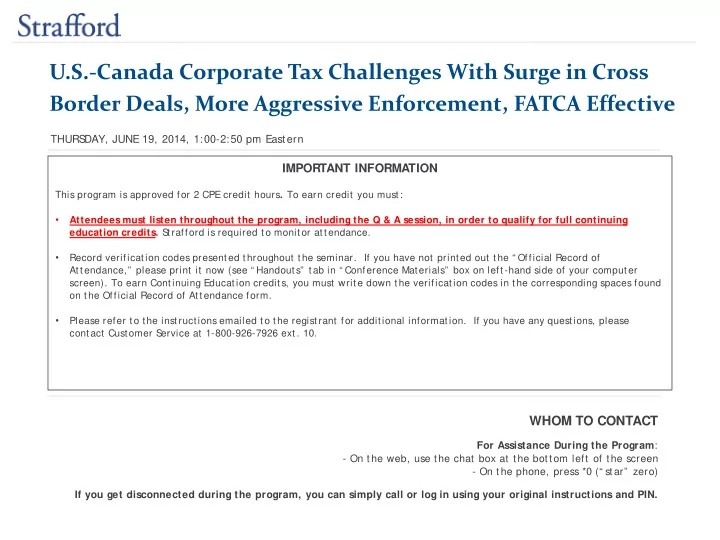
U.S.-Canada Corporate Tax Challenges With Surge in Cross Border Deals, More Aggressive Enforcement, FATCA Effective THURS DAY, JUNE 19, 2014, 1:00-2:50 pm Eastern IMPORTANT INFORMATION This program is approved for 2 CPE credit hours . To earn


slide-1
SLIDE 1

U.S.-Canada Corporate Tax Challenges With Surge in Cross Border Deals, More Aggressive Enforcement, FATCA Effective

THURS DAY, JUNE 19, 2014, 1:00-2:50 pm Eastern

WHOM TO CONTACT

For Assistance During the Program:

  • On the web, use the chat box at the bottom left of the screen
  • On the phone, press *0 (“ star” zero)

If you get disconnected during the program, you can simply call or log in using your original instructions and PIN.

IMPORTANT INFORMATION

This program is approved for 2 CPE credit hours. To earn credit you must:

  • Attendees must listen throughout the program, including the Q & A session, in order to qualify for full continuing

education credits. S trafford is required to monitor attendance.

  • Record verification codes presented throughout the seminar. If you have not printed out the “ Official Record of

Attendance,” please print it now (see “ Handouts” tab in “ Conference Materials” box on left -hand side of your computer screen). To earn Continuing Education credits, you must write down the verification codes in the corresponding spaces found

  • n the Official Record of Attendance form.
  • Please refer to the instructions emailed to the registrant for additional information. If you have any questions, please

contact Customer S ervice at 1-800-926-7926 ext. 10.

slide-2
SLIDE 2

Tips for Optimal Quality

S

  • und Qualit y

If you are listening via your computer speakers, please note that the quality

  • f your sound will vary depending on the speed and quality of your internet

connection. If the sound quality is not satisfactory, you may listen via the phone: dial 1-866-873-1442 and enter your PIN when prompted. Otherwise, please send us a chat or e-mail sound@ straffordpub.com immediately so we can address the problem. If you dialed in and have any difficulties during the call, press *0 for assistance. Viewing Qualit y To maximize your screen, press the F11 key on your keyboard. To exit full screen, press the F11 key again.

FOR LIVE EVENT ONLY

slide-3
SLIDE 3

Continuing Education Credits

For CLE credits, please let us know how many people are listening online by completing each of the following steps:

  • Close the notification box
  • In the chat box, type (1) your company name and (2) the number of

attendees at your location

  • Click the S

END button beside the box For CPE credits, attendees must listen throughout the program, including the Q & A session, and record verification codes in the corresponding spaces found on the CPE form, in order to qualify for full continuing education credits. S trafford is required to monitor attendance. If you have not printed out the “ CPE Form,” please print it now (see “ Handouts” tab in “ Conference Materials” box on left -hand side of your computer screen). Please refer to the instructions emailed to registrants for additional information. If you have any questions, please contact Customer Service at 1-800-926-7926

  • ext. 10.

FOR LIVE EVENT ONLY

slide-4
SLIDE 4

Program Materials

If you have not printed the conference materials for this program, please complete the following steps:

  • Click on the ^ symbol next to “ Conference Materials” in the middle of t he left-

hand column on your screen.

  • Click on the tab labeled “ Handouts” that appears, and there you will see a

PDF of the slides and the Official Record of Attendance for today's program.

  • Double-click on the PDF and a separate page will open.
  • Print the slides by clicking on the printer icon.

FOR LIVE EVENT ONLY

slide-5
SLIDE 5

U.S.-Canada Corporate Tax Challenges

June 19, 2014 Jonathan Garbutt, Garbutt Tax Law j onathan@ garbutt-taxlaw.com Carl Irvine, McMillan carl.irvine@ mcmillan.ca Michel M. Ranger, McMillan michel.ranger@ mcmillan.ca

slide-6
SLIDE 6

Notice

ANY TAX ADVICE IN THIS COMMUNICATION IS NOT INTENDED OR WRITTEN BY THE S PEAKERS ’ FIRMS TO BE US ED, AND CANNOT BE US ED, BY A CLIENT OR ANY OTHER PERS ON OR ENTITY FOR THE PURPOS E OF (i) AVOIDING PENALTIES THAT MA Y BE IMPOS ED ON ANY TAXP A YER OR (ii) PROMOTING, MARKETING OR RECOMMENDING TO ANOTHER P ARTY ANY MATTERS ADDRES SED HEREIN.

Y

  • u (and your employees, representatives, or agents) may disclose to any and all persons,

without limitation, the tax treatment or tax structure, or both, of any transaction described in the associated materials we provide to you, including, but not limited to, any tax opinions, memoranda, or other tax analyses contained in those materials. The information contained herein is of a general nature and based on authorities that are subj ect to change. Applicability of the information to specific situations should be determined through consultation with your tax adviser.

6

slide-7
SLIDE 7

June 19, 2014 Jonathan Garbutt Dominion Tax Law jonathan.garbutt@dominiontaxlaw.com

Strafford Live Webinar: "U.S.-Canada Corporate Tax Challenges With Surge in Cross-Border Deals, More Aggressive Enforcement, FATCA Effective”

slide-8
SLIDE 8

Dom

  • minion
  • n T

Tax Law

Practice Restricted to C Canadian Tax, T Trusts & & Estates Law

Agenda

I.

FATCA and new Canada–United States IGA

  • A. Highlights of the IGA
  • B. New Canadian implementing legislation
  • C. Draft CRA guidance

II.

Transfer pricing issues for U.S. companies

  • A. Teletech Canada
  • B. Soft-Moc Inc.
  • C. McKesson Canada
  • D. Burlington Resources

E.

Cameco Corporation

8

slide-9
SLIDE 9

Dom

  • minion
  • n T

Tax Law

Practice Restricted to C Canadian Tax, T Trusts & & Estates Law

FATCA and new Canada–United States IGA

  • The Foreign Account Tax Compliance Act (FATCA) is US legislation

enacted 2010

  • Under FATCA, non-U.S. “foreign” financial institutions (FFIs) would be

required to report information to the IRS about financial accounts held by identified US persons

  • If FFIs fail to comply with FATCA, the IRS would impose a 30%

withholding tax on US source payments paid to the financial institution

  • r its clients
  • FATCA potentially puts FFIs at odds with their domestic banking,

privacy and constitutional laws.

9

slide-10
SLIDE 10

Dom

  • minion
  • n T

Tax Law

Practice Restricted to C Canadian Tax, T Trusts & & Estates Law

FATCA & Canada–US IGA

  • FFIs will be put in the unenviable position of either: a) complying with

FATCA and violating domestic law; or b) complying with domestic law and violating FATCA

  • As a result, the US Treasury offered cooperating countries a deal: if

you enter into an intergovernmental agreement (IGA), then the IGA will trump FATCA

  • On February 5, 2014 the US and Canada signed IGA, applicable to

Canadian Financial Institutions (CFIs)

  • CFIs will report on accounts of US persons to the Canada Revenue

Agency (CRA) rather than directly to the US IRS. The CRA will then exchange the information with the IRS through the provisions in the existing Canada-U.S. Tax Treaty 10

slide-11
SLIDE 11

Dom

  • minion
  • n T

Tax Law

Practice Restricted to C Canadian Tax, T Trusts & & Estates Law

FATCA and new Canada–United States IGA

  • The IGA will apply to: CFIs (excluding any branches that are located
  • utside Canada) and any Canadian branches of third country financial

institutions

  • Annex II of the IGA lists those accounts that are excluded from being

considered financial accounts, the most significant of which are: –RRSPs, RRIFs, TFSAs, RDSPs, RESPs) –Pooled Registered Pension Planns (PRPPs), Registered Pension Plans (RPPs), Deferred Profit Sharing Plans (DPSPs)

11

slide-12
SLIDE 12

Dom

  • minion
  • n T

Tax Law

Practice Restricted to C Canadian Tax, T Trusts & & Estates Law

FATCA and new Canada–United States IGA

  • The IGA specifically addresses legal impediments to compliance, i.e.

Canadian data protection and privacy legislation etc. New Canadian implementing legislation and CRA Guidelines:

  • Canada’s implementing legislation in Bill C-31, tabled on March 28,

2014, threatens to invalidate the IGA and causes concerns for Canadian private trusts. IGA classifies trusts as financial institutions that must meet FATCA requirements

  • The draft legislation - and CRA’s interpretation of it - appears to

suggest trusts are not financial institutions, and therefore aren’t required to report

12

slide-13
SLIDE 13

Dom

  • minion
  • n T

Tax Law

Practice Restricted to C Canadian Tax, T Trusts & & Estates Law

FATCA and new Canada–United States IGA

  • Draft Guidance has not be officially published, but a version of it has

been leaked

  • Serious issues with the Guideance – departures from OECD and other

countries interpretation documments

  • Issues like the definition of “unabiguous place of birth” regarding who

is or is not a US person, and other attempts to play cute with the wording

  • Leaked documents are leaked for a reason; someone at the CRA

thinks that the position is stupid, and wants to make sure that the guidance is changed – so upshot is do not worry

13

slide-14
SLIDE 14

Dom

  • minion
  • n T

Tax Law

Practice Restricted to C Canadian Tax, T Trusts & & Estates Law

Recent Transfer Pricing Developments

  • Recent Developments – not a lot going on in public
  • 5th Protocol to Canada-US Tax Treaty creates arbitration panel process
  • Canada-US issues are therefore increasingly being dealt with “behind

closed doors” in panels and by competent authority in an effort to avoid arbitration

  • Case law therefore illustrative of Canadian law, but the reality is that it

is not 100% applicable to US entities, even if it involves US companies because there is a “separate world” of CA & Panels

  • US is doing well in panels, or so I hear…

14

slide-15
SLIDE 15

Dom

  • minion
  • n T

Tax Law

Practice Restricted to C Canadian Tax, T Trusts & & Estates Law

Recent Transfer Pricing Case Law

  • A. Teletech Canada
  • B. Soft-Moc Inc.
  • C. McKesson Canada
  • D. Burlington Resources
  • E. Cameco Corporation

15

slide-16
SLIDE 16

Dom

  • minion
  • n T

Tax Law

Practice Restricted to C Canadian Tax, T Trusts & & Estates Law

Teletech Canada, Inc. v. Minister of National Revenue

  • TeleTech Canada Inc., (“TeleTech Canada”), is a wholly-owned

subsidiary of TeleTech Holdings Inc. (“TeleTech US”) that incidentally is frequently a company that appears in comparable call centre benchmarking sets in numerous transfer pricing studies

  • A corporate restructuring occurred in 2000 where TeleTech Canada

became a subcontractor of TeleTech US

  • TeleTech US provides administrative services to TeleTech Canada
  • After the fact, an internal accounting error was discovered on the

pricing of the inter-corporate administrative services which resulted in an

  • ver-reporting of income in Canada and an under-reporting of income in

the U.S.

16

slide-17
SLIDE 17

Dom

  • minion
  • n T

Tax Law

Practice Restricted to C Canadian Tax, T Trusts & & Estates Law

Teletech Canada

  • TeleTech US amended the US tax returns and requested competent

authority assistance in Canada and the US for relief from double

  • taxation. Request was made in May 2006 and was denied in November
  • 2006. Denial was based on that there was no action as of that point by

the CRA or the IRS re DT

  • In December 2006, IRS sends the CRA a letter that the IRS had

assessed the amended tax return. The IRS invited the CRA to participate in the competent authority process however the CRA did not respond or notify TeleTech Canada of the invitation

  • In July of 2008, the IRS adjusted TeleTech U.S.’s 2001 and 2002

returns by a further increase of $11.2 million – on top of $38.3 million from the 2000 through 2002 amended tax returns

17

slide-18
SLIDE 18

Dom

  • minion
  • n T

Tax Law

Practice Restricted to C Canadian Tax, T Trusts & & Estates Law

Teletech Canada

  • Strict procedural requirements for initiating a request for

competent authority relief under the Canada-US Tax Treaty

  • Request must be made pursuant to an adjustment made

(not filed, made) by the other government

18

slide-19
SLIDE 19

Dom

  • minion
  • n T

Tax Law

Practice Restricted to C Canadian Tax, T Trusts & & Estates Law

Teletech Canada

  • In May, 2011 TeleTech Canada sought an order for mandamus from

the Federal Court to compel the CRA to accept the request for competent authority assistance

  • The process was held in abeyance pending the CRA’s determination
  • f the second request, which the CRA then denied on the basis they

had not received the notification as required by the Canada-US Tax Treaty within six years from the end of the taxation years in issue

  • The application for mandamus was denied in May, 2013
  • The Crown won the case on effectively technical grounds

19

slide-20
SLIDE 20

Dom

  • minion
  • n T

Tax Law

Practice Restricted to C Canadian Tax, T Trusts & & Estates Law

Teletech Canada

  • The Federal Court found that the each of the two denial letters were

discrete decisions and there is a 30 day time limit for certiorari, the judicial review of a reviewable error committed

  • The order of Mandamus is the judicial review a continuing course of
  • conduct. The court found the judicial review of certiorari was

appropriate and not Mandamus. In addition, Mandamus is to order the CRA to make a decision, not the specific outcome

  • The CRA made the decision to deny the competent authority request,

and hence had made the decision. If TT disagreed with the outcome

  • f that decision, then jurisprudence has established mandamus will

not be granted, and the process is to request certiorari within the 30 day time limit

20

slide-21
SLIDE 21

Dom

  • minion
  • n T

Tax Law

Practice Restricted to C Canadian Tax, T Trusts & & Estates Law

Teletech Canada

  • The results of this case make it clear that the process of seeking

adjustments retroactively is dangerous and could potentially result in double tax if not done properly. Seeking an adjustment in one country requires following through in another country.

  • In the first decision the CRA refused the request because it was

premature, but indicated that if it received an indication of an adjustment from the US IRS, it would reconsider

  • When the CRA got the notification of the adjustment, it did not

respond or deal with it in any way. The IRS also did not let the taxpayer know it had given notice, although Teletech US would have been aware.

  • The CRA only disclosed the existence of the December 2006 notice

as part of the discovery process.

21

slide-22
SLIDE 22

Dom

  • minion
  • n T

Tax Law

Practice Restricted to C Canadian Tax, T Trusts & & Estates Law

Soft-Moc Inc. v. Canada (National Revenue)

  • Soft-Moc, a Canadian footwear retailer with related Bahamian

companies that provide Soft-Moc various services including merchandising, information technology, business development and software licensing

  • CRA auditing the 2005 and 2006 tax years and issued a formal

Foreign-Based Information Request (FBIR) (subsection 231.6(2) of the Income Tax Act of Canada) (the Act) to obtain financial and operational information in respect of the related Bahamian companies

22

slide-23
SLIDE 23

Dom

  • minion
  • n T

Tax Law

Practice Restricted to C Canadian Tax, T Trusts & & Estates Law

Soft-Moc Inc.

  • CRA review of payments to Bahamian companies were concerning:

– Whether services provided in Bahamas or Canada – How those services were provided, and – The appropriate transfer pricing methodology and whether the price paid was arm’s-length

  • Some of the information was provided but held a lot back on the

basis that that it was confidential and proprietary; releasing it would harm the company’s competitive advantage

  • Soft-Moc applied for judicial review from the Tax Court of Canada

(TCC) on the basis that the FBIR was too broad and unreasonable

23

slide-24
SLIDE 24

Dom

  • minion
  • n T

Tax Law

Practice Restricted to C Canadian Tax, T Trusts & & Estates Law

Soft-Moc Inc.

  • Soft-Moc lost; the TCC noted the wide-ranging statutory powers of

the CRA to collect information and the low threshold to be met in determining whether the requested information is relevant and reasonable.

  • Soft-Moc failed to show:

– That the FBIR would inadvertently capture the Bahamian companies’ irrelevant business dealings – That providing the info would destroy its value or endanger the business relationship with Soft-Moc (unlikely) – That the requested info was confidential, propriety, sensitive, or that the CRA was merely fishing

24

slide-25
SLIDE 25

Slide Intentionally Left Blank

slide-26
SLIDE 26

Dom

  • minion
  • n T

Tax Law

Practice Restricted to C Canadian Tax, T Trusts & & Estates Law

McKesson Canada Corporation v. The Queen

  • McKesson Canada Corporation v. The Queen, 2013 TCC 404 is a very

complicated case – but the upshot is “factoring is OK, you just have to do it right and pick your battles on appeal”:

  • McKesson Canada (McK Canada) in 2002 had sales of $3bn, $40m in

profits; wholesale distribution of ethical drugs and other products to pharmacies and hospitals; low margin (2%), high volume business. McKesson US is the “biggest company you have never heard of”

  • In its March 2003 tax year, McK Canada entered into effectively an

unsecured factoring arrangement with a related Luxembourg entity, “MIH”. It transferred approximately CAD$460m in receivables to MIH at a discount of 2.206%. The factoring transaction wiped out McK Canada’s profits for the for that year.

26

slide-27
SLIDE 27

Dom

  • minion
  • n T

Tax Law

Practice Restricted to C Canadian Tax, T Trusts & & Estates Law

McKesson Canada Corp. v. Canada

McKesson Canada MIH MIH 2 Indirect Ireland Parent RSA SA Loan Guarantee Loan Indemnity

27

slide-28
SLIDE 28

Dom

  • minion
  • n T

Tax Law

Practice Restricted to C Canadian Tax, T Trusts & & Estates Law

McKesson Canada Corporation v. The Queen

  • The CRA reassessed McK Canada, taking the position that arm’s-

length parties would not have entered into the same transaction at a discount of greater than 1.013%, amounting to a re-assessment of CAD$26m in tax for 2003

  • McK Canada, on the advice of its tax lawyers, originally did not

conduct a full transfer pricing study by transfer pricing experts (economists!), rather it’s lawyers contacted the securitization department of TD bank, and asked them to price it out

  • The TD report resulted in the discount rate used by McK Canada

despite the fact that there were material differences between the transactions that group in TD structured and the actual factoring transaction as between the two parties

28

slide-29
SLIDE 29

Dom

  • minion
  • n T

Tax Law

Practice Restricted to C Canadian Tax, T Trusts & & Estates Law

McKesson

  • The rate was determined by making a number of pro-taxpayer

assumptions (treating the risk of non-payment based on junk bond default rates rather than using their historical record, fixing certain volatile terms for the length of the agreement, spreading certain costs

  • ver the length of the 5 year agreement, assuming junk bond rate

interest costs for MIH, exaggerated servicing costs)

  • The taxpayer also took some very arbitrary decisions with regard to

time periods (averaging some things on a four month rolling average, but not others), rates, and risks

29

slide-30
SLIDE 30

Dom

  • minion
  • n T

Tax Law

Practice Restricted to C Canadian Tax, T Trusts & & Estates Law

McKesson

  • McK Canada took positions that were difficult to defend on appeal
  • But that did not stop them: McK Canada commissioned several

transfer pricing reports and hired \experts to support its positions

  • The experts themselves when testifying at trial, took very advocacy-

focused positions; they accepted various problematic positions without questioning, or made new assumptions that made little sense in order to arrive at the same answer by different means

  • The experts seemed to be too “bought and paid for” while testifying:

belittling the CRA’s positions and failing to recognize any critique of their own positions or assumptions/positions/methods

  • TCC Justice Boyle was unamused, and made clear that the

taxpayer’s experts’ opinions were in fact less credible as a result of their inability to be reasonable

30

slide-31
SLIDE 31

Dom

  • minion
  • n T

Tax Law

Practice Restricted to C Canadian Tax, T Trusts & & Estates Law

McKesson

  • There were many positive take-aways for taxpayers:

– “The Duke of Westminster is alive and well and living in Canada” – The TCC recognized that this was an entirely tax-driven transaction, and accepted this as entirely proper – there is no need for a “valid business purpose”, and taxpayers can arrange their affairs so as to pay the least amount of tax they legally owe – The TCC accepted that factoring transactions can be put in place where there is no real change or business need to re-allocate risk, no change in the circumstances of the Canadian entity, no decline in the credit-worthiness of its clients and customers, and no real need for the funds raised from the factoring transaction

31

slide-32
SLIDE 32

Dom

  • minion
  • n T

Tax Law

Practice Restricted to C Canadian Tax, T Trusts & & Estates Law

McKesson

  • There were many positive take-aways for taxpayers:

– The TCC did not believe it was proper or necessary to re- characterize the transaction, and instead merely adjusted the terms of the transaction as structured by the parties to what the terms would have been had they been operating at arm’s length – Those terms were not at all adverse to the taxpayer from the perspective of reducing its profits in Canada or tax payable. The terms did result in a large reassessment of tax, but the taxpayer’s position after the TCC’s adjustments were significantly better than what the taxpayer’s position was before the structure was put in place

32

slide-33
SLIDE 33

Dom

  • minion
  • n T

Tax Law

Practice Restricted to C Canadian Tax, T Trusts & & Estates Law

McKesson

  • Other Issues that Taxpayers need to be aware of that were

highlighted by this case: – Selection of Transfer Pricing Method – Comments on Transfer Pricing Penalty Threshold – Selection of point within range of results – Overall lack of arm’s length evidence

33

slide-34
SLIDE 34

Dom

  • minion
  • n T

Tax Law

Practice Restricted to C Canadian Tax, T Trusts & & Estates Law

Burlington Resources Finance Company v. The Queen

  • Burlington Resources Finance Company v. The Queen is a

procedural case – BRFC is involves a guarantee fee of $83m on a loan of $3Bn – Justice Department (the CRA’s lawyers) on their “Reply to the Notice of Appeal” was so bad the TCC gave them a Mulligan – 60 days to refile, and this time not be so lame & weak – Note in TelTech how the procedural issue worked in the CRAs favour, but TCC unwilling to provide taxpayers with relief based

  • n technicalities

– CRA theory of the case is weak, but it lost a similar case in GE, and is trying to take another kick at the can

34

slide-35
SLIDE 35

Dom

  • minion
  • n T

Tax Law

Practice Restricted to C Canadian Tax, T Trusts & & Estates Law

Cameco Corporation v. The Queen

  • Cameco Corporation v. The Queen, 2014 TCC 45 is also procedural

as the case has not yet even gone to discoveries

  • Cameco has marketing agreements with related parties in

Switzerland regarding is production of Uranium; Cameco Canada is effectively a “low risk” producer with a guaranteed price per unit, and the Swiss entities take on the market risk (and upside)

  • Ruling on cross-motions between the parties over the “list of

documents”

  • Huge number of documents, and parties cannot agree on format
  • Issue as to how to apply sorting procedures, and how to claim

documents as privileged;

  • CRA wants documents regarding years no longer “at issue”

35

slide-36
SLIDE 36

Dom

  • minion
  • n T

Tax Law

Practice Restricted to C Canadian Tax, T Trusts & & Estates Law

About your Speaker – Jonathan Garbutt

Jonathan practices Canadian income tax law, including matters of general tax planning; global corporate tax minimization, tax advice for M&A, international private investment and tax controversy & litigation. Jonathan has considerable experience with international transfer pricing

  • matters. Although called to the bar in New York, he does not practice

US law. However he has a particular understanding of how the Canadian and US tax systems work with (and sometimes against) each

  • ther.

While working at one of the largest global firms Jonathan worked on a number of important transfer pricing litigation and planning matters. Prior to practicing law, Jonathan was Chief Economist at the Canadian Electricity Association and prior to that he was an economist with Nakamae International Economic Research in Tokyo, Japan.

Garbutt Tax Law - Suite 2500, 120 Adelaide Street West Toronto, Ontario M5H 1T1 416-644-6587 / Fax:416-367-1954 jonathan@garbutt-taxlaw.com 36

slide-37
SLIDE 37

Dom

  • minion
  • n T

Tax Law

Practice Restricted to C Canadian Tax, T Trusts & & Estates Law

Contact Information

Jonathan N. Garbutt Dom

  • minion
  • n Tax Law

Practice Restricted to Canadian Tax, Trusts & Estates Law 120 Adelaide Street West, Suite 2500 Toronto, Ontario M5H 1T1 Phone: 416-644-6587| Fax: 416-367-1954 E-mail: Jonathan.Garbutt@DominionTaxLaw.com

37

slide-38
SLIDE 38

Slide Intentionally Left Blank

slide-39
SLIDE 39

Canadian Thin Capitalization Rules

Carl Irvine McMillan LLP

Presented at: U.S.-Canada Corporate Tax Challenges With Surge in Cross Border Deals Strafford Publications, Inc. June 19, 2014

slide-40
SLIDE 40

Agenda

I. Introduction II. Thin Capitalization for Canadian Corporations

  • concepts
  • implications
  • common traps
  • III. Thin Capitalization for Branches of Foreign

Corporations

  • IV. Thin Capitalization for other entities
  • partnerships
  • trusts

V. Anti-Avoidance Rules

  • back-to-back loan rules
  • new legislative proposals

40

slide-41
SLIDE 41
  • Thin capitalization rules were first introduced in 1971 to protect

Canadian tax base by limiting ability of foreign corporations to “strip” earnings from Canadian subsidiaries by capitalizing with debt rather than equity.

  • Denies interest deduction for “excessive” debt financing (giving

rise to tax in Canada).

  • Originally, interest on debt in excess of 3:1 debt-to-equity ratio

was disallowed.

  • Debt-to-equity ratio reduced to 2:1 since 2000

41

I. Introduction

slide-42
SLIDE 42
  • Since 2012 there have been significant changes to the rules
  • debt-to-equity ratio reduced to 1.5:1
  • rules expanded to apply to:

i. branches of non-resident corporations

  • ii. partnerships
  • iii. trusts
  • 2014 federal budget contained new anti-avoidance rules, with

significant impact on financing of Canadian subsidiaries of foreign corporations.

42

I. Introduction

slide-43
SLIDE 43

43

II.

Thin Capitalization for Canadian Corporations

  • Subsection 18(4) of the Income Tax Act (Canada) (the “Tax Act”)

limits deductibility of interest paid or payable by a Canadian corporation on “outstanding debts to specified non-residents” to the extent that i. the “debt amount” of corporation, exceeds ii. 1.5 times the “equity amount” of the corporation

  • Seemingly simple, but the technical rules contain detailed

definitions which create traps for the unwary

slide-44
SLIDE 44

44

  • What are “outstanding debts to specified non-residents”?
  • Definition includes all amounts

1) payable by corporation to: i. a “specified non-resident shareholder” or ii. a non-resident who does not deal at arm’s length with a “specified shareholder” 2)

  • n which any amount in respect of interest paid or payable is or

would be (but for these rules) deductible

  • Non-interest bearing debt is not subject to the thin capitalization

rules

  • Third-party debt that is guaranteed by a “specified non-resident

shareholder” is not caught by these rules (but, see Part V)

II.

Thin Capitalization for Canadian Corporations

slide-45
SLIDE 45

45

  • What is a “specified shareholder”?
  • a person who either alone or together with persons not dealing

at arm’s length owns shares of the capital stock of the corporation having: i. 25% of the voting rights at the annual meeting of the shareholders of the corporation (the “Votes Test”), or ii. 25% of the fair market value of all outstanding shares of the corporation (the “Value Test”)

  • Only one of Votes Test or Value Test need be satisfied
  • Special deeming rules apply to rights to acquire/cause

cancelation of shares, for purpose of these test

II.

Thin Capitalization for Canadian Corporations

slide-46
SLIDE 46

46

  • A “specified non-resident shareholder” is a non-resident who is

“specified shareholder”

  • A non-resident who deals at arm’s length with a Canadian

corporation can still be considered a “specified non-resident shareholder”

  • Example 1: As part of a restructuring of a Canadian

corporation, the US lender acquires options to acquire 26% of the shares of the Canadian corporation

  • Example 2: US lender lends funds to a Canadian corporation

and entities related to the US lender holds special voting shares

  • f the corporation having 26% of voting power

II.

Thin Capitalization for Canadian Corporations

slide-47
SLIDE 47

47

  • What is the “debt amount”?
  • The sum of the maximum total amount at any time in each

month of “outstanding debts to specified non-residents” of the corporation, divided by 12.

  • Because the “debt amount” is based on the maximum debt at any

time in a month, a large balance that is outstanding for only a moment in time can have a big impact on the calculation of the “debt amount” for a taxation year.

II.

Thin Capitalization for Canadian Corporations

slide-48
SLIDE 48

48

  • What is the “equity amount” for a Canadian corporation?
  • The sum of:

1) The retained earnings of the corporation as of the beginning of its taxation year (not including retained earnings attributable to other corporations), 2) The sum of the corporation’s “contributed surplus” contributed by “specified non-resident shareholders” as at the beginning of each month, divided by 12, and 3) The sum of the corporation’s “paid-up capital” attributable to shares of a “specified non-resident shareholder” as at the beginning of each month, divided by 12.

II.

Thin Capitalization for Canadian Corporations

slide-49
SLIDE 49

49

Implications of exceeding thin capitalization ratio

  • “excess” interest is not deductible in computing income of

Canadian corporation, resulting in greater Canadian tax liability

  • “excess interest” is deemed to be a dividend paid to specified non-

resident shareholder

  • Subject to withholding tax at rate of 25% (potentially reduced

to 5% or 15% under the Canada-US Income Tax Convention)

  • Interest deemed to be paid at year-end, if not otherwise paid.
  • Relief from penalties (but not interest) for failing to withhold

from deemed dividend

II.

Thin Capitalization for Canadian Corporations

slide-50
SLIDE 50

50

Traps for the Unwary! 1) Mismatch between timing of computation of equity vs. debt (equity is counted at beginning of the month/year, debt is computed based on the maximum at any time in each month) Example:

  • US Corporation capitalizes Canadian subsidiary on June 15 by

lending it $100 and subscribing for $100 in shares

  • Debt amount includes $100 for June
  • Equity Amount doesn’t include $100 in June (no recognition

until July) This can be an issue in corporate acquisition or reorganization transactions, particularly if they result in short tax years

II.

Thin Capitalization for Canadian Corporations

slide-51
SLIDE 51

51

Traps for the Unwary! (cont) 2) contributed surplus or retained earnings for accounting purposes might not be the same as contributed surplus or retained earnings for tax purposes

  • Where as part of take-over, “push-down accounting” requires

that a purchase price adjustment be credited to Canadian corporation’s contributed surplus, it is not associated with an actual contribution by a shareholder and does not qualify as contributed surplus for thin capitalization purposes

  • Retained earnings for thin capitalization purposes excludes

consolidated retained earnings of subsidiaries

II.

Thin Capitalization for Canadian Corporations

slide-52
SLIDE 52

52

Traps for the Unwary! (cont) 3) If Canadian corporation has a Canadian holding corporation, “contributed surplus” and “paid-up capital” doesn’t count towards “equity amount” of the corporation Loan from US Parent to Canadian Subsidiary 2 would trigger thin capitalization rule

II.

Thin Capitalization for Canadian Corporations

US Parent Canadian Subsidiary 1 Canadian Subsidiary 2

$100 $100 $100 $100

slide-53
SLIDE 53

53

Traps for the Unwary! (cont) 4) Withholding tax rate on deemed dividend is higher under Canada- US Income Tax Convention for persons who don’t hold shares directly If running afoul of thin capitalization rules is a real risk, make sure loans are to direct shareholder holding 10% of voting stock!

II.

Thin Capitalization for Canadian Corporations

US Parent US Subsidiary Canadian Subsidiary

5% $100 15%

slide-54
SLIDE 54

54

  • Before 2013, US (and other foreign) corporations carrying on

business in Canada had been excluded from the application of the thin capitalization rules

  • For example, one could establish a special purpose US LLC to
  • perate a Canadian business, which could be funded entirely

with debt from US parent

  • In 2012, the government introduced amended rules for branches of

foreign corporations.

  • As with Canadian corporations, foreign corporations are subject to

1.5:1 debt-to-equity ratio, but slightly modified (3:5 debt-to-net assets ratio)

  • III. Thin Capitalization Branches of US Corporations
slide-55
SLIDE 55

55

  • “equity amount” is an amount equal to 40% of the amount by

which 1) The sum of the book value of property that is (i) used in a business carrying on in Canada, or (ii) real property situated in Canada at the beginning of each month, divided by 12, exceeds 2) The sum of the amount of debt outstanding that can reasonably be considered to relate to the business carried

  • n Canada (other than debt owed to specified non-resident

shareholders) at the beginning of each month, divided by 12

  • III. Thin Capitalization Branches of US Corporations
slide-56
SLIDE 56

56

  • “debt amount” definition is same as for Canadian corporation
  • recall only includes amount deductible in computing Canadian

income

  • would not include debt used to finance business outside of

Canada

  • Note that mismatch between timing of computation of “debt

amount” and “equity amount” continues

  • III. Thin Capitalization Branches of US Corporations
slide-57
SLIDE 57

57

  • “excess” interest attributable to a business carried on in Canada is

not deductible

  • “excess” interest does not give rise to deemed dividend (or

additional withholding tax), but

  • denial of interest deduction will result in greater after-tax profit

(for tax purposes), giving rise to additional branch profits tax under Part XIV of the Tax Act

  • Generally 25%, but potentially reduced to 5% (or, in some

cases, eliminated, under the Convention)

  • III. Thin Capitalization Branches of US Corporations
slide-58
SLIDE 58

58

  • Changes in recent years have extended thin capitalization rules to

trusts and partnerships

  • Previously, partnerships or trusts were used (or, at least

considered, as financing vehicle to bypass application of the thin capitalization rules

  • 2012 budget extended thin capitalization rules to partnerships
  • In over-simplified terms, the new rules require each partner to

include it’s share of partnership debt in determining whether it is subject to the application of the thin capitalization rules

  • Rather than denying interest deduction in partnership, rules

require partner to include amount in income equal to the “excess” interest

  • IV. Thin Capitalization for other Entities
slide-59
SLIDE 59

59

  • 2013 budget extended thin capitalization to trusts (both Canadian

resident and non-resident)

  • Rules for trusts essentially mirror those for corporations, with

adjustments to reflect different legal nature of trusts.

  • gives rise to denial of interest deduction for “excess” interest
  • Possible withholding tax for “specified non-resident

beneficiaries” (25%)

  • IV. Thin Capitalization for other Entities
slide-60
SLIDE 60

60

V.

Anti-Avoidance Rules

  • Thin capitalization rules contain a specific anti-avoidance rule

intended to prevent taxpayers from using third-party loans to skirt these rules

  • These apply where:

1) a “specified non-resident shareholder” (or a non-resident person not dealing at arm’s length with a “specified shareholder”) makes a loan to a third party (the “first loan”); 2) a condition of the first loan is that the third party make a loan to the relevant corporation (the “second loan”).

  • Rule deems the relevant corporation to have borrowed an amount

from the person who made the first loan equal to the lesser of the balance of the first loan and the second loan.

slide-61
SLIDE 61

61

V.

Anti-Avoidance Rules

  • Example: Back-to-back loan

US Parent Bank Canadian Subsidiary 1 Canadian Subsidiary 2

$100 $50 $50

Deemed Loans

$50 $50

slide-62
SLIDE 62

62

V.

Anti-Avoidance Rules

  • Budget 2014 contained a proposal to extend these rules
  • New rules, if enacted, will apply starting in 2015 where:

1) a corporation has an obligation to pay an amount to a third-party lender (the “intermediary”), and 2) the intermediary (or a person not dealing at arm’s length with the intermediary): i. is pledged a property by a “specified non-resident shareholder”

  • r a non-resident who does not deal at arm’s length with a

“specified shareholder” as security in respect of the obligation,

  • r

ii. is indebted to a non-resident person under a debt for which recourse is limited to the obligation

slide-63
SLIDE 63

63

V.

Anti-Avoidance Rules

  • Recall that thin capitalization rules don’t apply where foreign

parent only guarantees third-party debt of Canadian corporation.

  • But, new rules will apply if US parent pledges security to support

the guarantee

  • in practice, nearly all third-party financing of Canadian

subsidiaries of US (or other foreign) corporations entail a pledge of some property by parent (at least, shares of the Canadian subsidiary)

  • effectively extents thin capitalization rule to most third-party

financing of Canadian subsidiaries of foreign corporations

  • including loans made by Canadian banks!
slide-64
SLIDE 64

64

V.

Anti-Avoidance Rules

  • Unlikely that this was what was intended by the Department of

Finance

  • effect is inconsistent with a number of other recent legislative

changes

  • potentially raises borrowing cost for Canadian corporations

(since parent corporations can’t post security)

  • This issue has been raised with the Department of Finance and it is

likely that these proposals will be amended before being enacted (if they’re enacted at all)

slide-65
SLIDE 65

Thank You !

Carl Irvine

carl.irvine@mcmillan.ca d 416.865.7266 | f 416.865.7048

McMillan LLP

181 Bay Street, Suite 4400 Toronto, ON M5J 2T3

65

slide-66
SLIDE 66

66

Cautionary Note

The foregoing commentary is summary in nature and does not address all of the issues and considerations that may be relevant under any particular set of circumstances. The statements and material presented herein do not represent legal or tax advice. No transactions should be executed on the basis of the foregoing statements and commentary. Formal legal, tax, and accounting advice should be obtained prior to making any investment or executing any transaction.

slide-67
SLIDE 67

Slide Intentionally Left Blank

slide-68
SLIDE 68

Anti-Treaty Shopping Proposals

Michel M. Ranger June 19, 2014

slide-69
SLIDE 69

69

Introduction

  • On February 11, 2014 federal budget announced

anti-treaty shopping proposals for public consultation (no draft legislation yet)

  • Amendment to the Income Tax Conventions

Interpretations Act (as opposed to renegotiating LOBs in existing tax treaties)

  • Quicker and applies to ALL tax treaties
  • Applies to taxation years that begin after enactment

date

  • Currently, no transitional or grandfathering rules
slide-70
SLIDE 70

70

Introduction

  • Proposed rule takes a general approach

(like a treaty GAAR) instead of a more specific and objective one (like an LOB-type clause)

  • Proposed rule is comprised of four main

elements:

  • “One of the main purposes” test
  • Conduit presumption
  • Safe harbour presumption
  • Relieving provision
slide-71
SLIDE 71

71

“One of the main purposes” test

  • Tax treaty benefit is denied if it is reasonable to

conclude that one of the main purposes of undertaking a transaction was to obtain the benefit

  • Relatively low threshold
  • Phrasing of test suggests that taxpayers can

have more than one “main” purpose

  • Not meant to catch “ordinary commercial

transactions” but scope of test is broad and somewhat unclear

slide-72
SLIDE 72

72

“One of the main purposes” test

  • Contrast to OECD’s BEPS Action 6 discussion

draft (released March 14, 2014):

  • Treaty-based approach as opposed to unilateral

domestic legislation overriding existing treaties

  • US-style comprehensive LOB clause
  • Limited purpose test to supplement LOB (act as a

backstop) – unless granting treaty benefits would be “in accordance with the object and purpose” of the relevant treaty

slide-73
SLIDE 73

73

Conduit Presumption

  • Creates a rebuttable presumption that the “one
  • f the main purposes” test applies
  • Presumption applies if relevant treaty income is

primarily used to pay, distribute or otherwise transfer, directly or indirectly, at any time or in any form, an amount to another person that would not have been entitled to an equivalent or more favorable benefit had they received the relevant income directly

slide-74
SLIDE 74

74

Conduit Presumption

  • “Primarily” is generally interpreted as meaning more

than 50%

  • “directly or indirectly, at any time or in any form”

results in extremely broad scope of conduit presumption potentially leading to unacceptable level

  • f uncertainty as to whether treaty benefits are

available

  • Can apply to any form of payment, even non-

deductible amounts such as a bona fide loan

  • No time limit – subsequent events could potentially

retroactively affect prior availability of treaty benefits

slide-75
SLIDE 75

75

Conduit Presumption Example 1 – Velcro case

Foreign Parent CanSub ForCo 1 ForCo 2 (Treaty Country) (Non-Treaty Country)

Royalties Royalties

  • Conduit presumption would

apply to extent more than 50%

  • f royalties paid to ForCo 1 are

used to pay royalties to ForCo 2

  • However, if less than 50% then

no conduit presumption, but one

  • f main purposes test may still

apply

  • Application of relieving

provision?

slide-76
SLIDE 76

76

Conduit Presumption Example 2 – Prevost Car case

Focrco 1 CanCo Holdco ForCo 2

Dividends Dividends Dividends

  • Conduit presumption would

apply to extent more than 50%

  • f dividends paid to Holdco are

used to pay dividends to Forco 1 and ForCo 2

  • However, if less than 50% then

no conduit presumption, but one

  • f main purposes test may still

apply

  • Application of relieving

provision?

slide-77
SLIDE 77

77

Conduit Presumption Example 3 – MIL Investments case

Mr X CanPubCo Holdco

(Cayman/Lux)

Sale of shares

  • Corporate migration of Holdco

from Cayman to Luxembourg immediately prior to sale of CanPubCo shares

  • Conduit presumption doesn’t

apply to the extent Holdco retains the sale proceeds

  • However, one of main purposes

test would apply

  • If Holdco were resident in Lux

from the outset – question of fact whether one of main purposes test would apply

slide-78
SLIDE 78

78

Safe Harbour presumption

  • Where presumption applies, none of the main

purposes of an arrangement will be assumed to be to

  • btain a tax treaty benefit
  • Application of safe harbour presumption is subject to

the conduit presumption and is also rebuttable

  • Three possible ways for the presumption to apply:
  • “Active business” test
  • “Derivative benefits” or “control” test
  • Regularly traded on recognized stock

exchange test

slide-79
SLIDE 79

79

Safe Harbour presumption “Active business” test

  • Applies where a treaty country resident receiving income

(or a related person) carries on an active business in that treaty country

  • Active business for this purpose does not include a

business of managing investments

  • Where relevant income is derived from a related person in

Canada, the active business carried on in the treaty country must be substantial compared to the activity carried on in Canada

slide-80
SLIDE 80

80

Safe Harbour presumption “Derivative benefits” or “control” test

  • Applies where the treaty country resident receiving income

is not controlled, directly or indirectly, in any manner whatever, by another person (or persons) that would not have been entitled to equivalent or more favourable treaty benefits had that person received the relevant income directly

  • Notion of control used incorporates de facto control
  • Unclear how to safe harbour presumption will apply where

multiple shareholders could potentially form a control group

  • Subject to conduit presumption
slide-81
SLIDE 81

81

Safe Harbour presumption Regularly traded on recognized stock exchange test

  • Applies where the treaty country resident receiving income

is a corporation or trust the shares or units of which are regularly traded on a recognized stock exchange

  • Very little guidance as to what “regularly traded”

means in this context (as opposed to clearer “listed” criteria)

  • As currently drafted, test would not apply to a “same

country” subsidiary of a public company or trust

slide-82
SLIDE 82

82

Relieving provision

  • Where “one of the main purposes” test applies,

the benefit is to be provided, in whole or in part, to the extent it is reasonable in the circumstances

  • Discretionary and inherently vague
  • Significant guidance from tax authorities will be

required as to situations where standard of reasonableness is met

slide-83
SLIDE 83

83

Other Issues

  • No payor protection – absence of due diligence

defense

  • No de minimis threshhold
  • Do the domestic proposed rules override LOB

provisions in existing tax treaties?

  • Do the domestic proposed rules violate the

Vienna Convention, and if so, how would a Canadian court react to a challenge based on public international law?

slide-84
SLIDE 84

84

Example of Application to US Investors

ULC Lux/BV

Dividends and interest

USCo

Dividends and interest

slide-85
SLIDE 85

85

Example of Application to PE Funds

CanCo Lux/BV

Dividends and interest

PE Fund

(LP)

slide-86
SLIDE 86

86

Thank you Michel Ranger

Partner 514.987.5064 michel.ranger@mcmillan.ca