Typhoon Haiyan Japans Disaster Response Lessons Learned, - - PowerPoint PPT Presentation

typhoon haiyan japan s disaster response lessons learned
SMART_READER_LITE
LIVE PREVIEW

Typhoon Haiyan Japans Disaster Response Lessons Learned, - - PowerPoint PPT Presentation

Typhoon Haiyan Japans Disaster Response Lessons Learned, Perspectives On Japan Overseas Aid Hideya SATO Deputy Director, Humanitarian Assistance and Emergency Relief Division, International Cooperation Bureau, Ministry of Foreign Affairs,


slide-1
SLIDE 1

Typhoon Haiyan Japan’s Disaster Response ‐ Lessons Learned, Perspectives On Japan Overseas Aid

1
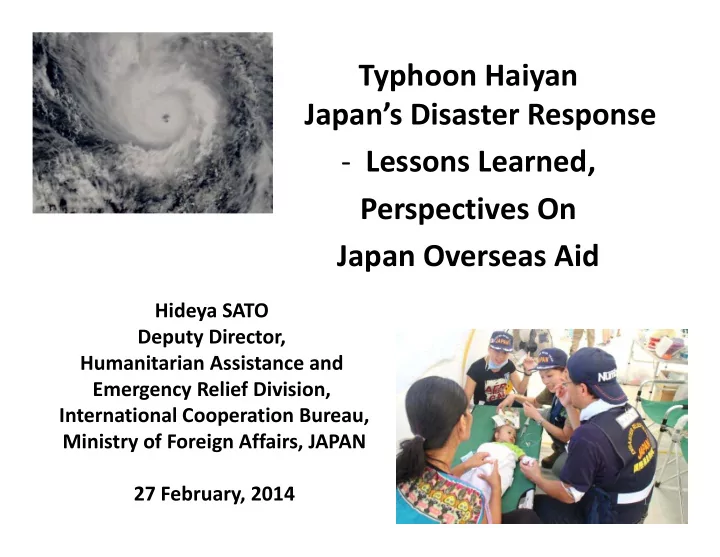
Hideya SATO Deputy Director, Humanitarian Assistance and Emergency Relief Division, International Cooperation Bureau, Ministry of Foreign Affairs, JAPAN 27 February, 2014

slide-2
SLIDE 2

1 Japan’s Framework for Emergency Relief 2 Japan’s Response to Typhoon Haiyan 3 Lessons Learned

2

Outline

slide-3
SLIDE 3

Japan’s Emergency Relief/Assistance

Japan provides Emergency Relief/Assistance to countries affected by large‐scale natural and man‐made disasters (except conflicts) in response to the request from affected government

  • r international organizations.

3

International Emergency Relief Dispatch of Personnel Relief Supplies Financial Aid

Japan Disaster Relief (JDR) Team Urban Search and Rescue (USAR) Teams, Medical Teams, Expert Teams, and Self‐Defense Force Units Emergency Relief Goods Major 8 relief items are in stock at

  • verseas storages. Other items are also

available, if requested. Emergency Grant Aid Assistance to affected government, or through international organizations.

Japan’s Emergency Relief/Assistance

slide-4
SLIDE 4

Emergency Grant Aid

  • Purpose:To provide urgent support for refugees, IDPs or

people affected by natural disasters or conflicts overseas.

  • Provide Emergency Grant Aid to affected governments, the

UN and other international organizations, or local Red Cross.

4

11 assistances in FY2012: USD 42M in total

・Refugees in South Sudan ($ 2M: UNHCR) ・Typhoon in Philippines ($ 4.2M: WFP, IFRC, UNICEF) ・Floods in Pakistan ($ 4.7M: WFP, IOM, UNHABITAT) ・Syrian Refugees and IDPs ($ 10M: UNHCR, WFP, OCHA)

9 assistances in FY2013 (as of Jan 2014): USD 94M in total

・Syrian Refugees and IDPs ($ 35M: UNHCR, etc) ・Host communities in Jordan and Lebanon accepting Syrian Refugees ($ 12M: Jordan Gov, $10 M: Lebanon Gov.) ・Earthquake in Philippines ($ 3.5M:IOM, UNICEF, UNDP, etc) ・Typhoon in Philippines ($ 30M: WFP, UNICEF, IFRC, etc)

Emergency Grant Aid

slide-5
SLIDE 5

Emergency Relief Goods

5

Tent Sleeping Pad Blanket Generator Water Tank Water Purifier Portable Jerry Can Plastic Sheet Major 8 items in stock at oversea storages. Other items are also available, if requested.

17 assistances in 2012 (worth \ 345 Million)

・ Floods in Fiji (18M: Generator, etc) ・ Earthquake in Guatemala (\12M: Generator, etc) ・ Hurricane in Cuba (\31M: Blankets, etc) ・ Typhoon in Philippines (\45M: Tents, etc) ・ Floods in Niger (\20M: Blankets, etc) ・ Floods in Sri Lanka (\23M: Plastic sheets, etc)

12 assistances in 2013 as of Jan. (worth \ 196 Million)

・ Floods in Sudan (\16M: Sleeping Pads, etc) ・ Typhoon in Philippines (\60M: Tents, etc) ・ Floods in Cambodia (\32M: Generators, etc) ・ Floods in Cameroon (\10M: Tents, etc)

Emergency Relief Goods

slide-6
SLIDE 6

Team (Composition) Operation Duration

Urban Search and Rescue Team (USAR) : Comprised of members from Fire and Disaster Management Agency, National Police Agency, Japan Coast Guard, MOFA and JICA (69 personnel in total)

Search and Rescue victims trapped in collapsed structures.

Approx. 7‐10 days Medical Team: Comprised of Doctors, Nurses, Pharmacists and members of MOFA and JICA (23 personnel in total)

Urgent medical assistance including patient treatment.

Approx. 2 weeks

Experts Team: Comprised of a few or some Experts (from 14 relevant Ministries and Agencies)

Technical advice or guidance

  • n disaster prevention and

damage mitigation based on an assessment of the situation.

Approx. 2 weeks

Self‐Defense Forces (SDF) Units: Units of Ground, Marine, and Air forces (50 ‐ 1,200 personnel)

Search and rescue, medical assistance (including disease control). Air and sea transport and water supply.

Approx. 2 weeks to 2 months

Japan Disaster Relief (JDR) Teams

6

Japan Disaster Relief (JDR) Team

slide-7
SLIDE 7

Deployment record of JDR Teams

As of Today (Since 1987):

113 Civilian teams and 30 SDF units deployed to 71 Disasters in 40 Countries/regions.

Deployment Details: USAR team ‐ 15 disasters (17 teams) Medical team ‐ 42 disasters (54 teams) Expert team ‐ 32 disasters (42 teams) SDF unit ‐ 14 disasters (30 units)

7

SDF was deployed for 14 disasters: 10 Earthquakes (including 2 Tsunamis), 2 Hurricane/Typhoon, 1 Flood, and 1 Submersible Vessel accident

(詳細:別添1参考)

Deployment Record of JDR Teams

USAR Team 14% Medical Team 41% Expert Team 31% SDF Unit 14%

Deployed JDR Teams/Units

slide-8
SLIDE 8

Floods in Pakistan (Aug 2010): SDF Transportation Unit and Medical Team (Civilian) Earthquake in NZ (Feb 2011): USAR Team and Gov. Aircraft (SDF) Earthquake in Haiti in Jan 2010: Medical team (Civilian) and SDF Medical Unit Floods in Thailand (Nov 2011): Expert Teams

8

Recent operations by Japan Disaster Relief Teams

slide-9
SLIDE 9

1 Japan’s Framework for Emergency Relief 2 Japan’s Response to Typhoon Haiyan 3 Lessons Learned

9

Outline

slide-10
SLIDE 10
  • Date: November 8 in local time
  • Affected areas: Leyte, Cebu, Eastern Samar
  • Casualties: 6,190 (dead) / 28,626 (injured)/

1,785 (missing)

  • Affected population: more than 16 million

people

  • Displaced population : 4 millions people

( Source: NDRRMC – January 10, 2014 )

Cebu Leyte Samar

Summary of the Disaster and Damages Summary of Typhoon Haiyan Disaster and Damages

10

slide-11
SLIDE 11

7 Nov Thu

  • Dispatch a JICA expert to UNDAC team
  • Dispatch a JICA expert to UNDAC team

8 Nov Fri

  • Typhoon Haiyan hit and landfall on middle of Philippines.
  • Typhoon Haiyan hit and landfall on middle of Philippines.

9 Nov Sat

  • Arrival of UNDAC team in Tacloban city
  • Arrival of UNDAC team in Tacloban city

10 Nov Sun

  • Request from the Philippines Government to dispatch JDR Medical Team
  • Dispatch of Assessment Team
  • Request from the Philippines Government to dispatch JDR Medical Team
  • Dispatch of Assessment Team

11 Nov Mon

  • Dispatch of JDR Medical Team
  • Dispatch of JDR Medical Team

12 Nov Tue

  • Request from the Philippines Government to dispatch JDR SDF units
  • Dispatch of JDR SDF Personnel
  • Request from the Philippines Government to dispatch JDR SDF units
  • Dispatch of JDR SDF Personnel

15 Nov Wed

  • JDR Medical Team and SDF unit start medical cares in Tacloban city
  • JDR Medical Team and SDF unit start medical cares in Tacloban city

Chronology (initial responses) Chronology (Initial Response)

11

slide-12
SLIDE 12

Typhoon Haiyan: Dispatching Japan Disaster Relief Teams

Medical Teams

  • 1st batch: Nov.11 ‐ Nov.24
  • 2nd batch: Nov.20 ‐ Dec.3
  • 3rd batch: Nov.29 ‐ Dec.12

Expert Teams

  • Early Recovery: Nov. 26 ‐ Dec.19
  • Oil Spill Response: Dec.4 ‐ Dec.13

Self‐Defense Forces (SDF) Units

  • Activity Period: Nov. 12 ‐ Dec.25
  • Joint Task Forces (Medical, Transportation, etc.) and

Joint Coordination Office (in Manila)

12

Disaster Response to Typhoon Haiyan Dispatch of Japan Disaster Relief (JDR) Teams

slide-13
SLIDE 13
  • Financial Assistances – US$ 56.3 M in total

13

Typhoon Haiyan: Japan’s Assistance to the Philippines

  • Food, water and sanitation, emergency shelter, health, debris

management, etc. through ICRC, IFRC, IOM, UNDP, UNICEF, UNHCR, UNOCHA, WFP, and WHO. Emergency Grant Aid ‐ US$ 30M

  • Plastic sheets for shelters, sleeping pads, and other necessary

commodities. Emergency Relief Goods ‐ US$ 0.6 M

  • Assistance through Japanese NGOs (Japan Platform)

Japan Platform (JPF) ‐ US$ 4.7 M Others ‐ US$ 21 M

Disaster Response to Typhoon Haiyan Financial and Relief Items assistances

slide-14
SLIDE 14

1 Japan’s Framework for Emergency Relief 2 Japan’s Response to Typhoon Haiyan 3 Lessons Learned

14

Outline

slide-15
SLIDE 15

15

Request/Needs‐Driven Approach. Close Coordination with Philippines Govt. Wide range of assistances from funding, providing relief items and rice, to dispatching personnel. Full‐cast Diplomacy. Seamless transition from emergency relief to early recovery.

Good Practices

slide-16
SLIDE 16

16

Smooth hand‐over to local authorities. Security measures offered by Philippine National Police. Cooperation by military aircraft to civilian medical team. Information exchange with other stakeholders through cluster meetings. Caring women and girls in special needs.

Good Practices

slide-17
SLIDE 17

17

Security issues

  • e.g., 1st batch of Medical Team was confused by fluctuate security

information at initial stage. Collecting valid information, making appropriate assessment and rapid sound judgment were required.

Logistic issues

  • e.g., 1st batch of Medical Team had difficulties from damaged

transportation means and communication network as well as lack

  • f fuels in devastated areas at initial stage.

Coordination issues

  • Closer coordination and cooperation among civilian teams, SDF,

UN, and civil societies for joint operation for consistent arrangement both in Manila and affected areas.

Challenges

slide-18
SLIDE 18

18

Information sharing on security and logistics issues at initial stage among stakeholders would be helpful. Multilateral Civil‐Military coordination facilitated by OCHA in affected areas is helpful. Regular dialogues among JDR Teams, Foreign Civil and Military Teams and UNs in peace time are helpful for closer contact and coordination at emergency crisis. Learning international coordination system and regional framework through active participations to international and regional exercises such as INSARAG FTX/TTX, ARF DiREx is useful.

Lessons Learned

slide-19
SLIDE 19

Thank you for your attention.

19