PHILIPPINES Briefjng note 12 November 2020 KEY FIGURES Typhoon - - PowerPoint PPT Presentation

philippines
SMART_READER_LITE
LIVE PREVIEW

PHILIPPINES Briefjng note 12 November 2020 KEY FIGURES Typhoon - - PowerPoint PPT Presentation

PHILIPPINES Briefjng note 12 November 2020 KEY FIGURES Typhoon Goni 1,5 million CRISIS IMPACT OVERVIEW PEOPLE AFFECTED BY On the morning of 1 November 2020, Typhoon Goni (known locally as Rolly) made landfall in Bicol Region and hit the


slide-1
SLIDE 1

Briefjng note 12 November 2020

KEY FIGURES

NATIONAL RESPONSE CAPACITY

AKKMA, Community Organizers Multiversity, Philippine Support Service Agencies, Philippine Red Cross

INTERNATIONAL RESPONSE CAPACITY

UN agencies (OCHA, WHO, IOM, WFP, UNDP, FAO, UNICEF),

PHILIPPINES

Typhoon Goni

CRISIS IMPACT OVERVIEW

  • On the morning of 1 November 2020, Typhoon Goni (known locally as Rolly) made landfall in Bicol Region and hit the town of Tiwi in Albay province, causing

rivers to overflow and flood much of the region. The typhoon – considered the world’s strongest typhoon so far this year – had maximum sustained winds of 225 km/h and gustiness of up to 280 km/h, moving at 25 km/h (ACT Alliance 02/11/2020).

  • At least 11 towns are reported to be cut off in Bato, Catanduanes province, as roads linking the province’s towns remain impassable. At least 137,000

houses were destroyed or damaged – including more than 300 houses buried under rock in Guinobatan, Albay province, because of a landslide following heavy rains caused by the typhoon (OCHA 09/11/2020; ECHO 10/11/2020; OCHA 04/11/2020; South China Morning Post 04/11/2020). Many families will remain in long-term displacement (UN News 06/11/2020; Map Action 08/11/2020).

  • As of 7 November, approximately 375,074 families or 1,459,762 people had been affected in the regions of Cagayan Valley, Central Luzon, Calabarzon,

Mimaropa, Bicol, Eastern Visayas, CAR, and NCR. Of these, 178,556 families or 686,400 people are in Bicol Region (AHA Centre 07/11/2020).

  • As of 07 November, there were 20 dead, 165 injured, and six missing people in the regions of Calabarzon, Mimaropa, and Bicol, while at least 11 people were

reported killed in Catanduanes and Albay provinces (AHA Centre 07/11/2020; UN News 03/11/2020).

  • A total of 128,200 people remain displaced and, as of 7 November, approximately 46,194 families or 181,759 people were still being assisted, both in

evacuation centres and elsewhere in the regions of Central Luzon, Calabarzon, Mimaropa, Bicol, CAR, and NCR (IOM 10/11/2020; OCHA 09/11/2020; AHA Centre 07/11/2020). Of these, 31,446 families or 123,283 people are in Bicol Region. The primary needs of the displaced population are shelter kits, blankets, clothing, face masks, food, and water (CARE International 02/11/2020).

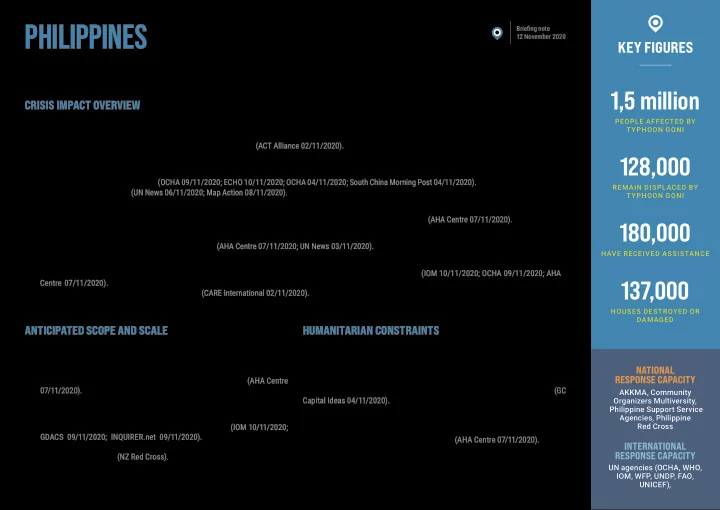
1,5 million

PEOPLE AFFECTED BY TYPHOON GONI

128,000

REMAIN DISPLACED BY TYPHOON GONI

180,000

HAVE RECEIVED ASSISTANCE

137,000

HOUSES DESTROYED OR DAMAGED

ANTICIPATED SCOPE AND SCALE

  • As of 7 November, there was an estimated USD225 million worth of dam-

ages to infrastructure in the regions of Ilocos, Cagayan Valley, Central Luzon, Calabarzon, Mimaropa, Bicol, Eastern Visayas, CAR, and NCR. The majority of the damages were recorded in Bicol Region (AHA Centre 07/11/2020).

  • On 9 November, Tropical Cyclone Ulysses intensifjed, and estimations of

its path show a high possibility that it could hit Bicol Region and Southern Luzon on 11 November before directly moving to NCR (IOM 10/11/2020; GDACS 09/11/2020; INQUIRER.net 09/11/2020). A further one to three typhoons in the Philippines are expected in November and two to three in December this year (NZ Red Cross).

HUMANITARIAN CONSTRAINTS

The Typhoon typhoon caused extensive damage to property, roads, bridges, power lines, and communication networks in the provinces of Catanduanes and Albay. Damage was also reported in Camarines Sur, Quezon, Batangas, and Sorsogon. All assessments of damage will take several more days, as communication with affected communities is progressively restored (GC Capital Ideas 04/11/2020). A total of 60 sections of road sections and 7 seven bridges are have been affected by fmooding, landslides, uprooted trees, and/

  • r fallen electric utility posts in the regions of Cagayan Valley, Central Luzon,

Calabarzon, ALABARZON, Bicol, and CAR. Of thesewhich, 16 road sections of road and 6 six bridges are still not passable (AHA Centre 07/11/2020).

slide-2
SLIDE 2

Briefjng note 12 November 2020

CRISIS IMPACT

Shelter and non-food items

Up to 90% of homes have been damaged or destroyed in some communities in Virac, Cat- anduanes province (NZ Red Cross; OCHA 04/11/2020). More than 137,000 houses have been damaged or destroyed in the region, with over 60 per cent of the destruction recorded in Albay and Catanduanes provinces (OCHA 09/11/2020). There is a need for essential household items, emergency shelter, and longer-term recov- ery assistance including rebuilding homes and restoring electricity lines (Center for Disaster Philanthropy 02/11/2020; IFRC 02/11/2020). There is also a need for COVID-19 precautionary measures in evacuation centres, including face masks, face shields, hand sanitiser, and modular tents (UN Geneva 03/11/2020).

WASH

The typhoon destroyed or damaged water and sanitation facilities, compromising access to safe water and sanitation facilities – which heightens the risk of communicable disease

  • utbreaks (OCHA 09/11/2020).

People have an immediate need for safe and clean drinking water (Center for Disaster Philan- thropy 02/11/2020; IFRC 02/11/2020).

Health

Affected people need fjrst aid services and stations to treat various injuries in hard- hit areas where access has been cut off because of infrastructure damage. There is a risk of water-borne and vector-borne diseases spreading, including dengue, and a need to provide hygiene kits (IFRC 02/11/2020). At least 67 health facilities were damaged across the country (OCHA 09/11/2020). Eight health facilities in Bicol Region were partly damaged but are still operational (Philstar 03/11/2020; ABS- CBN News 04/11/2020). Children in particular will need post-disaster psychosocial assistance by trained psychologi- cal support service and psychological fjrst aid volunteers (IFRC 02/11/2020).

Food and livelihoods

People living in evacuation centres require hot meals. Thousands of poor families who rely

  • n farming and fjshing have lost their income and their productive assets after crops were

damaged by fmoods and landslides. (IFRC 02/11/2020).

AGGRAVATING FACTORS

COVID-19

Typhoon Goni struck at a time when the Philippines was already suffering from a surge of COVID-19 infections. Since the virus arrived in the Philippines in February, the pandemic has developed into a major health crisis (IFRC 02/11/2020). Currently, the Philippines has the highest rate of COVID-19 infections in South East Asia, second only to Indonesia (Red Cross 02/11/2020). The government has issued lockdown orders of varying severity across the

  • country. As of 10 November, there are more than 300 confjrmed cases of COVID-19 across

Bicol and in total nation-wide there are more than 398,000 confjrmed cases, of which 29,018 are active (IOM 10/11/2020). With limited spaces in evacuation centres, the risk of COVID-19 spreading is considerable (CARE International 02/11/2020; Save the Children 01/11/2020). Bi- col’s main COVID-19 laboratory has sustained damage, prompting the suspension of testing (UN News 03/11/2020).

Typhoons

Because of its geographic location, the Philippines is vulnerable to various natural hazards such as typhoons, fmoods, and landslides. The country has improved its natural disaster management planning in recent years, and strong early warning and evacuation mecha- nisms helped to save lives in previous typhoon disasters. Typhoon Goni is the Philippines’ 18th tropical cyclone in 2020 and Goni is the third consecutive typhoon in two weeks (Oxfam International 02/11/2020). On 25 October, the region was affected by Typhoon Molave, which killed 22 people (IOM 02/11/2020). An average of 20 tropical cyclones form within or enter the Philippine Area of Responsibility each year (Oxfam International 02/11/2020; NZ Red Cross). A further one to three typhoons are expected in the Philippines in November and two to three in December this year (NZ Red Cross 2020). In 2013, Typhoon Haiyan – one of the most destructive disasters to strike the Philippines – affected 26 million people and claimed at least 8,000 lives (CFE-DMHA 28/03/2018).

slide-3
SLIDE 3

Briefjng note 12 November 2020

TYPHOON GONI (ROLLY)

Affected population by municipalities (as per 7 nov 2020)