Two kinds of phonology John Goldsmith February 26, 2015 Contents - - PDF document

two kinds of phonology
SMART_READER_LITE
LIVE PREVIEW

Two kinds of phonology John Goldsmith February 26, 2015 Contents - - PDF document

Two kinds of phonology John Goldsmith February 26, 2015 Contents 1 Pure phonology 2 1.1 Spanish . . . . . . . . . . . . . . . . . . . . . . . . . . . . . . . . . . . . . . . . . . . . . . . . . . . . . . . . . 2 1.1.1 Spanish nasal


slide-1
SLIDE 1

Two kinds of phonology

John Goldsmith February 26, 2015

Contents

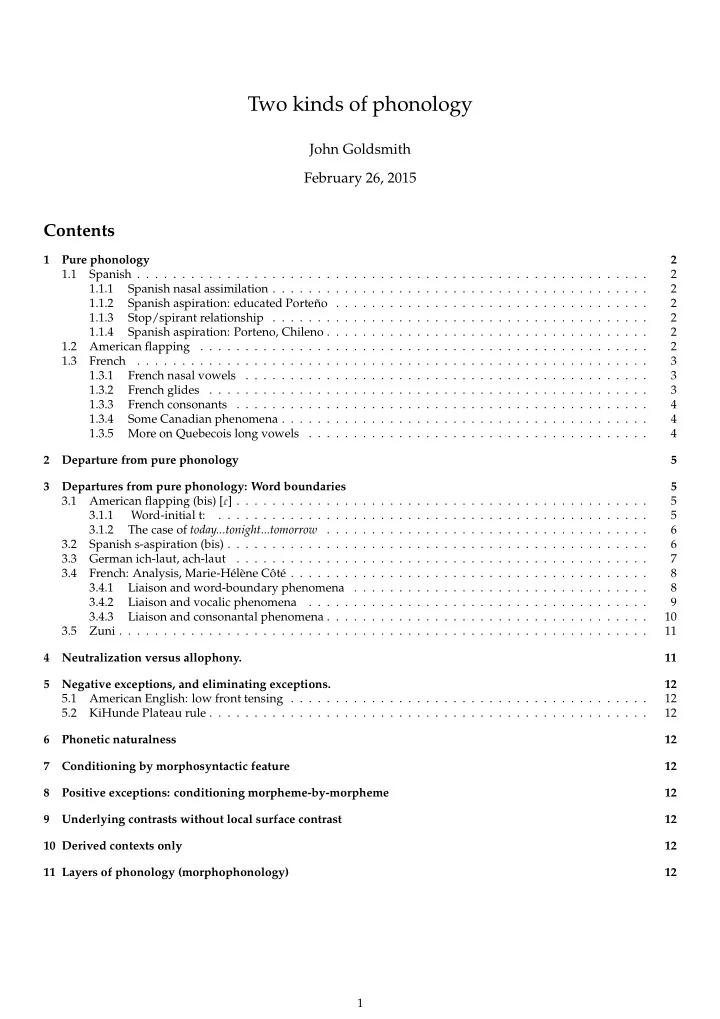
1 Pure phonology 2 1.1 Spanish . . . . . . . . . . . . . . . . . . . . . . . . . . . . . . . . . . . . . . . . . . . . . . . . . . . . . . . . . 2 1.1.1 Spanish nasal assimilation . . . . . . . . . . . . . . . . . . . . . . . . . . . . . . . . . . . . . . . . . . 2 1.1.2 Spanish aspiration: educated Porteño . . . . . . . . . . . . . . . . . . . . . . . . . . . . . . . . . . . 2 1.1.3 Stop/spirant relationship . . . . . . . . . . . . . . . . . . . . . . . . . . . . . . . . . . . . . . . . . . 2 1.1.4 Spanish aspiration: Porteno, Chileno . . . . . . . . . . . . . . . . . . . . . . . . . . . . . . . . . . . . 2 1.2 American flapping . . . . . . . . . . . . . . . . . . . . . . . . . . . . . . . . . . . . . . . . . . . . . . . . . . 2 1.3 French . . . . . . . . . . . . . . . . . . . . . . . . . . . . . . . . . . . . . . . . . . . . . . . . . . . . . . . . . 3 1.3.1 French nasal vowels . . . . . . . . . . . . . . . . . . . . . . . . . . . . . . . . . . . . . . . . . . . . . 3 1.3.2 French glides . . . . . . . . . . . . . . . . . . . . . . . . . . . . . . . . . . . . . . . . . . . . . . . . . 3 1.3.3 French consonants . . . . . . . . . . . . . . . . . . . . . . . . . . . . . . . . . . . . . . . . . . . . . . 4 1.3.4 Some Canadian phenomena . . . . . . . . . . . . . . . . . . . . . . . . . . . . . . . . . . . . . . . . . 4 1.3.5 More on Quebecois long vowels . . . . . . . . . . . . . . . . . . . . . . . . . . . . . . . . . . . . . . 4 2 Departure from pure phonology 5 3 Departures from pure phonology: Word boundaries 5 3.1 American flapping (bis) [ f] . . . . . . . . . . . . . . . . . . . . . . . . . . . . . . . . . . . . . . . . . . . . . . 5 3.1.1 Word-initial t: . . . . . . . . . . . . . . . . . . . . . . . . . . . . . . . . . . . . . . . . . . . . . . . . 5 3.1.2 The case of today...tonight...tomorrow . . . . . . . . . . . . . . . . . . . . . . . . . . . . . . . . . . . . 6 3.2 Spanish s-aspiration (bis) . . . . . . . . . . . . . . . . . . . . . . . . . . . . . . . . . . . . . . . . . . . . . . . 6 3.3 German ich-laut, ach-laut . . . . . . . . . . . . . . . . . . . . . . . . . . . . . . . . . . . . . . . . . . . . . . 7 3.4 French: Analysis, Marie-Hélène Côté . . . . . . . . . . . . . . . . . . . . . . . . . . . . . . . . . . . . . . . . 8 3.4.1 Liaison and word-boundary phenomena . . . . . . . . . . . . . . . . . . . . . . . . . . . . . . . . . 8 3.4.2 Liaison and vocalic phenomena . . . . . . . . . . . . . . . . . . . . . . . . . . . . . . . . . . . . . . 9 3.4.3 Liaison and consonantal phenomena . . . . . . . . . . . . . . . . . . . . . . . . . . . . . . . . . . . . 10 3.5 Zuni . . . . . . . . . . . . . . . . . . . . . . . . . . . . . . . . . . . . . . . . . . . . . . . . . . . . . . . . . . . 11 4 Neutralization versus allophony. 11 5 Negative exceptions, and eliminating exceptions. 12 5.1 American English: low front tensing . . . . . . . . . . . . . . . . . . . . . . . . . . . . . . . . . . . . . . . . 12 5.2 KiHunde Plateau rule . . . . . . . . . . . . . . . . . . . . . . . . . . . . . . . . . . . . . . . . . . . . . . . . . 12 6 Phonetic naturalness 12 7 Conditioning by morphosyntactic feature 12 8 Positive exceptions: conditioning morpheme-by-morpheme 12 9 Underlying contrasts without local surface contrast 12 10 Derived contexts only 12 11 Layers of phonology (morphophonology) 12 1

slide-2
SLIDE 2

1 Pure phonology

1.1 Spanish

bilabial labio-dental dental alveolar alveo-palatal palatal velar Voiceless stop p t k Voiced stop b d g Voiceless affricate Ù Voiceless fricative f θ s (S) x Voiced fricative B D (Z) G Nasal m n ñ N Lateral l L Glide w j 1.1.1 Spanish nasal assimilation A nasal is homorganic with an immediately following consonant. uno

  • ne

beso kiss umbeso a kiss deDo finger undeDo a finger gato cat uNgato a cat asko mess unasko a mess tonto stupid intelligente intelligent cambjar change supoNgo (I) suppose 1.1.2 Spanish aspiration: educated Porteño An /s/ is “aspirated” (loss of oral gesture) before a consonant. In Chile (and elsewhere) this context is enlarged to include word-final position. mas more mahGrande bigger tomár to take, to drink tomás you take (2nd sg.) áGwa water tomáhmasáGwa you take more water moléhta bothers (3rd. sg. verb present tense bóhke forest áse does (3rd. sg. verb present tense form of) hacer 1.1.3 Stop/spirant relationship bala ball undeDo a finger beso kiss gato cat suBeso his/her kiss uNgato a cat umbeso a kiss miGato my cat elBeso the kiss elGato the cat darBesos to give kisses deDo finger eldeDo the finger suDeDo his/her finger miDeDo my finger A voiced obstruent is a stop phrase-initially and after a homorganic non-continuant sonorant. 1.1.4 Spanish aspiration: Porteno, Chileno

1.2 American flapping

Word-internally: Let’s focus first on those words where the t is surrounded on both sides by vowels, and let’s then divide that group into four, based on the stress of the vowels on either side. Since we may speak of vowels as being either stressed or unstressed, that gives us four groups: 2

slide-3
SLIDE 3

Following vowel: UNSTRESSED STRESSED Preceding vowel: UNSTRESSED: any word ending in -ity: Italian sanity sani[ f]y sani[th]y I[th]alian STRESSED : Italy, writing Beethoven, rattan,, detail, retail, hotel I[ f]aly ho[th]el (But: Latin, button, satin, Martin) When a t is word-internal and surrounded by vowels, it must be realized as a flap [ f] when the preceding vowel is stressed and the following vowel is unstressed; it may be realized as a flap [ f] when the vowels on either side are unstressed; otherwise, it must be realized as a true [t]. We can ask what principle governs the realization of all the other word-internal ts. Making sure to avoid compound nouns (which function differently) like anteater, we find that no additional flaps come to light: all the flaps that we find

  • ccur when the following vowel is unstressed, but the nature of the consonants neighboring the t makes a difference.
  • If any consonant immediately follows the t, then we cannot have a flap [ f]. If the following consonant is an r, the

t and r together make a sound not all that different from the sound of ch; the sound is certainly not that of a flap, but it’s not a true [t] either: words like trick, troop, Petri, paltry.

  • If an r precedes the t, the flap is normal, with one special case. The normal cases include words like artichoke,

Sparta, Jakarta, article, artificial, aorta, mortal, and furtive. Important, Latin: In a sequence t + unstressed vowel + n follows, the t will, in the speach of many speakers, be realized as a glottal stop [P]. This is what occurs in such important words as important (though many American speakers, such as President Jimmy Carter, from Georgia, have a flap in words like important). When a consonant other than r follows the t, the t will normally be glottalized, as in Atkins, delightful, platform, beatnik, catnip, atmosphere, etc. No other cases present us with clearcut flaps. When a consonant other than r follows the t, the t will normally be glottalized, as in Atkins, delightful, platform, beatnik, catnip, atmosphere, etc. When a consonant other than r precedes, such as an l or an n, as in altitude or cantaloupe, we generally get a [th], though in casual speech, it is true that the combination of lt, and even more of nt, is produced so quickly that it is not possible to distinguish it from a rapid flap.

1.3 French

Height Vowel example Vowel example Vowel example Front unrounded Front rounded Back High i vie y du u tout Mid: tense e blé ø peu

  • mot

Mid: lax E tête œ peur O donne Low: a plat There is a length contrast in Canadian French for the vowels E and a. 1.3.1 French nasal vowels Height Vowel example Vowel example Vowel example Front unrounded Front rounded Back Mid: lax ˜ E plein ˜ œ brun* ˜ O bon Low: ã dans 1.3.2 French glides j yeux, paille, pied w

  • ui, Ouagadougou

4 huile, lui 3

slide-4
SLIDE 4

1.3.3 French consonants labial alveolar alveo-palatal palatal velar uvular laryngeal Voiceless stop p t k Voiced stop b d g Voiceless fricative f s S Voiced fricative v z Z K Nasal m n ñ N Liquid l Glide w j 4 1.3.4 Some Canadian phenomena This is from “Le statut des consonnes de liaison : l’apport de données du français laurentien,” Marie-Hélène Côté. I have translated a few sentences.

  • 1. Affrication: la réalisation affriquée [ţ d

z] des occlusives alvéo-dentales [t d] devant voyelle ou glissante antérieure fermée [i y j 4 ].

  • tu dis [ţy d

zi]

  • diamant [d

zjamã ]

  • tuile [ţ4Il]

Obligatory word-internally, except in recent borrowings from English (ex.meeting, building, pourtant autrement prononcés “à la française ”). L’affrication est considérée variable aux frontières de mots, sans que l’on sache toutefois comment se

comportent les consonnes de liaison par rapport aux autres consonnes susceptibles d’apparaître dans le même contexte.

  • 2. High vowels are laxed in closed syllable, with an additional phenomenon of leftward harmony, regardless of

whether the next word begins with a vowel (which would cause resyllabification).

  • jupe [ZYp]
  • route [rUt]
  • fourchette [fUrSEt]
  • minute [mInYt]

(a) Laxing occurs before a [stable] final consonant, including a feminine/gender marker: maudite amie [mod zItami] (b) However, initial consonants, proclitics and liaison does not trigger laxing, even when resyllabification to the left is expected: tense lax Liaison : maudit ami [mod zitami] *[mod zItami] Initiales : maudit tamis [mod zitami] *[mod zItami] Proclitiques Jordi t’amuse [ZOrd zitamyz] *[ZOrd zItamyz] 1.3.5 More on Quebecois long vowels Denis Dumas CJL 1981 26:1. 1-58. bajt bête bE:ţIz bêtise pwajl poêle pwE:l˜ O poêlon ãpajS empêche(nt) ãpE:Se empêcher majK maire mE:KEs mairesse fKãbwajz framboise fKãbwE:zje framboisier najZ neige nE:Za neigeait paws passe(nt) pa:saZ passage pawl pâle pa:liK pâlir KawK rare Ka:Kmã rarement Minimal pairs bEt bette bE:t [bajt] bête fEt fait(e) fE:t [fajt] fête pKEt pret(e) pKE:t [pKajt] prêtre 4

slide-5
SLIDE 5

2 Departure from pure phonology

  • i. Word boundaries
  • ii. Changing one phoneme to another: neutralization—versus allophony. Flapping, vowel-Shortening in

English, Spanish aspiration. Classic case of neutralization: vowel harmony.

  • iii. Negative exceptions, and eliminating exceptions. KiHunde Plateau rule.
  • iv. Phonetic naturalness and un-.
  • v. Conditioning by morphosyntactic feature.
  • vi. Positive exceptions: conditioning morpheme-by-morpheme. Spanish mid-vowel diphthongization.
  • vii. Underlying contrasts without local surface contrast: Yokuts
  • viii. Derived contexts only. Good cases?

3 Departures from pure phonology: Word boundaries

It was not at all obvious at the time, but the strict Bloomfieldians (like Charles Hockett) disagreed sharply with the Sapirean view on this: The Bloomfieldian line was that no phonological generalization could in- volve a word-boundary. Sapir, and even more (if it is possible) Zellig Harris, disagreed mightily; phonology absolutely needs to refer to boundaries. And where are boundaries found? To what extent does knowledge of syntax suffice to determine where phonological word-boundaries are? We still do not know the answer. Sometimes we do not know if there is a word boundary, and sometimes we do not know if a segment precedes or follows it (if it is there!). French illustrates this analytic uncertainty, though careful study has resolved most of the questions.

3.1 American flapping (bis) [

f]

The sounds of lettuce are no different from the sounds of the phrase let us ..., as in let us begin! If we wanted to mark the sound there, we would have to write le[ f] us begin. The word let, when said in isolation, can end with either a “non-released” t, written [t^] or a released t, written [th]. When the t of let comes at the end of a sentence (or more gen- erally, a phrase): Then it is pronounced as a glottalized t [t^]. When let is followed by us: Then the t is pronounced as a flap [ f].

  • 1. Unreleased [t^]

let go let Mary go let Paul go let Tom go

  • 2. Flap [ f]

let a man go free let a boy go home let him in the house let Amy do it Generalization 1: When an English word ends in a t, that t is realized as a flap [ f] when a word immediately follows which begins with a vowel; otherwise the t is realized as a glottalized stop [t^]. 3.1.1 Word-initial t: STRESSED: She took a test (both ts followed by a stressed vowel) flap is impossible She ate ten cookies. She brought the ten largest cookies. The tedium can be overwhelming. UNSTRESSED: True telepathy might be a boon to humanity. flap impossible He met with a tenacious opponent in the final round. I tried to buy a tomato. I saw Toledo from the air (or, I saw Topeka...) It’s not always easy to construct a topology for a fifteen-dimensional sphere. 5

slide-6
SLIDE 6

(I’m leaving five words out on purpose for now – the words to, tonight, today, tomorrow and together; we’ll come back to them later. Yes, they would have flaps in them in many of these sentences, unlike all of the other t-initial words we are looking at here.) In none of the phrases do we find a flap, and that hold true regardless of the stress, or lack of it, on the vowels before and after the t. So we have two quite different generalizations:

  • Generalization 1: When an English word ends in a t, that t is realized as a flap [ f] when a word immedi-

ately follows which begins with a vowel; otherwise the t is realized as a glottalized stop [t^].

  • Generalization 2: When an English word starts with a t, that t is realized as a true [t], not as a flap [ f].

Recall the generalization about word-internal (or as we say, word-medial) /t/?. Following vowel: UNSTRESSED STRESSED Preceding vowel: UNSTRESSED: any word ending in -ity: Italian sanity sani[ f]y sani[th]y I[th]alian STRESSED : Italy, writing Beethoven, rattan,, detail, retail, hotel I[ f]aly ho[th]el (But: Latin, button, satin, Martin) 3.1.2 The case of today...tonight...tomorrow Words that begin with a t followed by an unstressed vowel, four of the most common words that spring to mind are to, today, tonight, together, and tomorrow – surely more quickly than tomato or, certainly, Topeka. And yet these five to-words to, today, tonight, tomorrow, together do not follow the generalization that I suggested above for words that beginning with a t: the five to-words do take a form with an initial flap [ f]:

  • We’re going to fly [ f]o Seattle on Monday.
  • What are you going to see [ f]onight?
  • Who will you see [ f]omorrow?

One possible analysis, using the notion of the syllable and syllabification:

  • i. First, all sounds are syllabified inside their own words. A consonant is always part of the same syllable

with a vowel that immediately follows it.

  • ii. In American English, a consonant before an unstressed syllable may resyllabify to the left, to form an

ending with the previous syllable. This is obligatory if the syllable on the left is stressed.

  • iii. After that, a t at the end of a word will become part of the first syllable of the next word if the next word

begins with a vowel. (Why?) But it also remains part of its original syllable.

  • iv. A t that is part of two syllables becomes a flap.

Word-final t becomes a flap before a vowel by Principle 3. Word-internal t becomes a flap in Italy by Principle 2, but not in Italian. Word-initial t cannot become a flap, except in the case of the morpheme to−.

3.2 Spanish s-aspiration (bis)

In Chile (and other places), the right hand environment is expanded to include word-final position. So we find mas alto [mahalto]. An h between vowels is possible only if it is in word-final position. 6

slide-7
SLIDE 7

3.3 German ich-laut, ach-laut

bilabial labio- alveolar post- palatal velar uvular glottal dental alveolar plosive

p b t d k g P

affricate

pf ţ tS dZ

nasal

m n N

fricative

f v s z S Z ç x K h

approx-

j

imant lateral

l

approx

front central back

  • round

+round short long short long short long short long high tense i i: y y: u u: lax I Y U mid tense e e: ø ø:

  • :

lax E E: œ @ O

  • pen

a a: In the American context, the classic paper is Moulton Modern German Juncture, p. 214, 1947. He noted in his first pass:

  • p. 214: The voiceless spirants [ç] and [x] are in complementary distribution with each other; [x] occurs
  • nly after central and back vowels and semivowels: [bAx] ‘brook’, [na:x] ’towards’, [nOx] ‘still’, [ho:x]

‘high’, [bγUx]‘breach’, [bu:x] ‘book’,[PAwx] ‘also’; [ç] occurs only after front vowels and semivowels, and after consonants: [mIç] ‘me’ [p‘ǫç] ‘hard luck’, [k‘γi:çt] ‘crawls’, [ne:çst] ‘next’, [hø:çst] ‘highest’, [γAjç] ‘rich’,[POjç] ‘you’, [Pǫlç] ‘elk’, [mœnç] ‘monk’, [dUγç] ‘through’. We may therefore analyze [ç] and [x] as allophones of a single phoneme /x/. Looking at more data (p. 218), Moulton noted that In utterances of only one syllable, /x/ occurs only after vowels, or after vowel plus /l n r/. In utterances of more than one syllable, we find /x/ occurring initially before vowels, where it shows its palatal allophone [ç]: /"xi:na:/ ‘China’, /xe:"mi:/ ‘chemistry’. The complementary distribution fo [x] and [ç] remains uinchanged, hwoever: [x] occurs after central and back vowels and semivowels, [ç] in all other positions. And on page 223, he wrote: There are, however, cases where [ç] also occurs after central and back vowels and semivowels, and the distinction between [x] and [ç] is meaningfully distinctive. Examples (with [ç] written in): /"ku:xen/ ‘cake’ but /"ku:çen/ ‘little cow’(given as a nursery word); /"Sta:xen/ ‘stung’ but /ma"ma:çen/ ‘little mama’; /"brauxen/ ‘need’, but /"frauçen/ ‘dog’s mistress’. The above examples illustrate unstressed [x] and [ç]; examples of stressed [x] and [ç] are: /ra"xi:tis/ ‘rickets’, /ma"xandel/ ‘juniper brandy’; but /da:­çi:na:(zo:"gro:s­ist)/ ‘since China is so large’ /vo:"çe:miker(­arbaiten)/ ’where chemists (work). . . . If we accept a segmental phoneme of open juncture, we can amend this statement to read: /x/ appears as [x] after central and back vowels and semivowels, but as [ç ]after all other segmental phonemes (including,

  • f course /+/). [More about realization of /+/ omitted here.]

[See also Orrin Robinson, Whose German?, passim.] We find two sounds corresponding to the spelling ch. One of them is a palatal fricative, [ç], as in the word ich, which means I, and the other is a velar fricative, [x], as in the word Mach. Most of the occurrences of these sounds occur after the first vowel of the word; here are some typical examples: a. Bu[x] book Bü[ç]er books b. Lo[x] hole Lö[ç]er holes c. Ba[x] brook Bä[ç]e brooks d. Bau[x] belly Bäu[ç ] bellies e. i[ç] I f. bre[ç]en break g. Lei[ç]e body (corpse?) h. man[ç] many i. Dol[ç] dagger j. dur[ç] through 7

slide-8
SLIDE 8

The examples in a-g suggest a simple generalization, and it does indeed hold for a very large proportion of the data: [ç] appears after a front vowel, and [x] appears after a back vowel. The examples in i-j illustrate another fact, which is that when we consider words where the ch appears after the first vowel and a consonant— we might say, in the environment C0VS_, where S can be n,l, or r—then we always find [ç]. It is not only tempting, it is nearly right, to say: In German, the phoneme /x/ surfaces as [x] immediately after a back vowel, and as [ç] elsewhere. a. Frau[ç]en mistress (of an animal) b. Häus[ç]en little house c. Kuh[ç]en little cow

3.4 French: Analysis, Marie-Hélène Côté

Again, this is from “Le statut des consonnes de liaison : l’apport de données du français laurentien,” Marie- Hélène Côté. I have translated a few sentences.

  • Consonne de liaison: le petit ami
  • Consonne finale stable: la petite amie
  • Consonne initiale stable: le petit tamis
  • Consonne proclitique: le petit t’amuse
  • i. Consonnes finales : Les CL sont des consonnes finales du Mot1
  • A. Truncation : Les CL sont des consonnes stables qui chutent dans des contextes de non liaison

/døz/ /ami/

  • B. Suppletion : Les CL sont des consonnes stables appartenant à des allomorphes distincts /dø, døz/ /ami/
  • C. Analyse autosegmental : Les CL sont flottantes par rapport au squelette ou à la syllabe, avec une représentation distincte de

celle des consonnes stables /dø(z)/ /ami/

  • ii. epenthetic consonants : Les CL sont insérées par épenthèse

/dø/ /ami/

  • iii. Initial consonants : Les CL sont des consonnes initiales du Mot2

/dø/ /zami/

  • iv. Morphemic consonants : Les CL correspondent à des morphèmes affixaux
  • A. Prefixal analysis : Les CL sont des préfixes du Mot2

/dø/ /z+ami/

  • B. Suffixal analysis : Les CL sont des suffixes du Mot1 /dø+z/ /ami/
  • v. CONSONNES INTEGREES A DES : Les CL font partie de constructions plus larges que le mot et (partiellement) lexicalisées

/døz ami/

3.4.1 Liaison and word-boundary phenomena

  • i. Affrication: la réalisation affriquée [ţ d

z] des occlusives alvéo-dentales [t d] devant voyelle ou glissante antérieure fermée [i y j 4 ].

  • tu dis [ţy d

zi]

  • diamant [d

zjamã ]

  • tuile [ţ4Il]

Obligatory word-internally, except in recent borrowings from English (ex.meeting, building, pourtant autrement prononcés “à la française ”). L’affrication est considérée variable aux frontières de mots, sans que l’on sache

toutefois comment se comportent les consonnes de liaison par rapport aux autres consonnes susceptibles d’apparaître dans le même contexte.

  • ii. High vowels are laxed in closed syllable, with an additional phenomenon of leftward harmony, regard-

less of whether the next word begins with a vowel (which would cause resyllabification).

  • jupe [ZYp]
  • route [rUt]
  • fourchette [fUrSEt]
  • minute [mInYt]
  • iii. E tends to open to [a] or [æ] in two contexts: en finale absolue de mot et devant la séquence [r]+consonne.

Sociolinguistically marked, on the way out. Si les prononciations ci-dessous sont familières et relativement

fréquentes, les jugements sur l’ouvertude des [E] dans des contextes lexicaux moins habituels sont plus difficiles à recueillir.

8

slide-9
SLIDE 9
  • épais [epæ]
  • ferme [færm]
  • merci [mærsi]

Based on native speaker judgments: Les données présentées dans les sections suivantes sont basées sur les jugements de locuteurs natifs (dont les miens). Il ne s’agit ni d’une étude de corpus ni d’un recueil systématique et il serait souhaitable que ces étapes viennent compléter à l’avenir les données actuelles. Je note cependant que les jugements sur les données ci-dessous sont d’une stabilité remarquable et ne présentent pas de variation inter-locuteurs appréciable.

3.4.2 Liaison and vocalic phenomena (a) Laxing occurs before a stable final consonant, including a feminine/gender marker: maudite amie [mod zItami] damned friend (fem.) (b) However, initial consonants, proclitics and liaison does not trigger laxing, even when resyllabification to the left is expected: tense lax Liaison : maudit ami [mod zitami] *[mod zItami] damned friend (masc.) Initiales : maudit tamis [mod zitami] *[mod zItami] damned sieve (masc.) Proclitiques Jordi t’amuse [ZOrd zitamyz] *[ZOrd zItamyz] J. amuses you. La phrase Jordi te parle pourrait ainsi être syllabée [ZOr.d zit.parl] ; c’est du moins la syllabation régulièrement suggérée dans les analyses de la distribution du schwa. Jordi te parle [ZOrd zitparl] *[ZOrd zItparl] Jordi speaks to you. The failure to find laxing indicates either that the clitic does not resyllabify leftward into the coda, or else that laxing is sensitive to lexical, not syllabic structure. [JG: Or there is an organization of rules that includes the possibility that a laxing is a word-level rule, and is not fed by phrase-level resyllabication. ] Reighard (1986) argüe en fait que le relâchement est lexicalisé, comme l’illustrent des paires (quasi-)minimales commes cheap/chip [tSip]/ [tSIp] Pise [piz]/quiz [kwIz]. (c) The facts regarding the lowering of [E] go in the same direction as those regarding laxing (final stable Cs be- have differently). Les données relatives à l’ouverture de [E] vont dans le même sens que celles sur le relâche- ment, en ce que les consonnes finales stables sont celles qui se démarquent par leur comportement. Lowering is impossible before a final consonant, but variable in the other three cases. L’ouverture est impossible devant une consonne finale, mais elle est variable devant les trois autres catégories de consonnes : Finales : parfaite insulte [parfEt˜ esYlt] *[parfæt˜ esYlt] Initiales : mauvais traitement [mOvætrEtmã ] [mOvEtrEtmã ] parfait touriste [parfæturIs] [parfEturIs] Proclitiques : Gervais t’invite [Zærvæt˜ evIt] [ZErvEt˜ evIt] Buffet t’insulte [byfæt˜ esYlt] [byfEt˜ esYlt] Liaison: mauvais endroit [mOvæzã drwa] [mOvEzã drwa] parfait imbécile [parfæt˜ ebesIl] [parfEt˜ ebesIl]

Walker (1980, 1984b) exclut l’ouverture de [E] devant les consonnes de liaison. Mes propres jugements sur ces données et ceux de locu- teurs laurentiens interrogés indiquent que l’ouverture est possible, avec un contraste entre, par exemple, parfaite insulte (sans ouverture) et parfait imbécile (ouverture possible). Il faut toutefois noter qu’il est difficile de placer des consonnes de liaison après un [E] final dans des contextes de liaison naturels. La liaison après était, serait, dès et après, par exemple, est au mieux très marquée en français laurentien spontané. Mais, dans la mesure où on peut envisager la liaison, l’ouverture du [E] final ne paraît pas exclue.

Laxing and lowering thus indicate that liaison consonants act more like initial Cs (no laxing, possible opening

  • f vowel). But with adjectives like plein, which always have a nasal vowel [˜

e] in a non-liaison context, while in liaison context allow either the nasal vowel or its corresponding oral vowel [E]. But le [E] de plein ne peut s’ouvrir de la même façon que celui de mauvais ou parfait ci-haut. plein été [plEnete] [pl˜ enete] *[plænete] The [n] liaison C behaves like a fixed final consonant, unlike the [z] of liaison in mauvais or the [t] de liaison de parfait. This supports the analysis supplétive des formes de liaison avec les adjectifs prénominaux qui impliquent un changement de voyelle entre la forme de liaison et la forme de non liaison, analyse motivée au départ par des faits tout à fait distincts de ceux présentés ici (Tranel, 1990 ; Côté, 2005 ; voir aussi Morin, 1986). Plein serait lexicalisé /pl˜ e plEn/, avec une consonne finale fixe. Cela explique l’absence d’ouverture de [E] en contexte de liaison puisque la voyelle n’est pas finale de mot. Pour les adjectifs “ normaux ”, seule la forme de non liaison est lexicalisée (ex. mauvais /mOvE/), ce qui permet l’ouverture de la voyelle finale, si l’on considère que les consonnes de liaison ne sont pas des consonnes finales. 9

slide-10
SLIDE 10

Le contraste entre plein et parfait / mauvais pose problème pour les analyses dans lesquelles les consonnes de liaison des adjectifs sont lexicalisées comme consonnes finales stables (dans une forme de liaison supplétive

  • u non). Si les formes de liaison de plein et parfait ont la même structure, il est difficile d’expliquer que

l’ouverture du [E] ne soit possible que dans un cas. Cela concerne notamment l’analyse récente de Plénat (2008), même si celle-ci résout d’autres difficultés déjà avancées pour les consonnes de liaison conçues comme consonnes finales stables. 3.4.3 Liaison and consonantal phenomena Initial Cs are strongly affricated, as we see: Consonnes initiales sont donc forcément affriquées, comme le montrent les exemples suivants : (a) grand Tibet [grã ţibE] (b) il est divin [jed ziv˜ e] Affrication is variable for other Cs (L’affrication est variable pour toutes les autres catégories de consonnes ):

  • 3. Finales: trente idées [trã tide] [trã ţide]
  • 4. Proclitiques :
  • Jean t’imite (bien) [Zã timIt] [Zã ţimIt]
  • quand t’imites Papa [kã timIt] [kã ţimIt]
  • champ d’images [Sã dimaZ] [Sã d

zimaZ]

  • grand iguane [grã tigwan] [grã ţigwan]
  • il est immense [jetimã s] [jeţimã s]
  • 5. Liaison :

Liaison consonants do not behave here like initial consonants—consequences for analysis of vowel effects. Note that even proclitic consonants do not affricate obligatorily (despite their attachment to the next word), suggesting that affication is partially lexicalized?? But we can go further in the comparison of liaison consonants and the proclitic Cs and final Cs. Canadian speakers agree that affrication is more probable with proclitics than with liaison Cs, and less probable with stable final Cs. The pronunciation without affrication of Jean t’imite is possible but marked. On peut cependant aller plus loin dans la comparaison entre les consonnes de liaison et les consonnes proclitiques et

  • finales. Les locuteurs laurentiens s’entendent sur le fait que l’affrication est plus probable avec les proclitiques qu’avec

les consonnes de liaison, et moins probable avec les consonnes finales. La prononciation sans affrication de Jean t’imite est perçue comme possible mais marquée, ce qui n’est pas le cas pour les consonnes de liaison et les consonnes finales. D’autre part, une construction avec dislocation à droite, fréquente en français laurentien, nous permet de comparer plus directement les consonnes de liaison et les consonnes finales. Cette construction est également explorée par Tranel (1990), Côté (2005) et Plénat (2008). Dans les deux phrases suivantes, l’affrication paraît plus naturelle dans la première,

  • ù l’élément disloqué est précédé d’une consonne de liaison, que dans la seconde, qui implique une consonne finale
  • stable. La pause devant l’élément extraposé est optionnelle. S’il y a pause, elle intervient après la consonne finale fixe

(auquel cas il n’y a pas d’affrication) mais avant la consonne de liaison (ce qui permet l’affrication). Le fait qu’une pause

puisse intervenir entre la consonne de liaison et le Mot1 peut être interprété comme problématique pour les analyses qui font des consonnes de liaison des éléments lexicaux du Mot1; mais voir Plénat (2008) pour une réponse possible à cette objection.

  • 1. j’en ai un grand, iguane [Zã ne ˜

œ grã tigwan] [Zã ne ˜ œ grã ţigwan]

  • 2. j’en ai dix-sept, iguanes [Zã nedisEtigwan] [Zã nedisEţigwan]

Il est raisonnable de penser que l’affrication dépend du degré de proximité ou d’association entre la consonne cible et la voyelle suivante, du point de vue lexical, prosodique ou syntaxique. Lorsque les deux segments sont soudés lexicale- ment, l’affrication est catégorique, et plus la frontière qui les sépare est forte, plus l’affrication est difficile. Si l’affrication est moins fréquente avec les consonnes de liaison qu’avec les proclitiques, cela suggère que les consonnes de liaison sont moins fortement soudées au mot suivant que les consonnes clitiques. Cela fournit un argument contre les analyses des consonnes de liaison comme des préfixes du Mot2. Si l’on suppose que les préfixes sont encore plus dépendants du mot auquel ils se rattachent que les proclitiques, on s’attendrait à ce que des consonnes préfixales s’affriquent davantage, ce qui n’est pas le cas des consonnes de liaison. Le lien lexico-phonologique entre la consonne de liaison et le mot suivant est cependant plus fort que celui qui unit les consonnes finales fixes au mot suivant, ce qui n’a rien de surprenant dans la mesure où la présence des consonnes de liaison exige celle d’un Mot2, alors que les consonnes finales fixes sont le plus souvent indépendantes du mot suivant. Il est pourtant un contexte de liaison où l’affrication d’un [t] de liaison est catégorique. Il s’agit des constructions avec inversion du sujet pronominal, comme dans l’exemple suivant : doit-il “must he” [dwaţIl] *[dwatIl] 10

slide-11
SLIDE 11

Liaison consonants behave like fixed initial consonants in front of post-verbal enclitics, a conclusion which seems all the stronger since this kind of subject inversion, practically non-existent in spoken French and found only in formal speech, should (one would expect) prefer the lack of affrication. Judgments, however, are clear and unanimous that affrication is obligatory. Ils constituent un solide argument pour la lexicalisation des consonnes “ de liaison ” à l’initiale des enclitiques, tel que proposé par Morin (1979a, b, 1986) et Côté (2005). Les pronoms postverbaux y, en, il(s), elle(s) et on sont donc lexicalisés /zi, zã , tIl, tEl, t O/, les pronoms objet apparaissant dans les constructions impératives avec la consonne [z] (ex. vas-y, manges-en), les sujets dans les constructions avec inversion impliquant la consonne de 3 e personne [t].

  • 1. Les consonnes de liaison précédant les pronoms enclitiques sont des consonnes initiales.
  • 2. Les consonnes de liaison qui accompagnent les adjectifs du type bon et plein, qui présentent une voyelle nasale

dans les contextes de non liaison et une voyelle orale dans les contextes de liaison, sont des consonnes finales.

  • 3. D’autres consonnes de liaison, notamment celles de adjectifs prénominaux qui ne présentent pas d’alternance

vocalique, partagent à la fois des propriétés des consonnes initiales et finales. Les consonnes de liaison de ce dernier type ne correspondent simplement ni à des consonnes finales ni à des con- sonnes initiales. Cela rejoint la conclusion de Walker (1980 : 220), pour qui les consonnes de liaison “ function neither as syllable-final [...] nor as syllable-initial ”. Ces consonnes de liaison ne semblent pas non plus pouvoir être assimilées à des préfixes du Mot2, puisque la frontière qui les sépare du mot suivant apparaît plus forte que celle qui sépare les pronoms proclitiques. Ces résultats sont a priori compatibles avec des analyses de type épenthétique ou construction- niste, dans lesquelles les consonnes de liaison n’appartiennent ni au Mot1 ni au Mot2. Cela rendrait compte de leur comportement hétérogène par rapport aux processus segmentaux, qui répondent à des contraintes variées. Mais ces approches sont toujours en attente de formalisations suffisamment détaillées.

3.5 Zuni

Stanley Newman: Zuni grammar, 1965. “In a word of more than one syllable, the final -V or -VPis zeroed before another word beginning in h or P....frequently the second consonant of a cluster is itself zeroed before a zeroed -V or -VP.” Review by Irvine Davis, IJAL 1966. Davis writes, “This means that one kind of reduction that occurs at word bound- aries is of the type:

  • CV1 or CPV1 + PV2 > -CPV2 ≈ −CV2-

“What Newman has failed to note is the fact that this reduction results in the occurrence of presumed allophones of the velar stop in environments in which they ought not to occur.” /k/ [k] _{o,u} [ky] elsewhere łanakPo + Pa;kya > łanak a;kya the fox went away suskyi + Pa;kya > suskya;kya the coyote went away łanakPo + PelaPkya > łanak elaPkya the fox stood up suskyi + PelaPkya > suskyelaPkya the coyote stood up łanakPo + Pokwikya > łanak okwikya the fox woke up suskyi + Pokwikya > suskyokwikya the coyote woke up Davis: “These facts...indicate that k and kyare emerging as phonemically distinct entities in Zuni.” (84). Zuni: Newman responds “I would not be willing to go so far as to introduce a new phonemic distinction in order to accomodate these reduc- tion phenomena. . . The system works in such a way that...the final vowel...determines the allophonic character of the preceding k phoneme, regardless of whether the vowel is actualized or zeroed by reduction. I am aware that a reduced vowel is ‘not there’ and, in a conventional treatment, should be ignored. But reduced vowels in Zuni invariably de- termine the palatal or velar articulation of the preceding k; and, if this is the case, it seems reasonable to describe the phonology in these terms rather than to seek a descriptive circumlocution....” “Admittedly, the solution is not ideal. It is based upon the theory that ‘silent vowels’ exert an environmental influ-

  • ence. But it offers the simplest explanation of the phenomena, and it works.

To Davis’s solution there are...the following objections: (1) It adds an unnecessary phoneme to the inventory. (2) It assumes that a phonemic description should apply to allophonic phenomena between words as well as within

  • words. (188).”

4 Neutralization versus allophony.

Flapping, vowel-Shortening in English, Spanish aspiration. 11

slide-12
SLIDE 12

5 Negative exceptions, and eliminating exceptions.

5.1 American English: low front tensing

Sam and sang First the pure phonology. An incomplete description, first: Phoneme Phone Context /æ/ [e@] _{m,n} [æ] elsewhere Phoneme Phone Examples /æ/ [æ] cap [k–p] [e@] Sam [s–m] cat [k–t] tan [t–n] pack [p–k] Nam [n–m] nap [n–p] Nan [n–n] Nat [n–t] dam [d–m] knack [n–k] Dan [d–n] gap [g–p] cab [k–b] bat [b–t] bad [b–d] back [b–k] bag [b–g] half [h–f] half [h–f] calf [k–f] calf [k–f] have [h–v] math [m–θ] bath [b–θ] mass [m–s] jazz [ˇ j–z] cash [k–S] bang [b–N] sang [s–N] gang [g–N] /æ/ [æ] can [k–n] [e@] can’t [k–nt] (tin) can [k–n] have [h–v] cad [t–n] has [h–z]

5.2 KiHunde Plateau rule

6 Phonetic naturalness

Spanish S-aspiration.

7 Conditioning by morphosyntactic feature 8 Positive exceptions: conditioning morpheme-by-morpheme

Spanish mid-vowel diphthongization.

9 Underlying contrasts without local surface contrast

Yokuts

10 Derived contexts only

. Good cases?

11 Layers of phonology (morphophonology)

12