Attributes Sept 28, 2016 Kristen Grauman UT Austin What are - - PDF document

attributes
SMART_READER_LITE
LIVE PREVIEW

Attributes Sept 28, 2016 Kristen Grauman UT Austin What are - - PDF document

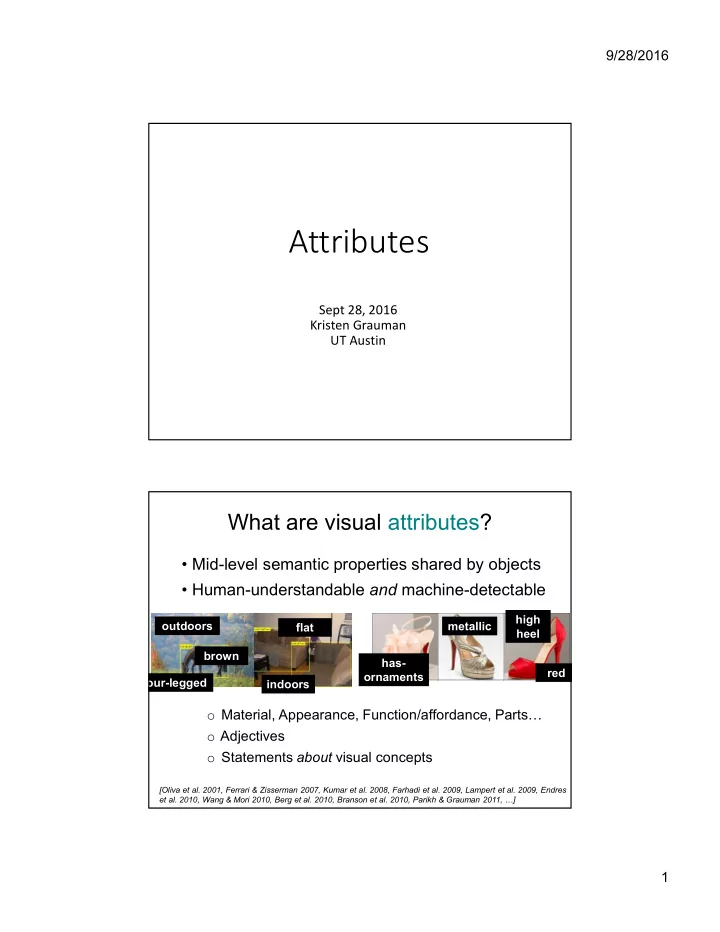
9/28/2016 Attributes Sept 28, 2016 Kristen Grauman UT Austin What are visual attributes? Mid-level semantic properties shared by objects Human-understandable and machine-detectable high outdoors metallic flat heel brown has-


slide-1
SLIDE 1

9/28/2016 1

Attributes

Sept 28, 2016 Kristen Grauman UT Austin

What are visual attributes?

  • Mid-level semantic properties shared by objects
  • Human-understandable and machine-detectable

brown indoors

  • utdoors

flat four-legged high heel red has-

  • rnaments

metallic

[Oliva et al. 2001, Ferrari & Zisserman 2007, Kumar et al. 2008, Farhadi et al. 2009, Lampert et al. 2009, Endres et al. 2010, Wang & Mori 2010, Berg et al. 2010, Branson et al. 2010, Parikh & Grauman 2011, …]

  • Material, Appearance, Function/affordance, Parts…
  • Adjectives
  • Statements about visual concepts
slide-2
SLIDE 2

9/28/2016 2

Examples: Binary Attributes

“Smiling Asian Men With Glasses” Kumar et al. 2008

Facial properties

Examples: Binary Attributes

Farhadi et al. 2009

Object parts and shapes

slide-3
SLIDE 3

9/28/2016 3

Examples: Binary Attributes

Lampert et al. 2009

Animal properties

Examples: Binary Attributes

Welinder et al. 2010

Animal properties

slide-4
SLIDE 4

9/28/2016 4

Examples: Binary Attributes

Patterson and Hays 2011

Scene properties

Examples: Binary Attributes

Berg et al. 2010

Shopping descriptors

slide-5
SLIDE 5

9/28/2016 5

Examples: Relative Attributes

> more natural < less smiling

Parikh and Grauman 2011

Comparative properties

Why attributes?

  • Why would a robot need to recognize a scene?

Can I walk around here? Is this walkable?

Slide credit: Devi Parikh

slide-6
SLIDE 6

9/28/2016 6

Why attributes?

  • Why would a robot need to recognize an object?

How hard should I grip this? Is it brittle?

Slide credit: Devi Parikh

Why attributes?

  • How do people naturally describe visual

concepts?

I want elegant silver sandals with high heels

Slide credit: Devi Parikh

Zebras have stripes.

Image search Semantic “teaching”

slide-7
SLIDE 7

9/28/2016 7

Training attribute classifiers

     

Features Classifier

Feature extraction Learning

  

Labeled images

   

Farhadi et al., CVPR 2009 Kumar et al. , ECCV 2008 Kovashka et al, CVPR 2012 Lampert et al, CVPR 2009 Kumar et al, ECCV 2008 Yu et al, CVPR 2013

Attributes for search and recognition

Attributes give human user way to

  • Teach novel categories with description
  • Communicate search queries
  • Give feedback in interactive search
  • Assist in interactive recognition
Slide credit: Kristen Grauman
slide-8
SLIDE 8

9/28/2016 8

Horse Horse Horse Donkey Donkey Mule

Attributes

Is furry Has four legs Has a tail

A mule…

slide-9
SLIDE 9

9/28/2016 9

Binary attributes

Is furry Has four legs Has a tail

A mule…

[Ferrari & Zisserman 2007, Kumar et al. 2008, Farhadi et al. 2009, Lampert et al. 2009, Endres et al. 2010, Wang & Mori 2010, Berg et al. 2010, Branson et al. 2010, …]

Zero-shot Learning

  • Seen categories with labeled images

– Train attribute predictors

  • Unseen categories

– No examples, only description

18

bear turtle rabbit furry big … … … … Farhadi et al. 2009, Lampert et al. 2009 Test image

slide-10
SLIDE 10

9/28/2016 10

Relative attributes

Is furry Has four legs Has a tail Tail longer than donkeys’ Legs shorter than horses’

A mule…

Idea: represent visual comparisons between classes, images, and their properties.

Relative attributes

Properties Image Properties Image Properties

Brighter than

[Parikh & Grauman, ICCV 2011]

Bright Bright

slide-11
SLIDE 11

9/28/2016 11

How to teach relative visual concepts?

1 4 2 3 1 4 2 3 1 4 2 3 1 4 2 3

How much is the person smiling?

How to teach relative visual concepts?

1 4 2 3 1 4 2 3 1 4 2 3 1 4 2 3

How much is the person smiling?

slide-12
SLIDE 12

9/28/2016 12

How to teach relative visual concepts?

1 4 2 3 1 4 2 3 1 4 2 3 1 4 2 3

How much is the person smiling?

How to teach relative visual concepts?

Less More

?

slide-13
SLIDE 13

9/28/2016 13

…,

Learning relative attributes

For each attribute, use ordered image pairs to train a ranking function:

=

[Parikh & Grauman, ICCV 2011; Joachims 2002]

Image features Ranking function

Max-margin learning to rank formulation Image Relative attribute score

Learning relative attributes

Joachims, KDD 2002 Rank margin

wm

Slide credit: Devi Parikh

A13

slide-14
SLIDE 14

Slide 26 A13 image space - GIST, color

Adriana, 5/20/2013

slide-15
SLIDE 15

9/28/2016 14

Relating images

Rather than simply label images with their properties,

Not bright Smiling Not natural

Relating images

Now we can compare images by attribute’s “strength”

bright smiling natural

slide-16
SLIDE 16

9/28/2016 15

Predict new classes based on their relationships to existing classes – even without training images. Leg length: Mule Horse Tail length: Donkey Mule Tail length Leg length

Mule

Relative zero-shot learning

… Comparative descriptions are more discriminative than categorical definitions.

Relative zero-shot learning

20 40 60

Outdoor Scenes Public Figures

Binary attributes Relative attributes - ranker

Accuracy

slide-17
SLIDE 17

9/28/2016 16

Attributes for search and recognition

Attributes give human user way to

  • Teach novel categories with description
  • Communicate search queries
  • Give feedback in interactive search
  • Assist in interactive recognition
Slide credit: Kristen Grauman

Image search

  • Meta-data commonly used, but insufficient

Keyword query: “smiling asian men with glasses”

Slide credit: Kristen Grauman
slide-18
SLIDE 18

9/28/2016 17

Why are attributes relevant to image search?

  • Human understandable
  • Support familiar keyword-based queries
  • Composable for different specificities
  • Efficiently divide space of images
Slide credit: Kristen Grauman

Attributes are composable

Caucasian Teeth showing Outside Tilted head

Attributes can be combined for different specificities

Slide credit: Neeraj Kumar
slide-19
SLIDE 19

9/28/2016 18

Attributes efficiently divide the space of images

Female Caucasian Eyeglasses Older

k attributes can distinguish 2k categories

Slide credit: Neeraj Kumar

Search applications: finding people

Slide credit: Rogerio Feris

slide-20
SLIDE 20

9/28/2016 19

Search applications: finding people

Slide credit: Rogerio Feris

Search applications: finding people

Slide credit: Rogerio Feris

http://lacrimestoppers.com/wanteds.aspx

Search surveillance feeds for suspects

slide-21
SLIDE 21

9/28/2016 20

Search applications: finding people

Adapted from: Rogerio Feris

Search images from ad hoc cameras using semantic descriptions

Search applications: finding people

What actress looks like a young Hillary Clinton? Similar to, but younger than…

?

Slide credit: Kristen Grauman
slide-22
SLIDE 22

9/28/2016 21

Search applications: products

Query: “I want a bright,

  • pen shoe that is short
  • n the leg.”
Slide credit: Kristen Grauman

Search applications: graphic design

Query: “I want an

  • utdoor scene that

looks uncrowded and calm

Slide credit: Kristen Grauman
slide-23
SLIDE 23

9/28/2016 22

Face Search with Attributes

FaceTracer: A Search Engine for Large Collections of Images with Faces, Neeraj Kumar, Peter N. Belhumeur, Shree K. Nayar, ECCV 2008. Describable Visual Attributes for Face Verification and Image Search, Neeraj Kumar, Alexander C. Berg, Peter N. Belhumeur, Shree K. Nayar, PAMI 2011.

Facial Attributes

  • Various properties of interest to search
  • Many are spatially localized within face
slide-24
SLIDE 24

9/28/2016 23

14 Regions x 20 Feature Types = 280 Feature Choices

45

face cheeks nose mouth eyes side hair eyebrows forehead mustache chin top hair small hair right hair neck

Face Regions

Not Normalize d Raw Pixels RGB Raw Pixels RGB Mean- Normalize d Raw Pixels RGB Energy- Normalize d Not Normalize d RGB Mean and Variance Not Normalize d Raw Pixels Intensity Not Normalize d Histogram Intensity Energy- Normalize d Histogram Intensity Mean- Normalize d Histogram Intensity Energy- Normalize d Raw Pixels Intensity Mean- Normalize d Raw Pixels Intensity Not Normalize d Raw Pixels Gradient Magnitude Mean Normalize d Raw Pixels Gradient Magnitude Not Normalize d Histogram Gradient Magnitude Not Normalize d Raw Pixels Gradient Orientation Not Normalize d Histogram Gradient Orientation Not Normalize d Raw Pixels HSV Raw Pixels HSV Mean- Normalize d Raw Pixels HSV Energy- Normalize d Not Normalize d Histogram HSV Not Normalize d Mean and Variance HSV

Feature Types

Slide credit: Neeraj Kumar

Learning a Face Attribute Classifier Learning a Face Attribute Classifier

Males Females

Feature selection Training images Low-level features

RGB HoG HSV … RGB HoG HSV …

RGB, Nose HoG, Eyes HSV, Hair Edges, Mouth …

Slide credit: Neeraj Kumar
slide-25
SLIDE 25

9/28/2016 24

Learning a Face Attribute Classifier

Males Females

Gender classifier Feature selection Train classifier Training images Low-level features

RGB HoG HSV … RGB HoG HSV …

RGB, Nose HoG, Eyes HSV, Hair Edges, Mouth …

Slide credit: Neeraj Kumar

gender 85.78 hair color: black 90.82 flushed face 88.85 age: young 87.72 hair color: blond 88.39 chubby 81.16 age: middle aged 84.93 hair color: brown 74.88 forehead: fully visible 89.31 age: senior 92.04 hair color: gray 89.86 forehead: partially visible 76.96 race: Asian 92.32 hair color: bald 90.39 forehead: obstructed 81.24 race: white 91.50 bangs 91.54 blurry 93.42 race: black 88.65 receding hairline 86.83 color / b&w 97.88 race: indian 86.47 attractive woman 82.56 photo type 71.89 face_shape: oval 73.30 attractive man 74.16 lighting: soft 68.46 face_shape: square 78.60 eye wear: eyeglasses 93.32 lighting: harsh 77.01 face_shape: round 75.47 eye wear: sunglasses 96.50 lighting: flash 73.36 hair_texture: curly 70.07 eye wear: none 93.32 environment 85.27 hair_texture: wavy 66.58 wearing hat 89.12 expression: smiling 95.91 hair texture: straight 78.38 pale skin 89.36 expression: frowning 95.28 heavy makeup 89.01 shiny skin 84.25

Attribute Classifier Accuracies

Slide credit: Neeraj Kumar

Binary facial attributes in Columbia Face Database Typically 80%-90% accuracy

slide-26
SLIDE 26

9/28/2016 25

FaceTracer: Searching for faces with attributes

  • Offline:

– Apply attribute classifiers to database images – Map classifier outputs to probabilities

  • Online:

– Convey available attribute names to user – Given query attributes, rank database images by confidence (e.g., product of probabilities)

FaceTracer: A Search Engine for Large Collections of Images with Faces, Neeraj Kumar, Peter N. Belhumeur, Shree K. Nayar, ECCV 2008.

Google: “smiling asian men with glasses” July 2008

Slide credit: Neeraj Kumar
slide-27
SLIDE 27

9/28/2016 26

FaceTracer: “smiling asian men with glasses”

Slide credit: Neeraj Kumar

FaceTracer: “older men with mustaches”

Slide credit: Neeraj Kumar
slide-28
SLIDE 28

9/28/2016 27

Attribute-based person search in video

Slide credit: Rogerio Feris

Search Interface

Database Backend

Video from camera

Result – thumbnails

  • f clips matching

the query

Suspect description form (query specification)

Face Detection & Tracking Background Subtraction Attribute Detectors

Analytics Engine

Vaquero, Feris, Tran, Brown, Hampapur and Turk. Attribute-Based People Search in Surveillance Environments. WACV 2009.

Video Demo: Attribute-based People Search

Vaquero, Feris, Tran, Brown, Hampapur and Turk. Attribute-Based People Search in Surveillance

  • Environments. WACV 2009.
slide-29
SLIDE 29

9/28/2016 28

Example query: Boston bombing scenario

Suspect #1 found in 4 images in top 8 results Suspect #2 found in 3 images in top page

 1071 detected faces from 50 high-res Boston images (all from Flickr)

Ability to spot a person with e.g., a white hat in a crowded scene

Slide credit: Rogerio Feris Rogerio Feris et al., IBM Research

Problem with one-shot visual search

  • Keywords (even attributes)

can be insufficient to capture query in one shot.

  • Complete “indicator vector”
  • ver attributes need not

adequately capture envisioned target.

Slide credit: Kristen Grauman
slide-30
SLIDE 30

9/28/2016 29

Interactive visual search

Feedback Results

  • Iteratively refine the set of retrieved images based
  • n user feedback on results so far
  • Potential to communicate more precisely the

desired visual content

Slide credit: Adriana Kovashka

How is interactive search done today?

  • Traditional binary feedback is imprecise
  • Coarse communication between user and system

relevant irrelevant

Keywords + binary relevance feedback

black high heels [Rui et al. 1998, Zhou et al. 2003, Tong & Chang 2001, Cox et al. 2000, Ferecatu & Geman 2007, …]

slide-31
SLIDE 31

9/28/2016 30

Idea: Search via comparisons

  • Whittle away irrelevant images via comparative

feedback on properties of results

“Like this… but more ornate”

[Kovashka et al., CVPR 2012]

WhittleSearch: Relative attribute feedback

Feedback: “shinier than these” Feedback: “less formal than these”

Refined top search results Initial top search results

… …

Query: “white high-heeled shoes”

[Kovashka et al., CVPR 2012]

slide-32
SLIDE 32

9/28/2016 31

Feedback: “broader nose”

Refined top search results Initial reference images

Feedback: “similar hair style”

WhittleSearch: Relative attribute feedback

[Kovashka et al., CVPR 2012]

formal shiny

“I want something more formal than this.” “I want something less formal than this.” “I want something more shiny than this.”

WhittleSearch: Relative attribute feedback

[Kovashka, Parikh, and Grauman, CVPR 2012] [Kovashka et al., CVPR 2012]

slide-33
SLIDE 33

9/28/2016 32

More open than

Example WhittleSearch

More open than Less ornaments than Match

Round 1 Round 2 Round 3

Query: “I want a bright,

  • pen shoe that is short
  • n the leg.”

Selected feedback

[Kovashka et al., CVPR 2012]

WhittleSearch: Relative attribute feedback

[Kovashka et al., CVPR 2012]

slide-34
SLIDE 34

9/28/2016 33

[Kovashka et al., CVPR 2012]

We more rapidly converge on the envisioned visual content.

WhittleSearch results

vs.

Relative attribute feedback Binary relevance feedback

Attributes for search and recognition

Attributes give human user way to

  • Teach novel categories with description
  • Communicate search queries
  • Give feedback in interactive search
  • Assist in interactive recognition
Slide credit: Kristen Grauman
slide-35
SLIDE 35

9/28/2016 34

What Plant Species is This?

Slide credit: Neeraj Kumar

Let’s Use a Field Guide

Slide credit: Neeraj Kumar

slide-36
SLIDE 36

9/28/2016 35

Categories of Recognition

Easy Airplane? Chair? Bottle? … Easy Yellow Belly? Blue Belly?…

Basic-Level Parts & Attributes

Hard, limited memory & experiences American Goldfinch? Indigo Bunting?…

Subordinate

Humans Some Success Some Success Hard, but can store large knowledge bases Computers

Slide credit: Steve Branson

Recognition With Humans in the Loop

Computer Vision Cone-shaped Beak? yes American Goldfinch? yes Computer Vision

  • Computers: reduce number of required questions
  • Humans: drive up accuracy of vision algorithms

Slide credit: Steve Branson

Wah et al., Multi-class Recognition and Part Localization with Humans in the Loop, ICCV 2011

slide-37
SLIDE 37

9/28/2016 36

Example Questions: Localize

Slide credit: Steve Branson

Wah et al., Multi-class Recognition and Part Localization with Humans in the Loop, ICCV 2011

Example Questions: Name attributes

Slide credit: Steve Branson

Wah et al., ICCV 2011

slide-38
SLIDE 38

9/28/2016 37

Basic Algorithm

Input Image ( )

x

Question 1: Click on the belly Question 2: Is the bill hooked? Computer Vision A: YES

) | ( x c p ) , | (

1

u x c p ) , , | (

2 1 u

u x c p

1

u

2

u

Max Expected Information Gain Max Expected Information Gain

A: (x,y)

Slide credit: Steve Branson

Wah et al., ICCV 2011

Basic Algorithm

Select the next question that maximizes expected information gain:

  • Involves estimating probabilities of the form:

) ... , , | (

2 1 t

u u u x c p

Object Class Image Sequence of user responses

Slide credit: Steve Branson

Wah et al., ICCV 2011

slide-39
SLIDE 39

9/28/2016 38

Basic Algorithm

    ) | ( ) , | ( ) , , | ... , ( x p x c p x c u u u p

t 2 1

Model of user responses Localized attribute estimator

) ... , , | (

2 1 t

u u u x c p

Part Localization

Slide credit: Steve Branson

Wah et al., ICCV 2011

Integrate over all possible locations of the parts:

Modeling User Responses: Attribute Questions

What is the color of the belly? Pine Grosbeak

 

  

t i i t

c u p c u u u p

...

) , | ( ) , | ... , (

1 2 1

  • Assume:
  • Estimate using Mechanical Turk

) , | (  c u p

i

grey red black brown blue grey red black white brown blue grey red black white brown blue Probably Guessing Definitely

Slide credit: Steve Branson

Wah et al., ICCV 2011

white

slide-40
SLIDE 40

9/28/2016 39

Modeling User Responses: Click Questions

 

  

t i i t

c u p c u u u p

...

) , | ( ) , | ... , (

1 2 1

  • Assume:
  • Estimate using Mechanical Turk

) , | (  c u p

i

Click on the breast

Slide credit: Steve Branson

Wah et al., ICCV 2011

CUB-200-2011 Dataset

13 part locations 288 binary attributes

Black-footed Albatross Groove-Billed Ani Parakeet Auklet Field Sparrow Vesper Sparrow

11,877 images, 200 bird species

Slide credit: Steve Branson

Wah et al., ICCV 2011

slide-41
SLIDE 41

9/28/2016 40

Results: Without Computer Vision

Perfect Users, Field Guide Attributes Real Users, Field Guide Attributes

100% accuracy in 8≈log2(200) questions if users agree with field guides… MTurkers don’t always agree with field guides…

Real Users, Probabilistic User Model

Tolerate ambiguous responses, user error

Slide credit: Steve Branson

Branson et al., ECCV 2010

Results: With Computer Vision

Base Computer Vision performance (30%)

  • Incorporating computer vision reduces ave time to identify true

species from 109 sec to 37 sec

  • Intelligently selecting questions reduces ave time from 69 sec to

37 sec

Slide credit: Steve Branson

Wah et al., ICCV 2011

slide-42
SLIDE 42

9/28/2016 41

Demo

Slide credit: Steve Branson

Wah, Branson, Perona, Belongie, Multi-class Recognition and Part Localization with Humans in the Loop, ICCV 2011

Summary: Attributes for search and recognition

Attributes give human user way to

  • Teach novel categories with description
  • Communicate search queries
  • Give feedback in interactive search
  • Assist in interactive recognition
Slide credit: Kristen Grauman
slide-43
SLIDE 43

9/28/2016 42

Ongoing challenges (1)

  • Accuracy of attribute models crucial to success
  • Human perception of attributes can vary
  • When is the attribute vocabulary expressive

enough?

  • If large attribute vocabulary is available, how to

convey it to the search user?

  • Practical issues in calibration and fusion
  • Localized vs. global properties
Slide credit: Kristen Grauman

Ongoing challenges (2)

  • What attributes should be in the vocabulary?
  • How to align user’s attribute language with the

visual attribute models?

  • Integrated treatment of binary and relative

attributes?

  • Joint learning of multiple attributes?
  • Class-specific attributes?
  • How do we make sure we’re learning the “right”

thing?

Kristen Grauman, UT-Austin

slide-44
SLIDE 44

9/28/2016 43

  • Animals with Attributes – 1 (1003 unlabeled, 732 test)
  • Animals with Attributes – 2 (1002 unlabeled, 993 test)
  • aYahoo (703 unlabeled, 200 test)
  • aPascal (903 unlabeled, 287 test)

hamster hippopotamus horse humpback whale killer whale tiger walrus weasel wolf zebra centaur donkey goat monkey wolf zebra aeroplane bicycle boat bus car motorbike train

Slide credit: Adriana Kovashka