Objectives You should be able to... Variables have many different - - PowerPoint PPT Presentation

objectives
SMART_READER_LITE
LIVE PREVIEW

Objectives You should be able to... Variables have many different - - PowerPoint PPT Presentation

Introduction Static vs. Dynamic Binding Value Typing Location Scoping Introduction Static vs. Dynamic Binding Value Typing Location Scoping Objectives You should be able to... Variables have many different attributes. These attributes


slide-1
SLIDE 1

Introduction Static vs. Dynamic Binding Value Typing Location Scoping

Variables

  • Dr. Mattox Beckman

University of Illinois at Urbana-Champaign Department of Computer Science

Introduction Static vs. Dynamic Binding Value Typing Location Scoping

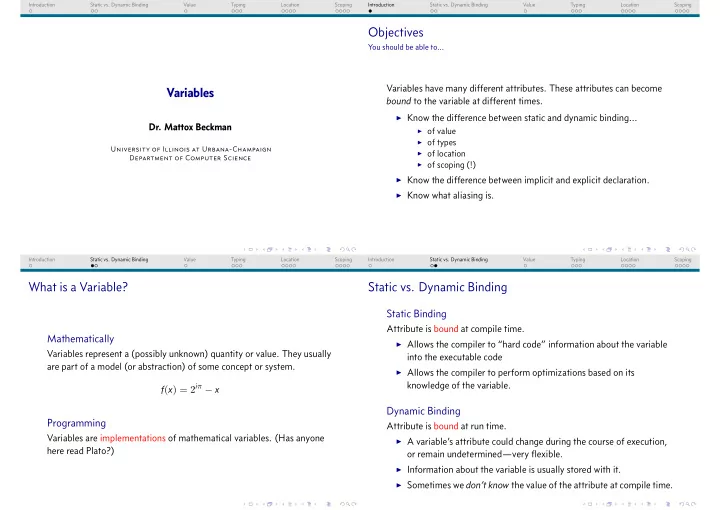
Objectives

You should be able to...

Variables have many different attributes. These attributes can become bound to the variable at different times.

◮ Know the difference between static and dynamic binding...

◮ of value ◮ of types ◮ of location ◮ of scoping (!)

◮ Know the difference between implicit and explicit declaration. ◮ Know what aliasing is.

Introduction Static vs. Dynamic Binding Value Typing Location Scoping

What is a Variable?

Mathematically

Variables represent a (possibly unknown) quantity or value. They usually are part of a model (or abstraction) of some concept or system. f(x) = 2iπ − x

Programming

Variables are implementations of mathematical variables. (Has anyone here read Plato?)

Introduction Static vs. Dynamic Binding Value Typing Location Scoping

Static vs. Dynamic Binding

Static Binding

Attribute is bound at compile time.

◮ Allows the compiler to “hard code” information about the variable

into the executable code

◮ Allows the compiler to perform optimizations based on its

knowledge of the variable.

Dynamic Binding

Attribute is bound at run time.

◮ A variable’s attribute could change during the course of execution,

  • r remain undetermined—very fmexible.

◮ Information about the variable is usually stored with it. ◮ Sometimes we don’t know the value of the attribute at compile time.

slide-2
SLIDE 2

Introduction Static vs. Dynamic Binding Value Typing Location Scoping

Value

◮ The value attribute of a variable is most likely to be dynamic. ◮ Sometimes we want the value to be static. (Not to be confused with

the static keyword in C.)

Static Value

1

const int i = 2;

2 3

int foo(int j) { return i * j; }

4 5

int bar() {

6

int i = 10;

7

i = foo(i);

8

return i;

9

}

Introduction Static vs. Dynamic Binding Value Typing Location Scoping

Static Typing

◮ Static Typing: the type of variables are known at compile time. ◮ This makes many operations very effjcient.

1

int sqr(int i) {

2 3

return i * i;

4

}

1

movi r1, val(i)

2

movi r2, val(i)

3

multi r1,r2,r3

4

pushi r3

◮ The compiler can catch errors: improving programmer reliability.

1

string s = "hi";

2

bool b = true;

3

if s then printf("4") else printf("9");

Introduction Static vs. Dynamic Binding Value Typing Location Scoping

Dynamic Typing

Some languages (e.g., BASIC, Perl most shell languages, TCL) use dynamic typing.

1

#!/usr/bin/perl

2 3

$i = "The answer is ";

4

print "$i";

5 6

$i = 42;

7

print "$i\n"; Actually, Perl types are partially dynamic. Scalars, arrays, and hashes are represented with different syntax.

Introduction Static vs. Dynamic Binding Value Typing Location Scoping

Polymorphism

◮ We can have both the advantages of strong typing and dynamic

typing at the same time!

Overloading

int identity(int i) { return i; } double identity(double x) { return x; }

Parameterized

template <class T> T ident(T &i) { return i; }

Automatic

# let id x = x;; val id : 'a -> 'a = <fun>

slide-3
SLIDE 3

Introduction Static vs. Dynamic Binding Value Typing Location Scoping

Location

◮ Heap allocated variables — completely dynamic ◮ Stack allocated variables — partially static “stack relative”

allocation

1

int length() {

2

int i = 10;

3

String s = new String("hello");

4

return i + length(s);

5

}

Weird Language

There is one language in which all variables — even function arguments — are allocated statically!

Introduction Static vs. Dynamic Binding Value Typing Location Scoping

Fortran

The Problem

◮ First released on the IBM 704 in 1957. It had core memory

(equivalent to 18,432 bytes) and a 12k FLOP processor.

◮ Can we use a high level language and translate it to machine code?

The Solution: Hard-code variable locations

◮ This made Fortran almost as fast as assembly. ◮ Still the language of choice for numerical computation. ◮ Downside—you don’t get recursion. (Modern Fortran fjxes this.)

Introduction Static vs. Dynamic Binding Value Typing Location Scoping

Aliasing

It is possible for multiple variables to refer to the same location.

1

int i = 20;

2 3

void inc(int &x) {

4

x = x + 1;

5

}

6

// after this i and x will be the same!

7

... inc(i) ... Use with extreme caution!

Introduction Static vs. Dynamic Binding Value Typing Location Scoping

Bad Aliasing

Knowing about aliasing and storage is critical. Never forget that your variables are representations only. Do the Aliasing Bug activity.

slide-4
SLIDE 4

Introduction Static vs. Dynamic Binding Value Typing Location Scoping

Lifetime

◮ Variables have a certain scope in the program for which they are

valid.

◮ This allows us to have multiple variables with the same name. ◮ Usually the scope (or lifetime) is determined syntactically.

1

int foo(int i) {

2

int j = 10;

3

return j + 10;

4

}

5 6

int bar(int i) {

7

int j = 20;

8

return foo(j) + foo(i);

9

}

Introduction Static vs. Dynamic Binding Value Typing Location Scoping

Example in C

Consider the following program:

1

int i = 2;

2 3

int foo() { return i * i; }

4 5

int bar() {

6

int i = 10;

7

return foo();

8

}

◮ What value will function bar return?

◮ 4 ◮ 100 Introduction Static vs. Dynamic Binding Value Typing Location Scoping

Example in Emacs Lisp

1

(setq i 2) ;; global variable i = 2

2 3

(defun foo ()

4

(* i i))

5 6

(defun bar ()

7

(let ((i 10)) ;; local variable i = 10

8

(foo))) ;; call function foo

◮ What value will expression (bar) return?

◮ 4 ◮ 100 Introduction Static vs. Dynamic Binding Value Typing Location Scoping

Static vs. Dynamic Scoping

◮ Most languages use static scoping. ◮ The fjrst Lisp implementations used dynamic scoping.

◮ Today it is considered to be a Bad ThingTM by most sentient

life-forms.

◮ As always, some disagree...

◮ It’s too easy to modify the behavior of a function. ◮ Correct use requires knowledge of a function’s internals.

Still used by Emacs Lisp!