Two identical small charged spheres, each having a mass of 3x10 -2 - - PowerPoint PPT Presentation

two identical small charged spheres each having a mass of
SMART_READER_LITE
LIVE PREVIEW

Two identical small charged spheres, each having a mass of 3x10 -2 - - PowerPoint PPT Presentation

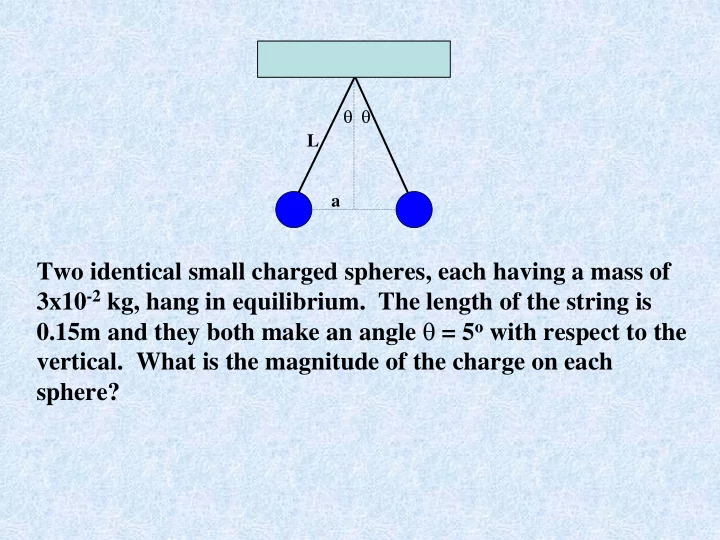
L a Two identical small charged spheres, each having a mass of 3x10 -2 kg, hang in equilibrium. The length of the string is 0.15m and they both make an angle = 5 o with respect to the vertical. What is the magnitude of the charge on


slide-1
SLIDE 1

θ θ a L

Two identical small charged spheres, each having a mass of 3x10⁻² kg, hang in equilibrium. The length of the string is 0.15m and they both make an angle θ = 5o with respect to the

  • vertical. What is the magnitude of the charge on each

sphere?

slide-2
SLIDE 2

0.30m

x

0.20m

  • 4µC

3µC

  • 8µC

What is the net electrostatic force on the 8µC charge due to the other two charges?

0.30m 0.52m 50µC 65µC

  • 86µC

0.6m 30o

y x What is the net electrostatic force on the 65µC charge due to the other two charges?

slide-3
SLIDE 3

P q2 q1 y x 0.3m 0.4m

A charge q1 = 7µC is located on the x-axis and a charge q2 = -5µC is located 0.3m from q1 on the x-axis. What is the electric field at the point P with coordinates (0,0.4)m? If a 2µC chare were placed at point P, what is the net electrostatic force felt by the charge?

slide-4
SLIDE 4

y x P x r θ a

  • a

What is the electric field at a point P due to the electric dipole (two equal and opposite charges separated by a fixed distance) situated on the y-axis as shown? What is the electric field at a point P if x >> a?

slide-5
SLIDE 5

v E L An electron enters a region of uniform electric field (E = 200 N/C) with a velocity of 3x10⁶ m/s. What is the acceleration of the electron, the time it takes the electron to travel through the field and the vertical displacement

  • f the electron while it is in the field? The length of the

region L = 0.1m. How much work was done on the particle by the field?

slide-6
SLIDE 6

Given the two charges shown below, at what position(s) x is the electric field zero? Is the field zero at any other points, not on the x axis? A proton (mp = 1.67x10⁻²⁷ kg) is suspended at rest in a uniform electric field Take into account gravity at the Earth’s surface, and determine