Two Approaches To A Job Algorithmic: A task in which a set of - - PDF document

two approaches to a job
SMART_READER_LITE
LIVE PREVIEW

Two Approaches To A Job Algorithmic: A task in which a set of - - PDF document

Two Approaches To A Job Algorithmic: A task in which a set of established instructions are A NEW APPROACH TO MANAGEMENT AND followed to one conclusion. Extrinsic profit maximizes MOTIVATION Heuristic: Opposite of algorithmic,


slide-1
SLIDE 1

A NEW APPROACH TO MANAGEMENT AND MOTIVATION

Two Approaches To A Job

 Algorithmic:

 A task in which a set of established instructions are

followed to one conclusion. Extrinsic profit maximizes  Heuristic:

 Opposite of algorithmic, involves experimentation with

possibilities to devise a novel solution. Intrinsic purpose maximizes.

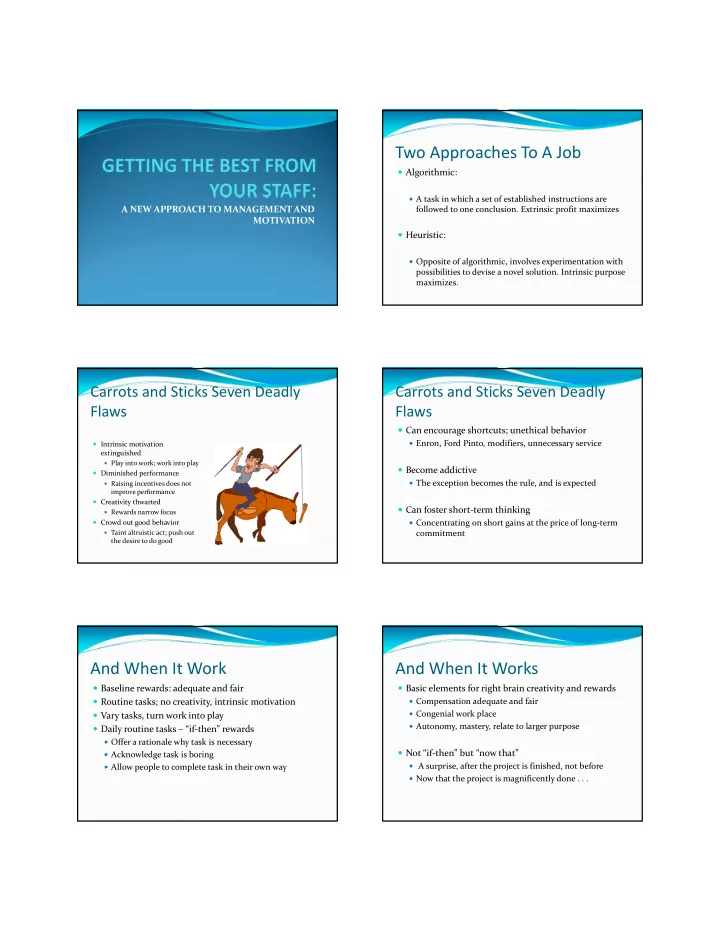
Carrots and Sticks Seven Deadly Flaws

 Intrinsic motivation extinguished

 Play into work; work into play

 Diminished performance

 Raising incentives does not

improve performance  Creativity thwarted

 Rewards narrow focus

 Crowd out good behavior

 Taint altruistic act; push out

the desire to do good

Carrots and Sticks Seven Deadly Flaws

 Can encourage shortcuts; unethical behavior

 Enron, Ford Pinto, modifiers, unnecessary service

 Become addictive

 The exception becomes the rule, and is expected

 Can foster short‐term thinking

 Concentrating on short gains at the price of long‐term

commitment

And When It Work

 Baseline rewards: adequate and fair  Routine tasks; no creativity, intrinsic motivation  Vary tasks, turn work into play  Daily routine tasks – “if‐then” rewards

 Offer a rationale why task is necessary  Acknowledge task is boring  Allow people to complete task in their own way

And When It Works

 Basic elements for right brain creativity and rewards

 Compensation adequate and fair  Congenial work place  Autonomy, mastery, relate to larger purpose

 Not “if‐then” but “now that”

 A surprise, after the project is finished, not before  Now that the project is magnificently done . . .

slide-2
SLIDE 2

And When It Works

 For creative, right brain tasks:

 Consider non‐tangible rewards; praise and positive

feedback

 Provide useful information; praise about effort and

strategy rather achieving a particular outcome

Routine? Yes: Can it be made less routine

No: Use rewards; even if/then; but Rational Boring Own way

No: mastery, autonomy, purpose Use now/that rewards Praise & feedback; Useful info.

Type I and Type X

 Type X: Yesterday’s theory

 Fueled by extrinsic desires  Concerned less with inherent satisfaction

 Type I: 21st Century theory

 Concerned less with external rewards  Inherent satisfaction of the activity itself

Need to move from Type X to Type I

Type I Traits

 Almost always outperforms Type X in the long run.  Type I is both born and made.  Type I does not disdain money or recognition  Type I is a renewable source  Type I behavior promotes greater physical and mental well‐being

Moving from Type X to Type I

 Autonomy

 What they do; When they do it; Who they do it with;

How they do it  Mastery

 A mindset; See abilities as infinitely improvable;

Demands effort, grit and deliberate practice  Purpose

 Goals that use profit to reach purpose; in words that

emphasize more than self interest; in policies that allow staff to pursue purpose on their own terms.

Autonomy

 Task – FedEx days  Time – ROWE v. billable hours  Technique – Ritz‐Carlton  Team – Building cooperation

slide-3
SLIDE 3

Mastery

 The desire to get better and better at something that matters.  Compliance v. Engagement  Goldilocks Tasks  Mindset – all in your head  Painful  Unattainable

Purpose

 Provides context for mastery and autonomy  Goals  Words: Hippocratic Oath; us/they; why not how  Policies: Time to do meaningful activities  Purpose goals v. profit goals.

Type I’s: 13 Ways to Improve Your Hospital or Group

 Time for noncommissioned work: The Big Idea

 Carve out a small island of noncommissioned work

 20 percent time with training wheels

 Noncommissioned work  Start small, 10%, small group, limited time

 Turn your next off‐site into a FedEx Day

 One day to work on whatever staff wants  Have the proper tools  Must deliver something; new idea, better internal process

13 Ways Continued

 Conduct an autonomy audit

 How much autonomy do you have over your tasks?  How much autonomy do you have over your time at

work?

 How much autonomy do you have over your team at

work?

 How much autonomy do you have over your technique

at work?

13 Ways Continued

 Feedback:

 Annual review flaws: Yearly and rehearsed  Self and/or peer performance reviews monthly  Not as a replacement, but supplement  Set both smaller and larger goals  Relationship to larger purpose  Be honest

13 Ways continued

 Peer‐to‐peer “now that” rewards

 Avoids flaws of corporate carrot rewards  Carry a different meaning  Puts feedback control in the hands of those closest to

the activity

slide-4
SLIDE 4

13 Ways Continued

 Take three steps toward giving up control

 Involve people in goal‐setting  Use non‐controlling language: must/think about;

should/consider

 Hold office hours

 Play “Whose purpose is it anyway?”

 In own words “What is our group/department/hospital’s

purpose?”

 Uniform or all over the map

 Is it “we” or “they”?

13 Ways Continued

 Design for the 85%

 Workforce policies designed for 15%: Those that need

rigid structures and strict enforcement

 Systems design rules to guard against bad behavior

actually promotes it

 Assuming good faith encourages good behavior

13 Ways Continued

 Promote Goldilocks for groups: Not too easy, not too hard

 Begin with a diverse team  Group a “No competition zone”  Try task shifting  Concentrate on purpose, not rewards

13 Ways Continued

 Get agile

 Build projects around motivated people  Simplicity  Self‐organizing teams

 Start small and subversive

 Ask the right question  Be strategically subversive  Emphasize results

Paying People the Type I Way

 Ensure internal and external fairness  Pay more than average  Make performance metrics wide‐ranging, relevant, and hard to game  Salespeople: are they different?