Turings Real Machines Michael R. Williams Professor Emeritus - - PowerPoint PPT Presentation

turing s real machines
SMART_READER_LITE
LIVE PREVIEW

Turings Real Machines Michael R. Williams Professor Emeritus - - PowerPoint PPT Presentation

Turings Real Machines Michael R. Williams Professor Emeritus Department of Computer Science University of Calgary 2012 - Turing centenary year Some ground rules I am not a Turing expert, but I do know a lot about the man and his


slide-1
SLIDE 1

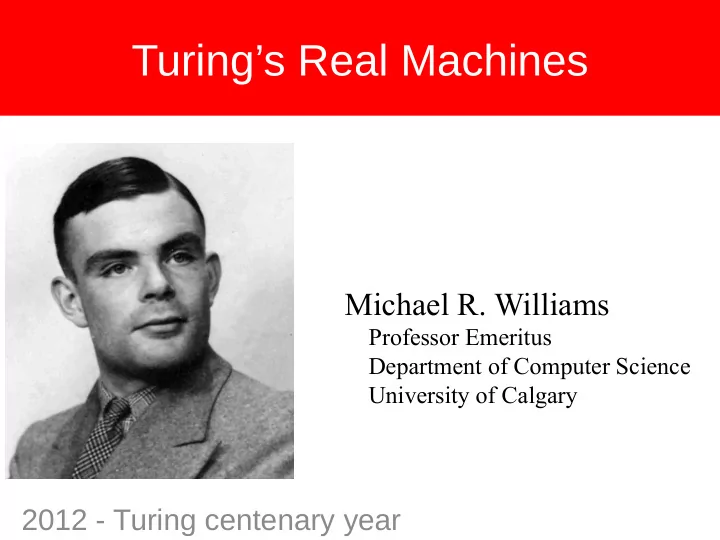
Turing’s Real Machines

2012 - Turing centenary year

Michael R. Williams

Professor Emeritus Department of Computer Science University of Calgary
slide-2
SLIDE 2
  • I am not a Turing expert, but I do know a lot

about the man and his accomplishments.

  • So do a lot of other people, but they are not here

at the moment (or at least I hope they are not here to cause me embarrassment)

  • I don’t intend to say much about his mathematics

– a substantial and lasting contribution!

Some ground rules

slide-3
SLIDE 3
  • I am old enough to knew many of the first generation
  • f computer pioneers on a personal basis (few are now

left alive – those that are in their 90s).

  • I never knew Turing because I was only 12 when he

took his own life.

  • But I have talked to those who worked with him and

collected stories, photos, etc.

Turing’s Real Machines

slide-4
SLIDE 4

Turing’s Real Machines The house where Turing lived and died in Manchester

For example:

slide-5
SLIDE 5

Mathematical Gazetteer of the British Isles By David Singmaster Retired mathematics prof at London Southbank University

Turing’s Real Machines

slide-6
SLIDE 6

Click to edit Master text styles

Second level

Third level

  • Fourth level

– Fifth level

Turing’s Real Machines

George Dyson’s new book

GEORGE DYSON, a historian among futurists, is the author of Darwin Among the Machines; and Project Orion: The True Story of the Atomic Spaceship. available March 6

slide-7
SLIDE 7
  • He had an impulse to build things and had done

physical experiments since his youth

  • But he was never any good at it

– he could conceive of things and explain what he had in mind but his actual ability at construction was almost zero – “bird’s nest” wiring and clumsy.

Turing’s Real Machines

slide-8
SLIDE 8

1936-37 (at Princeton) he attempted to build a cypher machine

– relay based multiplier – would take binary message – multiply it by “a horrendously long but secret number” – transmit the product

Number was to be long enough that it would take 100 Germans, 8 hours per day, for 100 years to find the secret number by simple search. Machine was never finished (typical).

First attempt at a secret cypher machine

slide-9
SLIDE 9
  • He was interested in what was known as the zeros of

the Riemann Zeta function – why is not important at the moment.

  • He saw that any attempt at hand calculation was futile
  • Knew of a mechanical tide calculating machine that he
  • nce saw at Liverpool

Zeros of the Riemann Zeta Function

slide-10
SLIDE 10

Tide Calculating Machine (invented by Lord Kelvin)

slide-11
SLIDE 11
  • Kelvin’s machine was analog – only did

approximate calculations (good enough for tides and to find exceptions to Zeta function)

  • When Turing returned to Cambridge he had

help from a mechanical engineer (the brother of a Princeton friend) to design one for finding zeros of Riemann Zeta function

Zeros of the Riemann Zeta Function

slide-12
SLIDE 12
  • Asked for a 40 Pound grant to get it

constructed

  • Turing admitted in the grant application that it

would have no other use.

  • War started and machine never finished!

Zeros of the Riemann Zeta Function

slide-13
SLIDE 13
  • World War II changed everything for Turing.
  • Took him out of Cambridge and the academic

life and put him into a less tolerant society

  • unfortunate because of his lifestyle, but

fortunate for the experience it gave him.

The War was a turning point

slide-14
SLIDE 14
  • Turing was an original thinker!
  • He had (an almost unique) ability to think through

a problem from the beginning and not just rely on what other had done or thought.

  • His contributions to the WWII code breaking effort

were fundamental.

Three truths

slide-15
SLIDE 15

Turing has become an icon - helped by his other contributions and his early death

Click to edit Master text styles

econd level

ird level

Fourth level – Fifth level

slide-16
SLIDE 16

His mathematics and personal life are well known His code breaking work was unknown to most until the 1970s when it began to leak out Some of what has been written about him is based on (now) questionable sources Complete declassification only took place about 10 years ago (some stuff might still be unavailable)

A lot of what we think about Turing is only partly true

slide-17
SLIDE 17

Most people think that

  • The German military invented the Enigma code machine
  • Turing single-handedly broke the Enigma code
  • Turing invented the Colossus machine to break the

Enigma code

  • Turing was the inventor of the modern computer
  • And a lot of other stuff – most of it wrong

The first thing I am going to do is to disabuse you of some

  • f your misconceptions

Like all icons/heros, the stories get confused and embellished

slide-18
SLIDE 18

Enigma encoding machine

slide-19
SLIDE 19

Click to edit Master text styles

econd level

rd level

Fourth level – Fifth level

Enigma encoding machine

slide-20
SLIDE 20
  • Invented in 1918 by German engineer Arthur Scherbius
  • approached the German Navy and Foreign Office with

the design, but neither was interested

  • Sold many as a business communication encoding

device for telegraph use (banks etc.)

  • Replaced the telegraph code books then in use
  • Enigma was no secret – you could buy one on the open

market!

Enigma

slide-21
SLIDE 21
  • Added a plug board to

exchange 6 pairs of letters

  • Devised new wiring for the

rotors

German Military Enigma

slide-22
SLIDE 22
  • Click to edit Master text styles

– Second level

– Third level

  • Fourth level

– Fifth level

Poles break Enigma code before World War II

  • Created the first Bombe to help break the code
  • Pass the secret of the plug board, rotor wiring, and how they

broke it to the British and French

slide-23
SLIDE 23
  • Germans modify the plug board to exchange 10 (rather

than 6) pairs of letters

  • Introduce new rotors with different wiring
  • Polish methods didn’t work anymore
  • Alan Turing (aided by Gordon Welchman) try to figure out

how to cope with the new situation

German military made changes to Enigma

slide-24
SLIDE 24
  • Turing “designed” a more advanced version of the

bombe to cope with German Enigma modifications

  • 6’ high, 7’ wide – 1 ton
  • simulated 30 Enigmas working at once - each with

different rotor settings etc.

  • Bombes actually built by trained engineers but Turing

helped with the design and found new creative ways of using them.

Turing’s Real Machines

slide-25
SLIDE 25

Turing’s Bombe

  • Click to edit Master text styles

– Second level

– Third level

  • Fourth level

– Fifth level

US version

  • f Turing’s

Bombe Much the same as the British version.

slide-26
SLIDE 26

Turing’s Bombe

Click to edit Master text styles

– Second level

– Third level

  • Fourth level

– Fifth level

Didn’t decipher Enigma messages Was used to try and find the initial wheel settings

  • f the Enigma for a

given message. Relied in knowing a “crib” of some kind

slide-27
SLIDE 27
  • First one (“Victory”) available in March 1940
  • Second in August, others quickly thereafter
  • Many produced
  • By 1942 they were decoding 39,000 messages per month.
  • Code breaking became routine and Turing went on to other projects
  • Further German Enigma modifications made it impossible to decipher some

messages.

  • Extra interchangeable rotors added (different wiring)
  • Some units used 4 rotor machines (instead of 3)

Turing’s Bombe

slide-28
SLIDE 28
  • 4 Rotor machines impossible to decipher with current

bombe

  • Enigma not the only coding system used
  • German High Command used the Lorenz SZ40/42

(Geheimschreiber )

  • Produced “Fish” (“Tunny”)

Turing’s Real Machines

slide-29
SLIDE 29
  • Click to edit Master text styles

– Second level

– Third level

  • Fourth level

– Fifth level

Lorenz SZ40/42 (Geheimschreiber )

Lorenz internal workings Transmitted binary code – not transmitted via Morse Code like Enigma Note 12 rotors

slide-30
SLIDE 30
  • The only possible way to deal with the more

complex 4 Rotor Enigma and the Geheimschreiber codes was to speed up the process they already had in operation.

  • Turing had once proposed that the setup time

for a Bombe could be automated and this now seemed like something to do.

Turing’s Real Machines

slide-31
SLIDE 31
  • First proposal was made by Max

Newman – mostly because he found he disliked doing the hand stuff he had been assigned.

  • Cambridge Math. Prof. who had

given Turing the idea of proving things by mechanical process.

  • Likely the one that suggested Turing

join the code breaking group

Max Newmann

slide-32
SLIDE 32
  • Newmann suggested that they might use electronics

and relays to create a more powerful machine to implement Turing’s ideas.

  • “Robinson” built by British Telecom Engineers under

Newmann’s direction.

  • (Heath Robinson – cartoonist who created whimsical

machines)

Robinson machines

slide-33
SLIDE 33
  • Machine set itself up and read

encrypted message and possible rotor settings from tapes (1,000 c/s – 100 inches/sec. – later 2000 c/s)

  • Tapes were driven by sprocket gears –

regularly tore up tapes

  • While trouble prone it proved

Newmann’s (and Turing’s) ideas correct.

Robinson machines

slide-34
SLIDE 34
  • Incremental improvements were made to the Robinson
  • named “Robinson and Cleaver” etc.
  • problems keeping two paper tapes in synchrony
  • Essentially performed correlations between the data on the encrypted

message tape and one representing the Lorenz wheel settings

  • Wheel setting then moved forward one place and the correlation ran again
  • The code breaker was looking for the relative position which gave the

highest cross-correlation score — which hopefully would correspond to the correct Lorenz wheel start position

Robinson machines

slide-35
SLIDE 35
  • Tommy Flowers became

involved and realized that using vacuum tubes would permit a lot faster speed

  • replaced sprocket tape with

smooth drive rollers

  • Colossus was finally created

by the British Post Office Research Laboratory

The Collossus

slide-36
SLIDE 36

Used to break the Fish teleprinter code (Gehimschriber) not usually Enigma. About a dozen were made – all destroyed to keep the secret.

Colossus

slide-37
SLIDE 37
  • Read tape at 5,000 c/s – could run through all

the combinations of wheel settings (for some code machines) in 30 minutes

  • printed out when it had found a setting that

matched a potential key.

Colossus

slide-38
SLIDE 38
  • Bill Tutte deduced the structure
  • f the Lorenz machine
  • devised the statistical method

which made Heath Robinson and the Colossi possible

  • invented a method to keep pace

with the Germans’ daily changes

  • f the Lorenz code-wheel

patterns.

Bill Tutte

slide-39
SLIDE 39
  • Bill Tutte later moved to Canada and became a distinguished

math professor at Waterloo.

  • Max Newmann became a math professor at Manchester and

founded the Royal Society Computing Laboratory there.

  • Turing had thought long and hard about computing.
  • In 1945 he went to work at the National Physical Laboratory

in Teddington to design and develop an electronic stored- program digital computer for scientific work (a year before the Moore School Lectures)

After the War

slide-40
SLIDE 40
  • John Womersley, Turing's immediate superior

at NPL, christened Turing's proposed machine the Automatic Computing Engine, or ACE, in homage to Babbage's Difference Engine and Analytical Engine.

  • Turing was in contact with others who were

interested in building a computer – but did his usual rethinking the problem from scratch.

Turing’s Real Machines

slide-41
SLIDE 41

Other people’s computers

  • Click to edit Master text styles

– Second level

– Third level

  • Fourth level

– Fifth level

Often termed the “von Neumann model” But he had nothing to do with its creation – but that is another story…

slide-42
SLIDE 42
  • Click to edit Master text styles

– Second level

– Third level

  • Fourth level

– Fifth level

Turing’s concept of a computer

Memory was not just a passive place to store numbers (“numbers live in houses”) Memory cells were active – some would add the incoming number to whatever was currently there, some would subtract, some multiply, some invert, etc., etc.

slide-43
SLIDE 43
  • Jim Wilkinson was hired to be

Turing’s assistant on the ACE project.

  • He and Turing designed 7 versions of

the machine.

  • They wrote many programs to test out

various configurations, instructions,

  • etc. before anything was built

The ACE Computer

slide-44
SLIDE 44
  • Three different computer construction projects

were going on in Britain

– The Manchester “baby” computer – (1948) – The Cambridge EDSAC – (1949) – Turing’s ACE (1950)

  • Turing lectured at joint meetings of the three in

London (1945 - 1948)

Turing’s Real Machines

slide-45
SLIDE 45

A Mercury Delay Line Memory

Mercury had its problems but it was used for many different early computers. Turing had suggestions on using other media.

slide-46
SLIDE 46

ACE mercury delay line

Turing’s delay line EDSAC (Cambridge) Delay line

slide-47
SLIDE 47
  • Harry Huskey came from the US (ENIAC project)

to work with the group.

  • Harry appreciated the design but gave Turing

grief.

  • Turing was frustrated at the slow progress on

construction and this caused other problems with Charles Darwin (the Director of the NPL and grandson of the biologist).

Turing’s Real Machines

slide-48
SLIDE 48
  • Max Newmann offered Turing the job of Deputy

Director at the Royal Society Computing Laboratory in Manchester.

  • A made-up job as there was no Director!
  • Turing left NPL and Jim Wilkinson took over

responsibility for the ACE.

Turing leaves NPL

slide-49
SLIDE 49

Jim Wilkinson decided to produce a “Pilot ACE” because of the construction difficulties.

The Pilot ACE

slide-50
SLIDE 50

Publicity photo at a press conference in 1950. Machine unreliable Power brownouts were a problem.

The Pilot ACE

slide-51
SLIDE 51

English Electric Deuce (1955)

The Pilot ACE Spinoffs

Harry Huskey’s Bendix G15 (1956)

slide-52
SLIDE 52

Pilot ACE remained in service until 1955

  • Click to edit Master text styles

– Second level

– Third level

  • Fourth level

– Fifth level

Pilot ACE in production mode in early 1950s Fastest machine of its era.

slide-53
SLIDE 53

The British air defense system used a MOSIAC computer (essentially an ACE) during the Cold War for radar tracking

ACE Spinoffs

The Packard-Bell PB250 (1961) was another.

  • a bit-serial computer with

acoustic delay line memory

slide-54
SLIDE 54

Alan Turing spent the rest of his life in Manchester. He made several suggestions that changed the architecture of the Ferranti Mark I (“the Manchester machine”) and wrote its first programming manual. University of Toronto got the second Ferranti Mark I. “The programming manual was useless and had to be recreated entirely”

Turing in Manchester

slide-55
SLIDE 55

He did some of the first work on proving programs correct via making assertions that can be checked – a technique still used. He was not careful about his publishing and early conference papers are almost impossible to read because the number of errors in both text and mathematical notation. When asked what he was doing, he often replied “making plants grow”

Turing in Manchester

slide-56
SLIDE 56
  • Biologists associate Turing’s name with his 1952 paper,

“The chemical basis of morphogenesis”

– pioneered the use of mathematical models in the study of pattern formation and advocated the application of computers to simulate biological phenomena

First simulation of nonlinear dynamics ever to be published!

Turing in Manchester

slide-57
SLIDE 57

Turing simply assumed that his way of working was the most

  • bvious – it was not to most of the human race!

Turing’s ways of working

slide-58
SLIDE 58

Manchester Ferranti Mark I

  • Click to edit Master text styles

– Second level

– Third level

  • Fourth level

– Fifth level

slide-59
SLIDE 59

The Full version of ACE was finally finished in 1957

Turing’s Real Machines

slide-60
SLIDE 60

Thanks for listening!

Turing’s Real Machines