Outline Super-Turing I. The Limits of Turing Computation or A. - - PDF document

outline super turing
SMART_READER_LITE
LIVE PREVIEW

Outline Super-Turing I. The Limits of Turing Computation or A. - - PDF document

Super-Turing or Non-Turing? Outline Super-Turing I. The Limits of Turing Computation or A. Models & Frames of Relevance Non-Turing? B. The Frame of Turing Computability II. New Computational Models Bruce MacLennan A. Natural


slide-1
SLIDE 1

Super-Turing or Non-Turing? 1

Super-Turing

  • r

Non-Turing?

Bruce MacLennan

  • Dept. of Computer Science

University of Tennessee, Knoxville www.cs.utk.edu/~mclennan

2006-09-11 Super-Turing or Non-Turing? 2

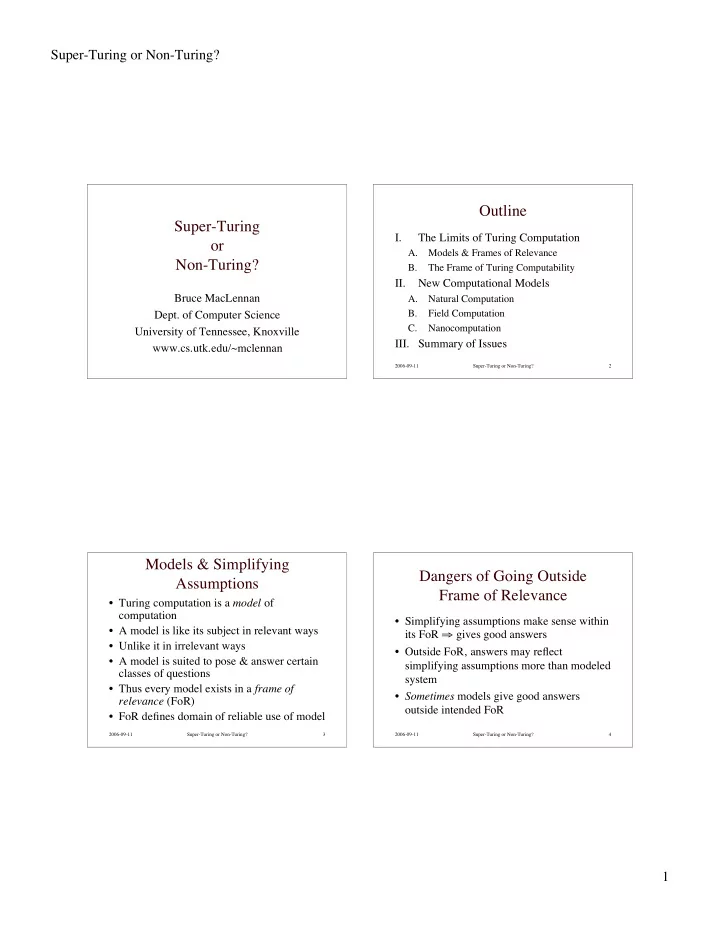
Outline

I. The Limits of Turing Computation

A. Models & Frames of Relevance B. The Frame of Turing Computability

II. New Computational Models

A. Natural Computation B. Field Computation C. Nanocomputation

  • III. Summary of Issues

2006-09-11 Super-Turing or Non-Turing? 3

Models & Simplifying Assumptions

  • Turing computation is a model of

computation

  • A model is like its subject in relevant ways
  • Unlike it in irrelevant ways
  • A model is suited to pose & answer certain

classes of questions

  • Thus every model exists in a frame of

relevance (FoR)

  • FoR defines domain of reliable use of model

2006-09-11 Super-Turing or Non-Turing? 4

Dangers of Going Outside Frame of Relevance

  • Simplifying assumptions make sense within

its FoR ⇒ gives good answers

  • Outside FoR, answers may reflect

simplifying assumptions more than modeled system

  • Sometimes models give good answers
  • utside intended FoR
slide-2
SLIDE 2

Super-Turing or Non-Turing? 2

2006-09-11 Super-Turing or Non-Turing? 5

The FoR of Turing Computation

  • Historical roots: issues of formal

calculability & provability in axiomatic mathematics; hence:

– finite number of steps & finite but unlimited resources – computation viewed as function evaluation – discreteness assumptions

2006-09-11 Super-Turing or Non-Turing? 6

Idealizing Assumptions

  • Finite but unbounded resources
  • Discreteness & definiteness
  • Sequential time
  • Computational task = evaluation of well-

defined function

2006-09-11 Super-Turing or Non-Turing? 7

Alternative Frames of Relevance

  • Is TC the only kind of computation?
  • Natural computation
  • Field computation
  • Nanocomputation

2006-09-11 Super-Turing or Non-Turing? 8

Natural Computation

  • Natural computation = computation
  • ccurring in nature or inspired by it
  • Occurs in nervous systems, DNA,

microorganisms, animal groups

  • Good models for robust, efficient &

effective artificial systems (autonomous robots etc.)

  • Different issues are relevant
slide-3
SLIDE 3

Super-Turing or Non-Turing? 3

2006-09-11 Super-Turing or Non-Turing? 9

Relevant Issues Outside TC FoR

  • Real-time control
  • Continuous computation
  • Robustness
  • Generality, flexibility & adaptability
  • Non-functional computation

2006-09-11 Super-Turing or Non-Turing? 10

Real-Time Control

  • Real-time (RT) response constraints
  • Asymptotic complexity is usually irrelevant

– Input size typically constant or of limited variability – Computational resources are bounded

  • Relevant: relation of RT response rate to RT

rates of its components

2006-09-11 Super-Turing or Non-Turing? 11

Continuous Computation

  • Inputs & outputs often:

– Are continuous quantities – Vary continuously in real time

  • Computational processes often continuous
  • Obviously can be approximated by discrete

quantities varying at discrete times, but …

2006-09-11 Super-Turing or Non-Turing? 12

“Metaphysics” of Reals

  • “Metaphysical issues”:

– Turing-computable reals vs. standard reals – Standard reals vs. non-standard reals

  • Results depend on “metaphysical issues” ⇒
  • utside FoR of model
  • Naïve real analysis is sufficient for models
  • f natural computation
slide-4
SLIDE 4

Super-Turing or Non-Turing? 4

2006-09-11 Super-Turing or Non-Turing? 13

Cross-Frame Comparisons

  • Can we compare models with different

FoRs?

  • Yes: can translate one to other’s FoR
  • Typically make incompatible simplifying

assumptions

  • Results may depend on specifics of

translation

  • E.g., how are continuous quantities

represented in TC?

2006-09-11 Super-Turing or Non-Turing? 14

Within-Frame Comparison

Common Frame of Relevance Model 1 Model 2 Comparison OK

2006-09-11 Super-Turing or Non-Turing? 15

FoR B

Cross-Frame Comparison

FoR A Model 1 Model 2 Meaningless Comparison

2006-09-11 Super-Turing or Non-Turing? 16

FoR B

Translated Comparison

FoR A Model 1 Model 2 Meaningful Comparison, But Relevant? Model 1′ trans- lation

slide-5
SLIDE 5

Super-Turing or Non-Turing? 5

2006-09-11 Super-Turing or Non-Turing? 17

FoR C FoR B

Translation to Third Frame

FoR A Model 1 Model 2′ Relevant? Model 1′ trans- lation Model 2 trans- lation

2006-09-11 Super-Turing or Non-Turing? 18

Field Computation

  • Field computation = computation of

continuous distributions of continuous data

  • Examples:

– Optical computing – Kirkhoff machines – Cortical maps – Very dense cellular automata

2006-09-11 Super-Turing or Non-Turing? 19

Nanocomputation

  • Computation involving sub-micron devices

& arrangements of information

  • Examples:

– Molecular computation (e.g., DNA) – Quantum computation – Nanoscale electronic logic gates (SETs etc.)

2006-09-11 Super-Turing or Non-Turing? 20

Relevant Issues Outside TC FoR

  • Error, noise & uncertainty are unavoidable

– must be part of model of computation – may be used productively

  • Microscopic reversibility may occur

– e.g., reversible chemical reactions – want statistical or macroscopic progress

  • Computation proceeds asynchronously in

continuous-time parallelism

slide-6
SLIDE 6

Super-Turing or Non-Turing? 6

2006-09-11 Super-Turing or Non-Turing? 21

Conclusions

2006-09-11 Super-Turing or Non-Turing? 22

Super-Turing and Non-Turing

  • Notion of Super-Turing computation is

relative to FoR of Turing computation

  • Super-Turing computation is important, but

so is Non-Turing computation

2006-09-11 Super-Turing or Non-Turing? 23

Some Issues in Non-Turing Computation

  • What is computation in broad sense?
  • What FoRs are appropriate for non-Turing

computation?

  • Models of non-Turing computation
  • How fundamentally to incorporate error,

uncertainty, imperfection, reversibility?

  • How systematically to exploit new physical

processes?