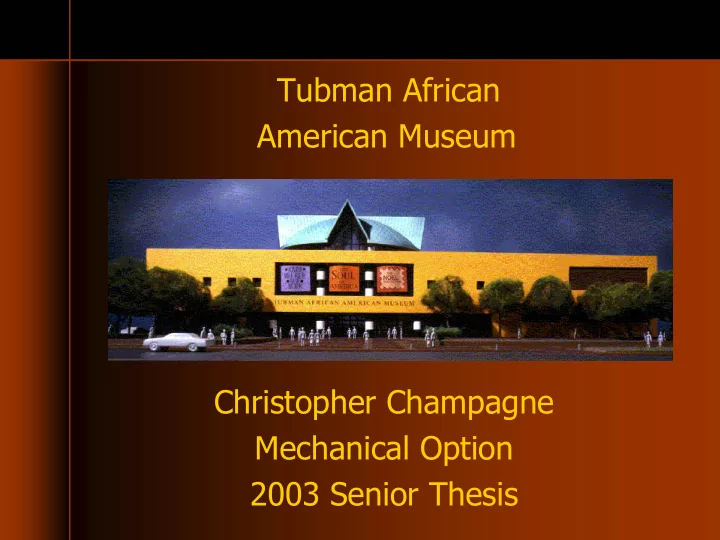
Tubman African American Museum Christopher Champagne Mechanical - - PowerPoint PPT Presentation

tubman african american museum christopher champagne
SMART_READER_LITE
LIVE PREVIEW

Tubman African American Museum Christopher Champagne Mechanical - - PowerPoint PPT Presentation

Tubman African American Museum Christopher Champagne Mechanical Option 2003 Senior Thesis Presentation Outline Presentation Goals Existing Conditions Existing Mechanical System Chiller Optimization Chilled Water Pumping Lighting of


slide-1
SLIDE 1

Tubman African American Museum Christopher Champagne Mechanical Option 2003 Senior Thesis

slide-2
SLIDE 2

Christopher Champagne Mechanical Option Tubman African American Museum Atlanta, Georgia

Presentation Outline Presentation Goals Existing Conditions Existing Mechanical System Chiller Optimization Chilled Water Pumping Lighting of Gallery Space Conclusions and Recommendations

slide-3
SLIDE 3

Christopher Champagne Mechanical Option Tubman African American Museum Atlanta, Georgia

Presentation Outline Presentation Goals Existing Conditions Existing Mechanical System Chiller Optimization Chilled Water Pumping Lighting of Gallery Space Conclusions and Recommendations

slide-4
SLIDE 4

Christopher Champagne Mechanical Option Tubman African American Museum Atlanta, Georgia

Presentation Goals

Investigation of the air-cooled water chillers:

  • Museums have low load profiles during the evenings when
  • nly the exhibit spaces or anywhere artwork is stored needs to

be cooled.

  • A smaller chiller for off-hours cooling and a larger one for
  • ccupied mode.
  • Staging of the chillers to see if an energy savings could be

realized. Investigation of switching from constant speed pumping to variable speed pumping:

  • Advantages of primary-only, variable speed pumping.
  • Possibility of switching the chilled water pumps in this case.
  • Should the switch be made?

Investigation of current lighting system in gallery space

slide-5
SLIDE 5

Christopher Champagne Mechanical Option Tubman African American Museum Atlanta, Georgia

Presentation Outline Presentation Goals Existing Conditions Existing Mechanical System Chiller Optimization Chilled Water Pumping Lighting of Gallery Space Conclusions and Recommendations

slide-6
SLIDE 6

Christopher Champagne Mechanical Option Tubman African American Museum Atlanta, Georgia

Existing Conditions

Location: Atlanta, GA Use: Museum Size: 45,000 ft2 Two stories Construction Started: October 2001 Planned Completion: Spring 2004 Construction Cost: $15.5 million

slide-7
SLIDE 7

Christopher Champagne Mechanical Option Tubman African American Museum Atlanta, Georgia

Design Team

The PRD Group, Ltd Exhibit Designer Souza, True and Partners, Inc. Structural Vanderweil Engineers M/E/P Harmon-Piedmont Construction, LLC CM/GC

  • E. Verner Johnson and

Associates, Inc. Architect

slide-8
SLIDE 8

Christopher Champagne Mechanical Option Tubman African American Museum Atlanta, Georgia

Presentation Outline Presentation Goals Existing Conditions Existing Mechanical System Chiller Optimization Chilled Water Pumping Lighting of Gallery Space Conclusions and Recommendations

slide-9
SLIDE 9

Christopher Champagne Mechanical Option Tubman African American Museum Atlanta, Georgia

Existing Mechanical System (2) 121.5 ton HCFC-22 air-cooled water chillers (3) 290 GPM chilled water pumps (2) 25,000 CFM constant volume and (1) 18,000 CFM variable volume custom air handling unit.

slide-10
SLIDE 10

Christopher Champagne Mechanical Option Tubman African American Museum Atlanta, Georgia

Chilled Water Equipment

(2) Trane Air-Cooled Water Chillers 121.5 tons 290 GPM EWT = 55 ˚F LWT = 45 ˚F HCFC-22 Refrigerant Screw compressor (3) Bell & Gossett 1510 - 2 ½ BB Pumps 290 GPM 65 ft. head 1750 RPM 10.0 motor HP (1) Pump Standby

slide-11
SLIDE 11

Christopher Champagne Mechanical Option Tubman African American Museum Atlanta, Georgia

Presentation Outline Presentation Goals Existing Conditions Existing Mechanical System Chiller Optimization Chilled Water Pumping Lighting of Gallery Space Conclusions and Recommendations

slide-12
SLIDE 12

Christopher Champagne Mechanical Option Tubman African American Museum Atlanta, Georgia

Chiller Optimization Technique

The maximum cooling load is 189.1 tons on July 15th at 2 pm using Atlanta Bin Data and Carrier’s Hourly Analysis Program (HAP). Engineering Equation Solver (EES) was used to simulate two equal

size air-cooled chillers

  • 1. Trane Air-Cooled Series R Rotary Liquid Chillers Model RTAA

125 (Design Capacity = 120.1 ton)

  • 2. Trane RTAA 110 (Design Capacity = 108.5 ton)
  • 3. Trane RTAA 100 (Design Capacity = 100.6 ton).

Upper capacity that one chiller would run before the second chiller was run was varied from 85% to 100% of capacity to see which is the most efficient. The lower capacity at which the second chiller would turn off was set to 40%.

slide-13
SLIDE 13

Christopher Champagne Mechanical Option Tubman African American Museum Atlanta, Georgia

Chiller Optimization Equations

The optimization equations used in the EES simulation are from the California Energy Commission’s 2001 Non-Residential Alternative Calculation Methods (ACMs) document, specifically Chapter 2 entitled “Reference Method and Required Modeling Capabilities for Alternative Calculation Methods (ACMs).” The following three terms are functions of chilled water supply temperature (Tchws) and the outdoor dry-bulb temperature (Toa). They are used to establish the efficiency of the chiller

  • peration.

CAP_FT is the full load capacity as a fraction of rated capacity. It is a capacity correction that is a function of those terms. EIR_FT is the full load efficiency (kW/ton) as fraction of rated

  • capacity. It is an efficiency correction factor.

EIR_FPLR is the fraction of full load power as a function of fraction

  • f full load output.
slide-14
SLIDE 14

Christopher Champagne Mechanical Option Tubman African American Museum Atlanta, Georgia

EES Model Cases

100 40 113.6 100.6 100 L 100 40 108.5 108.5 110 K 100 40 120.1 120.1 125 J 95 40 113.6 100.6 100 I 95 40 108.5 108.5 110 H 95 40 120.1 120.1 125 G 85 40 113.6 100.6 100 F 85 40 108.5 108.5 110 E 85 40 120.1 120.1 125 D 90 40 113.6 100.6 100 C 90 40 108.5 108.5 110 B 90 40 120.1 120.1 125 A

  • Cap. (%)
  • Cap. (%)

Upper Lower kW Ton Model Case

slide-15
SLIDE 15

Christopher Champagne Mechanical Option Tubman African American Museum Atlanta, Georgia

Electrical Utility Rates

6.910¢ per kWh Next 190,000 kWh 8.026¢ per kWh Next 7,000 kWh 8.757¢ per kWh First 3,000 kWh All consumption (kWh) not greater than 200 hours 200 hours times the billing demand. $14.00 Base Charge (includes first 25 kWh or less

The electricity would be provided by Georgia Power (a subsidiary of Southern Company). PLM-3 rate which is for small to medium building size. “Not less than 30 kW but less than 500 kW.”

slide-16
SLIDE 16

Christopher Champagne Mechanical Option Tubman African American Museum Atlanta, Georgia

Annual Operating Cost and Time

7 2 14,121 81,393 929,304 L 3 3 13,583 81,763 934,654 K 1 1 12,670 81,284 927,718 J 10 7 14,907 88,964 1,038,866 I 5 5 13,966 85,299 985,828 H 2 4 13,136 84,717 977,400 G 12 11 15,350 93,495 1,104,441 F 9 12 14,762 93,794 1,108,762 E 6 10 14,034 92,981 1,096,997 D 11 8 15,014 88,964 1,038,866 C 8 9 14,339 89,291 1,043,601 B 4 6 13,618 88,572 1,033,188 A Rankings Rankings (hrs) ($) (kWh) Operating Time Cost Operating Time Operating Cost AEC Case

slide-17
SLIDE 17

Christopher Champagne Mechanical Option Tubman African American Museum Atlanta, Georgia

Annual Operating Cost

75,000 80,000 85,000 90,000 95,000 Cost ($) 1

Annual Energy Cost

A B C D E F G H I J K L

slide-18
SLIDE 18

Christopher Champagne Mechanical Option Tubman African American Museum Atlanta, Georgia

Life Cycle Cost of Chillers

$75,000 100.6 100 C $84,000 108.5 110 B $96,000 120.1 125 A First Cost (FC) Ton Model Case

Where: FC = first cost of plant UCj = plant utility cost for year j MCj = relative maintenance cost for year j d = discount rate N = number of years of analysis

MCj = $500 d = 12 % N = 20

The following formula from CoolTools was used in the calculation of the LCC.

( )

( )

( )

=

+ ÷ + + =

N j j j j

d MC UC FC LCC

1

1

slide-19
SLIDE 19

Christopher Champagne Mechanical Option Tubman African American Museum Atlanta, Georgia

Life Cycle Cost of Chillers

$706,880.98 $698,458.84 $686,695.15 500,000.00 550,000.00 600,000.00 650,000.00 700,000.00 750,000.00 Cost ($) RTAA 125 RTAA 110 RTAA 100 Trane Model Number

LCC of Different Size Chillers

slide-20
SLIDE 20

Christopher Champagne Mechanical Option Tubman African American Museum Atlanta, Georgia

Chiller Optimization Recommendation

  • The RTAA 100 has the smallest life cycle cost

based on the assumptions stated above.

  • However given its tonnage being only slightly

above the design cooling load, this might not be a wise selection.

  • The RTAA 110 would still provide cost savings
  • ver the RTAA 125 (LCC savings = $10,422.14), along

with some added safety to the designer.

  • The staging should be set to 100% of capacity
  • f the first chiller before the second chiller is

turned on.

slide-21
SLIDE 21

Christopher Champagne Mechanical Option Tubman African American Museum Atlanta, Georgia

Presentation Outline Presentation Goals Existing Conditions Existing Mechanical System Chiller Optimization Chilled Water Pumping Lighting of Gallery Space Conclusions and Recommendations

slide-22
SLIDE 22

Christopher Champagne Mechanical Option Tubman African American Museum Atlanta, Georgia

Chilled Water Pumping

One method of saving energy used by a building is changing the primary pumps of a primary-only, chilled water system from constant speed to variable speed. Important Considerations: Does the chilled water system meets the requirements for being switched from constant speed to variable speed pumps? What is the overall economic benefit along with benefits that are not quantifiable?

slide-23
SLIDE 23

Christopher Champagne Mechanical Option Tubman African American Museum Atlanta, Georgia

Advantages of Variable Speed Pumps

  • Improved efficiency (motor and pump) and

consequently energy savings.

  • Reduced system noise.
  • Improved control of system flow to respond to flow

and pressure requirements of the system.

  • Extended motor life due to soft stops & starts

which puts less wear and tear on the parts of the pump.

  • Lower installation cost.
  • The control valve in the bypass ensures that

neither of the chillers would become “starved” during a low load situation, as flow is diverted directly from the supply back to the chillers.

slide-24
SLIDE 24

Christopher Champagne Mechanical Option Tubman African American Museum Atlanta, Georgia

Possibility of Switching Pumps

Trane mentions four situations where variable primary flow should not be used (Trane, 1999). They are for system where: System chilled-water temperature is critical. Examples are a “clean room” or computer chip making plants.

  • Although there are specific temperature and humidity guidelines

for a museum, they are not critical. Slight temporary fluctuations will not cause permanent damage to the artifacts. The system flow rate, and consequently the load, does not vary.

  • The load does vary in the Tubman Museum, between the occupied

hours and the unoccupied hours. Also, due to the large transient load of occupants, the location of the load varies frequently within the inside of the building during the occupied hours. It is unlikely that the owner/operator will run the plant as designed.

  • This is a slight area of concern, but something that doesn’t

eliminate the use of variable speed pumps for the system. Existing chiller controls are old and inaccurate.

  • This is a new construction project, so this also is not a concern.
slide-25
SLIDE 25

Christopher Champagne Mechanical Option Tubman African American Museum Atlanta, Georgia

Current Piping Schematic

CHILLER 1 (CH-1): CAPACITY = 121.5 TONS HCFC-22 REFRIGERANT (2) SCREW COMPRESSORS (10) CONDENSER FANS 1.0 HP EACH 850 RPM AMBIENT MAX = 95°F AMBIENT MIN = 23°F CHILLER 2 (CH-2): CAPACITY = 121.5 TONS HCFC-22 REFRIGERANT (2) SCREW COMPRESSORS (10) CONDENSER FANS 1.0 HP EACH 850 RPM AMBIENT MAX = 95°F AMBIENT MIN = 23°F AFTER CHILLER: LWT = 45°F 290 GPM AFTER CHILLER: LWT = 45°F 290 GPM BEFORE CHILLER: EWT = 55°F 290 GPM BEFORE CHILLER: EWT = 55°F 290 GPM CHWS CHWR CHWS CHWR AIR SEPARATOR EXPANSION TANK CS PUMP (P-4): FOR ALL PUMPS: 290 GPM WATER TEMP. = 55°F NPSHR = 8.4 FT HEAD = 65 FT PUMP RPM = 1750 BHP = 7.25 MOTOR HP = 10 CS PUMP (P-3): CSPUMP (P-6): (STAND BY) SHOT CHEMICAL FEEDER PRESSURE RELIEF VALVE BALL VALVE BUTTERFLY VALVE BUTTERFLY VALVE WITH MEMORY STOP (BALANCING VALVE) CHECK VALVE STRAINER W/BALL VALVE, HOSE BIBB & CAP AUTOMATIC CONTROL VALVE, MODULATING ACTUATOR COMBINATION FLOWMETER/SHUT OFF/BALANCING VALVE (CIRCUIT SETTER) UNION OR FLANGE LEGEND: AHU-1A&1B (LOAD) AHU-2 (LOAD)

slide-26
SLIDE 26

Christopher Champagne Mechanical Option Tubman African American Museum Atlanta, Georgia

Proposed Piping Schematic

CHILLER 2 (CH-2): CAPACITY = 108.5 TONS HCFC-22 REFRIGERANT (2) SCREW COMPRESSORS (10) CONDENSER FANS 1.0 HP EACH 850 RPM AMBIENT MAX = 95°F AMBIENT MIN = 23°F BALL VALVE BUTTERFLY VALVE BUTTERFLY VALVE WITH MEMORY STOP (BALANCING VALVE) CHECK VALVE STRAINER W/BALL VALVE, HOSE BIBB & CAP AUTOMATIC CONTROL VALVE, MODULATING ACTUATOR COMBINATION FLOWMETER/SHUT OFF/BALANCING VALVE (CIRCUIT SETTER) UNION OR FLANGE AFTER CHILLER: LWT = 45°F 290 GPM FOR ALL PUMPS: 290 GPM WATER TEMP. = 55°F NPSHR = 8.4 FT HEAD = 65 FT VS PUMP (P-3): VS PUMP (P-4): VSPUMP (P-6): (STAND BY) EXPANSION TANK LEGEND: CHWR AIR SEPARATOR CHWS SHOT CHEMICAL FEEDER PRESSURE RELIEF VALVE CHWS CHWR CHILLER 2 (CH-2): CAPACITY = 108.5 TONS HCFC-22 REFRIGERANT (2) SCREW COMPRESSORS (10) CONDENSER FANS 1.0 HP EACH 850 RPM AMBIENT MAX = 95°F AMBIENT MIN = 23°F BEFORE CHILLER: EWT = 55°F 290 GPM AFTER CHILLER: LWT = 45°F 290 GPM AHU-1A&1B (LOAD) BEFORE CHILLER: EWT = 55°F 290 GPM AHU-2 (LOAD)

slide-27
SLIDE 27

Christopher Champagne Mechanical Option Tubman African American Museum Atlanta, Georgia

Chilled Water Bypass Control

Normally closed control valve. Permits the operation of a single chiller below its low flow limit. Programmed to maintain only the minimum flow for each chiller that is on as opposed to constant flow, which would waste energy. Located near to the chillers so that the pressure drop throughout the system can drop as the coil loads drop.

slide-28
SLIDE 28

Christopher Champagne Mechanical Option Tubman African American Museum Atlanta, Georgia

Additional Costs

Savings: The three-way valves are replaced with two-way valves at the AHU’s. Less piping needs to be around the load with the elimination of the three-way valves. Steel schedule 40 piping, which costs $97 per linear foot for 6” piping for 100 feet of piping, meaning a savings of $9,700. Costs: A control valve in the bypass has to be added in the bypass line, which would typically cost $1950. Three variable frequency drives must be purchased each costing $5,800. Additional cost = $9,650.

slide-29
SLIDE 29

Christopher Champagne Mechanical Option Tubman African American Museum Atlanta, Georgia

Cost Savings – Energy

There are several different techniques available for calculating the energy savings (kWh) for variable speed pumps. Carrier’s Hourly Analysis Program (HAP) Bell & Gossett ESP-Plus Online Program Engineering Equation Solver (EES) The results from EES will be presented further.

slide-30
SLIDE 30

Christopher Champagne Mechanical Option Tubman African American Museum Atlanta, Georgia

Engineering Equations Solver (EES)

The following terms were created using lookup tables: Flow Rate vs. Head Flow Rate vs. Pump Efficiency Percent of Nameplate Load vs. Motor Efficiency Percent of Design Speed vs. Drive Efficiency (for the Variable speed pumps only) Individual functions were created for: Total Power Pump Efficiency Pump Model Curve Percent of Nameplate Load Deciding Number of Pumps Operating Based on the Load Speed the Variable Speed Pumps Operate At

slide-31
SLIDE 31

Christopher Champagne Mechanical Option Tubman African American Museum Atlanta, Georgia

Engineering Equations Solver (EES)

slide-32
SLIDE 32

Christopher Champagne Mechanical Option Tubman African American Museum Atlanta, Georgia

Engineering Equations Solver (EES)

slide-33
SLIDE 33

Christopher Champagne Mechanical Option Tubman African American Museum Atlanta, Georgia

Life Cycle Cost of Pumps

Where: FC = first cost of equipment UCj = utility cost for year j MCj = relative maintenance cost for year j d = discount rate N = number of years of analysis The following formula from CoolTools was used in the calculation of the LCC.

( )

( )

( )

=

+ ÷ + + =

N j j j j

d MC UC FC LCC

1

1

In this example: FCconstant = $0 FCvariable = $9,650 MCj = $500 d = 12% N = 20 years UCj constant speed = $4,092 UCj variable speed = $2,369

slide-34
SLIDE 34

Christopher Champagne Mechanical Option Tubman African American Museum Atlanta, Georgia

Payback Period of Pumps

Initial Additional Cost for Variable Speed Pumps = $9,650 Yearly Savings = $1,723.53 Payback Period = $9,650 / $1,723.53 = 5.6 years

slide-35
SLIDE 35

Christopher Champagne Mechanical Option Tubman African American Museum Atlanta, Georgia

Chilled Water Pumping Conclusion

Based solely on cost, it makes sense to switch from constant speed pumps to variable-speed pumps. The LLC is $3,219.85 less for variable speed. The payback period is slightly lengthy, but realistic.

slide-36
SLIDE 36

Christopher Champagne Mechanical Option Tubman African American Museum Atlanta, Georgia

Presentation Outline Presentation Goals Existing Conditions Existing Mechanical System Chiller Optimization Chilled Water Pumping Lighting of Gallery Space Conclusions and Recommendations

slide-37
SLIDE 37

Christopher Champagne Mechanical Option Tubman African American Museum Atlanta, Georgia

Lighting of Gallery Space

The lighting system for a gallery space in the museum (Collection Gallery 255) was designed using industry guidelines. The IESNA Lighting Handbook – Ninth Edition (2000)

slide-38
SLIDE 38

Christopher Champagne Mechanical Option Tubman African American Museum Atlanta, Georgia

Placement of Luminaries

X = (Ceiling height – eye level) * 0.577 = (15’-0” – 5’6”) * 0.577 = 66” = 5’-6”

slide-39
SLIDE 39

Christopher Champagne Mechanical Option Tubman African American Museum Atlanta, Georgia

Lightscape Renderings

Southeast corner of room from above South of the room from above

slide-40
SLIDE 40

Christopher Champagne Mechanical Option Tubman African American Museum Atlanta, Georgia

Target Illuminance

The IESNA Lighting Handbook target illuminance for: Flat displays and 3-dimensional objects is 300 lx (30 fc) Lobbies, general gallery areas and corridors is 100 lx (10 fc).

slide-41
SLIDE 41

Christopher Champagne Mechanical Option Tubman African American Museum Atlanta, Georgia

Photometric Data

Southeast corner of room from above

slide-42
SLIDE 42

Christopher Champagne Mechanical Option Tubman African American Museum Atlanta, Georgia

Photometric Data

South of the room from above

slide-43
SLIDE 43

Christopher Champagne Mechanical Option Tubman African American Museum Atlanta, Georgia

Lighting of Gallery Space Conclusion

The new lighting design is compliant with the lighting requirements stated in the IESNA Lighting Handbook for illuminance. Artwork and artifacts are accentuated.

slide-44
SLIDE 44

Christopher Champagne Mechanical Option Tubman African American Museum Atlanta, Georgia

Presentation Outline Presentation Goals Existing Conditions Existing Mechanical System Chiller Optimization Chilled Water Pumping Lighting of Gallery Space Conclusions and Recommendations

slide-45
SLIDE 45

Christopher Champagne Mechanical Option Tubman African American Museum Atlanta, Georgia

Conclusions and Recommendations

The RTAA 110 would still provide cost savings (LCC savings = $10,422.14) over the RTAA 125, along with some added safety to the designer and should be selected. The staging should be set to 100% of capacity of the first chiller before the second chiller is turned on. The primary-only, chilled water pumps should be switched from constant speed pumps to variable-speed

  • pumps. The LCC is $3,219.85 less for variable speed.

Variable speed control also has some advantages that are not quantifiable in economic terms. The new lighting design is compliant with the lighting requirements stated in the IESNA Lighting Handbook.

slide-46
SLIDE 46

Christopher Champagne Mechanical Option Tubman African American Museum Atlanta, Georgia

Acknowledgements

I would like to thank the following people who have made my thesis possible:

  • The Pennsylvania State University Department of

Architectural Engineering faculty including:

  • My advisor, Dr. James Freihaut
  • Dr. William Bahnfleth and Dr. Stanley Mumma
  • Jonathan Dougherty, Moses Ling, M. Kevin

Parfitt and Kenneth Davidson

  • Vanderweil Engineers, especially Heather Tsatsarones

and Ron Edwards

  • Fellow architectural engineering students who have

lent their knowledge and expertise

  • Mom, Dad and Jen who are always there for me
  • My friends who have been understanding and helpful
slide-47
SLIDE 47

Christopher Champagne Mechanical Option Tubman African American Museum Atlanta, Georgia

Questions Thank you for your time Any questions ???