Trucking 101 IFTA/IRP 2006 Audit Workshop Bob Pitcher Page - - PDF document

trucking 101
SMART_READER_LITE
LIVE PREVIEW

Trucking 101 IFTA/IRP 2006 Audit Workshop Bob Pitcher Page - - PDF document

Trucking 101 IFTA/IRP 2006 Audit Workshop Bob Pitcher Page Dunnegan DeAnn Williams Donna Burch Size & Scope (U.S.) $585 Billion gross freight revenue (02) 86.5% of the Nations freight bill 67.8% of US-Canada trade by


slide-1
SLIDE 1

1

Trucking 101

IFTA/IRP 2006 Audit Workshop Bob Pitcher Page Dunnegan DeAnn Williams Donna Burch

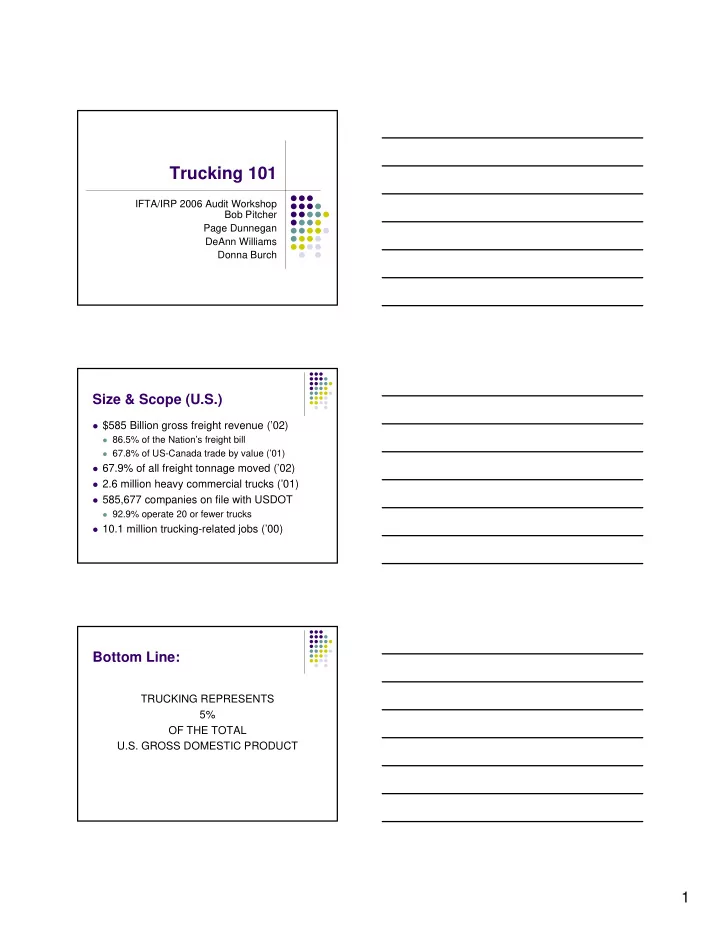
Size & Scope (U.S.)

$585 Billion gross freight revenue (’02)

86.5% of the Nation’s freight bill 67.8% of US-Canada trade by value (’01)

67.9% of all freight tonnage moved (’02) 2.6 million heavy commercial trucks (’01) 585,677 companies on file with USDOT

92.9% operate 20 or fewer trucks

10.1 million trucking-related jobs (’00)

Bottom Line:

TRUCKING REPRESENTS 5% OF THE TOTAL U.S. GROSS DOMESTIC PRODUCT

slide-2
SLIDE 2

2

A Changing Industry

New Styles of Manufacturing & Retailing New Logistics Demands

Just-in-Time Plus Supply-Chain Management Rolling Warehouses

Economic Regulation & Categories Gone:

Competition Intense

Industry Now Must Be Flexible, Agile

Old Categories Gone

Common Carriers Contract Carriers Exempt Carriers Regular-route Carriers Irregular-route Carriers

Functional Categories Remain

Private Carriers For-Hire Carriers

LTL TL Movers Package Carriers Other, by equipment, freight, operation

Truck Leasing Companies

slide-3
SLIDE 3

3

Impacts on Household Goods Carriers

“Household Goods Carrier” means a carrier handling: (a) personal effects and property used or to be used in a dwelling; (b) furniture, fixtures, equipment, and the property of stores

  • ffices, museums, institutions, hospitals or other

establishments, when a part of the stock, equipment, or supply of such stores, offices, museums, institutions, including objects of art, displays and exhibits, which, because of their unusual nature or value, require the specialized handling and equipment usually employed in moving household goods.

Characteristics of a Household Goods Carrier

HHG Carrier Agent of HHG Carrier

HHG carrier leases vehicles from agent to

  • perate under

carrier’s operating authority Permanent lease

  • r

Intermittent lease

Characteristics of Agent

  • f HHG Carrier

Agent Vehicle Either Agent owns vehicle

  • r

leases from 3rd party

Agent has own trucking

  • peration and operates

under: Carrier’s authority and/or Agent’s own authority

slide-4
SLIDE 4

4

Who Reports the IFTA?

IFTA ARTICLES OF AGREEMENT ARTICLE V. LICENSING

  • D5. In case of a household goods carrier using independent contractors, agents, or

service representatives, under intermittent leases, the party liable for motor fuel tax shall be: a. The lessee (carrier) when the qualified motor vehicle is being operated under the lessee’s jurisdictional operating authority. b. The lessor (agent, IOO or service representative) when the qualified motor vehicle is being operated under the lessor’s (agent’s) jurisdictional operating

  • authority. The base jurisdiction … shall be the base jurisdiction of the lessor,

regardless of the jurisdiction in which the qualified motor vehicle is registered for vehicle registration purposes.

Who Reports the IFTA?

(continued)

HHG Carrier Lease Agreement

HHG Agent

HHG Carrier’s Authority HHG Agent’s Authority

HHG Carrier’s IFTA Return to Carrier’s base jurisdiction HHG Agent’s IFTA Return to agent’s base jurisdiction

Which IFTA Decal Do I Wear?

IFTA ARTICLES OF AGREEMENT ARTICLE VI. MOTOR VEHICLE IDENTIFICATION

  • G. Qualified motor vehicles that are to be operated by more than one IFTA

licensee during the calendar year may display IFTA decals for each active licensee concurrently.

HHG CARRIER’S DECAL HHG AGENT’S DECAL

slide-5
SLIDE 5

5

Types of Record Keeping Systems for HHG Carriers and their Agents

Driver submits paper/electronic trip record to either HHG carrier or agent HHG Agent’s computer system- electronically or manually HHG Carrier’s computer system- electronically or manually HHG Carrier’s reports HHG Agent’s reports

Types of Fuel Purchasing Practices for HHG Carriers and their Agents

OVER THE ROAD PURCHASES Fuel receipt attached to trip record BULK FUELING AT AGENT’S LOCATION Bulk fueling statement forwarded to HHG carrier by agent CARD LOCK FUELING AT AGENT’S LOCATION Card lock statement forwarded to HHG carrier by agent

IRP Registration Options for HHG Carriers and Agents

HHG Carrier

Obtains IRP…..

HHG Agent (Service Representative)

Obtains IRP…..

State IRP Apportioned Cab Card

USDOT # - HHG CARRIER Registrant – HHG Carrier Lessee/Lessor – HHG Agent (Service Representative)

State IRP Apportioned Cab Card

USDOT # - HHG CARRIER Registrant – HHG Carrier Lessee/Lessor – HHG Agent (Service Representative)

OR

slide-6
SLIDE 6

6

IRP Rewrite – Article XII Household Goods Carriers

254 SERVICE REPRESENTATIVE

"Service Representative" means a person who furnishes facilities and services, including sales, warehousing, motorized equipment, and drivers under contract or other arrangement to a motor carrier for the transportation of household goods.

273 HOUSEHOLD GOODS CARRIER

“Household Goods Carrier” means a motor carrier handling: (a) personal effects and property used or to be used in a dwelling; or (b) furniture, fixtures, equipment, and the property of stores, offices, museums, institutions, hospitals, or other establishments, when a part of the stock, equipment, or supply of such stores, offices, museums, or institutions, including

  • bjects of art, displays, and exhibits, which, because of their unusual nature or

value, require the specialized handling and equipment usually employed in moving household goods.

Article XII Household Goods Carriers

1200 EQUIPMENT LEASED FROM SERVICE REPRESENTATIVES

A household goods carrier using a vehicle leased from a service representative may elect to base the vehicle in the base jurisdiction of the service representative or in that of the carrier.

1204 REGISTRATION IN BASE OF SERVICE REPRESENTATIVE

When under section 1200 a household goods carrier elects to base a vehicle in the base jurisdiction of the service representative, the vehicle shall be registered in the name of the service representative, with the carrier shown as lessee, and the fees for the vehicle shall be apportioned according to the combined records of the service representative and the carrier. Such records must be kept or made available in the base jurisdiction of the service representative. A vehicle registered under this section shall be fully registered for operations under the authority of the service representative as well as that

  • f the carrier.

Article XII Household Goods Carriers

(Continued)

1206 REGISTRATION IN BASE OF CARRIER

When under section 1200 a household goods carrier elects to base a vehicle in the carrier’s base jurisdiction, the vehicle shall be registered in the carrier’s name, with the service representative shown as lessor, and the fees for the vehicle shall be apportioned according to the combined records of the service representative and the carrier. Such records shall be kept or made available in the base jurisdiction of the carrier. A vehicle registered under this section shall be fully registered for operations under the authority of the service representative as well as that of the carrier.

[The names of both the carrier as lessee and the service representative as lessor must be shown, since the vehicle is

  • perated on an intermittent basis under the carrier's interjurisdictional operating authority, pursuant to regulations of the

U.S. Department of Transportation, and the service representative's local or intrajurisdictional operating authority pursuant to regulations of a state or province. Intrajurisdictional distance records are to be maintained by the service representative and interjurisdictional distance records are to be maintained by the carrier and furnished to the service representative as may be necessary.]
slide-7
SLIDE 7

7

Are there differences between small and large motor carriers….and not just the size of the fleet????

Differences in Carrier Operations

Small carriers = one, two, up to 10 truck

  • peration.

Medium size carrier = less than 100

vehicles

Large size carrier = more than 100

vehicles

Small Carrier ( 1-10)

Many are owner/operators. Many will use a broker

for their loads and will travel coast to coast.

In the Midwest we have many small carriers that will

be regionalized and move agricultural commodities and may lease trucks to move the commodities. Fleets usually range from three vehicles up to ten.

Fuel and mileage reporting information is taken from

a trip reports that may be completed as a trip or on a weekly basis. Fuel receipts are attached to the trip

  • report. Local CO-OP’s will provide a monthly report
  • n fuel purchased
slide-8
SLIDE 8

8

Medium Carrier ( 11-100)

Many of the companies of this size will have

  • wner/operators and well as company owned

vehicles.

Some will have regionalized vehicles, but the

majority will be over the road trucks (coast to coast).

More of the computerized equipment is used in this

  • peration. Mileage programs are used. GPS is

utilized, but mainly as a communication tool.

Fuel purchases are made by “Purchase Cards” (P-

cards) or by local fueling agreements.

Large Carrier (100+)

Computer, computer, computer is the name of the game for

carriers of this size. Approved computer mileage programs are utilized, as well as computerized fuel pricing/mileage routing

  • system. GPS is used as a routing tool also.

Large carriers usually have two different divisions – linehaul

(over the road) and city operations.

The line haul trucks use a mileage program and base all miles for

reporting purposes on this. Vehicles fuel before leaving terminal and use the “P card” for over the road purchases.

City operations – Vehicles in this group make local deliveries

  • nly – deliveries within 100 miles of terminal. All vehicles use the

bulk fuel method. Daily trip reports are turned in at the end of the day and are completed manually. This information is entered into the company’s computer and this information is used for reporting

Leasing Industry

Truck Rental and Full Service Leasing

Long Term Short Term

Consumer Rental Finance Leasing – Maintenance Support

Tax Advantage Leases Traditional Financing

slide-9
SLIDE 9

9

Long Term Leases

Long-term Full Service Lease (FSL) as the name implies

provides customers with more than just financing and equipment. A Full Service Lease includes all the administration and maintenance needed to support truck transportation activities. Under a FSL, the LC purchases the equipment to conform to the customer’s specific needs. The customer enjoys the exclusive use of the vehicle under a long-term contract usually for four or more years. The vehicle is painted with the customer’s colors and logo. The LC provides services such as maintenance, safety, licensing, permitting and tax reporting, fuel, insurance, emergency road service and repairs and washing.

Short Term Leases ( Rentals)

Short-term Rental vehicles are available to

businesses on short-term notice and typically for a period of 29 days or less. These vehicles are generally identified with the LC and painted with their colors and logo. Rental vehicles can also be used as substitute or supplemental equipment to FSL customers to service peak or seasonal needs or to other qualified IFTA carriers to fulfill their supplemental equipment needs.

Consumer Rentals

One-Way Consumer Rentals are the move-it-

yourself part of the business. One-Way or local, families use these light duty trucks (non-IFTA qualified) usually for a short term of just a few days to move personal property. The LC assists the customers with the entire moving process including advice on packing and loading route selection and insurance. The vehicles are typically identified with the LC logo and colors.

slide-10
SLIDE 10

10

Finance Leasing

Finance Leased or Maintenance Only vehicles

has the same level of service provided to the FSL vehicles with the exception that the LC does not own the vehicle the customer does. Since the LC is not the Lessor, the IFTA account is in the customer’s name

What Does IFTA Say?

ARTICLE V R500 LESSORS/LESSEES AND HOUSEHOLD GOODS CARRIERS R510 RENTAL/LEASING .100 Short-Term Leases.

In the case of a short-term motor vehicle rental, by a lessor regularly engaged in the business of leasing, or renting motor vehicles without drivers, for compensation to licensees or other lessees of 29 days or less, the lessor will report and pay the fuel use tax unless the following two conditions are met:

.005 The lessor has a written rental contract which designates the lessee as the party responsible for reporting and paying the fuel use tax; and .010 The lessor has a copy of the lessee’s IFTA fuel tax license which is valid for the term of the rental.

What Does IFTA Say?

.200 Long-Term Leases.

A Lessor regularly engaged in the business of leasing or renting motor vehicles without drivers for compensation to licensees or other lessees may be deemed to be the licensee, and such Lessor may be issued a license if an application has been properly filed and approved by the base jurisdiction

slide-11
SLIDE 11

11

What does IRP Say?

ARTICLE XI REGISTRATION OF RENTAL VEHICLES

  • This article sets forth procedures specifically and solely applicable to

persons or firms engaged in the business of renting and/or leasing fleets of vehicles with or without drivers. A "rental fleet" must be designated as such by the "rental owner. "The intention of the IRP drafters in the adoption of this article was to allow, but not require, the

  • wner of a rental fleet to be the "registrant" (see Section 246) of such

fleet vehicles whether rented or leased. The minutes (Page 6) of the IRP Signatories Meeting held in St. Louis, Missouri, October 15-16, 1983, indicate as follows: The next subject discussed concerned the apportioned registration of rental fleets. In general, all vehicles that are leased by a registrant shall be apportioned in the name of the carrier. However, it was agreed that in the case of vehicles that are part of a rental fleet, such vehicles may be apportioned in the name of the rental company as part of the rental fleet even though such vehicles may be under long-term lease to an individual apportioned carrier.

IRP – Article Xl

1111 RENTAL VEHICLE: BASE JURISDICTION

The “base jurisdiction” definition in Section 210

  • f Article II applies under this Article and the

conditions therein specified must be met by the rental company as registrant of the fleet; except when the rental agreement is for more than sixty (60) days, the rental customer must have an established place of business and his fleet must accrue miles or kilometers in the jurisdiction selected as the base jurisdiction for the registration

IRP Rewrite

Eliminates special requirements for Leasing

Companies – treats all IRP qualified vehicles the same

Special article for Rental Passenger Cars

remains as is

slide-12
SLIDE 12

12

Challenges

Leasing Companies do not have control over the

Driver but depend on them for record keeping

Fuel may be purchased by the Lessor or Lessee

and include all of the fuel purchasing type programs available i.e..

Lessor or Lessee Bulk Fuel On Site Wet Fueling Third Party Credit Card Programs Cash Purchases Card-Lock Station Purchases

Challenges

Mileage Documentation may be in the

following forms:

Driver Trip Records – Lessor provided forms Driver Trip Records – Lessee provided forms On Board Recording Devices GPS based Systems

System Help

Validate individual vehicle MPG against

industry standards

Check for contiguous travel between

jurisdictions and trips

System check for vehicle liability ( intra vs

inter) and fuel type

Automate the capture of Lessor Bulk Fuel Record Imaging

slide-13
SLIDE 13

13

Keys to Success

Awareness of changing trucking

environment and economy

Flexibility in both IRP and IFTA plans Continued cooperation between

jurisdictions