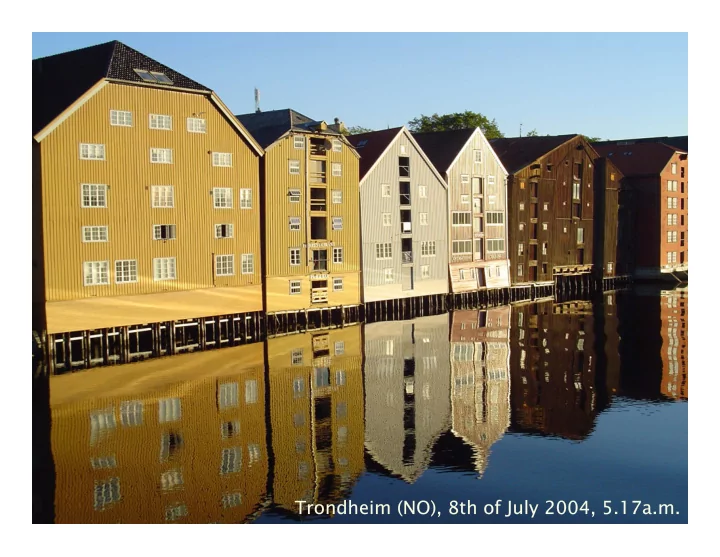
Trondhei Trondheim (NO), 8th of m (NO), 8th of July 2004, 5.17a.m. - - PowerPoint PPT Presentation

trondhei trondheim no 8th of m no 8th of july 2004 5 17a
SMART_READER_LITE
LIVE PREVIEW

Trondhei Trondheim (NO), 8th of m (NO), 8th of July 2004, 5.17a.m. - - PowerPoint PPT Presentation

Trondhei Trondheim (NO), 8th of m (NO), 8th of July 2004, 5.17a.m. July 2004, 5.17a.m. 2 Outline Outline 1. Introduction 2. CFD code SSIIM 3. Application and Results 4. Conclusion and Outlook 3 Introduction Introduction 1. Introduction


slide-1
SLIDE 1

Trondhei Trondheim (NO), 8th of m (NO), 8th of July 2004, 5.17a.m. July 2004, 5.17a.m.

slide-2
SLIDE 2

2

slide-3
SLIDE 3

3

Outline Outline

  • 1. Introduction
  • 2. CFD code SSIIM
  • 3. Application and Results
  • 4. Conclusion and Outlook
slide-4
SLIDE 4

4

Introduction Introduction

  • 1. Introduction
  • river management
  • management of water quality
  • ....many more topics

Why estimate sediment transport?

slide-5
SLIDE 5

5

Introduction Introduction

Patt (1998)

river management

slide-6
SLIDE 6

6

Introduction Introduction

water quality management

slide-7
SLIDE 7

7

Outline Outline

1.Introduction

  • 2. CFD code SSIIM
  • 3. Application and Results
  • 4. Conclusions and Outlook
slide-8
SLIDE 8

8

CFD code SSIIM - CFD code SSIIM - Basics asics

SSIIM acronym for runs on standard PC and is freeware Sediment Simulation In Intakes Sediment Simulation In Intakes with Multiblock option with Multiblock option developed by Nils developed by Nils R. B. Olsen at NTNU

  • R. B. Olsen at NTNU
slide-9
SLIDE 9

9

CFD code SSIIM - CFD code SSIIM - Basics asics

structured, non-orthogonal grid finite volume approach fully 3D

slide-10
SLIDE 10

10

CFD code SSIIM - CFD code SSIIM - Hydraulics ydraulics

III

III Pressure term SIMPL SIMPLE Method (Patankar 1980) Method (Patankar 1980)

I

I Transient term Implicit Method Implicit Method

II

II Convective term First First/Second Orde cond Order Scheme r Scheme

IV

IV Stress term Boussinesq Approx ussinesq Approx. & k- . & k-ε turb. closure

  • turb. closure

(Rodi 1993) (Rodi 1993)

slide-11
SLIDE 11

11

CFD code SSIIM – CFD code SSIIM – sediment transport mechanism ediment transport mechanism

Shields‘ approach (1936)

θ

z

u(z)

x

τ < { τ

c

θ

z

u(z)

x

τ >τc{

no partic particle le motion motion pa particle rticle motion motion

slide-12
SLIDE 12

12

CFD code SSIIM – CFD code SSIIM – sediment transport mechanism ediment transport mechanism

θ z x

y

Q α>0° and and θ>>0° ? 0° ?

α=0°

α x

y

z

Shi Shields lds

slide-13
SLIDE 13

13

CFD code SSIIM – CFD code SSIIM – sediment transport mechanism ediment transport mechanism

(Dey, 2001) (Dey, 2001)

slide-14
SLIDE 14

14

CFD code SSIIM – CFD code SSIIM – sediment transport mechanism ediment transport mechanism

Dey Deys e empirica pirical equa quation ion

slide-15
SLIDE 15

15

CFD code SSIIM – CFD code SSIIM – sediment transport mechanism ediment transport mechanism x z u(z)

slide-16
SLIDE 16

16

CFD code SSIIM – CFD code SSIIM – sediment transport mechanism ediment transport mechanism

x z u(z)

suspension load bed load bed material

δb

slide-17
SLIDE 17

17

CFD code SSIIM – CFD code SSIIM – sediment transport mechanism ediment transport mechanism

x z u(z)

suspension load bed load bed material rolling

δb

slide-18
SLIDE 18

18

CFD code SSIIM – CFD code SSIIM – sediment transport mechanism ediment transport mechanism

x z u(z)

suspension load bed load bed material saltation

δb

slide-19
SLIDE 19

19

CFD code SSIIM – CFD code SSIIM – sediment transport mechanism ediment transport mechanism

x z u(z)

suspension load bed load bed material rolling saltation Suspension

δb

slide-20
SLIDE 20

20

CFD code SSIIM – CFD code SSIIM – sediment transport mechanism ediment transport mechanism

x z u(z) δb

slide-21
SLIDE 21

21

CFD code SSIIM – CFD code SSIIM – sediment transport mechanism ediment transport mechanism

x z u(z) C(z)

slide-22
SLIDE 22

22

CFD code SSIIM – CFD code SSIIM – sediment transport mechanism ediment transport mechanism

x z u(z) C(z)

conv convection-diffusion ection-diffusion eqn. eqn.

slide-23
SLIDE 23

23

Outline Outline

1.Introduction

  • 2. CFD code SSIIM
  • 3. Application and Results
  • 4. Conclusions and Outlook
slide-24
SLIDE 24

24

Application and Results

Capabilities and limitations of SSIIM with regard to sediment transport Aim: Verification: physical experimental run

slide-25
SLIDE 25

25

Application and Results–physical model

125 mm 125 mm 350 mm 425 mm 200 mm 117° 490mm C L

  • uter bank

inclined area inner bank

plan view:

slide-26
SLIDE 26

26

side view:

100 mm 300 mm 150 mm 50 mm sand α =30°

Application and Results–physical model

slide-27
SLIDE 27

27

Application and Results–numerical model

side view:

∆y ∆z

1 2 3 4

Qin Qout

plan view:

slide-28
SLIDE 28

28

Application and Results–numerical model

Q=1.0 l/s discharge h=50 mm mean flow depth I0=0.005 mean bed slope D50=0.7 mm mean particle diameter Flow condition Flow condition ∆t=4h simulation time

slide-29
SLIDE 29

29

Application and Results – Exp. vs. SSIIM

Experiment/measurements Computed by SSIIM without Dey algorithm Q Q

slide-30
SLIDE 30

30

Application and Results – Exp. vs. SSIIM

Computed by SSIIM with Dey algorithm Q Experiment/measurements Q

slide-31
SLIDE 31

31

Application and Results – Exp. vs. SSIIM

Computed by SSIIM with Dey algorithm Photo by Guymer and Dutton, Sheffield Q

slide-32
SLIDE 32

32

Conclusions and Outlook Conclusions and Outlook

  • …improved results if using ‘sloping bed

algorithm’.

SSIIM shows…

  • …a quantitative overprediction in erosion.

an interesting topic for further research!

  • …that overall trends in deposition and erosion

agree on the main points.

slide-33
SLIDE 33

33

Conclusions and Outlook Conclusions and Outlook

…to conclude:

  • Hydraulic calculation 3D
  • Sediment transport model 1D – empirical input

Applying these models give fairly good agreement with measurements

slide-34
SLIDE 34

34

Conclusions and Outlook Conclusions and Outlook

…to conclude:

  • SSIIM is a reliable instrument in river,

environmental and sedimentation engineering.

  • SSIIM’s ability to run on standard PCs will

promote its distribution among practical working hydraulic engineers,

  • and will cause it to be accepted as a design tool

for water and environmental related engineering.

slide-35
SLIDE 35

35

Conclusions and Outlook Conclusions and Outlook

Last but not least:

eye candy: time-dependent development of bed topography

slide-36
SLIDE 36

.....Thank you for your attention. Diploma Thesis available @:

http://www.stud.uni-karlsruhe.de/~uj8a/thesis/da.pdf

slide-37
SLIDE 37

.....Thank you for your attention.