TRISTAN measurements at Troitsk nu-mass experiment Tim Brunst - - - PowerPoint PPT Presentation

tristan measurements at troitsk nu mass experiment
SMART_READER_LITE
LIVE PREVIEW

TRISTAN measurements at Troitsk nu-mass experiment Tim Brunst - - - PowerPoint PPT Presentation

TRISTAN measurements at Troitsk nu-mass experiment Tim Brunst - September 12 th 2019 - Toyama (Japan) Topics in Astroparticle and Underground Physics Conference 2019 Max Planck Institute for Physics Technical University of Munich


slide-1
SLIDE 1

Max Planck Institute for Physics www.mpp.mpg.de Technical University of Munich www.tum.de
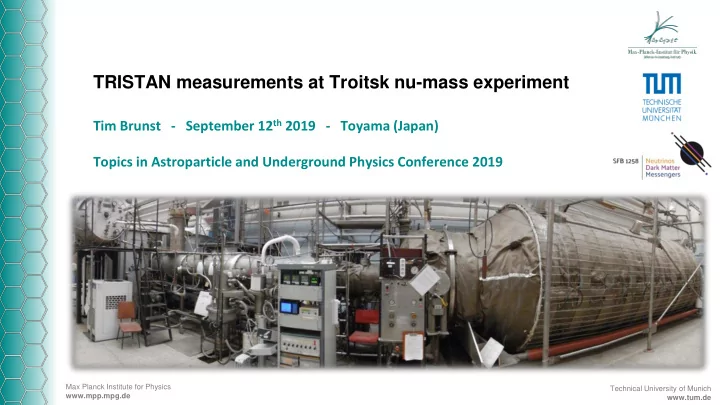
TRISTAN measurements at Troitsk nu-mass experiment

Tim Brunst - September 12th 2019 - Toyama (Japan) Topics in Astroparticle and Underground Physics Conference 2019

slide-2
SLIDE 2

KATRIN Collaboration TRISTAN Group 2 12-Sep-19

Quarks Leptons n-Minimal Standard Model

Sterile neutrinos

Particle Physics The existence of right-handed partners for neutrinos introduces neutrino mass Sterile neutrinos are a natural and minimal extension

  • f the SM

Cosmology In agreement with cosmological observations A sterile neutrino in the keV mass range is a prime candidate for Dark Matter

TRISTAN measurements at Troitsk nu-mass experiment Tim Brunst - TAUP 2019

96%: Dark Matter, Dark Energy 4%: Atoms

slide-3
SLIDE 3

KATRIN Collaboration TRISTAN Group 3 12-Sep-19

Sterile neutrinos in tritium decay

d𝛥 d𝐹 = cos2(𝜄) dΓ d𝐹 (𝑛β) + sin2 𝜄 d𝛥 d𝐹 (𝑛s)

Characteristic spectral distortion and kink-like signature Active-to-sterile mixing amplitude Mass of sterile neutrino

TRISTAN measurements at Troitsk nu-mass experiment Tim Brunst - TAUP 2019

slide-4
SLIDE 4

KATRIN Collaboration TRISTAN Group 4 12-Sep-19

Troitsk nu-mass experiment

tritium pumps magnet spectrometer

TRISTAN measurements at Troitsk nu-mass experiment Tim Brunst - TAUP 2019

  • V. N. Aseev, A. I. Belesev, A. I. Berlev, et al.,

Upper limit on the electron antineutrino mass from the Troitsk experiment,

  • Phys. Rev. D 84 (Dec, 2011) 112003.
slide-5
SLIDE 5

KATRIN Collaboration TRISTAN Group 5 12-Sep-19

Troitsk nu-mass experiment

tritium pumps magnet spectrometer

TRISTAN measurements at Troitsk nu-mass experiment Tim Brunst - TAUP 2019

TRISTAN detector

  • V. N. Aseev, A. I. Belesev, A. I. Berlev, et al.,

Upper limit on the electron antineutrino mass from the Troitsk experiment,

  • Phys. Rev. D 84 (Dec, 2011) 112003.
slide-6
SLIDE 6

KATRIN Collaboration TRISTAN Group 6 12-Sep-19

7 CUBE ASICs by XGLab

  • CMOS technology in

pulsed-reset mode

  • Intrinsic ENC 3.4 e-

 125 eV (fwhm) at 6 keV

  • Intrinsic rise time < 10 ns
  • DAQ time synchronized

TRISTAN prototype

TRISTAN measurements at Troitsk nu-mass experiment Tim Brunst - TAUP 2019

7-pixel SDD prototype by HLL MPG

  • 2 mm pixel diameter
  • 450 µm thickness
  • 12 drift rings
  • Dead layer < 100 nm
  • Monolithic design

 no dead area

  • Anode capacitance 110 fF

 low noise

8 mm

slide-7
SLIDE 7

KATRIN Collaboration TRISTAN Group 7 12-Sep-19

change retarding energy in steps to cut lower part of the spectrum integral mode use detector to count electrons

Measurement modes

TRISTAN measurements at Troitsk nu-mass experiment Tim Brunst - TAUP 2019

Energy resolution determined by spectrometer

slide-8
SLIDE 8

KATRIN Collaboration TRISTAN Group 8 12-Sep-19

Measurement modes

TRISTAN measurements at Troitsk nu-mass experiment Tim Brunst - TAUP 2019

Energy resolution determined by spectrometer Energy resolution determined by detector set main spectrometer to 0 kV or small non-zero potential differential mode use detector to measure energy change retarding energy in steps to cut lower part of the spectrum integral mode use detector to count electrons

slide-9
SLIDE 9

KATRIN Collaboration TRISTAN Group 9 12-Sep-19

Probability for electrons to change energy, direction of motion, and/or position

Experimental response

TRISTAN measurements at Troitsk nu-mass experiment Tim Brunst - TAUP 2019

Model

Retarding energy Backscattering background Tritium

Measurement

slide-10
SLIDE 10

KATRIN Collaboration TRISTAN Group 10 12-Sep-19

Probability for electrons to change energy, direction of motion, and/or position Expressed as response matrices

Experimental response

TRISTAN measurements at Troitsk nu-mass experiment Tim Brunst - TAUP 2019 Retarding energy Backscattering background Tritium

Measurement Response Model

slide-11
SLIDE 11

KATRIN Collaboration TRISTAN Group 11 12-Sep-19

Experimental response

Probability for electrons to change energy, direction of motion, and/or position Expressed as response matrices Response of Troitsk nu-mass setup separated into three parts

Trapping Transport Detector

TRISTAN measurements at Troitsk nu-mass experiment Tim Brunst - TAUP 2019

slide-12
SLIDE 12

KATRIN Collaboration TRISTAN Group 12 12-Sep-19

Experimental response

Probability for electrons to change energy, direction of motion, and/or position Expressed as response matrices Response of Troitsk nu-mass setup separated into three parts

Trapping Transport Detector

TRISTAN measurements at Troitsk nu-mass experiment Tim Brunst - TAUP 2019

slide-13
SLIDE 13

KATRIN Collaboration TRISTAN Group 13 12-Sep-19

Experimental response

Probability for electrons to change energy, direction of motion, and/or position Expressed as response matrices Response of Troitsk nu-mass setup separated into three parts

Trapping Transport Detector

TRISTAN measurements at Troitsk nu-mass experiment Tim Brunst - TAUP 2019

slide-14
SLIDE 14

KATRIN Collaboration TRISTAN Group 14 12-Sep-19

Experimental response

Probability for electrons to change energy, direction of motion, and/or position Expressed as response matrices Response of Troitsk nu-mass setup separated into three parts

Trapping Transport Detector

TRISTAN measurements at Troitsk nu-mass experiment Tim Brunst - TAUP 2019

slide-15
SLIDE 15

KATRIN Collaboration TRISTAN Group 15 12-Sep-19

Experimental response

Probability for electrons to change energy, direction of motion, and/or position Expressed as response matrices Response of Troitsk nu-mass setup separated into three parts

Trapping Transport Detector

Determined via simulations and calibration data

TRISTAN measurements at Troitsk nu-mass experiment Tim Brunst - TAUP 2019

slide-16
SLIDE 16

KATRIN Collaboration TRISTAN Group 16 12-Sep-19

Detector response

Experimental response

TRISTAN measurements at Troitsk nu-mass experiment Tim Brunst - TAUP 2019

slide-17
SLIDE 17

KATRIN Collaboration TRISTAN Group 17 12-Sep-19

Detector response

Experimental response

TRISTAN measurements at Troitsk nu-mass experiment Tim Brunst - TAUP 2019

slide-18
SLIDE 18

KATRIN Collaboration TRISTAN Group 18 12-Sep-19

Detector response Include as nuisance parameters in the differential fit

Experimental response

TRISTAN measurements at Troitsk nu-mass experiment Tim Brunst - TAUP 2019

slide-19
SLIDE 19

KATRIN Collaboration TRISTAN Group 19 12-Sep-19

set main spectrometer to 0 kV or small non-zero potential differential mode use detector to measure energy change retarding energy in steps to cut lower part of the spectrum integral mode use detector to count electrons

Integral mode

TRISTAN measurements at Troitsk nu-mass experiment Tim Brunst - TAUP 2019

slide-20
SLIDE 20

KATRIN Collaboration TRISTAN Group 20 12-Sep-19

Integral mode

TRISTAN measurements at Troitsk nu-mass experiment Tim Brunst - TAUP 2019

Amount of data Total of 5.8 million electrons

Lowest retarding energy

slide-21
SLIDE 21

KATRIN Collaboration TRISTAN Group 21 12-Sep-19

Integral mode

TRISTAN measurements at Troitsk nu-mass experiment Tim Brunst - TAUP 2019

Amount of data Total of 5.8 million electrons Fit χ2 / dof p-value = 134 / 129 = 1.042 = 35.5 %

slide-22
SLIDE 22

KATRIN Collaboration TRISTAN Group 22 12-Sep-19

Integral mode

TRISTAN measurements at Troitsk nu-mass experiment Tim Brunst - TAUP 2019

Amount of data Total of 5.8 million electrons Fit χ2 / dof p-value Systematics treatment Covariance matrix method = 134 / 129 = 1.042 = 35.5 %

slide-23
SLIDE 23

KATRIN Collaboration TRISTAN Group 23 12-Sep-19

Integral mode

Covariance matrix method Vary parameters of systematic correction within (correlated) uncertainties O(104) times Generate MC model spectrum for each variation Calculate covariance matrix from MC spectra Account for systematic uncertainties in χ2-fit χ2 = Ԧ 𝑦 − Ԧ 𝑧 𝑈𝑁−1 Ԧ 𝑦 − Ԧ 𝑧

TRISTAN measurements at Troitsk nu-mass experiment Tim Brunst - TAUP 2019

slide-24
SLIDE 24

KATRIN Collaboration TRISTAN Group 24 12-Sep-19

Integral mode

Covariance matrix method Vary parameters of systematic correction within (correlated) uncertainties O(104) times Generate MC model spectrum for each variation Calculate covariance matrix from MC spectra Account for systematic uncertainties in χ2-fit χ2 = Ԧ 𝑦 − Ԧ 𝑧 𝑈𝑁−1 Ԧ 𝑦 − Ԧ 𝑧 Systematics dominant below 15 keV

TRISTAN measurements at Troitsk nu-mass experiment Tim Brunst - TAUP 2019

slide-25
SLIDE 25

KATRIN Collaboration TRISTAN Group 25 12-Sep-19

set main spectrometer to 0 kV or small non-zero potential differential mode use detector to measure energy change retarding energy in steps to cut lower part of the spectrum integral mode use detector to count electrons

Differential mode

TRISTAN measurements at Troitsk nu-mass experiment Tim Brunst - TAUP 2019

slide-26
SLIDE 26

KATRIN Collaboration TRISTAN Group 26 12-Sep-19

Differential mode

TRISTAN measurements at Troitsk nu-mass experiment Tim Brunst - TAUP 2019

Amount of data Total of 1.7 million electrons

Retarding energy Backscattering background Tritium

slide-27
SLIDE 27

KATRIN Collaboration TRISTAN Group 27 12-Sep-19

Differential mode

TRISTAN measurements at Troitsk nu-mass experiment Tim Brunst - TAUP 2019

Amount of data Total of 1.7 million electrons Fit χ2 / dof p-value = 364 / 311 = 1.172 = 2.0 %

slide-28
SLIDE 28

KATRIN Collaboration TRISTAN Group 28 12-Sep-19

Differential mode

TRISTAN measurements at Troitsk nu-mass experiment Tim Brunst - TAUP 2019

Amount of data Total of 1.7 million electrons Fit χ2 / dof p-value Systematics treatment Nuisance parameters = 364 / 311 = 1.172 = 2.0 %

slide-29
SLIDE 29

KATRIN Collaboration TRISTAN Group 29 12-Sep-19

Differential mode

Usual parameters Endpoint, normalization, background (3) Nuisance parameters All energy dependent parameters of the model (15) Slope and offset of the calibration (2)  Total of 20 free parameters

TRISTAN measurements at Troitsk nu-mass experiment Tim Brunst - TAUP 2019

slide-30
SLIDE 30

KATRIN Collaboration TRISTAN Group 30 12-Sep-19

Limit setting

TRISTAN measurements at Troitsk nu-mass experiment Tim Brunst - TAUP 2019

Perform grid search in sterile neutrino parameter space

slide-31
SLIDE 31

KATRIN Collaboration TRISTAN Group 31 12-Sep-19

Limit setting

TRISTAN measurements at Troitsk nu-mass experiment Tim Brunst - TAUP 2019

Perform grid search in sterile neutrino parameter space

Sensitivity: Fit model with sterile neutrino to MC

95 % confidence level

slide-32
SLIDE 32

KATRIN Collaboration TRISTAN Group 32 12-Sep-19

Limit setting

TRISTAN measurements at Troitsk nu-mass experiment Tim Brunst - TAUP 2019

Perform grid search in sterile neutrino parameter space

Sensitivity: Fit model with sterile neutrino to MC Exclusion: Fit model with sterile neutrino to data

95 % confidence level

slide-33
SLIDE 33

KATRIN Collaboration TRISTAN Group 33 12-Sep-19

Limit setting

TRISTAN measurements at Troitsk nu-mass experiment Tim Brunst - TAUP 2019

Perform grid search in sterile neutrino parameter space

Sensitivity: Fit model with sterile neutrino to MC Exclusion: Fit model with sterile neutrino to data

Largely different systematic effects

Differential prone to detector effects Integral: prone to rate dependent effects

95 % confidence level

slide-34
SLIDE 34

KATRIN Collaboration TRISTAN Group 34 12-Sep-19

Limit setting

TRISTAN measurements at Troitsk nu-mass experiment Tim Brunst - TAUP 2019

Perform grid search in sterile neutrino parameter space

Sensitivity: Fit model with sterile neutrino to MC Exclusion: Fit model with sterile neutrino to data

Largely different systematic effects

Differential prone to detector effects Integral: prone to rate dependent effects

Larger mass range accessible with TRISTAN detector than with standard Troitsk nu-mass

95 % confidence level

slide-35
SLIDE 35

KATRIN Collaboration TRISTAN Group 35 12-Sep-19

Summary and outlook

7-pixel TRISTAN prototype detector successfully installed at Troitsk nu-mass experiment Stable detector performance, energy resolution for electrons below 400 eV (fwhm) Measurements in two complementary measurement modes with different systematic effects Detailed models developed for both modes including full experimental response functions Strategies developed to analyze the differential and integral spectrum Enlargement of the accessible mass range by a factor of 3 Combination and comparison: exclude false-positive sterile neutrino signals Basis for future sterile neutrino searches with TRISTAN at the KATRIN experiment

TRISTAN measurements at Troitsk nu-mass experiment Tim Brunst - TAUP 2019

  • T. Brunst, T. Houdy, S. Mertens, A. A. Nozik, V. S. Pantuev, et al.,

Measurements with a TRISTAN prototype detector at the „Troitsk nu-mass“ experiment in differential and integral mode, arXiv: 1909.02898 2019

slide-36
SLIDE 36

KATRIN Collaboration TRISTAN Group 36 12-Sep-19

Backup

TRISTAN measurements at Troitsk nu-mass experiment Tim Brunst - TAUP 2019

slide-37
SLIDE 37

KATRIN Collaboration TRISTAN Group 37 12-Sep-19

Troitsk nu-mass standard detector

Detector Custom made Si(Li) p-i-n- diode 25 mm pixel diameter Gold plated entrance window (20 µg/cm²) 4 keV threshold Aperture limited by 17 mm diameter copper collimator Front-end Charge sensitive pre-amp Back-end Typical shaping time of 1 µs 12-bit ADC

TRISTAN measurements at Troitsk nu-mass experiment Tim Brunst - TAUP 2019

  • D. Abdurashitov, A. Belesev, A. Berlev, V. Chernov, E.

Geraskin, A. Golubev et al., The current status of “Troitsk nu-mass” experiment in search for sterile neutrino, Journal of Instrumentation 10 (Oct, 2015) T10005–T10005.

slide-38
SLIDE 38

KATRIN Collaboration TRISTAN Group 38 12-Sep-19

Experimental response

Different tools: convolution, Geant4, calibration measurement Determine result of each effect in response to mono-energetic electrons

TRISTAN measurements at Troitsk nu-mass experiment Tim Brunst - TAUP 2019

Input Output

Simulation or Calibration measurement

Courtesy of M. Slezák

slide-39
SLIDE 39

KATRIN Collaboration TRISTAN Group 39 12-Sep-19

Experimental response

Different tools: convolution, Geant4, calibration measurement Determine result of each effect in response to mono-energetic electrons relative number of mono-energetic electrons determined by pure tritium spectrum weigh all responses by the corresponding tritium spectrum counts

TRISTAN measurements at Troitsk nu-mass experiment Tim Brunst - TAUP 2019

Courtesy of M. Slezák

slide-40
SLIDE 40

KATRIN Collaboration TRISTAN Group 40 12-Sep-19

Electron sources in Troitsk nu-mass

TRISTAN measurements at Troitsk nu-mass experiment Tim Brunst - TAUP 2019

Electrons from inner electrode

  • Mono-energetic
  • Isotropic flux over detector radius
  • Requires adjusted B-field

configuration

  • Response not influenced by trapping
  • r transport section

Tritium decay electrons

  • Continuous spectrum
  • Isotropic flux over

detector radius E-gun electrons

  • Mono-energetic
  • Beam-spot (Ø < 1 mm)

smaller then pixel-diameter

  • Position beam can be

controlled with B-fields

slide-41
SLIDE 41

KATRIN Collaboration TRISTAN Group 41 12-Sep-19

Differential mode

TRISTAN measurements at Troitsk nu-mass experiment Tim Brunst - TAUP 2019

Measurement the electrons’ energy 20 free parameters:

Endpoint, normalization, background (3) All energy dependent parameters of the model (15) Slope and offset of the calibration (2)

Cross-check of obtained parameters with input values

slide-42
SLIDE 42

KATRIN Collaboration TRISTAN Group 42 12-Sep-19

Integral mode

Measurement of the count rate as a function of retarding energy High resolution of TRISTAN detector  corrections on the differential spectrum

TRISTAN measurements at Troitsk nu-mass experiment Tim Brunst - TAUP 2019

slide-43
SLIDE 43

KATRIN Collaboration TRISTAN Group 43 12-Sep-19

Integral mode

Measurement of the count rate as a function of retarding energy High resolution of TRISTAN detector  corrections on the differential spectrum Rate corrections on the integral spectrum

TRISTAN measurements at Troitsk nu-mass experiment Tim Brunst - TAUP 2019