SLIDE 1
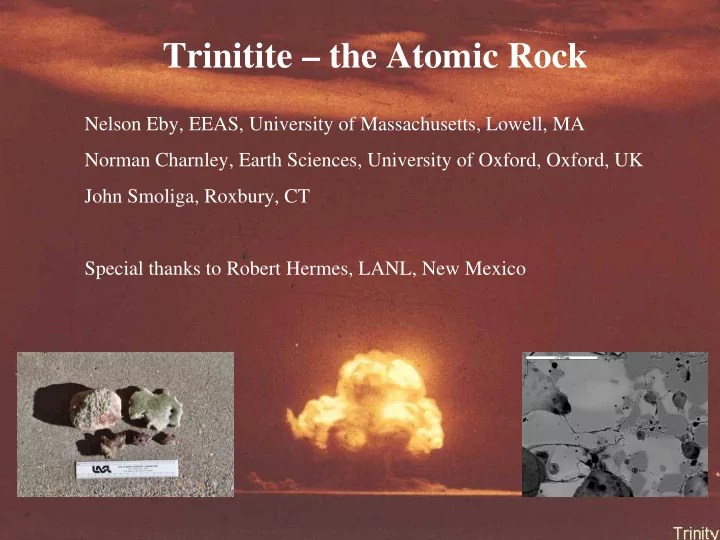
Trinitite – the Atomic Rock
Nelson Eby, EEAS, University of Massachusetts, Lowell, MA Norman Charnley, Earth Sciences, University of Oxford, Oxford, UK John Smoliga, Roxbury, CT Special thanks to Robert Hermes, LANL, New Mexico
SLIDE 2 Dawn of the Atomic Age
Detonation of the Trinity “gadget” Monday, 16 July, 1945 at 5:29 AM MWT
- Cloud height – 50,000 to 70,000 feet
- Yield 20 to 22 kilotons
- Of the 6 kg of Pu-239 in the bomb, it is estimated
that only 1.2 kg was consumed during the explosion.
- Average fireball temperature = 8430 K
SLIDE 3
Ground zero Trinitite glass forms the dark layer with radiating spikes around ground zero. 100-ton test shot
SLIDE 4 Types of Trinitite
Pancake trinitite Red trinitite Green trinitite glass Green trinitite beads
Underside Top
SLIDE 5 Radioactivity in trinitite
- Pu and U (used in the tamper) from the bomb
- Fission products – Ba, Cs, LREE
- Activation products – measurable today: Co, Eu
SLIDE 6
Trinitite protoliths
Arkosic sand Dune sand
Quartz Microcline Albite Muscovite Actinolite Rock frags Quartz Microcline Albite Actinolite
SLIDE 7
Photomicrographs of Trinity arkosic sand
Arkosic sand showing quartz (Qtz), microcline (K-spar) and plagioclase (Plag). The feldspars are partially sericitized. Limestone (calcite - Cal) fragments (carbonate grains) are also observed. Fossiliferous Limestone fragment. The presence of carbonate grains in the sand most likely accounts for the relatively high Ca content of the Trinitite glasses.
SLIDE 8 Trinite Fragments Trinitite Beads Fine sand Dune sand Sc 4.48 4.9 1.9 2.16 Co 4.7 5.34 1.86 2.63 Ni 23 21 8.8 7.0 Sr 179 176 126 80 Ba 808 740 694 432 La 24.13 22.67 14.74 11.84 Gd 3.5 3.3 2.7 1.25 Yb 2.16 1.97 2.33 1.1 Hf 6.91 5.19 4.96 4.06 Ta 0.78 0.67 0.44 0.35 Th 9.15 8.59 6.99 2.01 U 2.7 2.62 1.8 0.75
Chemical changes from source material (sand) to trinitite
Trace metals, Sc, Co and Ni increase in the trinitite. Fission products, Ba, La, etc. increase in the trinitite. Th and U increase in trinitite probably from
tamper. HREE are similar in trinitite and sand. Not added during the nuclear detonation.
SLIDE 9
XRD patterns for trinitite fragments and beads
The only crystalline phase found in trinitite is alpha-quartz. All other phases were melted during the detonation.
SLIDE 10
Red trinitite – bits of the first atomic bomb
SLIDE 11 Plane light Crossed polars
Trinity glass fragments
Typical of the material that is found in the immediate vicinity of ground zero. Forms the top part of the trinitite layer.
SLIDE 12
SEM Images of Trinitite fragments showing texture and relief
Back scattered electrons Secondary electrons
SLIDE 13 Sample SiO2 TiO2 Al2O3 FeO MnO MgO CaO Na2O K2O Total GL9 (light) 56.75 1.89 13.47 4.29 0.10 2.28 12.53 1.22 4.54 97.07 GL10 (dark) 63.46 0.27 18.82 nd nd 0.21 0.96 2.08 11.70 97.50 GL11 (light) 60.21 0.51 15.40 1.86 nd 1.16 10.71 1.49 6.50 97.84 GL12 (med) 62.99 0.36 13.86 2.52 0.11 1.68 8.49 1.46 6.11 97.58 GL13 (med) 62.26 0.45 14.65 3.00 0.07 1.81 8.38 1.63 5.63 97.88 GL14 (med) 62.04 0.21 17.93 1.55 nd 1.05 6.89 1.97 6.16 97.80
Variations in Trinitite Chemistry – Glass Fragment
SLIDE 14
Ant-Hill Trinitite
Trinitite particles were distributed across a broad area. During construction of ant-hills these particles are pushed to the surface and are found rimming the entrance to the ant-hill.
SLIDE 15
The trinitite particles found around ant-hills occur as beads and dumbbells and resemble tektities. These particles were apparently transported through the atmosphere as molten blobs. Tektites Trinitite dumbbells Trinitite beads Beads and dumbbells
SLIDE 16 TB1 TB2 TB3 TB4 TB5 TB6 SiO2 96.80 64.31 51.53 63.56 62.60 64.02 TiO2 0.10 0.31 0.26 0.08 0.37 0.27 Al2O3 0.35 14.57 11.49 18.46 15.19 14.67 FeO 0.17 2.18 3.20 0.13 2.39 2.37 MnO nd 0.13 0.11 nd nd 0.09 CaO 1.40 12.70 27.33 0.52 12.81 12.91 MgO 0.10 1.10 1.78 0.29 1.27 1.10 Na2O 0.10 0.95 0.73 1.83 0.74 0.74 K2O 0.53 1.44 2.66 13.47 1.43 1.44 Total 99.56 97.68 99.09 98.33 96.80 97.62
Trinitite Bead
Note quartz grains embedded along edge
- f bead. These were entrained during
transport. Darker areas within the bead are melted quartz grains (TB1). Also note the range in chemical composition shown for the glasses even in this small bead. TB4 is melted K-feldspar. High CaO in other glasses may be contributed by melted carbonate grains.
SLIDE 17 TDB1 TDB2 TDB3 TDB4 TDB5 TDB6 SiO2 70.53 64.41 47.52 47.15 64.25 66.32 TiO2 0.19 0.39 0.33 0.43 0.35 0.22 Al2O3 11.38 12.27 16.05 16.49 11.95 11.68 FeO 1.50 2.22 2.33 2.34 2.08 2.03 MnO 0.02 nd nd 0.05 nd 0.06 MgO 10.66 15.50 31.17 30.88 15.44 13.68 CaO 1.01 1.21 1.56 1.55 1.04 1.10 Na2O 2.26 1.84 0.45 0.54 1.77 1.85 K2O 3.15 2.66 0.63 0.58 2.77 3.07 Total 100.68 100.52 100.05 100.02 99.66 100.00
Trinitite Dumbbell
Glasses are MgO rich. TDB3 and TDB4, in terms of chemical composition, roughly correspond to Mg-Gedrite. Some of the
- ther compositions suggest dilution by
melted quartz grains plus feldspar. TDB1, which has the highest SiO2, is immediately adjacent to a partly melted quartz grain which supplied the SiO2.
SLIDE 18 Trinite Bead
Back-scatter image and element maps showing intimate layering at the 10 to 100 micron scale. Brighter areas are Ca-
- rich. Note fine banding shown by the Al
map and spot silica concentrations (probably remnant quartz grains) shown
- n the Si map. Relatively high potassium
concentrations indicated by the K map suggest that K-feldspar was an important component in the formation of this bead.
SLIDE 19
Chemistry of Trinitite Glasses I
The chemical compositions, when projected into the Ab-Or-Qtz phase diagram (not shown) scatter across much of the phase diagram – i.e. the glass compositions do not represent equilibrium melting. As a first approximation, the chemical variations in the glass can be ascribed to the melting of specific minerals and these melts are then blended to various degrees at the micron level. Variations in Na2O and K2O can be explained in terms of variable melt proportions of actinolite, albite, microcline, muscovite, and quartz.
SLIDE 20
Chemistry of Trinitite Glasses II
The major source for MgO in the glasses is apparently melted actinolite which contributes variable amounts of MgO. CaO is a major component of many of the glasses and in general the abundance of this element controls the intensity of the BSE image. The CaO amounts exceed that which can be provided by any of the silicate minerals. Calcite grains and fossil fragments are found in the arkosic sand and we conclude that calcite is a major source for CaO in the trinitite glasses.
SLIDE 21 Conclusions
Trinitite occurs in a variety of forms – (1) ~ 2 cm thick pancake trinitite with a glassy top and fused mineral grains constituting the bottom layer, (2) green vesiculated glass fragments, (3) red trinitite (red color due to copper in the glass), and (4) glass beads and dumbbells. Residual radioactivity is still detectable in the glass. The source of the activity is Pu and U from the bomb, fission fragments (Cs, Ba, LREE), and neutron activation products (Co, Eu). The protolith for the trinitite glasses is an arkosic sand that consists of quartz, microcline, albite, muscovite, actinolite, and carbonate. The only crystalline phase found in the glasses is alpha-quartz. Copper is found in the red trinitite glass and the glass also contains metallic chondrules consisting variously of iron, copper, and lead. At the 10s of micron levels the trinitite glasses are very heterogeneous. They usually contain quartz grains and recognizable domains of melted quartz. Glass compositions range from almost pure silica to K-rich, Na-rich, and Ca-rich
- compositions. The Ca-rich glasses represent the addition of Ca from calcite grains
and fossil fragments. None of the glass compositions represent equilibrium melts.