Trends in Operation and Maintenance Spending by the Department of - - PowerPoint PPT Presentation

trends in operation and maintenance spending by the
SMART_READER_LITE
LIVE PREVIEW

Trends in Operation and Maintenance Spending by the Department of - - PowerPoint PPT Presentation

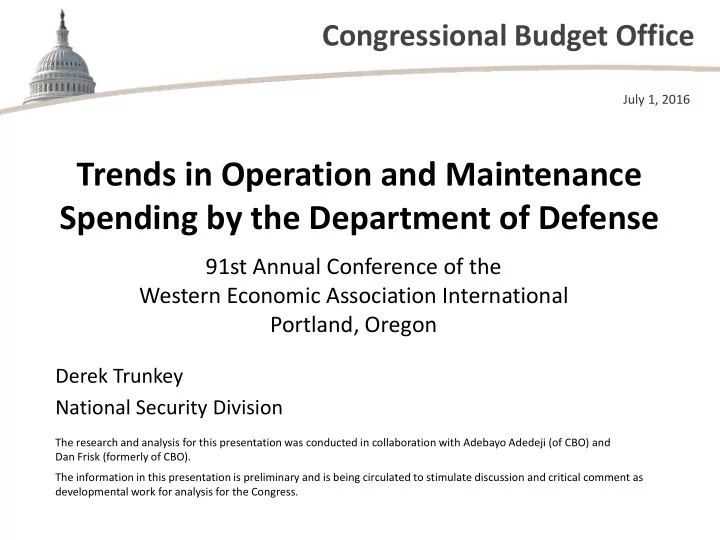
Congressional Budget Office July 1, 2016 Trends in Operation and Maintenance Spending by the Department of Defense 91st Annual Conference of the Western Economic Association International Portland, Oregon Derek Trunkey National Security


slide-1
SLIDE 1

Congressional Budget Office

Trends in Operation and Maintenance Spending by the Department of Defense

91st Annual Conference of the Western Economic Association International Portland, Oregon

July 1, 2016

Derek Trunkey National Security Division

The research and analysis for this presentation was conducted in collaboration with Adebayo Adedeji (of CBO) and Dan Frisk (formerly of CBO). The information in this presentation is preliminary and is being circulated to stimulate discussion and critical comment as developmental work for analysis for the Congress.

slide-2
SLIDE 2

1

CONGRESSIONAL BUDGET OFFICE

The Department of Defense’s (DoD’s)

  • peration and maintenance (O&M) account,

the largest single appropriation category, funds DoD’s day-to-day operations, from equipment maintenance to health care.

slide-3
SLIDE 3

2

CONGRESSIONAL BUDGET OFFICE

Over the past few decades, funding for O&M has increased significantly, accounting for a growing share of DoD’s budget. O&M funding for defensewide agencies and programs has grown the most.

slide-4
SLIDE 4

3

CONGRESSIONAL BUDGET OFFICE

50 100 150 200 250 300 350 1980 1985 1990 1995 2000 2005 2010 2015

Trends in O&M Funding

Billions of 2015 Dollars

Annual Real Growth (Percent) 1980– 2000 2001– 2015

Total DoD

1 2

Navy

  • 1

1

Marine Corps

3 4

Air Force

1

Army

1 1

Defensewide

7 5 Desert Storm Overseas Contingency Operations

slide-5
SLIDE 5

4

CONGRESSIONAL BUDGET OFFICE

O&M funding has been increasing as measures of force size have been decreasing.

slide-6
SLIDE 6

5

CONGRESSIONAL BUDGET OFFICE

Trends in O&M Funding and Number of Active Duty Service Members

500 1,000 1,500 2,000 2,500 50 100 150 200 250 1980 1985 1990 1995 2000 2005 2010 2015 O&M Spending (Left axis) Number of Active-Duty Service Members (Right axis) Billions of 2015 Dollars Thousands

slide-7
SLIDE 7

6

CONGRESSIONAL BUDGET OFFICE

O&M funding is used to purchase thousands

  • f different goods and services that are often

purchased at relatively low cost per unit.

slide-8
SLIDE 8

7

CONGRESSIONAL BUDGET OFFICE

CBO used the subactivity groups (SAGs) in DoD’s budget and their associated object class codes to group O&M funding into four categories. The categories represent the activities supported, goods and services purchased, and source of those goods and services.

slide-9
SLIDE 9

8

CONGRESSIONAL BUDGET OFFICE

Categories CBO Used to Organize O&M Data

Category Description Examples Activity or Function The relation of the activity to combat forces Combat forces, training, health care, administration Commodity Class The type of purchase Goods, services, property- related management Commodity A more detailed description

  • f the type of purchase

Maintenance, equipment, transportation, professional services Provider The source of the goods or services Private sector, DoD working capital funds, nondefense government agencies and

  • rganizations, DoD's civilian

employees

slide-10
SLIDE 10

9

CONGRESSIONAL BUDGET OFFICE

In the activity category, a relatively small portion of the $198 billion in O&M funding in 2012 was for what CBO defined as forces (combat units)—$24 billion, or 12 percent.

slide-11
SLIDE 11

10

CONGRESSIONAL BUDGET OFFICE

Nearly half of O&M funding in 2012 ($91 billion) was for services. Those services include maintenance, medical services, technical and research services, and transportation. Maintenance accounted for one-third of funding for services ($32.4 billion).

slide-12
SLIDE 12

11

CONGRESSIONAL BUDGET OFFICE

Base Budget O&M Purchases, 2012

Billions of 2012 Dollars Total base budget O&M: $198 billon

Activity

Forces (24.3) Support and Individual Training (74.1) Administration (33.5) Infrastructure (34.7) Health Care (31.4) Property (4.3)

Civilian Compensation, Non-WCF (53.6)

Services (90.6) Goods (33.3)

Commodity Class

Domestic Civilians Foreign National Civilians

Provider

Other Government Agencies (5.2) Working Capital Fund (37.6) Private Sector (87.7) DoD Civilians (53.6) Classified (14.8)

slide-13
SLIDE 13

12

CONGRESSIONAL BUDGET OFFICE

Forces (24.3) Property (4.3) Support and Individual Training (74.1) Administration (33.5) Transportation (10.0)

Fuel

Equipment (8.8) Civilian Compensation, Non-WCF (53.6) Services (90.6) Goods (33.3) Other and Uncategorized (12.2) Infrastructure (34.7)

Domestic Civilians Foreign National Civilians

Technical and Research Services (11.9) Professional and Other Services (7.9)

Supplies and Materials (20.8) Medical (19.2) Installation Support (4.9) Maintenance (32.4)

Property Maintenance

Equipment and Weapon Systems Maintenance

People Transport Materiel Transport

Health Care (31.4)

Base Budget O&M Purchases, Including Commodities, 2012

Billions of 2012 Dollars Total Base Budget O&M: $198 Billon

Other Government Agencies (5.2) Working Capital Fund (37.6) Private Sector (87.7)

Activity Commodity Class

Classified (14.8)

DoD Civilians (53.6)

Commodity Provider

slide-14
SLIDE 14

13

CONGRESSIONAL BUDGET OFFICE

Working capital funds (WCFs), which DoD uses to carry out businesslike activities, provide a large amount of goods and services to DoD.

slide-15
SLIDE 15

14

CONGRESSIONAL BUDGET OFFICE

A significant portion of the revenue for WCF activities comes from O&M accounts. In 2012, O&M accounts (including both base budget and OCO funding) provided $72.2 billion, or 66 percent, of total WCF external revenues.

slide-16
SLIDE 16

15

CONGRESSIONAL BUDGET OFFICE

Flows of Working Capital Funds for All Appropriations, in Base Budget and OCO Funding, 2012

Source of Revenue Input Category

Military Personnel, Military Construction, Family Housing, and Miscellaneous Accounts (11.9) RDT&E (5.2) Non-DoD Customers (12.5) Procurement (7.4) Operation and Maintenance (72.2) Goods (53.1) Civilian Pay (15.5) Services (17.8) Research and Development (1.0) All DoD Working Capital Funds (130.0) Other and Unknown (22.2)

Billions of 2012 Dollars

WCF Purchases From Other WCFs (20.4)

slide-17
SLIDE 17

16

CONGRESSIONAL BUDGET OFFICE

CBO analyzed growth in O&M spending between 2000 and 2012. The total growth during that period was $63 billion (47 percent), after removing the effects of inflation.

slide-18
SLIDE 18

17

CONGRESSIONAL BUDGET OFFICE

The two largest contributors to O&M growth were the Defense Health Program (DHP) and activities that support combat forces. Among DoD’s components, defensewide activities accounted for the largest share of the growth.

slide-19
SLIDE 19

18

CONGRESSIONAL BUDGET OFFICE

Growth in Base Budget O&M from 2000 to 2012 by Service, Defensewide Organizations, and Activity

  • 5

5 10 15 20 25 30 35 Army Air Force Navy Marine Corps Defense Wide Support Infrastructure Forces DHP Administration Billions of 2012 Dollars Defense Health Program Defensewide

slide-20
SLIDE 20

19

CONGRESSIONAL BUDGET OFFICE

Identifying the causes of growth in O&M funding is complicated by the diverse nature of the programs and activities supported by that appropriation. The O&M budget can be divided into a few large accounts and a collection of much smaller accounts that are more difficult to track.

slide-21
SLIDE 21

20

CONGRESSIONAL BUDGET OFFICE

O&M Funding in the 2012 Base Budget

Remaining O&M, $110 Billion (56%) DHP, Excluding Civilian Compensation, $26 Billion (13%) DHP Civilian Compensation, $6 Billion (3%) Civilian Compensation Excluding DHP and WCF, $48 Billion (24%) Fuel, $8 Billion (4%)

Remaining O&M comprises many smaller categories. The causes of growth in those categories are difficult to track. CBO can explain the causes of growth in these four large categories.

slide-22
SLIDE 22

21

CONGRESSIONAL BUDGET OFFICE

CBO can explain about half of the growth in O&M funding, including funding for the DHP and civilian compensation. CBO is working to explain the causes of growth within the remaining O&M

  • categories. Those with significant growth

include contracted facilities maintenance and contracted equipment maintenance.

slide-23
SLIDE 23

22

CONGRESSIONAL BUDGET OFFICE

Growth in Base Budget O&M for Equipment Maintenance and Property Maintenance, 2000 to 2012

Organic Depot Maintenance of Weapon Systems Contracted Depot Maintenance of Weapon Systems ($9 billion) Contracted Non-Depot Equipment Maintenance ($8 billion) Pentagon Reserve Maintenance Revolving Fund Contracted Facilities Sustainment, Restoration, and Modernization ($11 billion) Other Equipment and Facility Maintenance

  • 2
  • 1

1 2 3 4 5 6 7 8

Percentage Change in 2012 Dollars

Change in Billions of 2012 Dollars

  • 50

50 100 150 200

Areas of circles correspond to the amount of spending for each category in 2012.

slide-24
SLIDE 24

23

CONGRESSIONAL BUDGET OFFICE

CBO’s next step will be to focus on specific areas of growth such as WCFs, the cost of

  • perating weapon systems, and training.

CBO is working with DoD to obtain better data on O&M spending for those follow-on analyses.