SLIDE 1
Tree wooden logs wooden bark and chips - - PowerPoint PPT Presentation
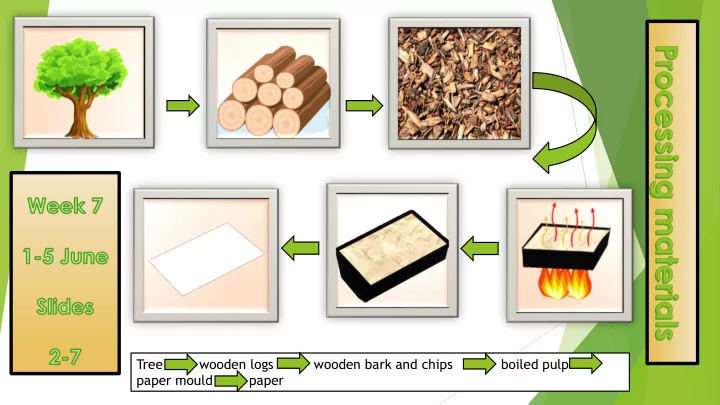
Tree wooden logs wooden bark and chips boiled pulp paper mould paper Read the note alongside and copy these key words and explanations down. C O Raw material : a natural material P from which a product is
SLIDE 2
SLIDE 3
Home Activity: Making my own glue (Ask mom/dad for help.)
You will need: a small bowl, water, flour, a picture or shape, newspaper Read these questions before you start as you need to make 5 observations. Give brief one word answers.
- 1. How does the flour feels before water is added?
- 2. How does it feel when you have made a paste with water?
- 3. Is the glue sticky enough to keep the picture in place for a long time?
- 4. Will it spoil the picture?
- 5. Will THIS glue be strong enough to mend a broken plastic cup?
Method:
1. Spread newspaper / old paper on your desk/table. 2. Put a tablespoon of flour on the paper. 3. Add a teaspoon of water and mix with flour and mix. 4. Keep adding water a tsp at a time until it forms a paste like toothpaste. 5. Using your fingers spread the paste onto the back of a picture / shape and paste it onto another piece of paper.
Flour + water mix glue
SLIDE 4
Home Activity: Making my own jelly (Ask mom/dad for help.)
You will need: a small bowl, 80 g box jelly powder (any flavour), 225 ml of boiling and 225 ml of room temperature water Read these questions before you start as you need to make 3 observations: Give brief one word answers. 1. Describe the properties of the jelly powder: taste, smell, touch. 2. Describe what happens to the jelly powder when water is added. 3. How does the final mixture once set in the fridge differ from the original ingredients used? Method:
- 1. Place jelly powder in bowl.
- 2. Add 225 ml of boiling water and stir well until powder dissolves.
- 3. Add 225 ml of room temperature water and continue to stir so that there are
no jelly crystals left.
- 4. When cooled down, place in refrigerator and allow to set.
SLIDE 5
Fail-safe flapjack recipe
Ingredients
- 500ml flour
- 2 eggs
- 5 tbsp sugar
- 1 ½ tbsp butter, melted
- 4 tsp baking powder
- 1/3 tsp salt
- 250ml milk
- cooking oil
Method
- 1. Beat the eggs and gradually add the sugar.
- 2. Add half of the milk and the melted butter to the egg mixture.
- 3. Stir well.
- 4. Sift the flour, baking powder and salt and add to the egg mixture.
- 5. Gradually stir in the remaining milk to form a smooth mixture.
- 6. If all ingredients are well mixed then don’t stir anymore.
- 7. Grease the pan with a little oil and drop spoonful's of dough into the frying pan.
- 8. Turn the flapjack once the top is full of air bubbles (bottom should be golden brown)
and bake on the other side.
- 9. Serve with butter and syrup, honey or jam.
Here is a YouTube video with a slightly different recipe you may like to try. http://titlisbusykitchen.com/recipe/flapjacks-pancakes
Egg+water/milk+ salt and pepper mix scrambled egg Maize meal+water+salt mix cook porridge Optional to make – not compulsory
SLIDE 6
Plaster of Paris + water mix set 1 part cement + 2 parts sand + 3 parts gravel mix set concrete Casts, moulds and ornaments roads bridges
SLIDE 7
A flow diagram shows which raw materials/natural materials are mixed/added together, which processes take place and which products are made/manufactured. INSTRUCTION: Redraw the flow diagrams below. Do all arrows with a red koki /pen or fineliner. Flour + w_ _ _ _ P_ _ _ _ _ _ of Paris + water glue mix p_ s _ e Jelly powder+hot +cold w _ _ _ _ m _ _ s_ _ _ d jelly cooling m _ _ s _ _ caste / mould /
- r_ _ _ _ _ t