Tree Breeding for Forest Health Current Successes How can - - PowerPoint PPT Presentation

tree breeding for forest health
SMART_READER_LITE
LIVE PREVIEW

Tree Breeding for Forest Health Current Successes How can - - PowerPoint PPT Presentation

Tree Breeding for Forest Health Current Successes How can Biotechnology Help? Richard A. Sniezko USDA Forest Service Dorena Genetic Resource Center Cottage Grove, OR rsniezko@fs.fed.us R.Sniezko- NAS Biotechnology for Forest Healthy Dec


slide-1
SLIDE 1

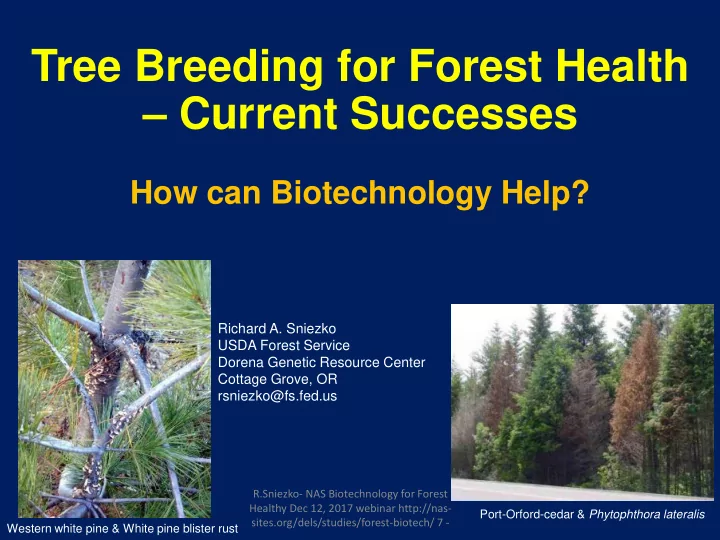
Tree Breeding for Forest Health – Current Successes

How can Biotechnology Help?

R.Sniezko- NAS Biotechnology for Forest Healthy Dec 12, 2017 webinar http://nas- sites.org/dels/studies/forest-biotech/ 7 -

Richard A. Sniezko USDA Forest Service Dorena Genetic Resource Center Cottage Grove, OR rsniezko@fs.fed.us

Western white pine & White pine blister rust Port-Orford-cedar & Phytophthora lateralis

slide-2
SLIDE 2

Information Brief

  • Requested Overview: my work in breeding

trees to address forest health concerns

  • What gaps, if any, exist in traditional breeding

that may be addressed by biotechnology

  • What are the logistics of apply biotechnology

tools in the content of tree breeding

R.Sniezko- NAS Biotechnology for Forest Healthy Dec 12, 2017 webinar http://nas- sites.org/dels/studies/forest-biotech/ 7 -

slide-3
SLIDE 3

Invasion

Chestnut blight White pine blister rust 1000 canker disease Sudden oak death Phytophthora cinnamomi WHO ARE YOU

GOING CALL? USDA Forest Service

  • Genetics & FHP

& partners

Solution

CLIMATE CHANGE

R.Sniezko- NAS Biotechnology for Forest Healthy Dec 12, 2017 webinar http://nas-sites.org/dels/studies/forest-biotech/ 7 -

Phytophthora austrocedrae Rapid ohia death

slide-4
SLIDE 4

Saving the Forests – ACTION NEEDED!

  • Exclude new pests or pathogens!
  • Confine spread or eradicate
  • Biocontrol
  • Silvicultural management
  • Harness Genetic Resistance
  • Restoration/Reforestation needed

R.Sniezko- NAS Biotechnology for Forest Healthy Dec 12, 2017 webinar http://nas-sites.org/dels/studies/forest-biotech/ 7 -

‘Early detection – Rapid Response – more tools needed!

slide-5
SLIDE 5

Envision the Future

  • How to help shape the future for society?
  • Do nothing
  • Do something
  • Genetics is the key
  • r

Dying forest Healthy forest

R.Sniezko- NAS Biotechnology for Forest Healthy Dec 12, 2017 webinar http://nas- sites.org/dels/studies/forest-biotech/ 7 -

slide-6
SLIDE 6

GOAL

  • Want trees to be on the landscape for 100’s
  • f years
  • And be progenitors of future generations
  • Don’t want start massive restoration effort

with ‘temporary’ resistance

  • (e.g. , any non-durable major gene resistances)
  • Use all available types of resistance

R.Sniezko- NAS Biotechnology for Forest Healthy Dec 12, 2017 webinar http://nas- sites.org/dels/studies/forest-biotech/ 7 -

slide-7
SLIDE 7

R.Sniezko- NAS Biotechnology for Forest Healthy Dec 12, 2017 webinar http://nas- sites.org/dels/studies/forest-biotech/ 7 -

Research Tree Improvement Reforestation or Restoration Management Commitment over Time

SUCCESS

Using Genetics for Forest Health

  • The road to success

Successful program takes several components – all must be present Partnerships, public support and ‘time’ also essential Continuity essential – long-term commitments can be vital

Time

slide-8
SLIDE 8

BACKGROUND 26 years* in Applied/Operational Development of Resistance - For Restoration or Reforestation

  • EXISTING PROGRAMS

– WHITE PINE BLISTER RUST – 8 western N.A. species of

5-needle (‘white’) pines –WWP & SP since 1991

– PHYTOPHTHORA ROOT DISEASE – Port-Orford-cedar

(since ~1993, designed/initiated operational program in 1997)

– KOA WILT –koa (designed/initiated in 2003)

  • POSSIBLE NEW PROGRAMS?

– Sudden oak death (SOD) – tanoak – Rapid ‘Ōhi‘a death (ROD) - ‘Ōhi‘a

  • *Dorena GRC program has been active for 51 years

R.Sniezko- NAS Biotechnology for Forest Healthy Dec 12, 2017 webinar http://nas-sites.org/dels/studies/forest-biotech/ 7

slide-9
SLIDE 9

Solution: GENETIC RESISTANCE

  • ‘Green’, natural solution to a disease problem
  • Is there genetic resistance?

– Is there ‘tolerance’? – Resistance vs. tolerance

  • What types and levels of resistance are available?
  • What level is needed?
  • What level is achievable?
  • Correlations with other adaptive traits?
  • Impacts of climate change on resistance?
  • Is it durable resistance?
  • Tree Improvement – producing seed

R.Sniezko- NAS Biotechnology for Forest Healthy Dec 12, 2017 webinar http://nas- sites.org/dels/studies/forest-biotech/ 7 -

slide-10
SLIDE 10

RESISTANCE: North American Examples

  • Major Gene Resistance

– Sugar pine* (Kinloch) – Western white pine* (Barnes/Sniezko/Kinloch) – Southwestern white pine & limber pine (Kinloch/Sniezko) – Port-Orford-cedar (Sniezko)

  • Quantitative Resistance (partial resistance)

– All 9 N.A. white pine species? (Hoff/Sniezko/Kinloch…) – Port-Orford-cedar (Sniezko)

  • Other/unknown

– Koa (Dudley/Sniezko)

R.Sniezko- NAS Biotechnology for Forest Healthy Dec 12, 2017 webinar http://nas- sites.org/dels/studies/forest-biotech/ 7

  • *virulence in pathogen (vcr1, vcr2) now limits utility in

some areas

slide-11
SLIDE 11

Major Gene Resistance

(Single dominant gene)

Partial Resistance

(quantitative resistance)

% MORTALITY (family means) in Resistance Trial*

R.Sniezko- NAS Biotechnology for Forest Healthy Dec 12, 2017 webinar http://nas-sites.org/dels/studies/forest-biotech/ 7 -

*greenhouse root dip test

Resistance Types and Levels

(Note: generally no 100% resistant orchard mixes)

slide-12
SLIDE 12

R.Sniezko- NAS Biotechnology for Forest Healthy Dec 12, 2017 webinar http://nas- sites.org/dels/studies/forest-biotech/ 7 -

The fate of Major Gene Resistance in forestry????

FIELD TRIALS ARE ESSENTIAL – Region 6 has largest array of field trials of any program in N.A. (for resistance to non-native pathogen-native forest trees). Long-term field trials are essential part of resistance program.

slide-13
SLIDE 13

Conclusion #1

  • Tree Breeding is the key

– Is Biotech useful w/o tree breeding/tree improvement support?

  • NO – need integrating, not piecemeal solution

– More support for Tree Breeding is needed

  • Very precarious status
  • More Support for Tree Breeding (resistance) institutes

needed – or no need for biotech?

  • One model: Dorena GRC – 50 years celebration in

2016

R.Sniezko- NAS Biotechnology for Forest Healthy Dec 12, 2017 webinar http://nas- sites.org/dels/studies/forest-biotech/ 7 -

slide-14
SLIDE 14

Conclusion#2

  • Tree Breeder’s Biotech tool ‘wish’ list:

– Help define what is durable resistance – Develop biomarkers for rapid resistance evaluation – Speed up breeding (‘insert’ genes….?) – Use ‘new’ of genes (chestnut example?), properly vetted – Tools to help determine genetic control & mechanisms of resistance – are similar phenotypes controlled by same genes/alleles? – Develop biocontrols?

Utility of endophytes, ….. in combination with quantitative resistance

And needs to be inexpensive, easy to use, ….

R.Sniezko- NAS Biotechnology for Forest Healthy Dec 12, 2017 webinar http://nas- sites.org/dels/studies/forest-biotech/ 7 -

slide-15
SLIDE 15

What is the timeframe for breeding a tree to address pest/pathogen pressures?

  • Depends on the species

– And level of resistance ‘needed’ – And when ‘serious’ effort is made

  • Depends on the background research

– Port-Orford-cedar example

  • Original thought: ‘ NO RESISTANCE’ ?

– Whitebark pine example

  • Originally thought: ‘MOST SUSCEPTIBLE SPECIES’ ?

– Koa example – Sugar pine & western white pine examples

R.Sniezko- NAS Biotechnology for Forest Healthy Dec 12, 2017 webinar http://nas- sites.org/dels/studies/forest-biotech/ 7 -

slide-16
SLIDE 16

R.Sniezko- NAS Biotechnology for Forest Healthy Dec 12, 2017 webinar http://nas-sites.org/dels/studies/forest-biotech/ 7 -

Maunawili Trial 07-01 Percentage Mortality OVERALL for 23 Families/Provenances

provenance

2 4 6 8 10 12 14 16 18 20 22 24

% mortality

10 20 30 40 50 60 70 80 90 100

Maunawili provenance trial Oahu Ko'olau Mts.

a-c a-c cd d b-d a-d a a-d a-c a-d a-c a-d a-d a-c d a-c ab a-d a-d a-d a-d a-c

TIMELINE:

1999: koa provenance trial at Maunawillli 2003: Sniezko, R. 2003. Potential for selecting

for genetic resistance to F. oxysporum (koa wilt) in koa for conservation, restoration and utilization in Hawaii. Trip Report (8/23/2003). Cottage Grove: OR. USDA Forest Service, Dorena Genetic Resource Center. 13 p

2007: First inoculation trial confirmation of

Acacia koa family variation in resistance to FOXY, the putative causative agent of koa wilt in Hawaii (Dudley, Sniezko, James, Cannon, unpub)

2008-2017: Evaluate 100’s of families, setup seed

  • rchards, setup seed zones, produce first seed.

PROBLEM SOLVED?

*Limitation: Continuity of Funding & staff

How fast can a program proceed?*

KOA WILT RESISTANCE
slide-17
SLIDE 17

R.Sniezko- NAS Biotechnology for Forest Healthy Dec 12, 2017 webinar http://nas- sites.org/dels/studies/forest-biotech/ 7 -

What are the effects of traditional breeding on local genetic diversity and local adaptation in forests?

LITTLE OR NONE (if done right and lucky)?

Do those effects differ, and if so how, from the effects of genetic engineering

  • n local genetic diversity and local

adaptation in forests?

POSSIBLY, but minimized if GE efforts fully engaged with tree breeders at a very early stage

slide-18
SLIDE 18

R.Sniezko- NAS Biotechnology for Forest Healthy Dec 12, 2017 webinar http://nas- sites.org/dels/studies/forest-biotech/ 7 -

OBJECTIVE White pine blister rust resistant whitebark pine seed that is 1) Resistant to WPBR 2) Locally adapted 3) Genetically diverse (seed from parent trees in forest or

from orchards)

NOTE: only Oregon & Washington portion of geographic range is shown – programs vary somewhat by Region

WHITEBARK PINE

(white pine blister rust resistance)

**Make selections from each zone**

slide-19
SLIDE 19

R.Sniezko- NAS Biotechnology for Forest Healthy Dec 12, 2017 webinar http://nas- sites.org/dels/studies/forest-biotech/ 7 -

OBJECTIVE 1) Phytophthora lateralis resistant seed 2) adapted to planting areas 3) genetically diverse 13 Breeding Zones Selections within each breeding zone

  • over 14,000 selections

Goal: Seed Orchards for each BZ

PORT-ORFORD-CEDAR

(Phytophthora root disease resistance)

slide-20
SLIDE 20

R.Sniezko- NAS Biotechnology for Forest Healthy Dec 12, 2017 webinar http://nas- sites.org/dels/studies/forest-biotech/ 7 -

Do you see new or different risks presented by using genetic engineering in trees to address pest/pathogen pressures versus using traditional breeding?

Do properly – no shortcut for commercial or publication expediency Aim for ‘durable’ resistance Fully integrate with traditional breeding program – hopefully from early stage Need to field test over long-term

MAYBE

slide-21
SLIDE 21

Example: USFS’s Dorena Genetic Resource Center

  • Lead role in development of applied resistance
  • USDA Forest Service & Cooperators
  • >50 year history and continuity (50th in 2016)
  • Interface between Research and

Restoration/Reforestation

  • Works closely with Forest Health Protection &

partners

  • Examines all types of resistance simultaneously
  • Facilitates the development of resistance in

useable form

R.Sniezko- NAS Biotechnology for Forest Healthy Dec 12, 2017 webinar http://nas- sites.org/dels/studies/forest-biotech/ 7 -

slide-22
SLIDE 22

USDA Forest Service

  • - Dorena Genetic Resource Center

R.Sniezko- NAS Biotechnology for Forest Healthy Dec 12, 2017 webinar http://nas- sites.org/dels/studies/forest-biotech/ 7 - whitebark limber WWP Sugar pine

slide-23
SLIDE 23

Strategy

  • Simultaneously evaluate both MGR and Partial

Resistance

  • Aim for long-term effectiveness
  • More difficult and longer term seedling trials
  • Unknown at onset what types exist
  • And may vary geographically in the range of the species
  • Field validation needed!
  • Incorporate both types into orchard production

population

  • Breed to increase level and mix of resistances
  • Maintain Genetic Variability
  • Maintain Adaptability

R.Sniezko- NAS Biotechnology for Forest Healthy Dec 12, 2017 webinar http://nas- sites.org/dels/studies/forest-biotech/ 7 -

slide-24
SLIDE 24

R.Sniezko- NAS Biotechnology for Forest Healthy Dec 12, 2017 webinar http://nas-sites.org/dels/studies/forest-biotech/ 7 - The proportion of western white pine (Pinus monticola) trees from 12 families with stem symptoms over time in one field trial in western

  • Oregon. Family 4 is a susceptible control, Families 11 & 12 have major gene resistance, but a virulent race of white pine blister rust pathogen is

known to be present in this area (graph from Figure 2, Sniezko et al 2012b). Note: not all ‘infected’ trees will die.

How much resistance is there? Is it durable?

% Infection

  • ver time

WPBR example **ONLY A SUBSET OF TREES FROM ORCHARDS WILL BE RESISTANT**

slide-25
SLIDE 25

Port-Orford-cedar (a) tree in urban area, (b) large, healthy tree in southern Oregon, (c) dead trees in forest along a creek in southwest Oregon, (d) dead and dying trees along Highway 101 in southwest Oregon, (e) resistant parent tree (510015) surrounded by dead Port-Orford-cedar. (Photo credits: Richard Sniezko, a to d; Chuck Frank, e) [from Figure 1, Sniezko et al. 2012]

Port-Orford-cedar (Chamaecyparis lawsoniana)

R.Sniezko- NAS Biotechnology for Forest Healthy Dec 12, 2017 webinar http://nas- sites.org/dels/studies/forest-biotech/ 7 -

Phytophthora lateralis resistance: Original investigators determined there was no resistance, but turned out wrong Operational breeding program started in ~1996 (FHP proposal) Both MGR and quantitative resistance present (Sniezko)

slide-26
SLIDE 26

R.Sniezko- NAS Biotechnology for Forest Healthy Dec 12, 2017 webinar http://nas-sites.org/dels/studies/forest-biotech/ 7 -

Durability of resistance (survival) to Phytophthora lateralis over time for 16 Port-Orford-cedar families at Foggy Eden trial in western Oregon (graph adapted from Figure 3, Sniezko et al 2012).

DURABILITY of P. lateralis Resistance – FIELD RESULTS

Family variation in %survival over time Extreme genetic variation in field resistance

slide-27
SLIDE 27

Restoring Port-Orford-cedar using resistance to Phytophthora lateralis

1)Select/breed for resistance 2) Maintain genetic diversity 3) Use adapted seed sources

SUCCESS SOLUTION PROBLEM

Photo: C. Frank

R.Sniezko- NAS Biotechnology for Forest Healthy Dec 12, 2017 webinar http://nas-sites.org/dels/studies/forest-biotech/ 7 -

slide-28
SLIDE 28

WHITEB WHITEBARK ARK PINE PINE

Jul uly 20 y 2011 11 – sta status tus un unde der r **E **End ndan ange gered ed Sp Spec ecies ies Act** Act**

U.S. Fish & Wildlife Service agreed that the whitebark pine, a wide-ranging tree species found on mountain tops in much of western North America, faces an "imminent" risk of extinction. The species was found warranted for protection but currently precluded due to limited budgets. Development of genetic resistance at Dorena Genetic Resource Center and elsewhere is a key step to successfully restoring the species in many areas.

R.Sniezko- NAS Biotechnology for Forest Healthy Dec 12, 2017 webinar http://nas-sites.org/dels/studies/forest-biotech/ 7 -

slide-29
SLIDE 29

R.Sniezko- NAS Biotechnology for Forest Healthy Dec 12, 2017 webinar http://nas-sites.org/dels/studies/forest-biotech/ 7 -

Partnerships in the Pacific Northwest help save an endangered species, whitebark pine (Pinus albicaulis): an example of dynamic genetic conservation

https://www.fs.fed.us/pnw/pubs/pnw_gtr963_065.pdf

slide-30
SLIDE 30

%Cankering – Whitebark pine families in SY2007R3 – early data

R.Sniezko- NAS Biotechnology for Forest Healthy Dec 12, 2017 webinar http://nas-sites.org/dels/studies/forest- biotech/ 7 -

What level of blister rust resistance is there?

**Large differences among families!

slide-31
SLIDE 31

R.Sniezko- NAS Biotechnology for Forest Healthy Dec 12, 2017 webinar http://nas- sites.org/dels/studies/forest-biotech/ 7 -  Surprisingly high levels of genetic resistance to the non-native rust exist (in some areas).

  • Example in map below, where

parent trees have been inoculated with the disease and given a ‘Grade’ of A-F, where A indicates higher level of resistance, and F indicates low resistance.

 Region 6 has the highest levels of resistance in whitebark pine recorded to date.  Restoration plantings have begun on FS & NPS lands.

Is there GEOGRAPHIC VARIATION in occurrence of Genetic Resistance?

Results shown are from SY2007 trial at USFS R6 Dorena Genetic Resource Center (Sniezko, unpublished) v1.0 Draft Contact Richard Sniezko, rsniezko@fs.fed.us, for more information.

slide-32
SLIDE 32

R.Sniezko- NAS Biotechnology for Forest Healthy Dec 12, 2017 webinar http://nas-sites.org/dels/studies/forest-biotech/ 7 - Genetic variation among seed sources in percentage of seedlings with early blister rust stem symptoms ~15 months post-inoculation. The number of half-sib families represented in each seed source mean is indicated above the bar (varies from 1 to 42). The 18 Oregon and Washington sources refer to individual National Forest, National Park and Confederated Tribes of Warm Springs boundaries from which the seedlots were collected (Sniezko, unpub)

WHITBARK PINE - Resistance to white pine blister rust

slide-33
SLIDE 33

GENETICS IN ACTION

Whitebark pine restoration at Crater Lake National Park Develop resistant populations Maintain genetic diversity Maintain genetic adaptability Plant seedlings PROBLEM SOLUTION SUCCESS

R.Sniezko- NAS Biotechnology for Forest Healthy Dec 12, 2017 webinar http://nas- sites.org/dels/studies/forest-biotech/ 7 -

slide-34
SLIDE 34

Restoration planting at Crater Lake National Park

(also a genetic resistance ‘validation’ trial) **Opportunity for public outreach & conservation education**

R.Sniezko- NAS Biotechnology for Forest Healthy Dec 12, 2017 webinar http://nas- sites.org/dels/studies/forest-biotech/ 7 -

slide-35
SLIDE 35

R.Sniezko- NAS Biotechnology for Forest Healthy Dec 12, 2017 webinar http://nas-sites.org/dels/studies/forest- biotech/ 7 -

NEEDED: Tools to fast- track resistance development

slide-36
SLIDE 36

R.Sniezko- NAS Biotechnology for Forest Healthy Dec 12, 2017 webinar http://nas-sites.org/dels/studies/forest-biotech/ 7 -

 The logistics of applying that tool in the context of tree breeding? 

  • need to incorporate genetic diversity & adaptability

How does a tree breeder think about environmental risk? What is known about the harm from/risk of traditional breeding?  What type of risk analysis is done for trees that result from traditional breeding?  What is the federal and state regulatory oversight of traditionally bred trees?  To your knowledge, when traditional tree breeding has been used to address a pest or pathogen threat, have there been unintended consequences? Using seeds directly from existing parent trees or their early generation selected progeny – no new genes – increasing frequency of rare genes - - Field trials help confirm ‘no risk’ Progeny tests & Provenance trials may give some indications

slide-37
SLIDE 37

IMMEDIATE NEED: Forest Genetics Research and Seedling Production Capacity/Infrastructure

Gap: Forest Service genetics and breeding capacity has been declining rapidly for the last 30 years, especially in the East, Midwest, and Rocky Mountain Regions. Less so in South & Pacific Northwest (Wheeler et al., 2015. The Evolution of Forest Genetics and Tree

Improvement Research in the United States, J. For. 113)

To develop & deploy regionally adapted, genetically diverse planting stock with durable resistance

R.Sniezko- NAS Biotechnology for Forest Healthy Dec 12, 2017 webinar http://nas- sites.org/dels/studies/forest-biotech/ 7 -

slide-38
SLIDE 38

Applied Resistance Programs

Benefit

  • Sometimes only feasible

solution

  • Solution oriented
  • Public support
  • Tool – can be combined

with silviculture, etc

  • ‘Green’ solution
  • Organic
  • Sustainable
  • Little or no side-effects

….but

  • Sometimes long-term
  • Sometimes uncertain
  • utcome
  • Not Inexpensive

R.Sniezko- NAS Biotechnology for Forest Healthy Dec 12, 2017 webinar http://nas- sites.org/dels/studies/forest-biotech/ 7 -

slide-39
SLIDE 39

SUCCESSES*

According to the IUCN Red List of Threatened Species, the species status of Port-Orford-cedar which was listed as ‘vulnerable’ in 2000, has been downgraded to ‘near threatened’ as of 2013, with anticipation that it will be listed as a species of ‘least concern’ within 10 years, if current conservation actions, including planting resistant seedlings, are successful and maintained (Farjon 2013). Whitebark pine has been proposed for listing under the U.S. Endangered Species Act. The threats to the species are ongoing, and therefore imminent, and are now moderate in magnitude. The identification of genetic resistance to WPBR is one of the factors that has recently led to a downgrading of listing priority number (LPN) from 2 to 8 for whitebark pine in 2015 (USFS 2015…). The status of the species is reviewed annually. Restoration with resistant seedlings will increase the level of WPBR resistant whitebark pine

R.Sniezko- NAS Biotechnology for Forest Healthy Dec 12, 2017 webinar http://nas-sites.org/dels/studies/forest-biotech/ 7 -

*programs are ongoing to increase resistance in all breeding zones, etc, but genetic resistance has been identified and is being used in first restoration and/or reforestation efforts

slide-40
SLIDE 40

R.Sniezko- NAS Biotechnology for Forest Healthy Dec 12, 2017 webinar http://nas- sites.org/dels/studies/forest-biotech/ 7 -

The 6th International Workshop on the Genetics of Tree- Parasite Interactions: Tree Resistance to Insects and Diseases: Putting Promise into Practice

Welcome!

Make plans to attend the 6th International Workshop on the Genetics of Tree-Parasite Interactions on August 5 - 10, 2018 in Mt. Sterling, OH USA. For more information, contact Jennifer Koch or Richard Sniezko. https://treeresistance2018.ca.uky.edu/

Possible discussion topic (Role of Biotechnology) at

slide-41
SLIDE 41

Acknowledgments

  • Funding from U.S. Forest Service Region 6 Forest Health

Protection and Genetic Resources Programs

  • All Cooperators, partners & colleagues
  • Co-workers at Dorena GRC
  • Photos: Michael Murray, Molly Oppliger, Chuck Frank,

Scott Kolpak, Richard Sniezko

  • Jennifer Koch (USDA FS – NRS) for many discussions
  • ver the years!

R.Sniezko- NAS Biotechnology for Forest Healthy Dec 12, 2017 webinar http://nas- sites.org/dels/studies/forest-biotech/ 7 -

slide-42
SLIDE 42

References

  • Sniezko, R.A.; Koch, J. 2017. Breeding trees resistant to insects

and diseases: putting theory into application. Biol Invasions 19(11):3377-3400. doi:10.1007/s10530-017-1482-5

  • Sniezko, R.A. ; Smith, J.; Liu, J-J; Hamelin R.C. 2014. Genetic

Resistance to Fusiform Rust in Southern Pines and White Pine Blister Rust in White Pines—A Contrasting Tale of Two Rust Pathosystems—Current Status and Future Prospects. Forests 2014, 5, 2050-2083; doi:10.3390/f5092050

  • Sniezko, RA 2006. Resistance breeding against nonnative

pathogens in forest trees — current successes in North America. Canadian Journal of Plant Pathology. 28: S270–S279

R.Sniezko- NAS Biotechnology for Forest Healthy Dec 12, 2017 webinar http://nas- sites.org/dels/studies/forest-biotech/ 7 -