
SLIDE 1
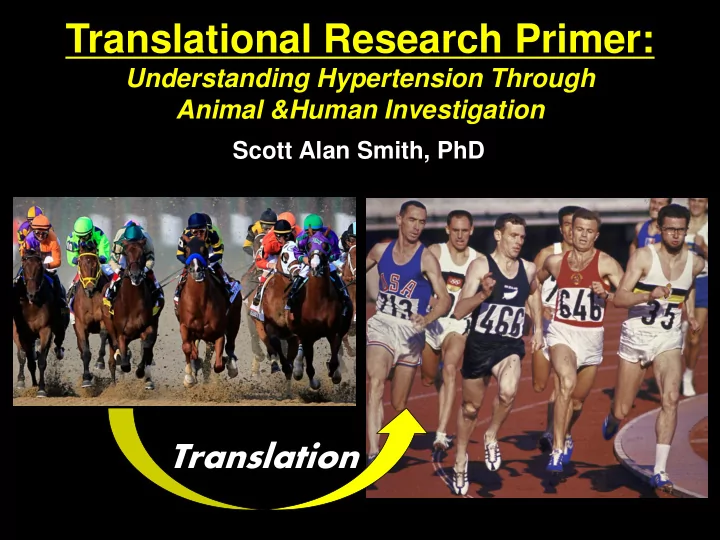
Translational Research Primer:
Understanding Hypertension Through Animal &Human Investigation
Scott Alan Smith, PhD
Translation
Translational Research Primer: Understanding Hypertension Through - - PowerPoint PPT Presentation
Translational Research Primer: Understanding Hypertension Through Animal &Human Investigation Scott Alan Smith, PhD Translation * Translational Research An effort to build on basic scientific research to create new therapies, medical
Translational Research Primer:
Understanding Hypertension Through Animal &Human Investigation
Scott Alan Smith, PhD
Translation
*
Translational Research
new therapies, medical procedures & diagnostics.
laboratory setting into potential treatments for disease.
Translational Research
(pre-clinical studies)
treatment
Advantages of Using Animal Models
Camilla Martin Christian Eriksen Eskild Ebbesen Thomas Bjorn
Caroline Wozniacki
hypertension
peripheral arterial disease, stroke, heart failure, etc.
hypertension by 2025 (1/3 of world’s population)
Hypertension
Significant National & Global Health Problem
Additional and/or improved strategies are urgently needed to prevent and treat hypertension
Current Strategies to Treat Hypertension
Hold op
Exercise is Medicine Example
Why Exercise?
The Pressor Response to Static Exercise is Exaggerated in Hypertensive Patients 20 40 60 80 100
D SBP D DBP
Isometric Handgrip (30% MVC)
NT (119/79) HT (162/112)
* *
Kazatani et al. Am J Ther 2: 165-169, 1995
mm Hg
From Smith SA, Mitchell JH & Garry MG. Exp Physiol, 91: 89-102, 2006
The Exercise Pressor Reflex is Overactive in Hypertension
Smith et al. J Physiol 577: 1009-1020, 2006
WKY: MAP = 89±8 mm Hg SHR: MAP = 149±5 mm Hg
Mizuno et al. Am J Physiol 300: H968-H977, 2011
D MAP (mm Hg) 20 40 60 D HR (beats min-1) 5 10 15 20* *
D Tension (kg) 0.0 0.5 1.0 1.5 2.0 WKY SHRWKY SHR
SHR
X
Mizuno et al. Am J Physiol 300: H968-H977, 2011 Mizuno et al. J Physiol 589: 6191-6204, 2011
Effects of Blocking Skeletal Muscle Sensory Transmission in Hypertensive Rats
Translation
Intrathecal Fentanyl Infusion
Time (min) ∆ Mean blood pressure (mmHg)
*P < 0.05 HT CTRL vs. NT †P < 0.05 HT CTRL vs. HT FENT
HT CTRL HT FENT NT
*† *† *† *† *†
Treatment Targets
Reflex sensory traffic from skeletal muscle
Dietary Interventions Example
Potential Target: Dietary Phosphate (Pi)
Phosphate Consumption BP?
Collaborative Research Team
Pre-Clinical Studies Clinical Studies
Physiologist
Physiologist
Cardiologist Dietician
Translational Research
Pre-Clinical Studies
Pre-Clinical Study Design
Normal Phosphate Diet (0.6% Pi) High Phosphate Diet (1.2% Pi) Males & Females 3 Months
Baseline MAP (mmHg) Normal Pi = 93±4 High Pi = 120±5
Responses to Exercise Pressor Reflex Activation
From Mizuno et al. Am J Physiol, 311: R39-R48, 2016
0.6% Pi 1.2% Pi
Translation
Study Population
Clinical Studies: Randomized Cross-over Design
Low Pi diet (700 mg/d) High Pi diet (1,200 mg/d) 4 wks Low Pi diet (700 mg/d) High Pi diet (1,200 mg/d) 4 wks Run-in Phase 2 wks
Washout phase 2 wks
muscle SNA
Hand Grip 30% MVC
Effects of High Pi on Neural control of BP
SNA at rest and during handgrip. Measure after 4 weeks of high vs. low Pi diet.
MSNA during Exercise
24 Hour Urine Phosphate = 818 mg 24 Hour Urine Phosphate = 1102 mg
High-Phosphate Diet Induces Exercise Intolerance and Impairs Fatty Acid Metabolism
activity level in mice
physical activity
Treatment Target
Phosphate consumption
risk factor that can be easily modified for the prevention or treatment of hypertension.
Bioelectronic Devices Example
Schlaich et al. J Am Coll Cardiol 62: 2031-2045, 2013
SNA SNA SNA SNA SNA
Response to Renal Injury/Ischemia:
Evidence from Animals and Humans
Translation
Schlaich et al. J Am Coll Cardiol 62: 2031-2045, 2013
Symplicity HTN-1 Investigators, Hypertension 57: 911-917, 2011
Treatment Target
Efferent and Afferent Renal Nerves
significantly lower systolic and diastolic blood pressure and may prove a viable long-term treatment for hypertension.
Take Home Message
Translational research is the KEY to the practical application of basic science discoveries to the development and implementation of new ways to prevent, diagnose and treat disease.
2-Time Olympian 1968 Olympics (Mexico City) – 8th Single Sculls 1972 Olympics (Munich) – 4th Double Sculls World Champion 1970 – World Champion, World Rowing Championships
Lars Ulrich