
SLIDE 1
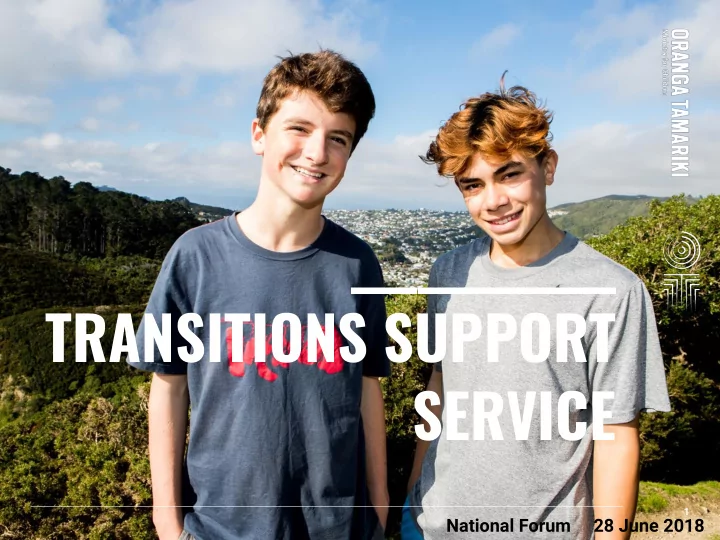
____________ TRANSITIONS SUPPORT SERVICE
1
National Forum 28 June 2018
____________ TRANSITIONS SUPPORT SERVICE 1 National Forum 28 - - PowerPoint PPT Presentation
____________ TRANSITIONS SUPPORT SERVICE 1 National Forum 28 June 2018 OUR SESSION Provide you with an overview of the Transition Support Service journey to date. Provide you with an opportunity to provide feedback on initial
1
National Forum 28 June 2018
Service journey to date.
initial thinking re the future service experience
service development.
2
The need for transition services
The Expert Panel identified that young people leaving care are among the most vulnerable in New Zealand. It was identified that young people leaving care or a youth justice residence are at risk
insecure or inadequate housing and are less likely to engage with education and employment than their peers. While most young people may receive help from their family well into their twenties, young people leaving care or a youth justice residential placement tend to receive relatively little financial or social support after they leave the placement. Many also suffer from the enduring effects of childhood trauma and are less ready than their peers to live independently.
3
4
In response to the Expert Panel’s findings, Cabinet agreed to a suite of legislative changes including: These changes were included in the Children, Young Persons, and Their Families (Oranga Tamariki) Legislation Act 2017 and will come into effect on 1 July 2019 (or earlier by Order in Council).
New purposes and principles for transition support
An entitlement for young people to remain or return to living with a caregiver from age 18 to 21 A duty to maintain contact with young people who have left care or custody until age 21 Extended duties to provide advice and assistance to these young people up to age 25
Phased in as young people age out of care Retrospective
5
Princip nciples les from the Oranga ga Tamariki iki Act 1989
accessing support and services for rangatahi leaving care
6
7
Young people in the transitions cohort are amongst the most vulnerable in our communities. While relatively small in number they have high demands for social, health and justice services.
Segmentation Personas
9
Young people need responsive, flexible, relationship based
direct them to services. They need persistent support despite their behaviours and decisions. They need support that can co-
services and help facilitate access.
10
11
1. Reflect on the design requirements for the service. 2. Walkthrough the future service experience 3. Provide feedback on things you agree with, disagree with, gaps,
4. In your group, discuss your observations and share the one primary reflection you have on the proposed service.
12