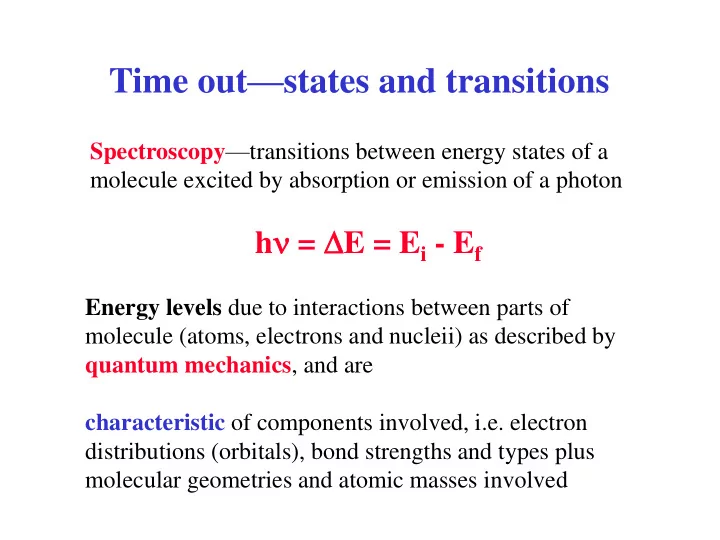
Time out states and transitions Spectroscopy transitions between - - PowerPoint PPT Presentation
Time out states and transitions Spectroscopy transitions between energy states of a molecule excited by absorption or emission of a photon h n = D E = E i - E f Energy levels due to interactions between parts of molecule (atoms, electrons
Spectroscopic Regions
Adapted from Table 7-1; Biophysical Chemistry, Part II by Cantor and Schimmel
Typical wavelength (cm) Approximate energy (kcal mole-1) Spectroscopic region Techniques and Applications 10
- 11
3 x 10
8
-ray MÖssbauer 10
- 8
3 x 10
5
X-ray x-ray diffraction, scattering 10
- 5
3 x 10
2
Vacuum UV Electronic Spectra 3 x 10
- 5
10
2
Near UV Electronic Spectra 6 x 10
- 5
5 x 10
3
Visible Electronic Spectra 10
- 3
3 x 10 IR Vibrational Spectra 10
- 2
3 x 10
- 1
Far IR Vibrational Spectra 10
- 1
3 x 10
- 2
Microwave Rotational Spectra 10 3 x 10
- 3
Microwave Electron paramagnetic resonance 10 3 x 10
- 4
Radio frequency Nuclear magnetic resonance
Spectroscopic Process
- Molecules contain distribution of charges (electrons and nuclei, charges
from protons) and spins which is dynamically changed when molecule is exposed to light
- In a spectroscopic experiment, light is used to probe a sample. What we
seek to understand is:
– the RATE at which the molecule responds to this perturbation (this is the response or spectral intensity) – why only certain wavelengths cause changes (this is the spectrum, the wavelength dependence of the response) – the process by which the molecule alters the radiation that emerges from the sample (absorption, scattering, fluorescence, photochemistry, etc.) so we can detect it
These tell us about molecular identity, structure, mechanisms and analytical concentrations
- Long wavelength radiowaves are of low energy that is
sufficient to ‘flip’ the spin of nuclei in a magnetic field (NMR). Nuclei interact weakly so spectral transitions between single, well defined energy levels are very sharp and well resolved. NMR is a vital technique for biological structure studies.
- Higher energy microwaves can promote changes in the
rotational motions of gas phase molecules, which is the basis of microwave rotational spectroscopy (not a method
- f biological importance).
- Microwaves are also used for spin-flips of electrons in
magnetic fields (ESR or EPR), important for free radicals and transition metal systems (open shell). Magnetic dipole coupling can be used to measure distances between spins—growing importance in peptides and proteins.
Magnetic Resonance—different course
Optical Spectroscopy - Processes Monitored UV/ Fluorescence/ IR/ Raman/ Circular Dichroism
IR – move nuclei
low freq. & inten.
Raman –nuclei,
inelastic scatter very low intensity
CD – circ. polarized
absorption, UV or IR
Raman: DE = hn0-hns Infrared: DE = hnvib = hnvib Fluorescence hn = Eex - Egrd Absorption hn = Egrd - Eex
Excited State (distorted geometry) Ground State (equil. geom.)
Q
n0 nS
- molec. coord.
UV-vis absorp. & Fluorescence.
move e- (change electronic state) high freq., intense
Analytical Methods
Diatomic Model
- Infrared radiation excites molecular vibrations, i.e.
stretching of bonds and deformation of bond angles. Molecule has 3N-6 internal degrees of freedom, N
- atoms. States characterize the bound ground state.
- Radiation in the visible (Vis) and ultraviolet (UV)
regions , will excite electrons from the bound (ground) state to more weakly bound and dissociative (excited) states.
- Changes in both the vibrational and rotational states
- f the molecule can be associated with this, causing
the spectra to become broadened or have fine structure.
Optical Spectra--topic of the course
These motions are sampled in absorption, emission or scattering
Essentially a probe technique sensing changes in the local environment of fluorophores
Opt ptical ical Spe pectrosco troscopy py – Ele lectronic, tronic, Exampl ample e Abs bsorptio
- rption
n an and d Flu luor
- res
escenc cence
Intrinsic fluorophores
- eg. Trp, Tyr
Change with tertiary structure, compactness
(M-1 cm-1)
What do you see? Amide absorption broad, Intense, featureless, far UV ~200 nm and below
Optical Spectroscopy - IR Spectroscopy
Protein and polypeptide secondary structural obtained from vibrational modes of amide (peptide bond) groups
Amide I (1700-1600 cm-1) Amide II (1580-1480 cm-1) Amide III (1300-1230 cm-1)
I II
a b rc
Aside: Raman is similar, but different amide I, little amide II, intense amide III
Model peptide IR What do you see?
Spectroscopy
- Study of the consequences of the interaction of
electromagnetic radiation (light) with molecules
- Light beam characteristics - wavelength (frequency),
intensity, polarization - determine types of transitions and information accessed
k || y
l
E || z B || x B | E
n = c/l
x z y
Linear Polarization
Preserved in isotropic medium
Right Circular Polarization Left Circular Polarization
Light Polarization
Phase retard orthogonal polarizations forward or back with birefringent medium [courtesy Hinds Inc. brochure]
RR = l/4 RL = -l/4 Rlin = 0
Light (E-M Radiation) Characteristics
- Frequency matches change in energy, type of motion
E = hn, where n = c/l (in sec-1 or Hz)
- Intensity increases the transition probability— Absorbance
I ~ 2 –where is the Electric Field strength in the radiation
- Absorbance is ratio A = -log(I/Io)
- Linear Polarization aligns to direction of dipole change
A ~ [dm/dQ]2 where Q is the coordinate of the motion
Circular Polarization results from an interference:
R ~ Im(m • m) m and m are electric and magnetic dipole
.4 .8 1.2 4000 3000 2000 1000
Frequency (cm ) Absorbance
- 1
hn A IR of an oil
C-H C=O CH2 C-C
Dispersive spectrometers measure transmission as a function of frequency (wavelength) - sequentially--same as typical CD Interferometric spectrometers measure intensity as a function of mirror position, all frequencies simultaneously--Multiplex advantage
Sample radiation source transmitted radiation
Techniques of Absorption Spectroscopy
UV-vis and Infrared spectroscopy deals with absorption of radiation--detect attenuation of beam by sample at detector
Frequency selector detector
Io I
T = I/Io A = -log10(T)
Dispersive and FT-NIR Spectrometer
Wolfram-Lampe(Tungsten lamp); Gitter(Grating); Spalt(Slit); Lichtquelle(Light source); Spiegel(Mirror), Detektor(Detector); Probe(Sample), Spektrum(Spectrum)
Single, double or triple monochromator Detector: PMT or CCD for multiplex Filter Lens Sample Laser
Dispersive Fluorescence or Raman
- use filter or double monochromator
to eliminate the intense Rayleigh scattered & reflected light
- -Fluorescence not big problem
–Raman typically 108 weaker than excitation
- Disperse the light
- nto a detector to
generate a spectrum
Polarizer Detect intensity, I, against zero background--ideal
Spectroscopy
- Study of the consequences of the interaction of electromagnetic
radiation (light) with molecules.
- Light beam characteristics - wavelength (frequency),
intensity, polarization - determine types of transitions and information accessed.
- Frequency matches change in energy, type of motion
E = hn, where n = c/l (in sec-1)
- Intensity increases the transition probability
- Linear Polarization aligns to direction of dipole change
I ~ [dm/dQ]2 where Q is the coordinate of the motion Circular Polarization results from an interference: Im(m • m) m and m are electric and magnetic dipole
Comparison of UV-CD, VCD and IR
___________________________________________________________________
UV-CD VCD IR
___________________________________________________________________ Measurement DA = AL -AR A Theoretical R = Im(m•m) D =m•m Experimental R = 0.23 x 10-38 ∫D/n dn D = 0.92x10-38 ∫/ndn Sensitivity high low to 3-D structure ___________________________________________________________________ Molecular transitions p - p*, n - p* C=O, C=C, C=N PO2-, C-O, N-H, etc Chromophore delocalized localized, each bond ___________________________________________________________________ Nucleotide weak negligible strong Helical polymer strong strong strong Observed signal size (A=1) 10-2 -10-3 10-4 -10-5 1 ___________________________________________________________________