Transition of Operational Satellites 2005 2006 2007 2008 2009 - - PowerPoint PPT Presentation

transition of operational satellites
SMART_READER_LITE
LIVE PREVIEW

Transition of Operational Satellites 2005 2006 2007 2008 2009 - - PowerPoint PPT Presentation

Introduction to the JMA s next generation meteorological satellite, Himawari-8/ 9 M asanori OBAY ASHI Satellite Program Division 12 March 2014, HQs of JMA Observations Department J M A Yasushi IZUMIKAWA, Japan Meteorological Agency 0


slide-1
SLIDE 1

Introduction to the JMA’s next generation meteorological satellite, Himawari-8/ 9

M asanori OBAY ASHI

Satellite Program Division Observations Department J M A
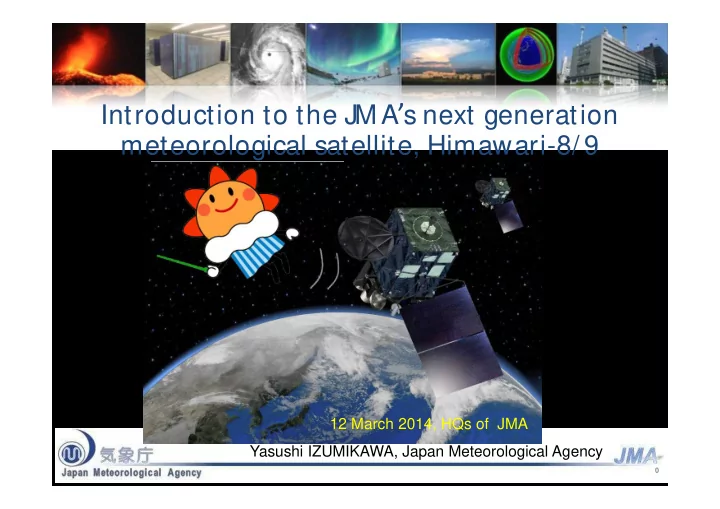
Yasushi IZUMIKAWA, Japan Meteorological Agency 12 March 2014, HQs of JMA

slide-2
SLIDE 2

1

 JMA plans to launch Himawari-8 in 2014 and begin its operation

in 2015.

 The launch of Himawari-9 for in-orbit standby is scheduled in

2016.

 Himawari-8/ 9 will be in operation around 140 degrees East

covering the East Asia and Western Pacific regions for 15 years.

2005 2006 2007 2008 2009 2010 2011 2012 2013 2014 2015 2016 2017 2018 2019 2020 2021 2022 2023 2024 2025 2026 2027 2028 2029 MTS AT-1R

Meteorological Mission

MTS AT-2

Meteorological Mission

Himawari-8 Himawari-9

In-orbit standby Operational In-orbit standby Manufacturing Launch In-orbit standby In-orbit standby Launch Operational Operational Operational In-orbit standby

Transition of Operational Satellites

slide-3
SLIDE 3

Himawari-8/ 9: Specification of Observation

Channel Central Wavelength [μm] Spatial Resolution 1 0.43 – 0.48 1 km 2 0.50 – 0.52 1 km 3 0.63 – 0.66 0.5 km 4 0.85 – 0.87 1 km 5 1.60 – 1.62 2 km 6 2.25 – 2.27 2 km 7 3.74 – 3.96 2 km 8 6.06 – 6.43 2 km 9 6.89 – 7.01 2 km 10 7.26 – 7.43 2 km 11 8.44 – 8.76 2 km 12 9.54 – 9.72 2 km 13 10.3 – 10.6 2 km 14 11.1 – 11.3 2 km 15 12.2 – 12.5 2 km 16 13.2 – 13.4 2 km

RGB Composite True Color Image

O3 SO2 CO2

Water Vapor Atmospheric Windows

Channels of the Advanced Himawari Imager (AHI)

Target area

Interval: 2.5 minutes (4 times in 10 minutes) Dimension: EW x NS: 1000 x 1000 km

Japan area

Interval: 2.5 minutes (4 times in 10 minutes) Dimension: EW x NS: 2000 x 1000 km x 2

Full disk Interval: 10 minutes (6 times per hour)

Number of Channels: 5 16 Interval: 30/60 min. 10min. 2

slide-4
SLIDE 4

M SC Web Page for Himawari-8/ 9 Information

MSC website top page http://mscweb.kishou.go.jp/

Details of AHI

3

slide-5
SLIDE 5

(a) Internet Service: National Meteorological and Hydrological Services (NMHSs) (b) CS: NMHSs with limited Internet connection

Himawari-8/ 9 raw data J M A

Himawari-8/ 9: Data Distribution/ Dissemination

CS Operator Communication Satellite (CS) C-band (4 GHz) DVB-S2 HRIT files, … (TBD) Internet Service

New equipment needs to be installed.

All imagery

(full resolution data)

C-band antenna LNB DVB-S2 receiver PC & software

Users

Main Target

Internet (a) (b)

You can freely re-distribute/re-disseminate both data you receive.

4

slide-6
SLIDE 6

2012 2013 2014 2015 2016

MTSAT-1R

M eteorological M ission

MTSAT-2

M eteorological M ission

Himawari-8 Himawari-9 via MTSAT (direct) via the Internet via a CS

In-orbit standby Manufacturing Launch Operational In-orbit standby Launch Operational Test Operational

(Himawari-8 imagery) (Himawari-8 imagery)

Operational

(MTSAT-2 imagery) (Himawari-8 imagery)

Operational

(MTSAT-2 imagery)

Imagery Distribution/Dissemination Operation of Satellites

 Parallel dissemination is planned to ensure users’ smooth

transition to receive imagery via a CS.

JMA will announce the details of CS (to be fixed in May 2014) and its receiving equipment in the spring of 2014.

Operational

Schedule of Distribution/ Dissemination

5

slide-7
SLIDE 7

Internet service

Format Observation Area Note Himawari Standard Data Full Disk Target Area

  • Full Disk: Every 10 minutes
  • Target Area: Every 2.5 minutes
  • 16 bands
  • The finest spatial resolution data

Portable Network Graphics (PNG) Full Disk Target Area

  • True-color images compositing 3 visible bands
  • Full Disk: Every 10 minutes
  • Target Area: Every 2.5 minutes
  • Same spatial resolution as Himawari Standard Data

Network Common Data Form (NetCDF) Target Area

  • Every 2.5 minutes
  • 16 bands
  • Same spatial resolution as Himawari Standard Data

HRIT files Full Disk

  • Compatible format as current MTSAT series’ HRIT

service

  • Every 10 minutes
  • 5 bands (VIS: 1 band, IR: 4 bands)
  • Coarser spatial resolution than Himawari Standard Data

Tentative data set to be distributed via the Internet service.

T entative!

  • Basically one download per one nation
  • Registration for account is required
  • No special equipment is needed but high-speed Internet connection is required

6

slide-8
SLIDE 8

CS dissemination

Data type Format Note Himawari-8/9 Imagery HRIT files LRIT files

  • Similar to current MTSAT series’ HRIT and LRIT

services

  • Every 10 minutes
  • HRIT: 5 bands (VIS: 1 band, IR: 4 bands)
  • LRIT: 3 bands (VIS: 1 band, IR: 2 bands)

Numerical Weather Prediction Products (GPV) SATAID format

  • Products of JMA’s Global Spectrum Model (GSM)
  • Every 6 hours

In-situ Observations (Surface stations, ships, radiosondes) SATAID format

  • Collected observation data from the East Asia

and Western Pacific regions ASCAT Ocean Surface Wind (EUMETSAT) SATAID format

  • Originally provided by EUMETSAT Ocean and

Sea Ice Satellite Application Facility (OSI SAF), and converted into SATAID format by JMA

Tentative data set to be disseminated via a communication satellite.

T entative!

  • No registration required
  • Some equipment and receiving software are required

7

slide-9
SLIDE 9

Sample screenshots of SATAID

8

slide-10
SLIDE 10

Contact point for Distribution/ Dissemination

Yasushi Izumikawa (Mr) E-mail: metsat@met.kishou.go.jp Phone: +81-3-3201-8677 FAX: +81-3-3217-1036

9

slide-11
SLIDE 11

Thank You for your attention.

10

slide-12
SLIDE 12

M ain feature of Himawari Standard Data/ HRIT

Himawari Standard Data (full set of Himawari-8/ 9 data) HRIT (light set of Himawari-8/ 9 data) From Internet service From Communication satellite dissemination, Internet service There is no standard viewer. User must prepare their own processing module for

  • peration.

There are some viewers for HRIT data. Recommended for product developers Recommended for weather forecasters

11