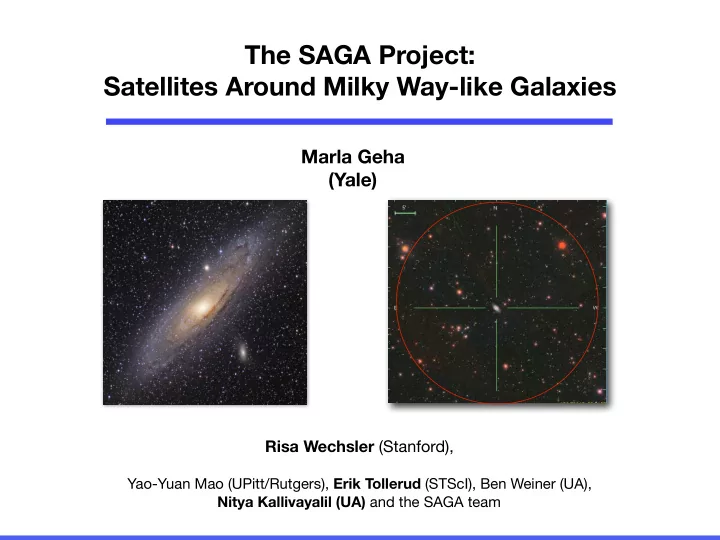
SLIDE 1
The SAGA Project: Satellites Around Milky Way-like Galaxies
Marla Geha (Yale)
Risa Wechsler (Stanford),
Yao-Yuan Mao (UPitt/Rutgers), Erik Tollerud (STScI), Ben Weiner (UA), Nitya Kallivayalil (UA) and the SAGA team
SLIDE 2 Satellites Around a Milky Way-mass Halo
Simulated mean of 1000 MW hosts 95% scatter single MW host 95% scatter ten MW hosts
- Y. Lu: EPS merger trees + SAM
MW satellites We need similar statistics for the observed MW population! Satellites Around Galactic Analogs (SAGA) Survey goal: Characterize satellite populations around ~100 MW analogs to Mr ~ -12.3 (Mstellar ~ 107 Msun).
MW has 5 satellites in this regime
SLIDE 3
Within 1o, there are a few thousand galaxies down to r = 21 At 30 Mpc, a virial radius (300 kpc) is equivalent to ~ 1 degree To observe ~100 MWs, need to survey a volume out to ~30 Mpc.
The SAGA Survey: Survey Design
At 30 Mpc, Mr = -12 is equivalent to r = 21
SLIDE 4
The SAGA Survey: Phase I Results
8 Milky Way-like hosts with complete satellite luminosity function down to Leo I to the viral radius. Phase I: Geha et al. (2017)
SLIDE 5
The SAGA Survey: Phase I versus Phase II
Geha et al. (2017) Y-Y. Mao et al. (2019 in prep) SDSS coverage 8 complete hosts DECALS coverage DES coverage 21 complete hosts
SLIDE 6
Same objects in each panel (all galaxies r < 20.5), ~94% complete gri SAGA spectra Deeper imaging improves target selection.
The SAGA Survey: Phase II Deeper Imaging
SLIDE 7 The SAGA Survey: Phase II Improved Selection Cuts
Paper 1: Color-only cuts for completeness
gri color cuts:
Paper 2: Color+mag+SB cuts GMM prioritization for targeting
Figure from S5 paper (Li et al, arXiv:1907.09481)
SLIDE 8 A ‘satellite’ is defined as a galaxy within the projected virial radius and ±250 km s-1
SAGA Results: Radial Distribution of Satellites
Paper I 8 hosts 27 satellites 14 newly discovered (13,000 redshifts) Paper II 21 hosts 77 satellites 41 newly discovered (19,000 redshifts) Current Progress 49 hosts 157 satellites 70 newly discovered (29,000 redshifts)
Literature SAGA
(preliminary numbers!)
SLIDE 9
Spectra are high S/N. Able to detect absorption or emission line spectra.
SAGA Results: Satellites Properties
Star-forming satellite Quenched satellite Single-slit follow-up for lowest surface brightness candidates.
SLIDE 10 We define a ‘quenched’ satellite as having Halpha EW less than 2A Paper I 8 hosts 27 satellites 2 of 21 quenched Paper II 21 hosts 77 satellites 8 of 63 quenched Current Progress 49 hosts 157 satellites 12 of 119 quenched
log[EW Ha]
MW: 3 of 5 quenched
O
SAGA Results: Radial Distribution and SFR
(preliminary numbers!)
SLIDE 11
SAGA Results: Radial Distribution and SFR
(preliminary)
SLIDE 12
SAGA Results: Radial Distribution of Satellites
SAGA satellites more extended that MW classical satellites?
(preliminary)
SLIDE 13 If a co-rotating plane exists, there should be more
- range within dashed lines and more blue outside.
SAGA Results: Plane of Satellites?
SAGA will provide significant data to test plane-of-satellite predictions. Phase 1: 58 pairs over 16 systems
SLIDE 14 If a co-rotating plane exists, there should be more
- range within dashed lines and more blue outside.
SAGA Results: Plane of Satellites?
SAGA will provide significant data to test plane-of-satellite predictions. Phase 2: 185 pairs over 49 systems Phase 1: 58 pairs over 16 systems
(preliminary)
SLIDE 15
SAGA Results: Luminosity Functions and Nsat
Paper I: 8 host Paper II: 21 host
(preliminary)
SLIDE 16
The SAGA Project: Towards 100 Milky Ways
With improved targeting scheme, 35 additional nights of AAT/MMT time is required to complete 100 MW analogs. 10 nights scheduled for 2019B 25 nights expected for 2020A/B With good weather, SAGA survey will be completed by early 2021.
SLIDE 17
Phase 1: Build complete sample of a few MW analogs using gri color cuts. Phase 2: Use data from Phase I to design an efficient targeting strategy. Efficiently measure satellite LF for 100 MW analog to Mr = -12. Do science.
The SAGA Project: Towards 100 Milky Ways
SAGA Observational Goal: Characterize the satellite populations down to Mr = -12 around 100 Milky Way-like galaxies. Paper I 8 hosts 27 satellites 14 newly discovered (13,000 redshifts) Paper II 21 hosts 77 satellites 41 newly discovered (19,000 redshifts) Phase 3: Current Progress 49 hosts 157 satellites 70 newly discovered (29,000 redshifts) Full SAGA redshift catalog from Paper I is available at sagasurvey.org, or by request.