Transition from Quasi-Static to Dynamic Fracture Carlos G. Dvila - - PowerPoint PPT Presentation

transition from quasi static
SMART_READER_LITE
LIVE PREVIEW

Transition from Quasi-Static to Dynamic Fracture Carlos G. Dvila - - PowerPoint PPT Presentation

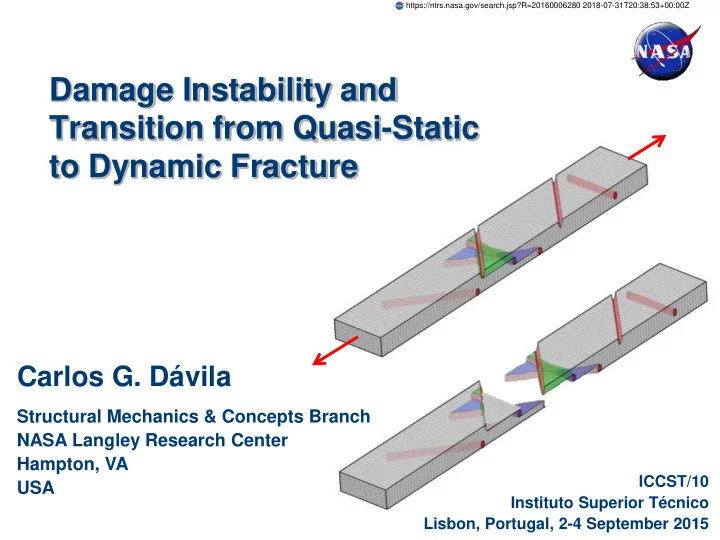
https://ntrs.nasa.gov/search.jsp?R=20160006280 2018-07-31T20:38:53+00:00Z Damage Instability and Transition from Quasi-Static to Dynamic Fracture Carlos G. Dvila Structural Mechanics & Concepts Branch NASA Langley Research Center


slide-1
SLIDE 1

Damage Instability and Transition from Quasi-Static to Dynamic Fracture

1

Carlos G. Dávila

Structural Mechanics & Concepts Branch NASA Langley Research Center Hampton, VA USA

ICCST/10 Instituto Superior Técnico Lisbon, Portugal, 2-4 September 2015

https://ntrs.nasa.gov/search.jsp?R=20160006280 2018-07-31T20:38:53+00:00Z

slide-2
SLIDE 2

Loading Phases:

  • 0) to A) – Quasi-static (QS) loading
  • A) to B) – Dynamic response

F, d

A) B)

Force Displacement

No QS solution exists

A) B) 0)

Snapback behavior:

  • More strain energy available than

necessary for fracture

Quasi-Static Loading and Rupture

2

slide-3
SLIDE 3

Failure Criteria and Material Degradation

Failure criterion E

1 Residual=E/100

Strain Stress

e/e0

Progressive Failure Analysis

1

Elastic property

Benefits

  • Simplicity (no programming needed)
  • Convergence of equilibrium iterations

Drawbacks

  • Mesh dependence
  • Dependence on load increment
  • Ad-hoc property degradation
  • Large strains can cause reloading
  • Errors due to improper load redistributions

3

slide-4
SLIDE 4

Failure Criteria and Material Degradation

Failure criterion E

1 Residual=E/100

Strain Stress

e/e0

1

Elastic property Failure criterion E

1

Strain Stress

e/e0

1

Elastic property Increasing lelem Increasing lelem

Progressive Failure Analysis Progressive Damage Analysis – Regularized Softening Laws

4

slide-5
SLIDE 5

       

f i i

K d K         , ) 1 ( ,

L+ +

K

F,

Gc

c

(1-d)K

Strength-Dominated Failure

K E L EA A F     

K E EG L G EA A F

c c c c

     

2

2 2   

Before damage After damage For “long” beams, the response is unstable, dynamic, and independent of Gc

   F

2

2

c c

EG L   For stable fracture under  control:  F

Stable Unstable

   F

5

slide-6
SLIDE 6

Fracture-Dominated Failure

E a G

2

  

2a G

a0

a

max R = GIc unstable E

2

: Slope   

Crack propagates unstably once driving force G(, a0) reaches GIc

G(, a0)

6

slide-7
SLIDE 7

Fracture-Dominated Failure

2a

E a G

2

  

G

a0 astable GR(a)

a

init max GInit unstable Gc

2(a+a)

G(, a0)

Crack propagates stably when driving force G(, a0) > GInit Unstable propagation initiates at

c Init

G G G  

7

slide-8
SLIDE 8

Mechanics of Crack Arrest

G

a0

a

max R = GIc unstable arrest aarrest

Crack arrest due to decreasing G

8

slide-9
SLIDE 9

Mechanics of Crack Arrest

G

a0

a

max unstable arrest?

R rate sensitive

Large strain rates often result in lower fracture toughness and delayed arrest

9

slide-10
SLIDE 10

Griffith growth criterion

Griffith Criterion and Stability

Stability of equilibrium propagation

Wimmer & Pettermann J of Comp. Mater, 2009

10

slide-11
SLIDE 11

Stability of Propagation with Multiple Crack Tips

P, v Wimmer & Pettermann J of Comp. Mater, 2009

a1 a2

a2, mm a1, mm Displacement, mm Force, N

0/90/…/90/0 15 plies total

P, v

Curved laminate with through-the-width delamination

2.25 mm

11

slide-12
SLIDE 12

Scaling: The Effect of Structure Size on Strength

Scaling from test coupon to structure Structural size, in. Yield or Strength Criteria

log n log D

(Z. Bažant)

Scaling Laws

Normal testing

12

slide-13
SLIDE 13

Cohesive Laws

Bilinear Traction-Displacement Law

c c

G d 

  

) (

Two material properties:

  • Gc Fracture toughness
  • c Strength

2 c c p

G E l   

Characteristic Length:

Final debond length

t0

unloading reloading

Yield or Strength Criteria

log n log D

Gc

Kp

c 0 c

13

slide-14
SLIDE 14

Crack Length and Process Zone

5 5 100 100 a l l a l l a

p p p p

   

Brittle: Quasi-brittle: Ductile:

Quasi- brittle

Force, F Applied displacement, 

LEFM error

2

c

c p

G E l   

a0

F,  Gc= constant

14

slide-15
SLIDE 15

Crack Length and Process Zone

5 5 100 100 a l l a l l a

p p p p

   

Brittle: Quasi-brittle: Ductile:

Long crack Brittle Quasi- brittle Short crack Ductile

LEFM error

Force, F Applied displacement, 

LEFM error LEFM error

2

c

c p

G E l   

a0

F, 

15

slide-16
SLIDE 16

2

c

c p

G E l   

a0

F, 

Strength and Process Zone

As the strength c decreases,

  • 1. the length lp of the process

zone increases

  • 2. the error of the Linear

LEFM solution increases

a0 a0+lp

Force, F Applied displacement, 

LEFM error

Gc = constant

Decreasing

c

16

slide-17
SLIDE 17

Size Effect and Material Softening Laws

Two material properties:

  • c Strength
  • Gc Fracture toughness

Damage Evolution Laws: Each damage mode has its

  • wn softening response

Fracture Tests Strength Tests

c

Gc / l

E Material length scale

2

c

c c

G E l   

e

17

slide-18
SLIDE 18

Damage Modes:

Tension Compression

Damage Evolution:

Thermodynamically-consistent material degradation takes into account energy release rate and element size for each mode

LaRC04 Criteria

  • In-situ matrix strength prediction
  • Advanced fiber kinking criterion
  • Prediction of angle of fracture (compression)
  • Criteria used as activation functions within

framework of continuum damage mechanics (CDM) e  Critical (maximum) finite element size:

Bazant Crack Band Theory:

2 * 2 *

2 2

i i i i i

X l G E X l A  

2 *

2

i i i

X G E l 

   

i i i i

f A f d    1 exp 1 1

fi: LaRC04 failure criteria as activation functions

s y y

M M M F F i ; ; ; ;

   

F

 y

M

F

 y

M

Progressive Damage Analysis (Maimí/Camanho 2007)

18

slide-19
SLIDE 19

log (diameter, mm) log (Strength, MPa) Prediction of size effects in notched composites

  • Stress-based criteria predict no size effect
  • CDM damage model predicts scale effects w/out calibration

(P. Camanho, 2007)

Hexcel IM7/8552 [90/0/45/-45]3s CFRP laminate

Experimental (mean) Analysis

Predicting Scale Effects with Continuum Damage Models

19

slide-20
SLIDE 20

log (diameter, mm) log (Strength, MPa)

Scale effect is due to relative size of process zone

Cohesive law Stress distribution

(P. Camanho, 2007)

Process Zone and Scale Effect in Open Hole Tension

20

slide-21
SLIDE 21

Length of the Process Zone (Elastic Bulk Material)

mm 4 . 3 6 .

2

 

c c c

G E l 

mm 7 . 4 

pz

l A B C D E F

Symmetry Symmetry

h/ao = 1

Maximum Load

ao

h

CT Sun, Purdue U

2ao

Short Tensile Test

Lexan Polycarbonate 2h Cohesive elements

21

slide-22
SLIDE 22
  • The use of cohesive laws to predict the

fracture in complex stress fields is explored

  • The bulk material is modeled as either

elastic or elastic-plastic

1000 2000 3000 4000 5000 6000 1 2 3 4

Fmax, N

h/a

Test (CT Sun) LEFM Cohesive

h/a = 0.25 (long process zone) Observations:

  • LEFM overpredicts tests for h/a<1

Lexan Plexiglass tensile specimens (CT Sun) h/a=0.25 h/a=0. 5 h/a=1 h/a=2 h/a=4

2h 2a

h/a=1 (short process zone) mm. 7 . 4 

cz

l Width 

cz

l

Cohesive Laws - Prediction of Scale Effects

22

slide-23
SLIDE 23

Study of size effect: measuring the R-curve

Double-notched compression specimens

G

a0 astable GR(a)

a

Increasing

w a 2w a0 a0 5 .

0 

w a

eff u

E a w a G

2

        

By FEM analysis From test

2 3 4 5 6 7 8 9 , MPa-2 *10-5

a0, mm

2  u

3.2 2.8 2.4 2.0 1.6 1.2 0.8 0.4 0.0 Catalanotti, et al., Comp A, 2014

E a G

2

  

(Similar to )

23

slide-24
SLIDE 24

Characterization of Through-Crack Cohesive Law

Clevis Anti- buckling guide Specimen 𝑦 𝑧 𝑨 Experimental setup 0° 𝑄 𝑏0 ∆𝑏 𝑋 1.18𝑋 𝑦 𝑧 Thin multidirectional laminate Compact Tension (CT) Specimen

Characterization Procedure: 1. Measure R-curve from CT test 2. Assuming a trilinear cohesive law, fit analytical R-curve to the measured R-curve 3. Obtain the cohesive law by differentiating the analytical R-curve 𝐻𝑆 = 𝑄2 2𝑢 𝜖𝐷 𝜖𝑏 𝜏 𝜀 = 𝜖𝐾fit 𝜖𝜀 𝜃 =

𝑗 𝑜𝑡

𝐾fit

𝑗 − 𝐻𝑆 𝑗

𝜏𝑑 𝜀 𝐻𝑑 𝐿 𝜏 Trilinear cohesive law

Bergan, 2014

24

slide-25
SLIDE 25

Size-Dependence of R-Curve

(a) ‘S’ (b) ‘L’ 25 mm

Plotting the R-curve as a function of the notch displacement removes the size-dependency

Bergan, 2014

Displacements measured through digital image correlation (DIC)

Small Large

aeff, mm aeff, mm

GR,N/mm GR,N/mm GR,N/mm 𝜀, mm

25

slide-26
SLIDE 26

R-Curve Effect in Fiber Fracture

𝐾𝑆 =

𝜀𝑑

𝜏 𝜀 𝑒𝜀

Curve fit assuming bilinear 

𝑄 [kN] 𝜀, mm

Analysis Test 0.0 1.0 2.0 3.0 4.0 6. 4. 2. 0.

P, 

𝑏0 ∆𝑏 Cohesive elements w/ characterized cohesive law

Bergan, 2014

200 400 600 800 0.0 0.5 1.0 1.5 2.0 [MPa] [mm]

Cohesive response for fiber failure

𝜀, mm

,MPa

P,kN

𝜀, mm

GR,N/mm

26

slide-27
SLIDE 27

Mode II-Dominated Adhesive Fracture

Tip of adhesive Teflon Adhesive thickness: 0.13 mm

27

slide-28
SLIDE 28

ENF J-Integral from DIC

slide-29
SLIDE 29

MMB Test - Analysis Results

Nominally identical bonded MMB specimens sometimes fail in quasi-static mode and others dynamically. Why?

Displacement, mm Applied load, N

Mixed mode bending (MMB) test fixture

29

slide-30
SLIDE 30

Double Delamination in MMB Tests

Composite delamination Adhesive failure

Failure Surfaces

  • Unexpected failure mechanism
  • Two delamination fronts run in

parallel: one in the adhesive, the other in the composite

  • When the fiber bridge breaks, the crack grows unstably in the

composite causing the drop in the load-displacement curve

30

slide-31
SLIDE 31

Modeling the Double Delamination

Fiber bridge Cohesive layer Adhesive Layer

  • A model was developed to evaluate the observed double

delamination phenomenon

  • The model contains two additional cohesive layers within the

composite arms

  • This failure mechanism is often observed in bonded joints

Displacement, mm Applied load, N

MMB test specimen Model of MMB specimen with double delamination

Model with double delamination Model with single delamination Experimental result

31

slide-32
SLIDE 32

Representative Volume Element and Micromechanics

32

Why Micromechanics?

Assumption: “Micromechanics has more built-in physics because it is closer to the scale at which fracture occurs”

Why NOT Micromechanics? (Representative Volume Element [RVE])

  • Problem of localization
  • Randomness of unit cell configurations
  • Lengthscales missing
  • Characterization of material properties, especially the interface
  • Computational expense
slide-33
SLIDE 33

RVE: 1) Problem of Localization

33

Scale of RVE cannot be eliminated Linear

RVE, Schapery Theory, homogenization Localization; regularized CDM, nonlocal methods

Softening Softening Linear Hardening Hardening Localized Smeared

 e

slide-34
SLIDE 34

RVE: 2) Randomness of Unit Cell Configurations

34

Melro et al. IJSS, 2013. Bloodworth, V., PhD Dissertation, Imperial College, UK, 2008.

Fracture is a combination of interacting discrete and diffuse damage mechanisms

slide-35
SLIDE 35

RVE: 3) Issue of Length Scales

35

RVE may not account for:

  • Ply thickness
  • Longitudinal crack length
  • Crack spacing

Crack spacing = RVE Shielding

slide-36
SLIDE 36

Matrix Cracking ̶ In Situ Effect

36

slide-37
SLIDE 37

Transverse Matrix Cracks w/ One Element Per Ply

Multi-element model: correct crack evolution Conventional single-element: no opening w/out delam. Modified single-element: correct Energy Release Rate

K

t E K

2 2

4  

t

Van der Meer, F.P. & Dávila, C., JCM, 2013

Ply thickness, mm

Typical

90, MPa

37

slide-38
SLIDE 38

Crack Initiation, Densification, and Saturation

Van der Meer, F.P. & Dávila, C., JCM, 2013

 = 182 MPa  = 273 MPa  = 372 MPa  = 679 MPa

Cohesive zone Traction-free cohesive zone Delamination

38

slide-39
SLIDE 39

𝑔(x)

Material Inhomogeneity

39 F Leone, 2015

Initial crack density in a uniformly stressed laminate is strictly a function of material inhomogeneity

x

  • Strength scaled by 𝑔, Fracture toughness scaled by 𝑔2
  • Constant 𝑔 along each crack path

10 elts.

Inhomogeneity applied to 3 levels of mesh refinement

Crack density Stress

Stochastic Deterministic

2 elts. 1 elt.

slide-40
SLIDE 40

Effect of Transverse Mesh Density on Crack Spacing

40 F Leone, 2015

slide-41
SLIDE 41

Commercial finite element vendors and developers are providing more and more tools for progressive damage analysis.

… more analysis tools = more rope!

But, if the load incrementation procedures do not converge…

What Happened to Quadratic Convergence!!??

41

slide-42
SLIDE 42
  • Viscoelastic Stabilization
  • Delayed damage evolution
  • Implicit dynamics or Explicit solution
  • Arc-length techniques
  • Dissipation-based arc-length

Constant energy dissipation in each load increment

Gutiérrez, Comm Numer Meth Eng (2004) Verhoosel et al. Int J Numer Meth Eng (2009)

g

Techniques for Achieving Solution Convergence

42

slide-43
SLIDE 43

Van der Meer, Eng Fract Mech, 2010

QS Solution of Unstable OHT Fracture

43

slide-44
SLIDE 44

Open Questions

  • Is the QS solution physical?
  • Are the dynamic effects necessary?
  • Which solution provides more

insight into failure modes?

F d F d

A)

Implicit Explicit

44

slide-45
SLIDE 45

Concluding Remarks

  • A typical structural tests usually consist of three stages:
  • 1. QS elastic response without damage
  • 2. QS response with damage accumulation
  • 3. Dynamic collapse/rupture
  • Most structural failures exhibit size effects that depend on load

redistribution that occurs during the QS phases

  • Correct softening laws based on strength and toughness considerations

are required

  • Dynamic collapse/rupture is a result of the interaction between

damage propagation and structural response

  • A stable equilibrium state often does not exist after failure under either

load or displacement control

  • Onset of instability (failure) occurs when more elastic strain energy can

be released by the structure than is necessary for damage propagation

  • Simulation of unstable rupture is often needed to ascertain mode of

failure and to compare to test results

45