Transfusion To list risks and benefits of various Pitfalls blood - - PDF document

transfusion
SMART_READER_LITE
LIVE PREVIEW

Transfusion To list risks and benefits of various Pitfalls blood - - PDF document

Objectives Transfusion To list risks and benefits of various Pitfalls blood products To discuss controversy over liberal vs restrictive blood transfusion Gregory W. Hendey, MD, FACEP To analyze new literature on


slide-1
SLIDE 1

Transfusion Pitfalls

Gregory W. Hendey, MD, FACEP Professor and Chief UCSF Fresno, Emergency Medicine

Objectives

 To list risks and benefits of various

blood products

 To discuss controversy over “liberal”

vs “restrictive” blood transfusion

 To analyze new literature on Massive

Transfusion

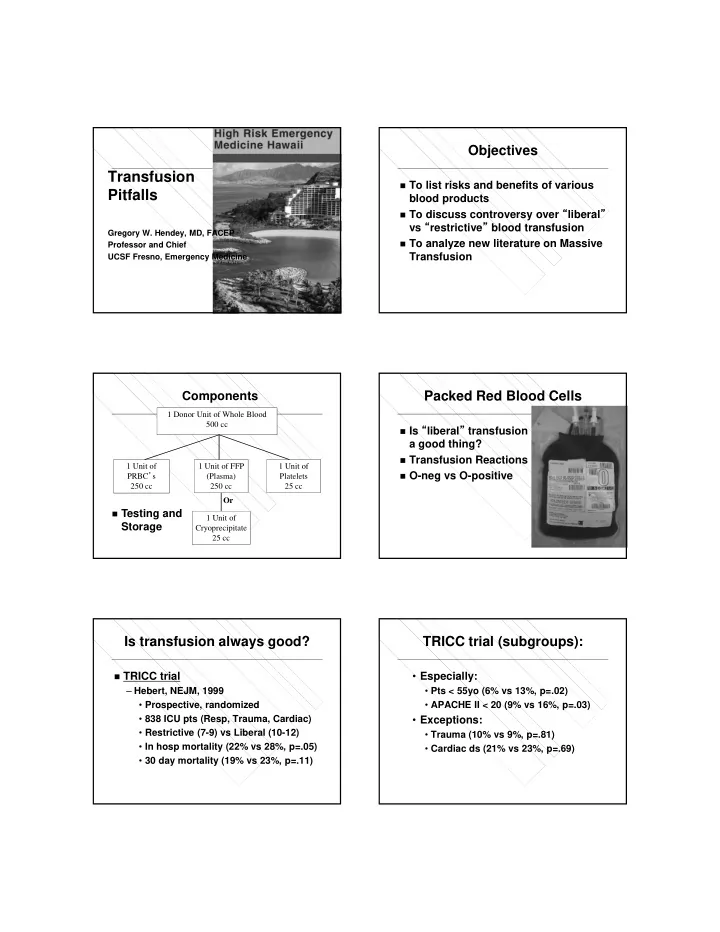
1 Donor Unit of Whole Blood 500 cc 1 Unit of FFP (Plasma) 250 cc 1 Unit of Platelets 25 cc 1 Unit of PRBC’s 250 cc 1 Unit of Cryoprecipitate 25 cc Or

Components

 Testing and

Storage

Packed Red Blood Cells

 Is “liberal” transfusion

a good thing?

 Transfusion Reactions  O-neg vs O-positive

Is transfusion always good?

 TRICC trial

– Hebert, NEJM, 1999

  • Prospective, randomized
  • 838 ICU pts (Resp, Trauma, Cardiac)
  • Restrictive (7-9) vs Liberal (10-12)
  • In hosp mortality (22% vs 28%, p=.05)
  • 30 day mortality (19% vs 23%, p=.11)

TRICC trial (subgroups):

  • Especially:
  • Pts < 55yo (6% vs 13%, p=.02)
  • APACHE II < 20 (9% vs 16%, p=.03)
  • Exceptions:
  • Trauma (10% vs 9%, p=.81)
  • Cardiac ds (21% vs 23%, p=.69)
slide-2
SLIDE 2

Non-randomized studies:

 CRIT trial

– Corwin, Crit Care Med, 2004 – 4,892 ICU pts, prospective

  • bservational

– 44% were transfused, mean 5 units – Txn independently assoc with incr mort

 Several studies in Trauma, Critical Care

– More transfusion = higher mortality

 Selection bias?

Why would it be bad?

Oxygen delivery Volume expansion Coagulation Hemolysis Anaphylaxis HIV, HCV Volume overload TRALI TRIM

Minor Transfusion Reactions:

 Simple febrile (1%)

– Antibody vs donor Leukocyte antigens – Acetaminophen

 Simple allergic (0.1%)

– Antibody vs donor plasma proteins – Diphenhydramine

Severe Transfusion Reactions:

 Acute hemolysis

– ABO error (non ABO) – 1 in 250K

 Anaphylaxis

– Congenital IgA deficiency – 1 in 150K

 Bacterial contamination

– Plts > PRBC – Babesia microti, S. aureus – 1 in 2-10K

Delayed Transfusion Reactions:

 HIV

– 1 in 1 million

 Hepatitis B

– 1 in 137K

 Hepatitis C

– 1 in 1 million

 Graft vs Host disease

Transfusion Fatalities

2007-11 FDA data

slide-3
SLIDE 3

 TRALI

– Transfusion related acute lung injury

 TACO

– Transfusion assoc circulatory overload

 TRIM

– Transfusion related immunomodulation

 TGIF

– Thank God it’s Friday!

TRALI

Transfusion-related Acute Lung Injury

 1 in 5K. FFP > PRBC > Plts  50% transfusion related deaths  Immune-related, donor antibodies vs

patient WBC’s cytokines

 Prevention:

– Reduce female plasma donors

 Non-cardiogenic pulmonary edema

Overload vs TRALI

 PRBC  Cardiomegaly  High wedge/CVP  High BP  NTG, Diuresis  FFP > PRBC  Normal  Normal / low  Normal / low BP  Supportive

TRIM

(Transfusion Related Immunomodulation)

 Immunosuppression, inflammatory

– WBC’s and mediators (cytokines, IL)

 Benefit: organ transplant survival  Harm:

– Recurrence of malignancies – Pneumonia, post-op infections – Increased mortality

 Prevention: Leukoreduction

Is Old blood Bad blood?

 Storage lesion 

pH, K, free Hgb

 Might scavenge nitric oxide

– NO vasodilates for tissue perfusion

 Multiple studies: worse outcomes

– Cardiac surg, Trauma, Critical care

 Multiple studies: no difference

**So what should I do?**

 Napolitano, CCM and J Trauma, 2009:

– Guideline from ACCCM and EAST – Txn indicated for hemorrhagic shock – Restrictive strategy (Hgb<7) for stable anemia (except ACS) – Sepsis: EGDT 1st 6 hrs (Hgb 10)

  • Then Restrictive (Hgb 7)
slide-4
SLIDE 4

CCM / Trauma Guideline (cont.)

– One unit at a time

  • Except acute hemorrhage

– Must also consider clinical indicators »Hemodynamics, ongoing loss – Txn incr risk of Infxn, SIRS, ARDS

EXAMPLE

 50 yo M alcoholic, GI bleeding, BP

80/40, HR 130, Hgb 8.1

 Should I transfuse, or use restrictive

trigger of Hgb<7?

 TRANSFUSE

– Acute hemorrhage – Hemodynamically compromised

2 Units of O-negative, Stat!

 O-neg to women of childbearing age

– Alloimmunization – Hemolytic disease of newborn

 O-positive to men, older women

– Tiny chance of hemolysis if Rh negative – Future emergency transfusion

O+ blood transfusion

 Dutton, J Trauma, 2005:

–Maryland Shock Trauma, one year –O- to young women, O+ all others –581 units type O to 161 patients –No transfusion reactions –One Rh- male developed Ab

Type and Screen vs Type and Cross

 T&S: test for atypical Ab in serum  T&C: mix pt serum and donor RBCs  Electronic cross matching

Massive transfusion

 Definition:

– Entire blood volume in 24 hrs (75 cc/kg, 5L, 10 units PRBC) – 5 units in 3 hrs + ongoing hemorrhage

 Problems:

– Coagulopathy, DIC – Hypothermia – Acidosis – Hypocalcemia (citrate toxicity)

slide-5
SLIDE 5

Coagulopathy:

 Multi-factorial

– Dilution – Hypothermia, acidosis

 2 approaches:

– 1) treat problems as they arise – 2) treat prophylactically (Protocol)

  • 5 PRBC / 5 U FFP / 1 apheresis Plts
  • Approximates Whole blood

 No randomized trials

Ho, Can J Surg, 2005:

 Mathematical model

– Ongoing loss, various ratios of transfxn

 Assumptions:

– 30% blood loss, IVF, 2 U PRBC – Clotting factors already 50%

 Only way to maintain or “catch up” is

1:1 or higher (more FFP)

 Vary PRBC:FFP 3:1, 2:1, 1:1

Ho, Can J Surg, 2005 (cont):

 Only way to maintain or “catch up” is

1:1 or higher (more FFP)

Borgman, J Trauma, 2007:

 Retro, 246 pts, > 10 U PRBC  Higher FFP:PRBC, higher survival  Low ratio (1:8) Survival 35%  High ratio (1:1.4) Survival 81%  Supports 1:1 massive transfusion

Holcomb, Ann Surg, 2008:

 Retro, 466 massive transfusion pts  High FFP:PRBC ratio (>1:2) vs low  30 day survival: 60% vs 40%  Same effect with Plt:PRBC ratio  Recommended 1:1:1

slide-6
SLIDE 6

Massive Transfusion Pack

 5 U PRBC (O-negative)  5 U FFP (AB, pre-thawed)  1 U Apheresis Platelets

Summary

 Transfusion indications and

controversies

 Transfusion reactions  Massive Transfusion  Thank you!

And don’t worry . . . All bleeding eventually stops!