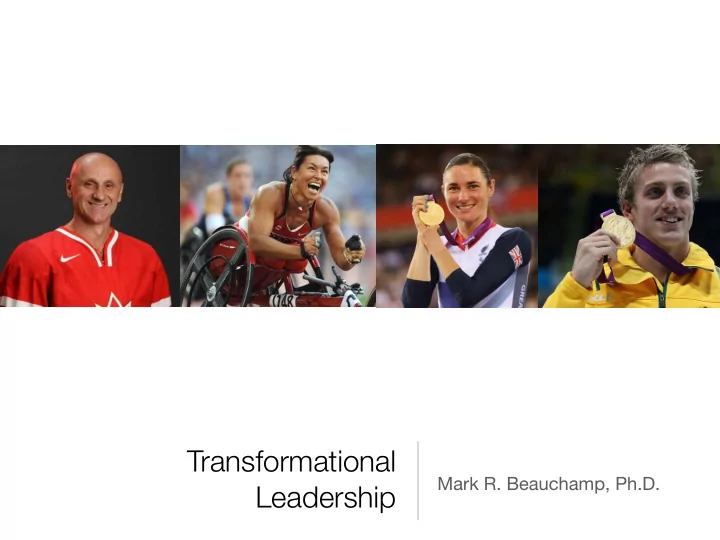
SLIDE 1
Transformational Leadership
Mark R. Beauchamp, Ph.D.
SLIDE 2
Leaders and mentors change lives!
SLIDE 3 Peer Mentoring and Disabilities
- Motivation
- Hope
- Comfort/Acceptance
- Engagement
- Redefining Limitations
- Self-confidence
- Overall Well-Being/
Happiness
SLIDE 4 Dilbert Definition of Leadership
"Leadership is an intangible quality with no definition. That's probably a good thing, because if the people being led knew the definition, they would hunt down their leaders and kill them."
SLIDE 5 Differentiating Wonderful and Dreadful Leaders (and Peer Mentors)
- Dreadful leaders demean their followers
- Wonderful leaders elevate their followers
"Recognize the smartest person in the room rather than act like the smartest person in the room."
- New York Times, February 26, 2006
SLIDE 6 Working Definition of Leadership
To take people1 to places they would not have gone by themselves, and get them to do things they otherwise would not have done because
[a] they want to do it [b] they understand why!
1 Could be peer mentees, employees, athletes, students.
SLIDE 7 Purpose of SCI Peer Mentorship
- Fulfilling family roles and responsibilities (being a father, mother, spouse,
etc.)
- Getting out and about-going shopping, to concerts, to restaurants
- Returning to work
- Participating in sports, exercise, leisure activities
- Travelling/touring abroad
- Dating, sexuality
- Getting around the community
- Using public transit, taxis, etc
- Self-care (i.e. bowel and bladder routines, dressing)
- Housework, household chores
- Parenting
SLIDE 8
Transformational Leadership
Actions that transcend one’s own self-interests with the purpose of empowering, inspiring, and challenging others to achieve a higher level of functioning. (Bass & Riggio, 2006)
SLIDE 9 Transformational Leadership
- Leadership is pivotal
- Consistently predicts
employee, student, athlete:
- attitudes
- motivation
- performance
- well-being
SLIDE 10 Four ‘I’s of Transformational Leadership
Idealized Influence (II)
- Engender trust and respect
- Demonstration of personally held values
Inspirational Motivation (IM)
- Communicating high expectations
- Inspiring and energizing others to go beyond minimal standards
Individual Consideration (IC)
- Recognizing individual needs
- Genuine sense of care and concern
Intellectual Stimulation (IS)
- Encouraging others to approach old problems in new ways
- Contribute new/alternative solutions
SLIDE 11
Hockey is Hockey
SLIDE 12
Full Range of Leadership
SLIDE 13 Feedback and Recognition
"The key to developing people is to catch them doing something right."
The One-Minute Manager
SLIDE 14 Full Range of Leadership
- Contingent Reward
- Constructive transactions
- Immediate and specific feedback
- Management-By-Exception
- Corrective transactions
- When standards aren’t met – has ‘active’ and ‘passive’
forms
- Laissez Faire
- Non-leadership
SLIDE 15
Can We learn to be Transformational?
SLIDE 16
Bottom Line?
SLIDE 17
SLIDE 18
Lunch
SLIDE 19
SLIDE 20 Idealized Influence
- Behave as a role model
- Do what is right, not what is
convenient
- Create trust and respect
- Consistent and dependable
- And if you make a mistake don’t be
afraid to APOLOGIZE!
Idealized influence takes place when leaders foster trust and respect among others, and model ethically desirable behaviours through the demonstration of personally held beliefs.
SLIDE 21 Idealized Influence
“You believe in something, you stand up for it, you try to pull together a team of people who can be inspired by that same vision, and then help encourage people to add value by putting their unique talents to the task - and you treat everybody with respect, no matter what role they’re playing.”
SLIDE 22 Idealized Influence: Strategies, Barriers, and Solutions?
challenges
speak with my mentee”
solutions
calendar, that way you ensure that you allocate time
SLIDE 23 Inspirational Motivation
Inspirational motivation involves the communication of high expectations, through which leaders inspire and energize
- thers to achieve their goals.
- Raise expectations
- Convince others that they can
achieve ‘beyond expectations’
- Be optimistic and enthusiastic
about what can be achieved
- Set high (but achievable) standards
SLIDE 24 Inspirational Motivation
"You see, really and truly, apart from the things anyone can pick up (the dressing and the proper way of speaking, and so on), the difference between a lady and a flower girl is not how she behaves but how she is treated. I shall always be a flower girl to Professor Higgins because he always treats me as a flower girl and always will; but I know I can be a lady to you because you always treat me as a lady and always will.” Eliza Doolittle
SLIDE 25 Inspirational Motivation: Strategies, Barriers, and Solutions?
- Identify potential challenges
- “I’m finding it difficult to
motivate my mentee; s/he seems just so unenthusiastic”
solutions
- Give personal examples
- f when you overcame a
challenge, try and motivate them, lead by example
SLIDE 26 Inspirational Motivation Tips
- 1. Encourage mentees to leave
their comfort zones and explore their abilities Example: As a mentor, be aware of the opportunities and events available to your mentee. This will enable you to provide your mentee with valuable information about all
- f the possible activities they can
participate in.
SLIDE 27 Inspirational Motivation Tips
- 2. Let mentees know you believe
in them. Example: Encourage your mentee when they have doubts about their
- abilities. Be enthusiastic and offer
to accompany or assist them in the activity they are finding difficult or are nervous about (e.g. taking public transportation the first time).
SLIDE 28 Inspirational Motivation Tips
- 3. Challenge mentees to set
meaningful and challenging goals that promote personal growth. Example: Be familiar with how to help your mentee set S.M.A.R.T.
- goals. Ensure that the goals are
meaningful and important to your mentee, as this will help motivate them.
SLIDE 29 Intellectual Stimulation
Intellectual stimulation involves encouraging others to see issues from multiple perspectives, and question their own and others’ commonly held assumptions.
difficulties and challenges
- Try to brainstorm potential
strategies
- Discuss alternatives and challenge
your mentee
SLIDE 30
Intellectual Stimulation
"Man's mind, stretched to a new idea, never goes back to its original dimensions."
Oliver Wendell Holmes
SLIDE 31 Intellectual Stimulation: Strategies, Barriers, and Solutions?
- Identify potential challenges
- “My mentees say that
physical/social activities aren’t for them, and they just can’t see the benefits”
solutions
scientific evidence that shows its benefits
SLIDE 32 Individualized Consideration
Individualized consideration takes place when leaders respond to the personal and psychological needs of others, and display a genuine sense of care and concern.
- Listen, display empathy and
compassion
psychological and physical needs and abilities
concern
SLIDE 33 Individualized Consideration
"It was not just affability or good manners or his physical appearance... But a genuine capacity for empathy, for interesting himself in the circumstances of other people."
SLIDE 34 Individualized Consideration: Potential Barriers, Challenges, and Solutions
- Identify potential challenges
- “Given the limited time, money,
and resources available to us it’s impossible to support my mentee to engage in activities that s/he will really like”
- Brainstorm possible solutions
- Get creative and think of
alternative activities that may be just as enjoyable and benefit them
SLIDE 35 Individualized Consideration Tips
- 1. Treat each mentee as a
unique, valued individual. Example: Thank your mentee for
something with you. This action will show that you care for your mentee and value their thoughts and opinions.
SLIDE 36 Individualized Consideration Tips
Example: Give your full attention to your mentee when they are talking and allow them to finish before you respond. If engaging
- ver the phone make sure your
volume is loud enough and take note of specific items that you feel are important to respond to.
SLIDE 37 Individualized Consideration Tips
- 3. Give specific, personalized
feedback or advice that suits your mentee’s individual needs. Example: Avoid using generalized statements (e.g. “you should get out more”) when providing advice. Instead try to make your advice specific to your mentees problem (e.g., your mentee seems to be lacking in social support, so you recommend they attend a social event or join a social club in their area).
SLIDE 38
– Don Shula and Ken Blanchard
“Learning is defined as a change in behaviour. You haven't learned a thing until you can take action and use it.”
SLIDE 39
SMARTi Goals
Specific Measurable Action-Oriented Realistic (but challenging) Time-based Important for you!
SLIDE 40 What Next?
- Select 1 goal from your list to work
- n
- 3-months and 6-month program.
- Each week:
- Review challenges to your goal
- Think of strategies to
- vercome these challenges
- Use handbook provided,
modify your goal if you need to!
- Support Available?
- Coaching
- Phone support
SLIDE 41 Follow-up Support
Phone call (once per month)
- 1. How have goals been going?
- 2. Anything we can do to help?
SLIDE 42 But What if I Have a Setback?
- Most people attempting major behavioural change suffer
setbacks - including leaders
- Acute (short term) causes: Interpersonal conflict, bad
moods, unpredictable events.
- Chronic (long term) causes: Stress, fatigue, lack of social
support.
- Setbacks are not fatal:
- They are expected and predictable
- An opportunity for growth
SLIDE 43
Thank you!