SLIDE 1 1
<Transcript> Presentation of Analyst Briefing Session for Medium-Term Management Plan Date: May 18, 2016 Presenter: Yuzuru Yamamoto, President and CEO Presentation Material:
https://www.ube-ind.co.jp/ube/en/ir/ir_library/presentation/pdf/keiei_change_challenge_2016_en_17111521.pdf
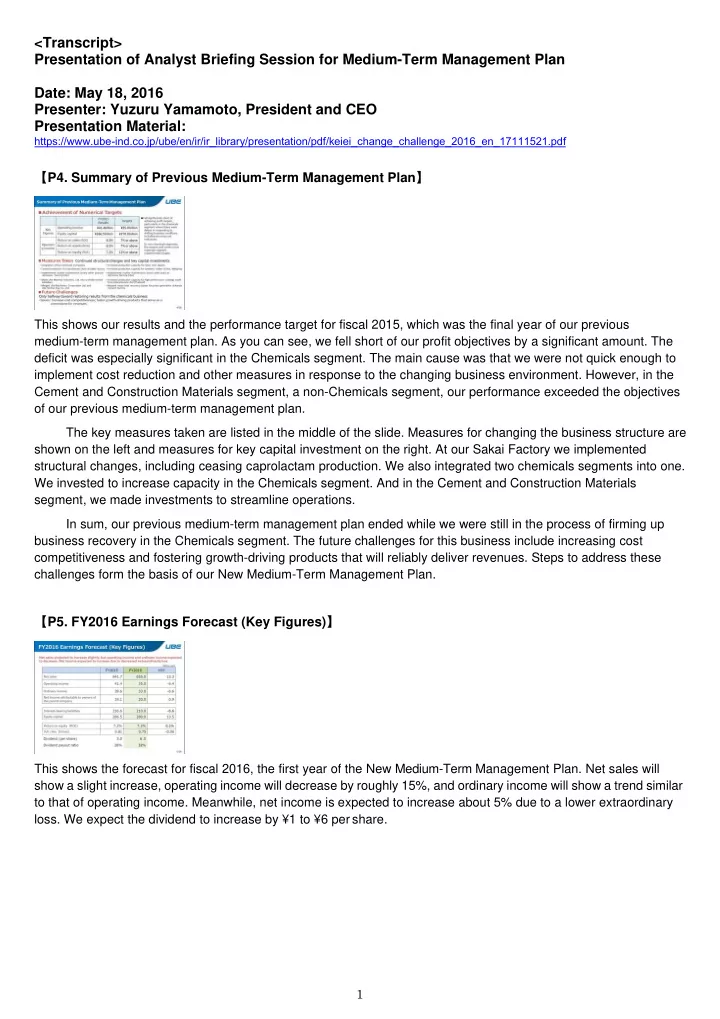
【P4. Summary of Previous Medium-Term Management Plan】 This shows our results and the performance target for fiscal 2015, which was the final year of our previous medium-term management plan. As you can see, we fell short of our profit objectives by a significant amount. The deficit was especially significant in the Chemicals segment. The main cause was that we were not quick enough to implement cost reduction and other measures in response to the changing business environment. However, in the Cement and Construction Materials segment, a non-Chemicals segment, our performance exceeded the objectives
- f our previous medium-term management plan.
The key measures taken are listed in the middle of the slide. Measures for changing the business structure are shown on the left and measures for key capital investment on the right. At our Sakai Factory we implemented structural changes, including ceasing caprolactam production. We also integrated two chemicals segments into one. We invested to increase capacity in the Chemicals segment. And in the Cement and Construction Materials segment, we made investments to streamline operations. In sum, our previous medium-term management plan ended while we were still in the process of firming up business recovery in the Chemicals segment. The future challenges for this business include increasing cost competitiveness and fostering growth-driving products that will reliably deliver revenues. Steps to address these challenges form the basis of our New Medium-Term Management Plan. 【P5. FY2016 Earnings Forecast (Key Figures)】 This shows the forecast for fiscal 2016, the first year of the New Medium-Term Management Plan. Net sales will show a slight increase, operating income will decrease by roughly 15%, and ordinary income will show a trend similar to that of operating income. Meanwhile, net income is expected to increase about 5% due to a lower extraordinary
- loss. We expect the dividend to increase by ¥1 to ¥6 per share.
SLIDE 2 2 【P6. FY2016 Earnings Forecast by Business Segment】 This compares the fiscal 2016 forecast for net sales and operating income against results for the prior year, by business segment. We are forecasting reduced operating income in each business segment. In particular, the Chemicals segment and the Cement and Construction Materials segment are expected to see the most significant
- reductions. We are assuming an exchange rate of ¥110 to one US dollar, which represents a yen that is about ¥10
stronger against the dollar compared to the previous fiscal year. Major factors in the reduced income forecasted are routine maintenance that is scheduled in fiscal 2016 at our ammonia plant and our private power plant. This will account for an expected reduction of ¥5 billion compared to the previous year. In particular, these two instances of routine maintenance may account for a roughly ¥4.3 billion lower
- perating income in the Chemicals segment. At the same time, we expect an increase in income for battery materials
and other products. On the whole, then, we are forecasting a ¥3 billion reduction in the Chemicals segment. For the Construction Materials and Cement segment, a major factor in reduced income will be the lower profit margin, caused by sluggish conditions in the export market (which was firm in fiscal 2015) on a dollar basis, and the stronger yen. We are forecasting an overall operating income of ¥35 billion for fiscal 2016. 【P7. New Medium-Term Management Plan Change & Challenge 2018: Overview】 Now, let’s discuss our New Medium-Term Management Plan. We implemented our previous medium-term management plan under the theme “Change & Challenge — Driving Growth,” but the results fell short of our
- expectations. In light of this, we feel that there are still areas where we have not made the required changes nor
finished addressing the challenges we face. Therefore, we have kept “Change & Challenge” as the theme for our New Medium-Term Management Plan. However, with the intent of successfully following through on this plan we have added “2018” to the theme. 【P8. Corporate Images the UBE Group Targets to Realize】
SLIDE 3
3 First, I would like to briefly review the kind of company we are trying to be. To date we have managed our businesses based on two founding principles: “coexistence and mutual prosperity” and “from finite mining to infinite industry.” The year 2017 marks the 120th anniversary of the establishment of the UBE Group. On the verge of this major milestone, we once again embrace the founding principles that have guided us for the past 120 years. The Group Vision is based on our business principles and provides us with a path toward future development. To date our vision has been “Wings of technology and spirit of innovation. That’s our DNA driving our global success.” To establish further clarity to the vision, internally we held many discussions on what we want to become in 10 years. Our businesses, including Chemicals and Cement and Construction Materials, are rooted in the process industry. Thus, we have had a corporate culture which prioritizes bringing products to market. Instead, in the New Medium- Term Management Plan, we describe the kind of company we want to be as “An enterprise that continues to create value for customers.” Manufacturing “things” includes both tangible and intangible elements. We are striving to become a company that continues to provide various kinds of value to our customers, including providing services and solutions. 【P9. Management Strategies】 Next, I will review the management strategies of the New Medium-Term Management Plan. We have established two major strategies. The first is “Strengthen the business foundation to enable sustainable growth.” Under this strategy we have four sub-strategies. Number one is a strong focus on profitability and conduct comprehensive cost reductions, in order to increase revenues from existing products. To date we have aimed to achieve an absolute value for profitability, and going forward we will also add efficiency as a focus. Comprehensive cost reductions are necessary to achieve this. That was the thinking behind this strategy. Number two is to continue emphasizing cash flow, which is a longstanding strategy, and we will continue to implement it. While doing so, we are going to make necessary investments for expanding separator production facilities, for changing the production process for caprolactam in the Ube area, and for expanding nylon production capacity overseas, among other areas. We have incorporated the expected results from these investments in our targets under the New Medium-Term Management Plan, which concludes in fiscal 2018. Therefore, it is very important that we make certain to generate results from these investments. Number three is to expand the network of international business locations and foster greater coordination between Group companies in and outside of Japan. In order to pursue business opportunities in international markets, we will further strengthen our ties with Group companies outside of Japan. In Japan, particularly for the Cement and Construction Materials segment, which has a large number of Group companies, we will work toward streamlining operations through integration and other means. Number four is recovery in the Chemicals segment, and this is the key point of the New Medium-Term Management Plan. Target operating income is ¥20 billion, which may not be sufficient, but we must achieve this target in the New Medium-Term Management Plan as a launch pad for the next stage of growth. These are the four sub strategies under “Strengthen the business foundation to enable sustainable growth.” The second major strategy is “Address and be part of the solution for resource, energy, and global environmental issues” by reducing greenhouse gas emissions. Details of this strategy are provided, as reference, in the last few pages of the PowerPoint materials.
SLIDE 4 4 【P10. FY2018 Numerical Targets: Key Figures and Indicators】 Our performance objectives for the final fiscal year of the New Medium-Term Management Plan are operating income of ¥50 billion and ordinary income of ¥49 billion. For key indicators, we are aiming for ROS of 6.5% or higher and ROE of 9% or higher. As background, for fiscal 2015 our operating income was ¥41.4 billion and our ROS was 6.5%. The difference between fiscal 2015 and fiscal 2018 can be accounted for by routine maintenance at the ammonia plant and the private power plant. The routine maintenance, which is scheduled for both fiscal 2016 and 2018, will be a factor in reduced revenues. In previous slides, we looked at the year-on-year difference between fiscal 2015 results and fiscal 2016 forecasts. When compared to fiscal 2015, when there was no routine maintenance reducing revenues, we will have to generate revenues of ¥55 billion in fiscal 2018 in order to achieve profitability. This won’t be an easy target to achieve, but I believe we can do it. 【P11. Business Portfolio Segmentation】 I will now review our business portfolio. The UBE Group is engaged in various businesses, but as we move forward
- ur focus will be on our four target business domains: environment and energy, mobility, construction and
infrastructure, and healthcare. We will move in this direction for existing businesses as well as our developing
- businesses. We have classified each business into one of the following categories: Developing Fields, Active Growth
Businesses, Platform Businesses, and Restructuring Businesses. We will prioritize resource allocation to expand the Active Growth Businesses. We will make long-term infrastructure investments in Platform Businesses to ensure they continue to provide a stable source of cash flow. In the New Medium-Term Management Plan, we have categorized polyimide and electrolytes as Restructuring Businesses, partly due to an impairment loss in fiscal 2015. However, both businesses still maintain technological superiority, and by continuing to invest in research and development, they will be drivers of profitability under the New Medium-Term Management Plan. 【P12. Target Business Domains】
SLIDE 5 5 The chart shows our active businesses categorized by target business domains. Those with a white background are existing businesses, while those with a color background are developing businesses. All of the businesses fit within the four target business domains we are pursuing. 【P13. Net Sales and Operating Income by Business Portfolio Categorization】 This slide shows a comparison of net sales and operating income for fiscal 2015 and fiscal 2018 by business
- portfolio. For fiscal 2018 we are aiming to achieve combined net sales of ¥750 billion for all business portfolios. Most
- f this growth will come from our Active Growth Businesses. Regarding operating income, we expect to continue to
see growth in our Active Growth Businesses and Platform Businesses. However, due to the routine maintenance scheduled for fiscal 2018, we expect that they will make up a smaller percentage of total operating income. Further, Restructuring Businesses, namely polyimide and electrolytes, were not profitable in fiscal 2015. We aim to make them profitable contributors to our operating income by fiscal 2018. 【P14. R&D Expenditure and Investment by Business Portfolio Categorization】 This slide show R&D expenditure and investments by business portfolio over the next three years. We plan to spend ¥45 billion on R&D over three years as shown on the left. This is in line with the previous medium-term management
- plan. We will allocate 40% to Active Growth Businesses and 17% to new and Developing Fields. For Restructuring
Businesses we will continue to allocate R&D expenditure to selected areas. We plan to make ¥150 billion in investments, including capital investments, over three years, as shown in the chart on the right. We plan to appropriate roughly one quarter to Active Growth Businesses. Just under three quarters will be allocated to Platform Businesses for upgrades, plant infrastructure and various other investments. For reference, the figure for investments in the previous plan was ¥115 billion, roughly ¥35 billion less than under the New Medium-Term Management Plan. 【P15. Investment Plan and Cash Flow Plan】
SLIDE 6 6 This graph illustrates our plan for the ¥150 billion in investments, by objective. Roughly 20% will be allocated to new products and businesses and capacity expansion for Active Growth Businesses. For Platform Businesses, the focus will be on streamlining, energy efficiency improvements and plant infrastructure, among others. We plan to allocate the largest portion, nearly 40%, to maintenance and upgrades for existing businesses. Of the ¥150 billion, ¥130 billion will be allocated to growth investment, streamlining expenditures, and maintenance and upgrades. The remaining ¥20 billion will be allocated to investment and lending. Funds for investment and lending are planned to be used for M&A in Active Growth Businesses such as nylon and fine chemicals, overseas operations for the Cement and Construction Materials segment and securing stable export partners for cement and other products. We plan to generate ¥26 billion in free cash flow over the next three years. The previous plan generated ¥50 billion in cash flow. 【P16. Challenges and Strategies in Key Business Segments: Chemicals and Pharmaceuticals】 Moving forward, I will now say a few words about each segment. The challenges and strategies for the Chemicals and Pharmaceuticals segments are shown here. The numerical target we aim to achieve in the Chemicals segment is an operating income of ¥20 billion in fiscal
- 2018. For Active Growth Business, we will be focusing our resources in four areas: nylon, synthetic rubber,
separators, and high-performance coatings. In other areas our approach will be comprehensive cash flow management, in accordance with the portfolio. We will also place further emphasis on cost reduction measures. Traditionally, in our research and development and production technology development efforts, we’ve had a tendency to emphasize creating products with superior functionality. In the New Medium-Term Management Plan, though, we will undertake research and development efforts that also contribute to enhancing cost competitiveness. Thus, going forward, we will allocate resources for a balanced combination of research, development and production technology. In Pharmaceuticals, we currently have three products on the market. However, during the New Medium-Term Management Plan we are facing the problem of drug patent expiration. This is why we have been working extra hard to bolster our drug development pipeline. We are advancing the number of development themes of drugs that have the potential to reach market. If these are commercialized, their impact won’t be seen until the subsequent medium-term management plan. Thus, during the New Medium-Term Management Plan we are facing a revenue problem driven by patent expiration. We will continue to invest in research and development to expand the pipeline for pharmaceuticals, but to increase revenue generation we will focus on increasing revenue from pharmaceutical manufacturing including contract manufacturing. This focus will help, but we are still forecasting a decrease in revenues in fiscal 2018, the last year of the New Medium-Term Management Plan. 【P17. Chemicals and Pharmaceuticals: Nylon】
SLIDE 7 7 Next, I will provide details on Chemicals businesses categorized under Active Growth Business. First is the nylon 6
- business. We produce and sell nylon resin for extrusion and injection molding applications. For extrusion
applications, last year we expanded production capacity in Spain by 10,000 tonnes and sales have remained firm. We are planning an additional 40,000-tonne expansion in Spain that will come online in fiscal 2018 and contribute to profits. Further, during the period of the New Medium-Term Management Plan, we will study the feasibility of a 40,000-tonne expansion including nylon for injection molding in Thailand that would be completed during the subsequent medium-term management plan. We aim to expand sales while securing market share in the Americas, Europe, Southeast Asia, China and other markets. Regarding injection molding applications, we are currently producing in Japan and Thailand. Beginning last year we have developed our production base through outsourced compounding. We are now building a global supply
- rganization in locations around the world, including the United States and Mexico. This fiscal year, we start shipping
samples from suppliers, and by fiscal 2018, we aim to increase our shipments of compounds by 40% compared to the previous medium-term management plan. While we are moving forward with outsourcing, we are also studying mergers, acquisitions, and alliances with local companies. For both extrusion and injection molding applications, we must always be developing new products, so we will be enhancing efforts in this area, as well. Further, to strengthen the nylon chain, we must secure fundamental cost reductions for raw material
- caprolactam. Therefore, we will continue these efforts, including changing production methods. Also, at 10,000
tonnes, our production of nylon 12 is at full capacity. We would like to shift to manufacturing products with higher added value, such as gas pipes, in stages. In the future, we are considering additional capital investment to expand capacity, should we deem it necessary. 【P18. Chemicals and Pharmaceuticals: Synthetic Rubber】 For synthetic rubber, we will pursue joint development with strategic customers to further promote differentiation and
- specialization. We will expand the production ratio of specialized products across all plants. Further, to strengthen
- ur supply chains we will bolster ties among our Chiba, Thailand and Malaysia plants, aiming to achieve supply chain
diversity during the period of the New Medium-Term Management Plan and to enhance cost reductions. Additionally, we are planning to increase capacity at our Malaysia Plant, which is currently at 50,000 tonnes, by 20,000 tonnes. We are already studying a subsequent plant expansion, however securing supplies of butadiene remains an issue. We will continue reviewing this in terms of profitability. 【P19. Chemicals and Pharmaceuticals: Separator】
SLIDE 8
8 The third Active Growth Business is separators. UBE’s separator products are manufactured using a unique dry process and have been mainly used in automotive applications. Our separator product sales have been growing steadily as production of lithium-ion batteries for automotive applications has been significantly increasing in China since last year. We expect demand for automotive applications to grow even more during the New Medium-Term Management Plan, and we have already begun construction of a new separator plant that we aim to bring online in the next fiscal year. We will consider the possibility of expanding capacity even beyond that. We are looking particularly closely at expanding production of high value-added coated separator films for automotive applications. Production and sales of separator products are expanding, but we face strong competition on a cost basis. To address this, we are implementing new processes and improving productivity to enhance our cost competitiveness. In partnership with Hitachi Maxell, Ltd., we have established Ube Maxell Co., Ltd., a company that is producing coated separators. Using Hitachi Maxell technology in high-speed coating, we are achieving quality, performance and cost superiority. Customers are demanding thinner and safer-performing separators, so we are aggressively developing products to meet their needs. We aim to grow annual net sales of separators to ¥20 billion. 【P20. Chemicals and Pharmaceuticals: High-performance coatings】 We have traditionally approached high-performance coatings as a customer demand-driven solution provider. We currently sell polycarbonate diol (PCD) and polyurethane dispersion (PUD), and we are developing urethane acrylate (UA) and thermoplastic urethane (TSU) as new products. With productions plants in Japan and Spain and a new plant completed in Thailand in the second half of 2015, PCD production is progressing on track. We have established a global supply base with a capacity of 11,000 tonnes. As we expand sales of PCD we will consider additional production capacity expansion as necessary. During the period of the New Medium-Term Management Plan, we aim to reach full production and full sales of PUD and will consider adding more production capacity under the following medium term plan. Our targets for high-performance PCD and PUD are roughly ¥10 billion in net sales and ROS of 20% in fiscal 2018. These are the four Active Growth Businesses within the Chemicals segment where we will be aggressively investing. 【P21. Chemicals and Pharmaceuticals: Polyimides, Electrolytes】
SLIDE 9 9 We have classified polyimides and electrolytes as Restructuring Businesses and will invest in research and development accordingly. In the case of polyimides, we will monitor cash flow as we further narrow the focus of our research and development on the areas of varnishes for flexible displays and films for double-sided COF, and other
- applications. We aim to grow net sales by 30% over the next three years.
For electrolytes, we have not been able to expand production at our China plant due to severe competition. We still expect production will pick up and sales will grow, starting in fiscal 2016. We are competitive and have performed well in consumer applications, but for automotive applications we are behind the competition in terms of product
- development. During the New Medium-Term Management Plan, we will do what it takes to catch up and will expand
sales while working hard on development for automotive and storage battery applications. We aim to more than double our current net sales over the next three years. This concludes my remarks on chemicals-related products. 【P22. Cement and Construction Materials】 Next, I will cover the Cement and Construction Materials segment. Cement is the primary product here, and this graph shows that demand in Japan is projected to grow gradually over the next three years. In fiscal 2015 demand in Japan was 42.7 million tonnes. In the run up to the 2020 Olympics in Tokyo a variety of construction projects will
- commence. Construction of building frames will need to be finished by 2018 or early 2019 in order for facilities to be
completed in time for the Olympic events. So we expect demand in Japan to increase steadily. Operating income for Cement and Construction Materials was ¥19.8 billion in fiscal 2015, and we aim to reach ¥20 billion by fiscal 2018. We are not predicting a large increase over the three-year period, because cement exports in fiscal 2015 were very robust and we don’t expect that trend to continue. We also expect that fuel prices will rise, causing the business environment to deteriorate. In light of this, our plan is to secure an operating income in line with that of fiscal 2015. In the Cement and Construction Materials segment, we will streamline production and reduce costs in the cement, ready-mixed concrete, recycling, limestone, calcia and magnesia businesses, which are categorized as Platform Businesses. In addition we will increase re-use of waste. We will also enhance the level of collaboration with Group companies. In April of this year, we merged our resources business, which was under the direct control of Ube Industries, with the calcia operations of Ube Materials, Ltd. We aim to expand this business by streamlining
- perations and creating synergies.
Further, during the period of the New Medium-Term Management Plan, we plan to merge the cement and construction materials businesses, which are currently conducted by the Cement and Construction Materials segment of Ube Industries, with the cement and construction materials operations conducted by other Group companies of the Cement and Construction Materials segment. Through this integration, we will increase efficiency and expand the scope of our business. Meanwhile, we are aiming to expand the geographic and operational scope of our businesses. First is securing steady cement export customers. To achieve this we are currently studying joint ventures, capital participation and
- ther options. For Ube Materials’ fine materials business, we are studying ways to expand sales and production of
MOS-HIGE (which is a filler for automotive applications) and are considering production outside of Japan. Further, we will grow our business by expanding offerings of environmental materials such as neutral solidification material and heavy metal immobilizer, both which are currently in the spotlight. In fiscal 2018, we will achieve profits in the Cement and Construction Materials segment in line with those of fiscal 2015, and will expand new areas within strategic growth businesses as a long-term source of profits.
SLIDE 10 10 【P.23 Machinery and Energy & Environment】 The top half of the slide shows machinery and the bottom shows energy and environment. For the machinery business the focus of the market has transitioned outside of Japan, therefore we will bolster international operations and expand revenue generated overseas. For molding machinery and industrial machinery we need to maintain cost reductions and product
- development. While making further efforts in cost reduction, we will develop new products and offer new models to
customers with a focus on international markets. Further, we will also enhance our servicing business outside of Japan. The servicing business accounts for two-thirds of the revenue of the machinery business. By focusing on the servicing business, we can significantly increase revenues. We only started servicing operations for production machinery outside of Japan during the previous medium-term management plan, so there is a lot of growth potential. During the New Medium-Term Management Plan, we expect that more power plants in Japan will reinforce their facilities. This presents opportunities for our industrial machinery business and a corresponding increase in net sales is forecasted in the Plan. The Energy and Environment business should really be viewed from a five- or ten-year perspective instead of a three-year perspective. In the New Medium-Term Management Plan, we will build up a structure that can reliably generate profits on an ongoing basis. Further, as a pressing issue for our coal business, we will continue with the development of Ube Port while working closely with local governments. Finally, our private power plants are continuing to age, so developing a long-term plan for upgrading them is an important task to be completed during the New Medium-Term Management Plan. 【P24. R&D】 In research and development, we will create new business opportunities by leveraging our strategic technologies, focusing on the four business domains. In this chart, businesses shown in black are in the Developing Fields. Technologies and materials shown in red are the focus of research and development projects in areas where we have yet to see tangible results. 【P.25 Shareholder Dividends (Dividend Policy)】
SLIDE 11 11 Last but not least, let me discuss shareholder dividends and dividend policy. Ube Group’s capital policy is implemented with three objectives: to maintain and improve financial health; to increase ownership equity to apply toward future investment; and to strive to pay out consistent dividends. We plan to remain focused on these three
Regarding our dividend policy, in principle we aim to deliver a consolidated payout ratio of 30% or higher. This is why we plan to increase the next dividend by ¥1 to ¥6. As shown on the graph, although the payout ratio fluctuates significantly, we are paying a consistent dividend, and we plan to continue with this policy. This concludes my briefing. We have provided details on our numerical targets in the materials which you can
- reference. We will implement the New Medium-Term Management Plan I presented today and work to increase the
value of the Group by leveraging our long-term growth potential for the future. I look forward to your continued interest in the Ube Group. Thank you very much.