<Transcript> Presentation of Analyst Briefing Session for - - PDF document

lt transcript gt presentation of analyst briefing session
SMART_READER_LITE
LIVE PREVIEW

<Transcript> Presentation of Analyst Briefing Session for - - PDF document

<Transcript> Presentation of Analyst Briefing Session for Change & Challenge 2018 Management Overview Briefing Date/Time: Thursday, June 7, 2018, 10:0011:30 a.m. Presenter: Yuzuru Yamamoto, President and Representative Director


slide-1
SLIDE 1

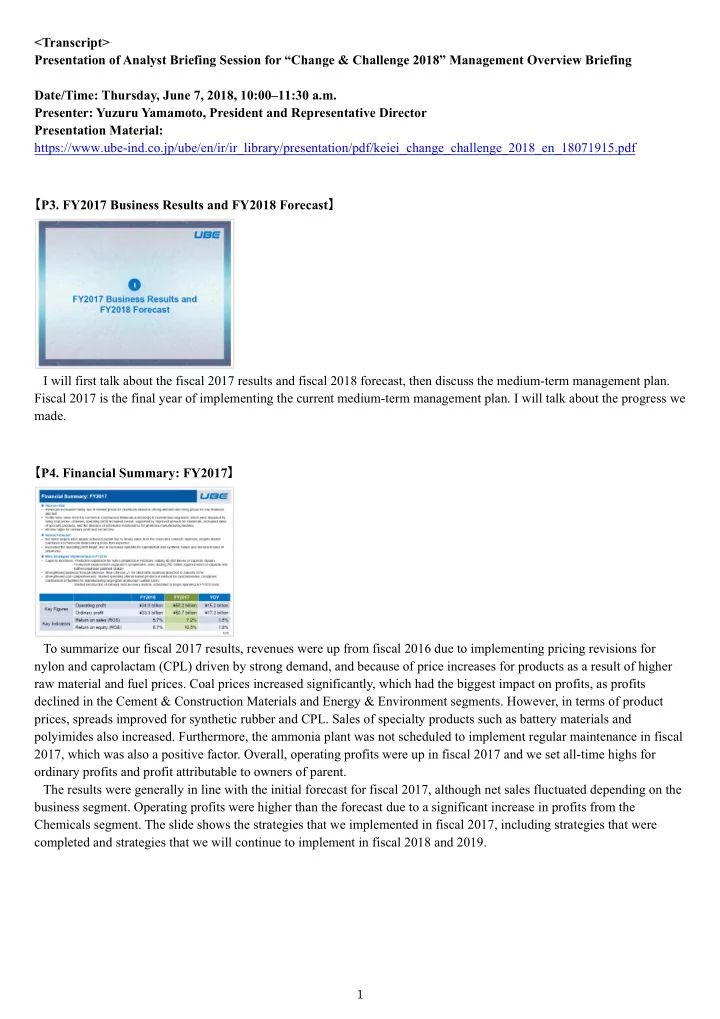
1 <Transcript> Presentation of Analyst Briefing Session for “Change & Challenge 2018” Management Overview Briefing Date/Time: Thursday, June 7, 2018, 10:00–11:30 a.m. Presenter: Yuzuru Yamamoto, President and Representative Director Presentation Material: https://www.ube-ind.co.jp/ube/en/ir/ir_library/presentation/pdf/keiei_change_challenge_2018_en_18071915.pdf 【P3. FY2017 Business Results and FY2018 Forecast】 I will first talk about the fiscal 2017 results and fiscal 2018 forecast, then discuss the medium-term management plan. Fiscal 2017 is the final year of implementing the current medium-term management plan. I will talk about the progress we made. 【P4. Financial Summary: FY2017】 To summarize our fiscal 2017 results, revenues were up from fiscal 2016 due to implementing pricing revisions for nylon and caprolactam (CPL) driven by strong demand, and because of price increases for products as a result of higher raw material and fuel prices. Coal prices increased significantly, which had the biggest impact on profits, as profits declined in the Cement & Construction Materials and Energy & Environment segments. However, in terms of product prices, spreads improved for synthetic rubber and CPL. Sales of specialty products such as battery materials and polyimides also increased. Furthermore, the ammonia plant was not scheduled to implement regular maintenance in fiscal 2017, which was also a positive factor. Overall, operating profits were up in fiscal 2017 and we set all-time highs for

  • rdinary profits and profit attributable to owners of parent.

The results were generally in line with the initial forecast for fiscal 2017, although net sales fluctuated depending on the business segment. Operating profits were higher than the forecast due to a significant increase in profits from the Chemicals segment. The slide shows the strategies that we implemented in fiscal 2017, including strategies that were completed and strategies that we will continue to implement in fiscal 2018 and 2019.

slide-2
SLIDE 2

2 【P5. FY2018 Earnings Forecast (Key Figures)】 For the earnings forecast for fiscal 2018, we are projecting higher revenues than in fiscal 2017. This includes sales growth for nylon and other chemicals, and pricing revisions for construction materials and particularly for cement. However, we expect that spreads for synthetic rubber will stabilize at normal levels after temporarily increasing sharply in fiscal 2017. Furthermore, while spreads for CPL are currently good, we do not know what direction market conditions will take and are expecting spreads to basically remain at fiscal 2017 levels. We expect coal prices to remain at high levels. Based on these factors, we are projecting that operating profits will decrease. Net sales are generally projected to be in line with the medium-term management plan. The major difference compared with the projection is the rise in coal prices. As a result, we are projecting that operating profits and ordinary profits will fall short of the medium-term management plan. 【P6. FY2018 Net Sales and Operating Profit: Progress by Segment】 The slide shows the earnings forecast for fiscal 2018 by business segment. Net sales in the Chemicals segment are projected to fall slightly short of the original forecast for fiscal 2018, but net sales in other segments are generally projected to be in line with the original forecast. Net sales are projected to increase over fiscal 2017. Operating profits from the Chemicals segment are expected to decline significantly compared with fiscal 2017. The biggest negative factor is the projected decrease in spreads for synthetic rubber. Other negative factors are the projection for CPL spreads to decrease slightly compared with fiscal 2017, and scheduling of regular maintenance for the ammonia plant in Japan. Separators will have a positive impact on operating profits, which are projected to be in line with the original forecast from the medium-term management plan. However, profits from electrolytes are projected to decline compared with fiscal 2017, without the temporary royalty income that we recorded in fiscal 2017. The medium-term management plan called for the Chemicals segment to generate ¥20 billion in operating profits in fiscal 2018. While earnings are forecasted to exceed this target, business conditions have changed significantly since the plan was formulated, and we cannot simply say that we achieved the target. Operating profits from the Pharmaceuticals segment are projected to decline due to decreasing royalty income from the expiry of patents for proprietary drugs. Operating profits from the Cement & Construction Materials segment are projected to remain in line with fiscal 2017

  • levels. This is because we expect coal prices to further rise, although we plan to increase prices for cement and magnesia

products. Revenues from the Machinery segment are projected to increase. This is due to net sales from industrial machinery already ordered by customers and additional net sales generated from the injection molding machinery business that we acquired from Mitsubishi Heavy Industries, Ltd. Although there will be a proportional increase in profits, component prices are increasing, which we have factored into the profit increase.

slide-3
SLIDE 3

3 The Energy & Environment segment will be negatively impacted by rising coal prices. Operating profits are projected to increase slightly over fiscal 2017, due to the independent power producer (IPP) facility not having regular maintenance scheduled in fiscal 2018. Total operating profits are projected to decline compared with fiscal 2017, falling short of the original target for fiscal

  • 2018. The main reason being that the Cement & Construction Materials and Energy & Environment segments will be

heavily impacted by coal prices. 【P7. Progress on the Change & Challenge 2018 Medium-Term Management Plan】 Next, I will talk about the progress we have made in implementing the medium-term management plan. 【P8. Medium-and Long-Term Management Strategy】 Our management policy is unchanged. The highest priority is to restore results from the Chemicals segment. Our long-term strategy is to address and be part of the solution for resource, energy, and global environmental issues. 【P9. Business Portfolio Segmentation】 The business portfolio segmentation is unchanged. Under the medium-term management plan, polyimides and electrolytes were positioned as restructuring businesses. However, based on trends in the last two years and our initiatives in fiscal 2018, we no longer consider them to be restructuring businesses. We will decide in the next medium-term management plan where to reposition the businesses.

slide-4
SLIDE 4

4 【P10. Target Business Domains】 Our target business domains are also unchanged. The businesses in colored boxes indicate new and developing fields. Existing businesses are in white boxes. Although we are making progress in each of these domains, overall we are slightly behind the original schedule in developing these domains. 【P11. Net Sales and Operating Profit: Progress by Business Portfolio Categorization】 The slide shows the progress of our net sales and operating profits by business portfolio categorization. Net sales are projected to be generally in line with the original targets. In fiscal 2017, operating profits were generally in line with the original targets but are projected to fall short of the targets in fiscal 2018. Operating profits from active growth businesses are projected to decline compared with the original target for fiscal 2018, due to falling profits from synthetic rubber and lower profits in the nylon business because of rising CPL prices. Profits from separators are projected to be generally in line with the original targets. Operating profits from platform businesses are projected to fall short of the medium-term management plan. This is due to the cement business being heavily impacted by coal prices. Operating profits from restructuring businesses are projected to be in line with the original target. We are slightly behind in terms of our progress in developing fields. 【P12. Progress of Investment Plan and Cash Flow Plan】 For the investment and cash flow plan, the medium-term management plan set a target of ¥150 billion in investments and ¥26 billion in free cash flow over three years. If we include the projections for fiscal 2018, we expect to generate roughly ¥60 billion in free cash flow. One reason for this is our operating cash flow. We recorded a significant increase in operating profits in fiscal 2017. Our actual investment spending is currently projected to amount to roughly ¥135 billion, which is below the ¥150 billion

  • target. We had to reconsider our investments as business conditions changed, and did not find suitable targets for mergers
slide-5
SLIDE 5

5 and acquisitions. As a result, we have significantly more cash on hand than expected, and will take a flexible approach in deciding how to use it. 【P13. Business Strategy by Segment (Changing Conditions, Implementation Status and Future Outlook)】 I will talk about the business strategy by segment. 【P14. Chemicals Company】 For the Chemicals Company, our basic strategy under the medium-term management plan is to realize a full recovery for the Chemicals segment and create growth-driving products for the next medium-term management plan. For active growth business, we are implementing various investments and changing the business models. For restructuring businesses, we will achieve a recovery for the polyimide and electrolytes businesses. The long-term strategy is to shift from general purpose products to products and services that incorporate added value unique to UBE. External conditions were very favorable in fiscal 2017, enabling the segment to exceed the operating profit target of ¥20

  • billion. However, we have reservations about calling it a full recovery. This is because while restructuring businesses have

progressed beyond restructuring as planned, not all of the active growth businesses are progressing as planned. The issues in fiscal 2018 are to fundamentally improve the framework for quality assurance and strengthen the related risk management. We will tackle these initiatives on a corporate basis, as well as for the Chemicals Company. One of the other issues in fiscal 2018 is to secure stable production to meet vigorous demand. In the long term, we are also working to use ICT and develop our human resources. 【P15. Synthetic Rubber Division】 For the Synthetic Rubber Division, we continue to execute our basic strategy of increasing added-value products while enhancing collaboration with strategic customers. The major strategy that we have been pursuing since the previous

slide-6
SLIDE 6

6 medium-term management plan is to manufacture added-value products at all three facilities in Thailand, Malaysia, and

  • Chiba. This is to create multiple supply points. We are continuing to develop new products and grades.

Production in Malaysia has been stable since the second half of 2017, and the facility currently continues to operate at full capacity. Looking ahead, we will add 22,000 tonnes of capacity in Malaysia, aiming to bring the additional capacity

  • nline around 2020. We will also establish a framework for manufacturing VCR in Malaysia.

Slightly later on, we will implement debottlenecking and expand the capacity in Thailand. We are also studying a fifth plant in the Atlantic Rim region, somewhere in the United States or Europe. We plan to bring the total annual production capacity up to roughly 450,000 tonnes by around 2025. We are aiming to be a global supplier of synthetic rubber focusing on added-value products. This requires that we build a fifth plant. 【P16. Engineering Plastics, Caprolactam and Industrial Chemicals Division】 For the Engineering Plastics, Caprolactam and Industrial Chemicals Division, our continued strategy is to increase production volumes for nylon while increasing the rate of CPL that we use internally. We do not intend to change this strategy, even while market conditions for CPL have improved. Under this strategy, we added 40,000 tonnes of nylon capacity in fiscal 2016 and 2017, and began operating new compounding facilities, both in Spain. We also developed new grades and products. At the same time, we fell short of our global sales target for nylon compound used for injection molding. We will continue to pursue this target in spite of the challenges we have faced. CPL manufacturers from other countries are expanding into downstream markets, and some of them have expanded into nylon resins and even further downstream into films. While nylon demand will grow, the market will also become more competitive. In fiscal 2018, we will mainly focus on capitalizing on the capital investments we have made to date. 【P17. Engineering Plastics, Caprolactam and Industrial Chemicals Division (2)】 For the CPL and industrial chemicals businesses, we have positioned CPL as a raw material for nylon, and have made various investments in fiscal 2016 and 2017 to reduce costs. We must capitalize on these investments in fiscal 2018. We expanded the production of large-crystal ammonium sulfate and will reexamine our sales channels by shifting to direct sales, rather than sales through UBE Group companies. Our production facilities for industrial chemicals are aging, which is causing maintenance costs to rise. Logistics costs are also rising. Demand is strong, so we will make up for the rising costs by increasing prices.

slide-7
SLIDE 7

7 【P18. Battery materials and Fine Chemicals Division: Separators】 For separators (battery materials), we are pursuing product development and cost reductions while also increasing production capacity and sales. We increased the production capacity for separators by 25% over fiscal 2017, as the new facilities at the Sakai Factory began operating in the spring of 2018. We have been expanding our capacity every year since fiscal 2016. We are studying a further 40% increase in capacity compared with fiscal 2018, which we plan to begin

  • perating in 2020.

In any case, our strategy is to focus on supplying customers that appreciate our strengths in dry and coated separators. It is not our strategy to expand capacity to capture market share. The separators business was profitable in fiscal 2017 and we expect to further increase the profitability in fiscal 2018. 【P19. Battery materials and Fine Chemicals Division: Electrolytes】 Price competition for electrolytes (battery materials) is severe, just as it is for separators. We have lowered costs for separators by deploying new production technologies every time we construct new production facilities, but electrolytes do not offer the same for cost reductions. To some extent, product prices are determined by procurement prices for raw materials, which makes electrolyte pricing severely competitive. That is why we formed a joint venture with Mitsubishi Chemical Corporation for the business in China. The joint venture, which began operating in January 2018, is off to a very good start and we expect revenues to improve significantly. However, since the joint venture is an equity-method affiliate, the Battery Materials and Fine Chemicals Division does not record net sales and operating profits from the joint venture, only recording ordinary profits. Therefore, net sales are projected to decline compared with fiscal 2017. On the

  • ther hand, since the electrolyte business in China was operating at a loss, the Division’s operating profits will improve.

In any case, we will strengthen the partnership with Mitsubishi Chemical globally, building on the Chinese joint venture. 【P20. Battery materials and Fine Chemicals Division: High-Performance Coatings】 For the high-performance coatings business, our strategy is to expand the eco-friendly coatings business centering on

slide-8
SLIDE 8

8 polycarbonate diol (PCD). We manufacture PCD at three global production bases. We improved the production process for PCD to realize a 30% increase in production capacity in fiscal 2017, so revenues will increase in fiscal 2018. However, the polyurethane dispersion (PUD) materials business that is downstream of PCD has been challenging. We are continuing to fall well short of the original targets that we set under the medium-term management plan. This is because

  • f the highly specialized nature our customers’ applications, the tall hurdles to commercialization, and our lack of

technical capabilities. Therefore, we are shifting our business strategy away from just focusing on PUD materials and an in-house approach, to encompass a broad range of business models centering on PCD. We will prioritize our investments on these four businesses as active growth business under the Chemicals Company. 【P21. Polyimide and Specialty Products Division: Polyimides】 Net sales of polyimides increased significantly in fiscal 2017. For a long time, the polyimide business was slow through fiscal 2016. During this time, we undertook various initiatives such as lowering our development costs by focusing on certain areas of development, recording an impairment of facilities, and reducing total costs for the business. On top of this, profits improved significantly due to positive business conditions, driven by strong shipments of smartphones and growth in sales of OLED flexible displays. We are projecting that demand for smartphones in fiscal 2018 will not reach the levels in fiscal 2017. However, we have developed products to compensate for the drop in smartphone demand. Therefore, we expect to be able to just match the business results that we recorded in fiscal 2017. We are projecting growth in varnishes for OLED flexible displays, particularly for the Chinese market. We will also develop new film grades and film grades that are compatible with new production processes, which we will introduce

  • ver time.

【P22. Polyimide and Specialty Products Division: Ceramics and Separation Membranes】 For ceramics and separation membranes, there is gradual growth in ceramics for aircraft engines and circuit boards for electric vehicles, which we will make sure to capture. Net sales of separation membranes increased significantly in fiscal 2017, and we are projecting further growth in fiscal 2018. The market for explosion-proofing applications used in resource development recovered in fiscal 2017, and we introduced new grades for this market. Among new applications, there is steady growth in the market for aircraft applications and growth in the biogas market. We are also securing orders for a large natural gas project in Russia. In fiscal 2018, we will work to increase sales of these products.

slide-9
SLIDE 9

9 【P.23 Chemicals R&D: Developing Businesses and New Businesses】 Our chemicals R&D strategy for developing businesses basically remains unchanged. In fiscal 2018, we will begin shipping samples to select customers, for new cell culturing technology using polyimide porous membrane. This technology significantly improves the efficiency of cell culturing and we will commercialize the technology. 【P24. Pharmaceutical Division: Drug Discovery】 The Pharmaceuticals business is built around the two pillars of drug discovery and manufacturing and sales of APIs and

  • intermediates. For drug discovery, we face the issue of expiring patents for existing drug, so that our focus remains on

developing new drugs. Development of the glaucoma treatment drug and pruritis treatment drug is progressing according to plan. However, we won’t know if we will be able to bring these drugs to market until two medium-term management plans from now. In the interim, the business will need to be sustained by manufacturing and sales of APIs and

  • intermediates. We recently announced that we have licensed our fibrosis treatment drug to Curadim Pharma Co., Ltd., and

we have other drugs that are in the incubation phase. Our business model for the pharmaceuticals business is to expand the pipeline for drug discovery as much as possible. 【P.25 Pharmaceutical Division: Manufacturing and sales of APIs and Intermediates】 The challenge we face in the APIs and intermediates business is to shift to high-mix, low-volume manufacturing. We have realized cost reductions as a result of expanding our upstream supply chains in fiscal 2016 and 2017, and will focus

  • n establishing a framework for high-mix, low-volume manufacturing.
slide-10
SLIDE 10

10 【P.26 Cement & Construction Materials Company: Business Conditions】 Business conditions for the Cement & Construction Materials Company are considerably different from what we had initially projected. When we originally assembled the medium-term management plan, we projected that cement demand in Japan would increase in the buildup to the 2020 Olympics, but demand has not increased at all. Meanwhile, coal prices have increased significantly. Because of these negative factors, the business has not progressed according to plan. We will take these conditions into account in formulating the business strategy under the next medium-term management plan. During this fiscal year, we will increase cement prices to secure business revenues. 【P.27 Cement & Construction Materials Company: Progress of Medium-Term Management Plan】 The platform businesses of the Cement & Construction Materials Company are large in scale, while new businesses are small in scale. Therefore, our basic strategy is to enhance the platform businesses. In the cement, ready-mix concrete, and recycling business, we have been implementing major capital investment projects at the Isa Factory. A new exhaust heat recovery system will begin operating by the end of fiscal 2019, and a new fuel-based waste plastics processing facilities will begin operating in fiscal 2018. These facilities will streamline the

  • perations.

In the limestone, calcia, and magnesia business, we are developing the next mining zone and will start mining in fiscal

  • 2018. We are also systematically refurbishing the older facilities of Ube Material Industries, which will continue through

fiscal 2019. In the construction materials business, we merged Ube Industries’ construction materials business with Ube Kenzai Corporation in April 2018. This will streamline the business to make it more adaptable to changing business conditions. We are developing new organic products for construction and infrastructure applications, under a unified R&D

  • rganization that encompasses chemicals and construction materials.
slide-11
SLIDE 11

11 【P.28 Cement & Construction Materials Company: Progress of Medium-Term Management Plan (2)】 The two strategies of the Cement & Construction Materials Company are to expand the business areas and expand the business scope. The key to expanding the business areas is securing steady cement export customers. We acquired a stake in Tokyo Cement Company (Sri Lanka) PLC from fiscal 2016 to 2017. In Thailand, Ube Material Industries started construction of a plant to manufacture MOS-HIGE plastics filler for automotive applications, which will begin operating in fiscal 2019. Ube Shipping & Logistics, Ltd., which has been providing technical consulting for vessels, will expand the business through a joint venture with an Indonesian company. The key to expanding the business scope is leveraging environmental materials. We will expand our lineup of various products that help to improve water, soil, and air quality. 【P.29 Machinery Company: Strengthen and Expand products】 Next, I’ll talk about the products of the Machinery Company. In the molding machinery business, we are seeing a global trend toward further tightening of automobile fuel economy regulations and a shift toward electric vehicles, which is leading to changes in automotive components and materials. In the die casting machinery business, we will seize on these trends as opportunities to develop and introduce corresponding

  • products. We will also expand the business by furthering collaboration with other companies. The key to the injection

molding machinery business will be to maximize the benefits derived from the merger with Mitsubishi Heavy Industries. Our strategies are to unify the brands, expand the U.S. assembly plant, and implement unified business management to further increase competitiveness. In the industrial machinery business, we are securing orders for IPP facilities in Japan, and equipment to accompany biomass power plants. Since net sales are recorded by a percentage of the completion method, we will comprehensively manage production to avoid unnecessary costs. In addition to these transitory improvements, the challenge will be to develop products and business models that will become future pillars of the industrial machinery business.

slide-12
SLIDE 12

12 【P.30 Machinery Company: Increase Revenues from Machinery Servicing Business】 The servicing business accounts for 70% of the profits generated by the Machinery Company. Growth in the servicing business increases the profits of the Machinery Company. In particular, we have not yet fully developed the servicing business in Southeast Asia, and will add servicing staff to expand the business. In some areas, we also offer maintenance services for non-UBE machinery. The injection molding machinery business of Mitsubishi Heavy Industries operated a number of servicing offices outside of Japan, half of which have already been absorbed into our existing servicing offices. We will absorb the remaining half of the servicing offices to form a unified service network that will strengthen the servicing business and increase profits. 【P.31 Energy & Environment Division】 The businesses of the Energy & Environment Division are long-term projects. The division will provide a stable supply

  • f competitive energy, and address global warming taking into account the negative conditions surrounding coal.

While business conditions for the coal business are poor, it does not mean that demand for coal will disappear. The increase in coal prices shows that there is demand for coal. We will increase the efficiency of the Coal Center operations and execute plans for the new power plant that is being developed in partnership between J-Power, Osaka Gas Co., Ltd., and Ube Industries. In the power business, the long-term contract for the IPP facility expires in March 2019. We will subsequently be able sell the facility’s electricity to anyone. This will increase our profits to a certain extent. In the biomass fuel business, we started construction of a demonstration facility for torrefied pellets, which will begin

  • perating in the fall of 2019. The torrefied pellets will be used as fuel together with coal at the IPP facility. This in-house

usage is a test business solution for co-storage, transport, pulverizing, and co-firing of torrefied pellets with coal. We will expand the business by accumulating technical expertise while identifying market needs.

slide-13
SLIDE 13

13 【P.32 Environment: Address and Be Part of the Solution for Resource, Energy, and Global Environmental Issues】 One of our major strategies under the medium-term management plan is to address and be part of the solution for resource, energy, and global environmental solutions. We have set targets for reducing greenhouse gas emissions, which decreased slightly in fiscal 2017 compared with the previous year. We are hoping to achieve the fiscal 2021 reduction target and are also endeavoring to increase the percentage of net sales from environmental businesses, which increased in fiscal 2017. 【P.33 Approach to Shareholder Dividends】 Lastly, I will talk about shareholder dividends. 【P.34 Approach to Shareholder Dividends】 Our approach to shareholder dividends remains unchanged. The first priority is to realize stable dividends, regardless of business results. Dividends must also be weighed against the company’s financial health and future investments. In addition, we will acquire treasury stock depending on the cash flow situation. Our basic aim of securing a consolidated total return ratio of 30% or higher remains unchanged. We acquired treasury stock in fiscal 2016 to realize a return ratio of 36%. We are currently planning for a ¥75 dividend per share for fiscal 2017, which by itself would realize a return ratio of 25%. We may consider acquiring treasury stock depending on projected cash flows.