SLIDE 1 <Transcript> Presentation of Analyst Briefing Session for “Change & Challenge 2018” Management Overview Briefing Date: May 18, 2017 Presenter: Yuzuru Yamamoto, President and CEO Presentation Material: https://www.ube-ind.co.jp/ube/en/ir/ir_library/presentation/pdf/keiei_change_challenge_2017_en_17101017.pdf 【P3. FY2016 Business Results and FY2017 Forecast】 I would like to start the briefing by covering our business results in fiscal 2016, then cover our projections for fiscal
- 2017. Afterwards, I will talk about our progress in implementing the medium-term management plan.
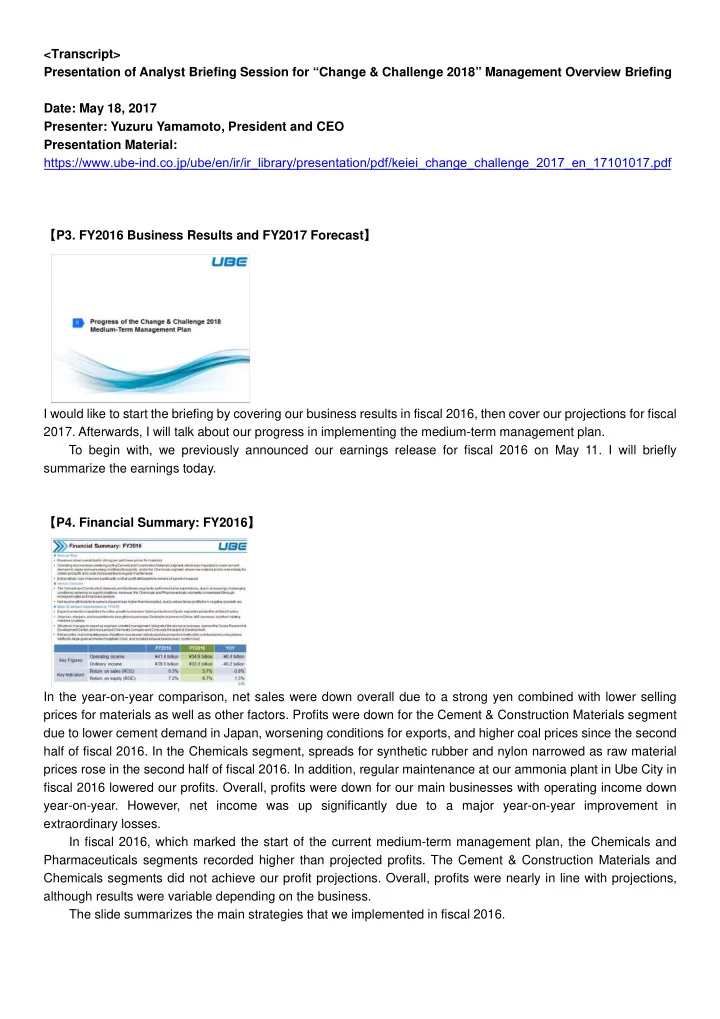
To begin with, we previously announced our earnings release for fiscal 2016 on May 11. I will briefly summarize the earnings today. 【P4. Financial Summary: FY2016】 In the year-on-year comparison, net sales were down overall due to a strong yen combined with lower selling prices for materials as well as other factors. Profits were down for the Cement & Construction Materials segment due to lower cement demand in Japan, worsening conditions for exports, and higher coal prices since the second half of fiscal 2016. In the Chemicals segment, spreads for synthetic rubber and nylon narrowed as raw material prices rose in the second half of fiscal 2016. In addition, regular maintenance at our ammonia plant in Ube City in fiscal 2016 lowered our profits. Overall, profits were down for our main businesses with operating income down year-on-year. However, net income was up significantly due to a major year-on-year improvement in extraordinary losses. In fiscal 2016, which marked the start of the current medium-term management plan, the Chemicals and Pharmaceuticals segments recorded higher than projected profits. The Cement & Construction Materials and Chemicals segments did not achieve our profit projections. Overall, profits were nearly in line with projections, although results were variable depending on the business. The slide summarizes the main strategies that we implemented in fiscal 2016.
SLIDE 2
【P5. FY2017 Earnings Forecast (Key Figures)】 Next, I will talk about the earnings projection for fiscal 2017. The UBE Group is aiming to secure higher revenues and profits in fiscal 2017. I will talk about the specifics for each business later, but raw material and fuel prices are increasing. Therefore, the main factors driving higher profits are businesses where we expect to increase net sales by capitalizing on pricing increases, and businesses where we will adjust spreads. Dividends are projected to remain the same at ¥6 per share. 【P6. FY2017 Earnings Forecast by Segment】 This summarizes our net sales and operating income projection in fiscal 2017 by segment. In the Chemicals segment, we are aiming to increase revenues and significantly increase profits year-on-year. There are several main factors driving increased profits. One is that we will improve spreads for synthetic rubber and nylon, which had narrowed in fiscal 2016. Secondly, we will increase shipments of separators for coating films, as additional separator production capacity comes online in May 2017. Thirdly, UBE is expanding the production capacity for separators in fiscal 2017 and again in fiscal 2018, which will increase shipments of separators for coating films. Additionally, shipments of electrolytes will also increase, as we aim to secure higher revenues and profits for battery materials. We also expect to turn a profit from specialty materials. Overall, we project a significant increase in profits. At the same time, we expect that spreads for caprolactam will normalize, which will negatively affect profits in the Chemicals segment. Spreads for caprolactam improved significantly around the end of fiscal 2016 and are already normalizing, which has been factored into the projection. Additionally, the ammonia plant is not scheduled for regular maintenance in fiscal 2017, which will reduce costs and positively affect profits. However, rising energy prices and the rising price of petro cokes used to make ammonia will drive costs higher. Additionally, ammonia prices in Japan are down, so the benefits from not having regular maintenance scheduled in fiscal 2017 will not be as pronounced as it would be in typical years. The Pharmaceuticals segment is projected to generate lower revenues due to year-on-year declines in net sales from both drug discovery and contract pharmaceuticals manufacturing. Revenues from Cement & Construction Materials are projected to increase slightly due to modest growth in demand for the Japanese market. However, coal prices began rising in the second half of fiscal 2016, which will fully impact earnings in fiscal 2017 and lead to lower profits. In the Machinery segment, the benefits from acquiring the injection molding machinery business of Mitsubishi Heavy Industries in January 2017 will be realized in the full-year earnings for fiscal 2017. We also expect net sales to increase due to growth in orders for existing products, leading to significantly higher revenues. We are projecting higher profits due partly to increased revenues, with the main driving factors being improvements in the
SLIDE 3
profitability of existing products and cost reductions for a variety of products. We expect that it will take a little bit longer for the benefits from merging the injection molding machinery business with Mitsubishi Heavy Industries to be realized in the profits. Lastly, we project higher revenues in the Energy & Environment segment, due to the impact of rising coal prices and increases in the volume of coal handled. The higher revenues will generate increased profits from the coal business. However, we expect the power business to record lower profits due to regular maintenance of the IPP power plant and increased costs because of higher coal prices. Overall, the energy and environment segment is projected to record slightly lower profits. That covers the earnings forecast by segment for fiscal 2017. In the overall earnings forecast, we are projecting higher revenues and profits, with higher profits from chemicals being a major driving factor. This concludes my briefing on the earnings forecast for fiscal 2017. 【P7. FY2017 Progress of the Change & Challenge 2018 Medium-Term Management Plan】 Next, I will talk about the progress we are making in implementing the current medium-term management plan. 【P8. Medium- and Long-Term Management Strategy】 The medium- and long-term management strategy encapsulates our medium- and long-range approach to business, and it remains unchanged. At the bottom, you can see our environmental, social and governance initiatives toward achieving sustainable growth. 【P9. Medium-Term Management Plan: Management Strategies】 The management strategies for implementing the current medium-term management plan also remain
SLIDE 4
- unchanged. There are two main strategies. The first strategy is to “Strengthen the business foundation to enable
sustainable growth.” Under this strategy, we are pursuing cost reductions with a strong emphasis on profitability. We are continuing to emphasize cash flow, paying greater attention to cash flow management. Additionally, our aim is to restore results from the Chemicals segment, to serve as a launch pad for the next stage of growth under the next medium-term management plan. These issues remain our biggest challenges under the current medium-term management plan. The second major strategy is to “Address and be part of the solution for resource, energy, and global environmental issues.” As a manufacturing entity, UBE consumes a significant amount of energy, and one of our major aims is to reduce greenhouse gas emissions and expand our technologies and products that help to reduce environmental impact. For more information on this topic, please refer to the reference documents at the end of the briefing document, which shows our medium- and long-range targets and our progress. 【P10. Medium-Term Management Plan: Progress of Numerical Targets】 This shows our progress in achieving the numerical targets of the medium-term management plan, comparing the fiscal 2016 results, fiscal 2017 forecast, and numerical end target for fiscal 2018, in the final year of the medium-term management plan. In fiscal 2016, our overall profits were generally in line with projections, while we expect to record higher operating income in fiscal 2017. However, the year-on-year growth in operating income in fiscal 2018 is much higher than in fiscal 2017. As to the possibility of achieving this, when we originally set a target of ¥50 billion in operating income by fiscal 2018, we thought it was an ambitious target. We now see this as a somewhat taller hurdle to overcome, but we do not think it is impossible to achieve. 【P11. Net Sales and Operating Income: Progress by Segment】 This shows our final targets for net sales and operating income in fiscal 2018. The Chemicals segment is projected to record ¥18 billion in operating income in fiscal 2017, while our initial target for fiscal 2018 calls for ¥20 billion in operating income. There are a number of positive factors that will be at work from fiscal 2017 to 2018. We have an additional 40 kilotonnes of nylon production capacity that will come online in Spain at the start of fiscal 2018, which will increase our sales. We are currently building additional production capacity for separators that will go online in fiscal 2018, as we aim for higher revenues and profits from separators. Furthermore, our Malaysian synthetic rubber plant will start up soon and will be running at full production for all of fiscal 2018. Additionally, we expect the polyimide and electrolyte businesses to contribute profits as we pursue initiatives to improve profitability.
SLIDE 5 One negative factor is regular maintenance that has been scheduled for the ammonia plant in fiscal 2018. We have weighed the positive and negative factors, and the large gap in operating income to be made up from fiscal 2017 to fiscal 2018. As long as we reach the fiscal 2017 projection, we expect to be able to meet the target for fiscal 2018 with room to spare, enabling us to exceed the operating income target for fiscal 2018. In the Pharmaceuticals segment, we originally expected operating income to sharply decline in fiscal 2018. This was based on the expiry of patents for our drug discovery and the resulting impact on operating income. At the same time, we have made more progress than expected in our efforts to streamline the production of APIs and intermediates, so that operating income will not decline so much in fiscal 2018. In summary, although
- perating income from the Pharmaceuticals segment will decline, it will not decline to the extent that we originally
projected. In the Cement & Construction Materials segment, it will be very difficult to achieve the target of ¥20 billion in
- perating income in fiscal 2018. Although we generated close to ¥20 billion in operating income in fiscal 2015, this
was due to a combination of positive factors occurring at once. Conditions for cement exporting were highly favorable with exchange rates also having a positive impact, while coal prices were stable and comparatively low. These positive conditions are no longer present, and we are projecting that business conditions will change to negatively impact earnings. When we take these factors into account, it will be very difficult to achieve the
In the Machinery segment, the net sales target for fiscal 2018 was set at the start of the medium-term management plan. That’s why the net sales target for fiscal 2018 is lower than the net sales projection for fiscal
- 2017. However, we expect to achieve the net sales in fiscal 2018 at the same level as the preceding fiscal year.
By fiscal 2018, we will begin to realize the benefits from merging the injection molding machinery business. Furthermore, in fiscal 2017 and 2018, we will record net sales from machinery orders for large power facilities, by the percentage of completion accounting method. As a result, we are hoping to exceed the end target for
The Energy & Environment is another segment that is being impacted by coal prices rising beyond our
- riginal assumptions. The target of ¥3.5 billion in operating income in fiscal 2018 will be difficult to achieve. In
summary, for the Cement & Construction Materials and Energy & Environment segments, coal prices have increased significantly above our original assumptions, making it very difficult to achieve our original targets. The challenge will be to exceed our original operating income targets in the Chemicals, Pharmaceuticals, and Machinery segments, and try to get as close as possible to the targets in the Cement & Construction Materials and Energy & Environment segments. It is still possible for us to achieve the target of ¥50 billion in total
- perating income. Our business activities in fiscal 2017 will consist of measures that will enable us to achieve the
final targets for fiscal 2018. 【P12. Business Portfolio Segmentation】 This is the business portfolio segmentation under the medium-term management plan. There are four segments: Developing fields, active growth businesses, platform businesses, and restructuring businesses. We will continue to direct concentrated investment toward active growth businesses. The progress of our developing businesses is slightly behind what we originally planned, and we have some concerns that commercialization is progressing behind schedule. We turned around the polyimide and electrolyte businesses, which are restructuring businesses, to generate operating income in fiscal 2016. We will continue working to both increase profits and generate
SLIDE 6
consistent profits from the polyimide and electrolyte businesses. Once these things happen, they will no longer be categorized as restructuring businesses. 【P13. Target Business Domains】 This shows our target business domains in the business portfolio, which remain unchanged. 【P14. Net Sales and Operating Income: Progress by Business Portfolio Categorization】 This shows how we are generating profits under the current medium-term management plan, based on the earnings progress in each of the four segments of the business portfolio. From fiscal 2016 to 2017, operating income from active growth business will increase significantly, while operating income from platform businesses will decline. This reflects our projection for higher profits from businesses such as synthetic rubber, nylon, and separators in fiscal 2017, and lower profits from core platform businesses such as caprolactam and cement in fiscal 2016 and beyond. While implementing the plans for fiscal 2017, we will carefully monitor the percentage of profits being generated by each segment of the business portfolio for fiscal 2018. However, we fully recognize that active growth businesses will continue to generate a large portion of operating income. Our restructuring businesses have been generating operating income that is in line with our projections, and we expect them to generate solid results in fiscal 2018. 【P15. Progress of Investment Plan and Cash Flow Plan】 This shows the progress of our investment plan and cash flow plans. We planned to invest ¥150 billion over three years, comprising ¥130 billion in capital investment and ¥20 billion in investments and loans. Our capital
SLIDE 7 investment is behind schedule by a fiscal year. Our investments are nearly in line with projections in fiscal 2016 and 2017. The delay in capital investment has increased our free cash flow above projections. Our investments and loans are behind schedule, with the merger of the injection molding machine business being the only merger, acquisition or alliance activity that we have realized. We will continue to study investments through mergers and acquisitions. This summarizes our progress in implementing the medium-term management plan. 【P16. Chemicals Company: Business Strategies】 I will briefly cover the business conditions in each business segment, and the strategies we are executing or are trying to execute. For the Chemicals Company, as I mentioned, we will make every effort to restore the business during the current medium-term management plan, and reestablish its role as a driver of future growth. That is an issue for the medium-term management plan and in fiscal 2017. Accordingly, we will direct concentrated investment toward active growth businesses, to expand the business scale and strengthen revenues. We will advance our platform businesses so that they anchor these efforts, by generating solid and consistent free cash flows. Our major strategy under the medium-term management plan is also to revive restructuring businesses to where they are no longer qualify as being restructuring businesses. 【P17. Chemicals Company: Business Strategies】 Accordingly, our immediate task is to ensure that we achieve the end target of at least ¥20 billion in operating income by fiscal 2018 of the medium-term management plan. Before that, we must generate ¥18 billion in
- perating income in fiscal 2017.
One of the measures we are taking is shifting to an organization in which production, sales, and engineering are closely integrated. In April 2017, we reorganized the Chemicals Company together with Corporate Research & Development and the Pharmaceuticals Division. We shifted research that is directly related to product development out from Corporate Research & Development, putting them under the responsibility of the Chemicals Company and Pharmaceuticals Division that oversee product development. The focus of Corporate Research & Development has been shifted to concentrate on R&D for new businesses, with more of a future
- focus. We also renamed the business units under the Chemicals Company as divisions, and reorganized the
divisions so that each division has a manufacturing, sales, and technology development department respectively,
SLIDE 8 in order to accelerate revenue generation. 【P18. Synthetic Rubber Division】 This April, we restructured the Chemicals Company by reorganizing the business units into four business divisions, each of which I will cover here. For the Synthetic Rubber Division, our thinking and approach remains unchanged. Specifically, we are developing the business to secure differentiation and specialization by strengthening collaboration with our existing strategic customers. Under this strategy, we are increasing the ratio of specialty synthetic rubber products that are manufactured at each plant. The figures shown here are end targets under the medium-term management plan, which we are on track to achieve. To accommodate customers who seek further supply stability, we are developing multi-supply frameworks for product grades made at each facility, to secure business
- continuity. The Malaysia plant will shift to full production in the second half of fiscal 2017, so we will need to soon
make a decision about expanding the production capacity from the current 50 kilotonnes to 72 kilotonnes. The graphic shows how customers continually demand opposing performance from a single material. Each customer has its own requirements, so we develop grades to meet these requirements under our continued specialization strategy. 【P19. Engineering Plastics, Caprolactam and Industrial Chemicals Division】 In the Engineering Plastics, Caprolactam and Industrial Chemicals Division, nylon is positioned as an active growth business. We are continuing to invest in the nylon business, aiming to become the global leader in extrusion applications. We are also strengthening our supply network in order to expand the compound business for injection molding applications. UBE directly manufactures nylon compounds in Japan and Thailand, but we have now secured tie-ups with plants in various parts of the world to manufacture compounds for UBE, nearly realizing a global supply framework. Beginning in fiscal 2017, we will actively ship samples to customers for their
- evaluation. We began doing this on a limited scale in fiscal 2016 and will fully implement these activities in fiscal
- 2017. We are targeting commercial shipments starting from fiscal 2019 during the next medium-term
management plan. For caprolactam and industrial chemicals, we are continuing to position caprolactam as a raw material for nylon, and are advancing initiatives to lower raw material prices and raw material costs as much as possible. We are investing in various facilities at each of our plants in Japan, Thailand, and Spain. In Japan, we are currently building facilities to change our manufacturing process for cyclohexane, and increase our production of
SLIDE 9 large-crystal ammonium sulfate. These facilities will go online at the end of 2017 and start of fiscal 2018 respectively, to lower the manufacturing cost for caprolactam and improve profitability in fiscal 2018. 【P20. Engineering Plastics, Caprolactam and Industrial Chemicals Division】 For nylon used for extrusion applications, we are currently building a new nylon 6 plant in Spain, which will begin commercial production in February 2018. Manufacturing nylon 6 in Spain will enable us to increase our sales to South America, North America, and Europe centering on Eastern Europe. We have already begun laying the groundwork to increase nylon sales. When the new plant in Spain is completed, the percentage of caprolactam that we consume internally will increase to almost 70%. We are also looking into building a nylon plant in Thailand to further increase our internal consumption of caprolactam. Our ultimate goal is to consume over 80% of our caprolactam output internally. 【P21. Battery Materials and Fine Chemicals Division: Separators】 For the Battery Materials and Fine Chemicals Division, we expanded our production capacity for substrates used to make coated separator films for batteries, bringing the expansion online in May 2017. We will begin shipping coated separator films in fiscal 2017, which will significantly increase our net sales, as shown in the graph. Shortly after that, our next production expansion will go online in early fiscal 2018, which will further increase our net sales of coated films. However, there continues to be severe price competition, mainly coming from China. We have not changed
- ur basic approach, which is to develop the business centering on coated separator films. The production
facilities that we just brought online incorporates a new process that will yield major productivity improvements to significantly increase our competitiveness. While demand for lithium-ion batteries is growing accordingly, other battery materials manufacturers are also expanding their production capacity, leading to very severe competition. As such, we are strengthening our development capabilities and currently working to expand our product lineup. In any case, we will build a framework that enables us to secure consistent profits by specializing on separators for automotive applications.
SLIDE 10 【P22. Battery Materials and Fine Chemicals Division: Electrolytes】 Our electrolytes business was originally centered on consumer applications. In fiscal 2016, we developed proprietary additives and electrolytes for automotive and storage battery applications, shipping the grades in large
- quantities. In fiscal 2017, we will continue to mainly ship these grades. Moving forward, our strategy is to expand
the business for automotive and storage battery applications, while maintaining the business for consumer
- applications. In China, we are laying the groundwork for a tie-up with Mitsubishi Chemical Corporation.
【P23. Battery Materials and Fine Chemicals Division: High-Performance Coatings】 We manufacture our high-performance coatings from polycarbonate diol or PCD at our three PCD plants in Japan, Thailand, and Spain. Shipments of PCD are steadily increasing and if they continue to rise, we will need to consider another production expansion. Polyurethane dispersion materials, urethane acrylate, and thermoplastic urethane are downstream products made from PCD. These businesses mainly revolve around proposal-based development, where we develop and supply products to meet the needs of each customer. However, we are slightly behind schedule in terms of developing the businesses. Nevertheless, we are securing steady growth and will continue to achieve further growth moving forward. 【P24. Polyimide and Specialty Products Division: Polyimides】 For the Polyimide and Specialty Products Division, our main approach for the polyimide business under the previous medium-term management plan was to expand the size of the business to generate profits. We pursued various product development and tried to expand the size of the business, but found it difficult to achieve profitability or increase the business scale as planned. Starting from the current medium-term management plan, we have changed our strategy by focusing on increasing profitability. We are doing this by replacing existing products with new products, while maintaining the current size of the polyimide business.
SLIDE 11 The most noteworthy development is varnishes used for flexible displays. We expect the market for these varnishes to develop rapidly in China. We are eager to leverage our strengths to capture this market, capitalizing
- n our established technical expertise and track record under the joint venture with Samsung. In the films
business, we are focusing on increasing sales of films such as new VT films and double-sided chip-on-films. We are close to making the polyimide business into a solid and stable business. 【P25. Polyimide and Specialty Products Division: Ceramics and Separation Membranes】 Net sales of ceramics and separation membranes declined slightly in fiscal 2016. In both businesses, our current core products are more for industrial use and B2B rather than being directly connected to consumer products, causing peaks and valleys in net sales. We are focusing on new product development and expect net sales to gradually increase, and begin to contribute to our profitability. Now that I have talked about the business side of the Chemicals segment, I will talk about chemicals R&D. 【P26. Chemicals R&D: Developing Businesses and New Businesses】 We are currently initiating R&D and business projects for developing businesses and new businesses respectively, in each of three business domains listed here. In healthcare, we have developed new cell culturing technology using polyimide multiparous membranes. The market is completely new to us, but we are planning to introduce this technology in fiscal 2017 to see how markets react to our proprietary technology and to gauge its public worth. 【P27. Pharmaceutical Division: Drug Discovery】
SLIDE 12
The Pharmaceutical Division centers on drug discovery and manufacturing and sales of APIs and intermediates. For drug discovery, we will continue our strategy of expanding the R&D pipeline and conducting comprehensive life cycle management. In terms of joint development for new drugs, DE-117 and SK-1405 are progressing almost according to plan. We will continue to actively pursue joint research with our partner drug companies. 【P28. Pharmaceutical Division: Manufacturing and sales of APIs and Intermediates】 For manufacturing and sales of APIs and intermediates, we are seeing rapid changes surrounding the business conditions for the pharmaceuticals industry. Under the circumstances, we are pursuing a manufacturing framework to support high-mix low-volume manufacturing so as to capitalize on opportunities and needs, and building a business framework to support this focus. Accordingly, we are currently working to increase our options in order to create multiple supply chains at several levels. In fiscal 2016, our partner company in China began manufacturing products on our behalf, which is already generating benefits. 【P29. Cement and Construction Materials Company: Business Conditions】 For the Cement & Construction Materials Company, we now see that demand in Japan will not reach the levels that we originally projected under the medium-term management plan. Furthermore, energy costs and in particular coal prices have been rising since the second half of fiscal 2016. It looks like prices will remain high with no sign that they will come down. These two negative factors are a major departure from our outlook at the start of the medium-term management plan. We will have to implement strategies keep up with changing business conditions. 【P30. Cement and Construction Materials Company: Progress of Medium-Term Management Plan】
SLIDE 13 In terms of progress under the medium-term management plan, the Cement & Construction Materials Company will focus on streamlining cement production, and continue to invest in exhaust heat recovery systems and facilities to increase waste recycling. Our subsidiary Ube Material Industries, which manufactures magnesium hydroxide and other materials, is implementing a four-year modernizing project that will streamline the plant once
- completed. We are also restructuring the business to maximize synergies among Group companies. In fiscal
2016, we merged our resources division with Ube Material Industries, and in fiscal 2017, we will take steps to restructure the construction materials business. 【P31. Cement and Construction Materials Company: Progress of Medium-Term Management Plan】 Alongside these streamlining initiatives, we are implementing measures to sustain the size of the business. Firstly, we are trying to expand the business scope overseas including working to secure steady cement export
- customers. Additionally, Ube Material Industries has established a company in Thailand to manufacture fillers for
automotive applications, with actual commercial production starting toward the beginning of the next medium-term management plan. This shows how we are expanding our production facilities. Additionally, Ube Shipping & Logistics, Ltd. has established a joint venture for coastal shipping in Indonesia. We are also expanding our environmental materials by moving into new areas. We already market materials such as magnesium hydroxide slurry, and we will increase our lineup of products to expand the business, including for environmental materials that improve soil and water quality and prevent air pollution. 【P32. Machinery Company: Molding Machinery, Industrial Machinery, and Steel Products Businesses】 For the Machinery Company, profitability unfortunately declined in the molding machinery, industrial machinery, and steel products businesses in fiscal 2016. To address this, we are securing cost reductions and developing new models to increase profitability in each business. 【P33. Machinery Company: Expand the Injection Molding Machine Business】
SLIDE 14 Additionally, we will realize benefits from the merger of the injection molding machine business and expand the
- business. The combined market shares of UBE’s and Mitsubishi’s injection molding machine businesses adds up
to about a seven percent share of the global market for large machines. We will integrate and expand the business, with a target of securing a 10% market share during the next medium-term management plan. We will steadily increase net sales from the business as we work toward this target. 【P34. Machinery Company: Machinery Servicing Business】 The machinery servicing business generates two-thirds of the profits of the Machinery Company. We will continue
- ur strategy to increase profits from the servicing business. However, having too many international offices can
create inefficiencies such as overlapping operations, so we will integrate and reorganize our network of offices. We will incrementally increase net sales from the servicing business, because of the difficulty of achieving exponential sales growth for servicing. We will continue to focus on the very high profit ratio of the servicing business. 【P35. Energy & Environment Division】 For the Energy & Environment Division, it is crucial to secure a stable supply of competitive energy. The Energy & Environment Division supports the infrastructure of the UBE Group and generates consistent revenues, and we will work to maintain this position as best as we can. I have one more thing to add. I’m sure you all recognize that the long-term prospects for the coal business are very challenging because of environmental issues. As an energy supplier, we are studying the biomass fuel business and will endeavor to make it into a viable business. 【P36. Shareholder Dividends (Dividend Policy)】
SLIDE 15
Finally, our policy on shareholder dividends is to realize consistent and sustainable dividends. Dividends are weighed against the company’s financial position, future investments, and capital policy. However, our basic aim is to secure a consolidated total return ratio of 30% or higher for shareholders. We will also consider options such as the consolidated total return ratio and acquiring treasury stock. This concludes my briefing. By implementing the initiatives that I spoke about today, we will secure future growth and enhance corporate value. We look forward to your continued support. Thank you.