
SLIDE 1
Total Productive Maintenance Planned Maintenance Step 1 Evaluate - - PowerPoint PPT Presentation
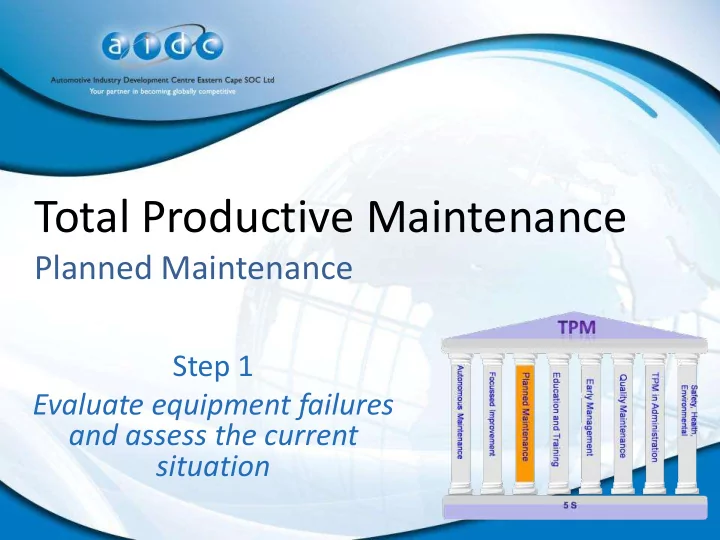
Total Productive Maintenance Planned Maintenance Step 1 Evaluate equipment failures and assess the current situation PLANNED MAINTENANCE OBJECTIVE EQUIPMENT DETERIORATION TYPES OF MAINTENANCE PM RESPONSIBILITIES
Early Management Education and Training
Autonomous Maintenance Focussed Improvement
Planned Maintenance TPM in Administration
Safety, Health, Environmental
Quality Maintenance 5 S
ZERO EQUIPMENT FAILURES AND BREAKDOWNS
REDUCE MAINTENANCE COST BY 20% ENSURE AVAILABILITY OF SPARES ALL THE TIME IMPROVE RELIABILITY AND MAINTAINABILITY BY 50%
Time Performance Natural Deterioration Forced Deterioration Limit Line
conditions
prevent breakdowns or make maintenance easier
Maintenance Classification Preventing Deterioration Measuring Deterioration Rectifying Deterioration Routine Maintenance Periodic inspection Periodic Maintenance Breakdown Maintenance Corrective Maintenance (Maintainability) Corrective Maintenance (Reliability) Minor maintenance Early Detection of situation and speedy countermeasures Enhancement of material strength Reduction of load Enhancement of accuracy Development of condition monitoring Oiling Tightening Cleaning and Countermeasures of defects Routine inspection of conditions of use and deterioration
Roles of the Production Department
Normal Operation Correct operation Setup and adjustment Maintenance Activities to be Performed
Maintenance Classification Preventing Deterioration Measuring Deterioration Rectifying Deterioration Sporadic repair Improvement of inspection work Corrective Maintenance (Maintainability) Improvement of maintenance work Enhancement of maintenance quality Breakdown Maintenance Development of condition monitoring Periodic examination Periodic shutdown Periodic Maintenance Trend control Unscheduled shutdown Predictive Maintenance Periodic inspection Early Detection of situation and speedy countermeasures Corrective Maintenance (Reliability) Enhancement of material strength Reduction of load Enhancement of accuracy
Roles of Maintenance Department
Maintenance Activities to be Performed
I ) Activities to Enhance Equipment Availability Activities to lengthen equipment MTBF Activities to shorten equipment MTTR Output Improvement – Zero failures, defects and accidents II) Activities to efficiently conduct maintenance Input Reduction
Maintenance Work Planning Maintenance information management Maintenance spare parts management Maintenance cost management Knowledge and skill development
IMPLEMENT PREDICTIVE MAINTENANCE AND ROLL OUT TO OTHER EQUIPMENT
EVALUATE THE PLANNED MAINTENANCE SYSTEM BUILD A PREDICTIVE MAINTENANCE SYSTEM – MAKE CHECKING AND OVERHAULING MORE EFFICIENT BUILD A PERIODIC MANAGEMENT SYSTEM – TAKE ACTION AGAINST EQUIPMENT WEAKNESSES BUILD AN INFORMATION MANAGEMENT SYSTEM – SET MAINTENANCE STANDARDS RESTORE DETERIORATION AND CORRECT WEAKNESSES
EVALUATE EQUIPMENT FAILURE/BREAKDOWN STATUS AND ASSESS THE CURRENT SITUATION
SUPPORT AND GUIDANCE OF JISHU HOZEN ACTIVITY (AM) STEP 7 STEP 6 STEP 5 STEP 4 STEP 3 STEP 2 STEP 1 STEP 0
Create and maintain an equipment ledger + negative map Creation and implementation of equipment evaluation standard and ranking Breakdown Occurrence Select PM equipment Mean time between failures (MTBF) Check sheet
current status Frequency & Intensity Rate Maintenance Cost Set goals for the team with planned maintenance Collect data on all failures/breakdowns causing production losses and analyse Documents: Equipment logs & breakdown sheets Prepare a plan to carry out the activities to achieve the target
1 2 3 4 5
Mean time to repair (MTTR)
6
equipment’s operating and maintenance history.
Equipment Management Record
Asset No. Equipment name Model Designed by Date created Purchased from Installation location Purchased date Purchase price per (R1,000) Drawing Substation/line name Date Periodic maintenance/modifications and improvements Amount per (R1, 000) Main failure and repair Amount per (R1, 000) Date Location Details (in-house manhour) Date Location Details (in-house manhour)
To decide which equipment receives planned maintenance
maintainability, etc.
ranked A or B, as well as those for which zero failure is a legal requirement.
Examples of planned maintenance goals
Negative Map Equipment classification Equipment ledger MTBF / MTTR Breakdown
Planned maintenance schedule Goals for reducing breakdowns Component / spare parts list Equipment ranking sheet Plant