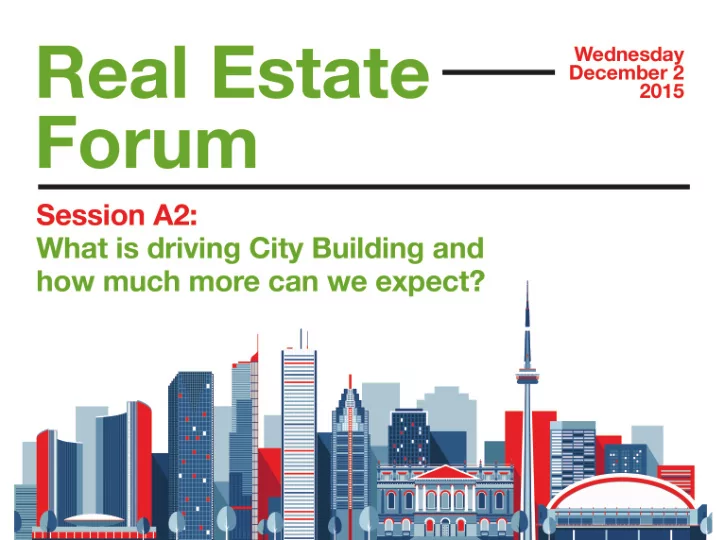
Toronto: 2015 Population: 2,615,060+ 4 th largest City in North - - PowerPoint PPT Presentation

toronto 2015
SMART_READER_LITE
LIVE PREVIEW

Toronto: 2015 Population: 2,615,060+ 4 th largest City in North - - PowerPoint PPT Presentation

Toronto: 2015 Population: 2,615,060+ 4 th largest City in North America No. 1 The Economists Best Place to Live No. 1 The Worlds Most Livable City No. 1 PwCs Building Be tu er Cities


slide-1
SLIDE 1
slide-2
SLIDE 2
slide-3
SLIDE 3
slide-4
SLIDE 4

Toronto: 2015

  • Population: 2,615,060+
  • 4th largest City in North America
  • No. 1 – The Economist’s “Best Place to Live”
  • No. 1 – “The World’s Most Livable City”
  • No. 1 – PwC’s “Building Betuer Cities”
  • No. 1 – “Best place for 18-25 year olds to start”
  • No. 5 – Scorecard on Prosperity
  • No. 8 – Global Financial Centres Index 18
  • No.8 – “Safe Cities Index”
  • No. 12 – “Sustainable Cities Index”
  • No. 19 – Times’ “Higher Education World

University Rankings” – UofT

  • No 25 – “How Global is the Business of Retail”
slide-5
SLIDE 5

Toronto has become the new gateway to Canada – helping the GTA welcome approximately 100,000 people per year.

Immigration Interest Rates

Bank of Canada’s Prime Loan Rate has been at less than 6% for the past decade. Canada’s banking system has been ranked #1 – soundest in the world for 7 years in a row by the World Economic Forum (2009-2015).

Stable Banking

slide-6
SLIDE 6

“I think what is happening in the real estate industry, with the intensification of the inner cities and land being so valuable, the only way to optimize the land is to pursue a well conceived mixed-use vision.”

  • Michael Emory

CEO & President, Allied

slide-7
SLIDE 7

(Condo) Boom-Town Toronto?

On Residential

26

new rental apartment buildings currently under construction (a 25-year high)

885 SF

average size of a 3-bedroom “family sized” unit in Toronto in 2014 (down from 1,087 SF in 1996)

$1,050,000

average price for a single family home in Toronto

slide-8
SLIDE 8

On Office

88,644,574SF

  • f office currently in Downtown and

Midtown Toronto (with a further 3,483,880SF under construction)

70,000

jobs planned from the development of the Unilever Site (outside the downtown core)

92%

  • f Toronto’s Manufacturing jobs sit in

Employment Districts (accounting for 9% of Toronto’s total employment)

Maintaining Canada’s Economic Engine?

Photo Credit Doublespace Photo Credit Doublespace ¡

slide-9
SLIDE 9

On Retail

$325/SF

average rent on Bloor Street’s “Mink Mile” (ranked 21st overall in the world)

4M SF

  • f retail space in the PATH open

Monday to Friday

10%

  • f all retail sales expected to be made online

in 2019 (6% in 2014)

How Strong is Toronto’s Retail Market?

slide-10
SLIDE 10

On Mixed Use

725

  • f 1,542 active development projects are

located in Toronto’s designated Mixed Use Areas

41%

  • f mixed use projects located along

designated Avenues

78 storeys

is the height of Aura– the tallest mixed use building in Canada, but not for long.

What Really is Mixed Use?

slide-11
SLIDE 11

“Now is the moment that we need to, once again, take action for great city building… Now is the moment where we need to pause, and we need to think really carefully about the legacy that we’re creating moving forward.”

  • Jennifer Keesmaat

Chief Planner, City of Toronto

slide-12
SLIDE 12

On Urban Design

1/4

Toronto residents surveyed identified “City Beauty” as a major weakness

45

projects that affect the public realm reviewed by Design Review Panel in 2014 (up from 28 in 2011)

14,500

Residential units approved or constructed at Yonge-Eglinton without associated secondary plan (2002-2013)

How do we move away from the “banal”?

slide-13
SLIDE 13

On Demographics

49%

  • f Toronto’s population identify as visible minorities*

80%

  • f high-rise communities are made up by visible

minorities*

16.2%

growth in Downtown Toronto’s population, between 2006-2011

How are we designing a Multicultural city?

* As defined by Statistics Canada * As defined by Statistics Canada

slide-14
SLIDE 14

On Mobility

500,000+

UberX riders per month in the City of Toronto

90%

  • f Bloor Street shoppers arrive by modes
  • ther than car (and spend more money
  • n average than car drivers)

22

proposed new stations for the new Smart Track line.

What does a connected future look like?

slide-15
SLIDE 15

What does a connected future look like?

slide-16
SLIDE 16

What does a connected future look like?

slide-17
SLIDE 17

“Great city building involves extraordinary collaboration, research, vision, passion and clarity of purpose.”

  • Dermot Sweeny

President, Sweeny&Co.

slide-18
SLIDE 18

On the Core vs. “Urban” Suburbs

17 km2

where majority of growth is happening (City is 650km2)

45%

  • f 18-34 year olds are “seriously” considering

leaving GTA due to high cost of home ownership

74%

  • f Toronto residents prefer “walkable”

neighbourhoods, vs. 46% in the suburbs

Hub vs. Sub?

slide-19
SLIDE 19

On Affordability

93,515

households currently on the waiting list for social housing

≈12,000

estimated affordable units that could have been built from 2010-2015 if inclusionary zoning had been possible

$162,950

household income required to carry an average Toronto home purchase with a 5-year mortgage

Making Toronto a livable city for all?

slide-20
SLIDE 20

“The City of Toronto is not yet a great City, but it has the potential to become one. Do we recognize that there is a batule being waged for the best and the brightest?”

  • David Gerofsky

CEO, First Gulf

slide-21
SLIDE 21

Is Toronto a World-Class City?

slide-22
SLIDE 22

Toronto – The next 10 years? Is this what we can expect?

Toronto 2012 ¡ Toronto 2022 ¡

Credit Sco Credit Scotu tu Dickson – Looking East from Mimico Dickson – Looking East from Mimico

slide-23
SLIDE 23
slide-24
SLIDE 24
slide-25
SLIDE 25

On the Future of Neighbourhoods

140

unique neighbourhoods in Toronto

$25M

from private philanthropy to fund the Under Gardiner project

64

TDSB school sites sold since 2009

Toronto, a city of neighborhoods?