
SLIDE 1
Topological Data Analysis
Samarth Bansal (11630) Deepak Choudhary (11234)
A Framework for Machine Learning
Topological Data Analysis A Framework for Machine Learning Samarth - - PowerPoint PPT Presentation
Topological Data Analysis A Framework for Machine Learning Samarth Bansal (11630) Deepak Choudhary (11234) Motivation Ayasdi was started in 2008 to bring a groundbreaking new approach to solving the worlds most complex problems after a
Samarth Bansal (11630) Deepak Choudhary (11234)
A Framework for Machine Learning
“Ayasdi was started in 2008 to bring a groundbreaking new approach to solving the world’s most complex problems after a decade of research at Stanford, DARPA and NSF”
Topology is a branch of mathematics from the 1700’s that studies continuity and connectivity of objects and spaces, utilizing the shape of data to derive meaning in data.
Goal of TDA : Understand shape without any pre-conceived model
Extract robust topological features from data and use these summaries for modelling the data. Formal Definition Given a finite dataset S ⊆ Y of noisy points sampled from an unknown space X, topological data analysis recovers the topology of X, assuming both X and Y are topological spaces.
Principal Component Analysis (PCA) assumes that X is a linear subspace, a flat hyper plane with no curvature. Both are instances of manifold learning Assumption : X is a manifold, that is, it is locally Euclidean. ISOMAP assumes that X is intrinsically flat, but is iso-metrically embedded.
TDA is model free than most statistical methods, since it does not use an a priori linear or algebraic model for the data, rather relies only on measures of similarity. NO Assumption
Slide adopted from Anthony Bak’s talk on TDA at Stanford Univeristy as part of Colloquium on Computer Systems Seminar Series (EE380)
Slide adopted from Anthony Bak’s talk on TDA at Stanford Univeristy as part of Colloquium on Computer Systems Seminar Series (EE380)
Slide adopted from Anthony Bak’s talk on TDA at Stanford Univeristy as part of Colloquium on Computer Systems Seminar Series (EE380)
Scatterplot methods, PCA, MDS
into nodes, and connecting those nodes by an edge if the corresponding collections have a data point in common.
compressed version of extremely high dimensional data.
Cluster analysis Goal : Divide a data set up into disjoint groups that have some distinct defining properties, or conceptual coherence.
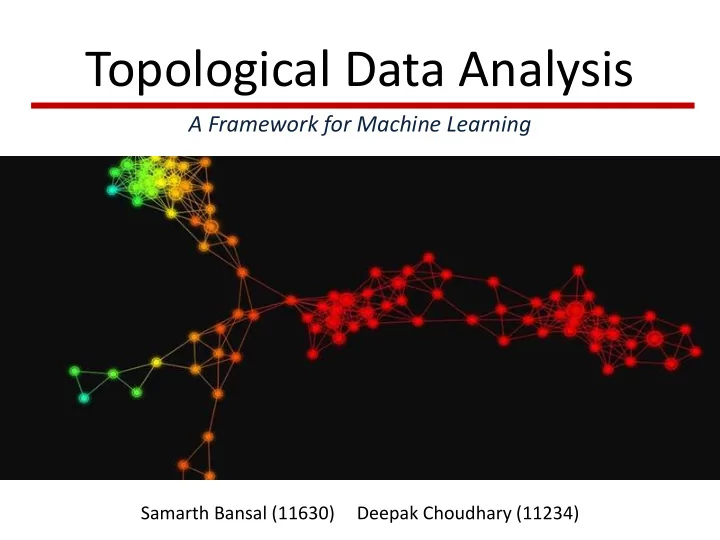
Data transformed into topological networks reveals insights and hidden patterns The combination of Topological Data Analysis (TDA) with machine- learning automatically creates topological networks revealing statistically significant patterns in complex data
Heart Disease Data Set UCI Machine Learning – 303 Instances, 75 Attributes Breast Cancer Wisconsin (Original) Data Set UCI Machine Learning – 699 Instances, 10 Attributes
American Mathematical Society, Volume 46, Number 2, April 2009, Pages 255–308
data using topology. Sci. Rep. 3, 1236; DOI:10.1038/srep01236 (2013).
breast cancers with a unique mutational profile and excellent survival. Monica Nicolaua, Arnold J. Levineb, and Gunnar Carlssona, Department of Mathematics, Stanford University, Stanford, CA 94305; School of Natural Sciences, Institute for Advanced Study, Princeton, NJ 08540; and Ayasdi, Inc., Palo Alto, CA 94301