CSE 326: Data Structures Graph representations Graphs Topological - - PowerPoint PPT Presentation

cse 326 data structures
SMART_READER_LITE
LIVE PREVIEW

CSE 326: Data Structures Graph representations Graphs Topological - - PowerPoint PPT Presentation

Agenda Basic graph terminology CSE 326: Data Structures Graph representations Graphs Topological Sort Topological sort Reference: Weiss, Ch. 9 Hal Perkins Spring 2007 Lectures 22-23 2 Some Applications: Graph ADT?


slide-1
SLIDE 1

1

CSE 326: Data Structures Graphs – Topological Sort

Hal Perkins Spring 2007 Lectures 22-23

2

Agenda

  • Basic graph terminology
  • Graph representations
  • Topological sort
  • Reference: Weiss, Ch. 9

3

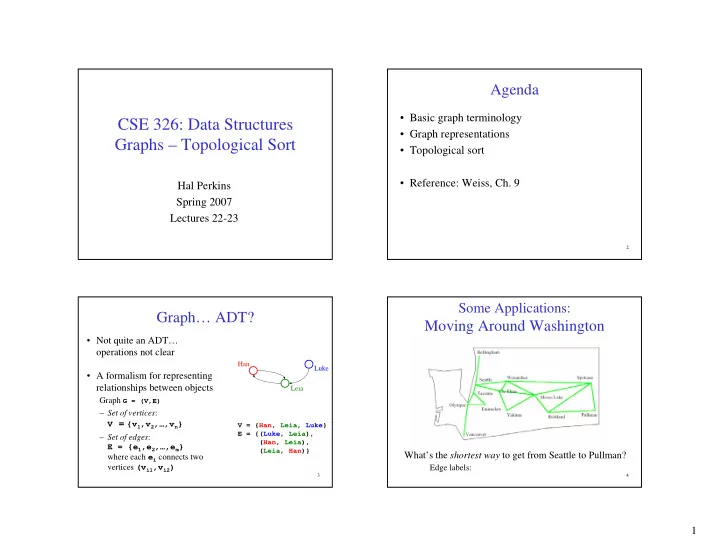
Graph… ADT?

  • Not quite an ADT…
  • perations not clear
  • A formalism for representing

relationships between objects

Graph G = (V,E) – Set of vertices: V = {v1,v2,…,vn} – Set of edges: E = {e1,e2,…,em} where each ei connects two vertices (vi1,vi2)

Han Leia Luke V = {Han, Leia, Luke} E = {(Luke, Leia), (Han, Leia), (Leia, Han)}

4

Some Applications:

Moving Around Washington

What’s the shortest way to get from Seattle to Pullman?

Edge labels:

slide-2
SLIDE 2

2

5

Some Applications:

Moving Around Washington

What’s the fastest way to get from Seattle to Pullman?

Edge labels:

6

Some Applications:

Reliability of Communication

If Wenatchee’s phone exchange goes down, can Seattle still talk to Pullman?

7

Some Applications:

Bus Routes in Downtown Seattle

If we’re at 3rd and Pine, how can we get to 1st and University using Metro?

8

Graph Definitions

In directed graphs, edges have a specific direction: In undirected graphs, they don’t (edges are two-way):

v is adjacent to u if (u,v) ∈ E

Han Leia Luke Han Leia Luke

slide-3
SLIDE 3

3

9

More Definitions:

Simple Paths and Cycles

A simple path repeats no vertices (except that the first can be the last):

p = {Seattle, Salt Lake City, San Francisco, Dallas} p = {Seattle, Salt Lake City, Dallas, San Francisco, Seattle}

A cycle is a path that starts and ends at the same node:

p = {Seattle, Salt Lake City, Dallas, San Francisco, Seattle} p = {Seattle, Salt Lake City, Seattle, San Francisco, Seattle}

A simple cycle is a cycle that repeats no vertices except that the first vertex is also the last (in undirected graphs, no edge can be repeated)

10

Trees as Graphs

  • Every tree is a graph!
  • Not all graphs are trees!

A graph is a tree if

– There are no cycles (directed or undirected) – There is a path from the root to every node

A B D E C F H G

11

Directed Acyclic Graphs (DAGs)

DAGs are directed graphs with no (directed) cycles.

main() add() access() mult() read()

Aside: If program call- graph is a DAG, then all procedure calls can be in- lined

12

Graph Representations

  • 0. List of vertices + list of edges
  • 1. 2-D matrix of vertices (marking edges in the cells)

“adjacency matrix”

  • 2. List of vertices each with a list of adjacent vertices

“adjacency list”

Things we might want to do:

  • iterate over vertices
  • iterate over edges
  • iterate over vertices adj. to a vertex
  • check whether an edge exists

Han Leia Luke

Vertices and edges may be labeled

slide-4
SLIDE 4

4

13

Representation 1: Adjacency Matrix

A |V| x |V| array in which an element

(u,v) is true if and only if there is an edge

from u to v

Han Leia Luke

Han Luke Leia Han Luke Leia runtime: space requirements:

14

Weighted Edges

  • adjacency matrix:

1 2 3 4

⎩ ⎨ ⎧ ∉ ∈ = E v) (u, if , E v) (u, if , weight A[u][v]

4 3 2 1

1 3 4 2

15

Representation 2: Adjacency List

A |V|-ary list (array) in which each entry stores a list (linked list) of all adjacent vertices

Han Leia Luke

Han Luke Leia runtime: space requirements:

16

Representation

  • adjacency list:

4 3 2 1 2 3 4 3 1 2

1 3 4 2

slide-5
SLIDE 5

5

17

Application: Topological Sort

Given a directed graph, G = (V,E), output all the vertices in V such that no vertex is output before any other vertex with an edge to it.

CSE 142 CSE 143 CSE 321 CSE 341 CSE 378 CSE 326 CSE 370 CSE 403 CSE 421 CSE 467 CSE 451 CSE 322

Is the output unique?

18

Topological Sort: Take One

1. Label each vertex with its in-degree (# of inbound edges) 2. While there are vertices remaining:

a. Choose a vertex v of in-degree zero; output v b. Reduce the in-degree of all vertices adjacent to v c. Remove v from the list of vertices Runtime:

19

void Graph::topsort(){ Vertex v, w; labelEachVertexWithItsIn-degree(); for (int counter=0; counter < NUM_VERTICES; counter++){ v = findNewVertexOfDegreeZero(); v.topologicalNum = counter; for each w adjacent to v w.indegree--; } }

20

Topological Sort: Take Two

1. Label each vertex with its in-degree 2. Initialize a queue Q to contain all in-degree zero vertices 3. While Q not empty

a. v = Q.dequeue; output v b. Reduce the in-degree of all vertices adjacent to v c. If new in-degree of any such vertex u is zero Q.enqueue(u) Runtime: Note: could use a stack, list, set, box, … instead of a queue

slide-6
SLIDE 6

6

21

void Graph::topsort(){ Queue q(NUM_VERTICES); int counter = 0; Vertex v, w;

labelEachVertexWithItsIn-degree();

q.makeEmpty(); for each vertex v if (v.indegree == 0) q.enqueue(v); while (!q.isEmpty()){ v = q.dequeue(); v.topologicalNum = ++counter; for each w adjacent to v if (--w.indegree == 0) q.enqueue(w); } } intialize the queue get a vertex with indegree 0 insert new eligible vertices

Runtime:

22

Example

CSE 142 CSE 143 CSE 321 CSE 341 CSE 378 CSE 326 CSE 370 CSE 403 CSE 421 CSE 467 CSE 451 CSE 322

Q: Output: