Learning Agent Learning Agents An Agent that observes its - - PDF document

learning agent learning agents
SMART_READER_LITE
LIVE PREVIEW

Learning Agent Learning Agents An Agent that observes its - - PDF document

Learning Agent Learning Agents An Agent that observes its performance and adapts its decision-making to improve its performance in the future. MSE 2400 EaLiCaRA Dr. Tom Way MSE 2400 Evolution & Learning 2 Agent Simple Reflex Agent


slide-1
SLIDE 1

1

Learning Agents

MSE 2400 EaLiCaRA

  • Dr. Tom Way

Learning Agent

  • An Agent that observes its performance

and adapts its decision-making to improve its performance in the future.

MSE 2400 Evolution & Learning 2

Agent

  • Something that does something
  • Computational Agent – a computer that

does something

MSE 2400 Evolution & Learning 3

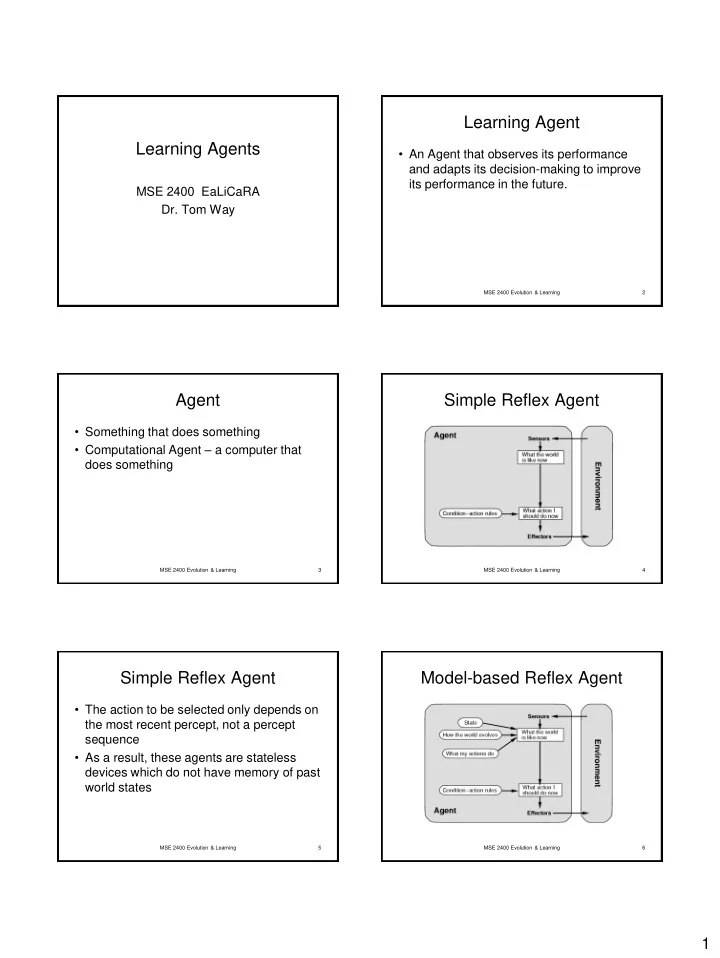
Simple Reflex Agent

MSE 2400 Evolution & Learning 4

Simple Reflex Agent

  • The action to be selected only depends on

the most recent percept, not a percept sequence

  • As a result, these agents are stateless

devices which do not have memory of past world states

MSE 2400 Evolution & Learning 5

Model-based Reflex Agent

MSE 2400 Evolution & Learning 6

slide-2
SLIDE 2

2

Model-based Reflex Agent

  • Have internal state which is used to keep

track of past states of the world (i.e., percept sequences may determine action)

  • Can assist an agent deal with at least

some of the observed aspects of the current state

MSE 2400 Evolution & Learning 7

Goal-based Agent

MSE 2400 Evolution & Learning 8

Goal-based Agent

  • Agent can act differently depending on

what the final state should look like

  • Example: automated taxi driver will act

differently depending on where the passenger wants to go

MSE 2400 Evolution & Learning 9

Utility-based Agent

MSE 2400 Evolution & Learning 10

Utility-based Agent

  • An agent's utility function is an

internalization of the performance measure (which is external)

  • Performance and utility may differ if the

environment is not completely observable

  • r deterministic

MSE 2400 Evolution & Learning 11

Learning Agent (in general)

MSE 2400 Evolution & Learning 12

slide-3
SLIDE 3

3

Learning Agent Parts (1)

  • Environment – world around the agent
  • Sensors – data input, senses
  • Critic – evaluates the input from sensors
  • Feedback – refined input, extracted info
  • Learning element – stores knowledge
  • Learning goals – tells what to learn

MSE 2400 Evolution & Learning 13

Learning Agent Parts (2)

  • Problem generator – test what is known
  • Performance element – considers all that

is known so far, refines what is known

  • Changes – new information
  • Knowledge – improved ideas & concepts
  • Actuators – probes environment, triggers

gathering of input in new ways

MSE 2400 Evolution & Learning 14

Intelligent Agents should…

  • accommodate new problem solving rules incrementally
  • adapt online and in real time
  • be able to analyze itself in terms of behavior, error and

success.

  • learn and improve through interaction with the

environment (embodiment)

  • learn quickly from large amounts of data
  • have memory-based exemplar storage and retrieval

capacities

  • have parameters to represent short and long term

memory, age, forgetting, etc.

MSE 2400 Evolution & Learning 15

Classes of Intelligent Agents (1)

MSE 2400 Evolution & Learning 16

  • Decision Agents – for decision making
  • Input Agents - that process and make

sense of sensor inputs (neural networks)

  • Processing Agents - solve a problem like

speech recognition

  • Spatial Agents - relate to physical world

Classes of Intelligent Agents (2)

MSE 2400 Evolution & Learning 17

  • World Agents - incorporate a combination
  • f all the other classes of agents to allow

autonomous behaviors

  • Believable agents - exhibits a personality

via the use of an artificial character for the interaction

Classes of Intelligent Agents (3)

MSE 2400 Evolution & Learning 18

  • Physical Agents - entity which percepts

through sensors and acts through actuators.

  • Temporal Agents - uses time based stored

information to offer instructions to a computer program or human being and uses feedback to adjust its next behaviors.
slide-4
SLIDE 4

4

How Learning Agents Acquire Knowledge

  • Supervised Learning

– Agent told by teacher what is best action for a given situation, then generalizes concept F(x)

  • Inductive Learning

– Given some outputs of F(x), agent builds h(x) that approximates F on all examples seen so far is SUPPOSED to be a good approximation for as yet unseen examples

MSE 2400 Evolution & Learning 19

How Learning Agents Acquire Concepts (1)

  • Incremental Learning: update hypothesis

model only when new examples are encountered

  • Feedback Learning: agent gets feedback
  • n quality of actions it chooses given the

h(x) it learned so far.

MSE 2400 Evolution & Learning 20

How Learning Agents Acquire Concepts (2)

  • Reinforcement Learning: rewards /

punishments prod agent into learning

  • Credit Assignment Problem: agent doesn’t

always know what the best (as opposed to just good) actions are, nor which rewards are due to which actions.

MSE 2400 Evolution & Learning 21

Examples

  • Eliza - http://www.simonebaldassarri.com/eliza/eliza.html
  • Mike - http://www.rong-chang.com/tutor_mike.htm
  • iEinstein -

http://www.pandorabots.com/pandora/talk?botid=ea77c0 200e365cfb

  • More Cleverbots - https://www.existor.com/en/
  • Chatbots - http://www.chatbots.org/

MSE 2400 Evolution & Learning 22