Topic 8 Parameters and Methods "We're flooding people with - - PowerPoint PPT Presentation

topic 8 parameters and methods
SMART_READER_LITE
LIVE PREVIEW

Topic 8 Parameters and Methods "We're flooding people with - - PowerPoint PPT Presentation

Topic 8 Parameters and Methods "We're flooding people with information. We need to feed it through a processor. A human must turn information into intelligence or knowledge. We've tended to forget that no computer will ever ask a new


slide-1
SLIDE 1

CS305j Introduction to Computing Parameters and Methods

1

Topic 8 Parameters and Methods

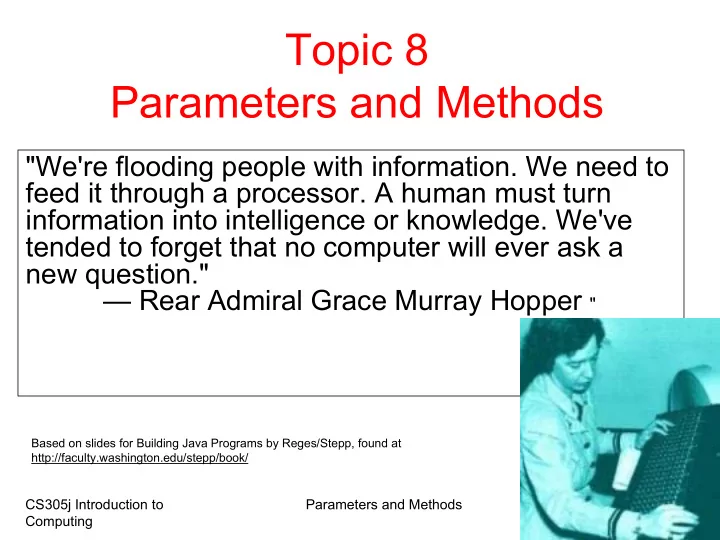
"We're flooding people with information. We need to feed it through a processor. A human must turn information into intelligence or knowledge. We've tended to forget that no computer will ever ask a new question." — Rear Admiral Grace Murray Hopper "

Based on slides for Building Java Programs by Reges/Stepp, found at http://faculty.washington.edu/stepp/book/

slide-2
SLIDE 2

CS305j Introduction to Computing Parameters and Methods

2

Reminder: global constants

8In the last topic, we used global constants to fix "magic number" redundancy problems:

public static final int SIZE = 3;

public static void main(String[] args) { drawDiamond(); System.out.println(); drawX(); } public static void drawDiamond(){ drawCone(); drawV(); } public static void drawX(){ drawV(); drawCone(); }

slide-3
SLIDE 3

CS305j Introduction to Computing Parameters and Methods

3

drawCone() method

public static void drawCone(){ //draws a cone with SIZE lines for(int lineNum = 1; lineNum <= SIZE; lineNum++){ //spaces before the forward slash for(int j = 1; j <= SIZE - lineNum; j++) System.out.print(" "); System.out.print("/");

//spaces between the forward slash and back slash

for(int j = 1; j <= (lineNum - 1) * 2; j++) System.out.print(" "); System.out.println("\\"); } }

slide-4
SLIDE 4

CS305j Introduction to Computing Parameters and Methods

4

drawV() method

public static void drawV(){ //draws a V with SIZE lines for(int lineNum = 1; lineNum <= SIZE; lineNum++){ // print spaces before back slash for(int j = 1; j <= lineNum - 1; j++) System.out.print(" "); System.out.print("\\");

// print spaces between back slash and forward slash

for(int j = 1; j <= (SIZE - lineNum) * 2; j++) System.out.print(" "); System.out.println("/"); } }

slide-5
SLIDE 5

CS305j Introduction to Computing Parameters and Methods

5

Another repetitive figure

8Now consider the task of drawing the following figures:

************* ******* ********** * * ********** ***** * * * * *****

8We'd like to structure the input using static methods, but each figure is different.

– What can we do?

8Note on drawing figures: It is the ability to generalize and break the problem into smaller steps that is important!

slide-6
SLIDE 6

CS305j Introduction to Computing Parameters and Methods

6

A poor solution

8Using what we already know, we could write a solution with the following methods:

– A method to draw a line of 13 stars. – A method to draw a line of 7 stars. – A method to draw a box of stars, size 10 x 3. – A method to draw a box of stars, size 5 x 4.

8These methods would be largely redundant. 8Constants would not help us solve this problem, because we do not want to share one value but want to run similar code with many values.

slide-7
SLIDE 7

CS305j Introduction to Computing Parameters and Methods

7

A poor solution

public static void oneLine13stars() public static void oneLine7stars() public static void draw10By3Box() public static void draw5By4Box() public static void draw12By100Box()

slide-8
SLIDE 8

CS305j Introduction to Computing Parameters and Methods

8

A better solution

8A better solution would look something like this:

– A method to draw a line of any number of stars. – A method to draw a box of stars of any size.

8It is possible to write parameterized methods; methods that are passed information when they are called which affects their behavior.

– Example: A parameterized method to draw a line of stars might ask us to specify how many stars to draw.

8parameter: A value given to a method by its caller, which takes the form of a variable inside the method's code. The method can use the value of this variable to adjust its behavior.

slide-9
SLIDE 9

CS305j Introduction to Computing Parameters and Methods

9

Methods with parameters

8Declaring a method that accepts a parameter:

public static void <name> ( <type> <name> ){ <statement(s)> ; } – Example: // Prints the given number of spaces. public static void printSpaces(int count) { for (int i = 1; i <= count; i++) { System.out.print(" "); } }

Does the declaration look like any other kind of statement we have already learned?

slide-10
SLIDE 10

CS305j Introduction to Computing Parameters and Methods

10

Passing parameters

8Calling a method and specifying a value for its parameter is called passing a parameter. 8Method call with passing parameter syntax:

<name>( <value> ); – Example: System.out.print("*"); printSpaces(7); System.out.print("**"); int x = 3 * 5; printSpaces(x + 2); System.out.println("***"); – Output: * ** ***

slide-11
SLIDE 11

CS305j Introduction to Computing Parameters and Methods

11

How parameters are passed

8formal parameter: The variable declared in the

  • method. Sometimes just called the parameter

8actual parameter: The value written between the parentheses in the call. Sometimes just called the argument

– When the program executes, the actual parameter's value is stored into the formal parameter variable, then the method's code executes.

printSpaces( 13 ); ... public static void printSpaces(int count) { for (int i = 1; i <= count; i++) { System.out.print(" "); } }

count will take the value 13 for this method call

slide-12
SLIDE 12

CS305j Introduction to Computing Parameters and Methods

12

Parameterized figure

8This code parameterizes the lines of stars:

public static void main(String[] args) { drawLineOfStars(13); System.out.println(); drawLineOfStars(7); } public static void drawLineOfStars(int length) { for (int i = 1; i <= length; i++) { System.out.print("*"); } System.out.println(); }

Output:

************* *******

slide-13
SLIDE 13

CS305j Introduction to Computing Parameters and Methods

13

Creating general solutions

8The ability to parameterize problems is a way of generalizing them, and this is a VERY important skill in programming!

slide-14
SLIDE 14

CS305j Introduction to Computing Parameters and Methods

14

Parameter details

8If a method accepts a parameter, it is illegal to call it without passing any value for that parameter.

– printSpaces(); // SYNTAX ERROR

8The actual parameter value passed to a method must be of the correct type, matching the type of the formal parameter variable.

– printSpaces(3.7); // SYNTAX ERROR must int

8Two methods may have the same name as long as they accept different parameters (this is called overloading).

public static void printLineOfStars() { ... } public static void printLineOfStars(int length) { ... }

slide-15
SLIDE 15

CS305j Introduction to Computing Parameters and Methods

15

Value parameter behavior

8value parameter: When primitive variables (such as int or double) are passed as parameters in Java, their values are copied and stored into the method's formal parameter.

– Modifying the formal parameter variable's value will not affect the value of the variable which was passed as the actual parameter. int x = 23; strange(x); System.out.println(x); // this x is unaffected ... public static void strange(int x) { x = x + 1; // modifies the x in strange System.out.println(x); }

Draw the boxes to understand the behavior!

Output: 24 23

slide-16
SLIDE 16

CS305j Introduction to Computing Parameters and Methods

16

Multiple parameters

8A method can accept more than one parameter, separated by commas:

public static void <name> ( <type> <name> , <type> <name> , ..., <type> <name> ) { <statement(s)> ; } – Example: public static void printPluses(int lines, int count) { for (int line = 1; line <= lines; line++) { for (int i = 1; i <= count; i++) { System.out.print("+"); } System.out.println(); } }

slide-17
SLIDE 17

CS305j Introduction to Computing Parameters and Methods

17

Parameterized box figure

8This code parameterizes the boxes of stars:

public static void main(String[] args) { drawBoxOfStars(10, 3); System.out.println(); drawBoxOfStars(4, 5); }

public static void drawBoxOfStars(int width, int height) drawLineOfStars(width); for (int line = 1; line <= height - 2; line++) { System.out.print("*"); printSpaces(width - 2); System.out.println("*"); } drawLineOfStars(width) }

slide-18
SLIDE 18

CS305j Introduction to Computing Parameters and Methods

18

Java's Math class

8Java has a class called Math that has several useful methods that perform mathematical calculations.

– The Math methods are called by writing:

  • Math. <name> ( <values> );

returns nearest whole number round(value) square root sqrt(value) sine, in radians sin(value) random double between 0 and 1 random() value1 to the value2 power pow(value1, value2) smaller of two values min(value1, value2) larger of two values max(value1, value2) logarithm base e log(value) cosine, in radians cos(value) absolute value abs(value) Description Method name

slide-19
SLIDE 19

CS305j Introduction to Computing Parameters and Methods

19

Methods that "return" values

8The methods of the Math class do not print their results to the console.

– Instead, a call to one of these methods can be used as an expression or part of an expression. – The method evaluates to produce (or return) a numeric result. – The result can be printed or used in a larger expression. – Example: double squareRoot = Math.sqrt(121.0); System.out.println(squareRoot); // 11.0 int absoluteValue = Math.abs(-50); System.out.println(absoluteValue); // 50 System.out.println(Math.min(3, 7) + 2); // 5

slide-20
SLIDE 20

CS305j Introduction to Computing Parameters and Methods

20

Methods that return values

8Declaring a method that returns a value:

public static <type> <name> ( <type> <name> ) { <statement(s)> ; }

8Returning a value from a method:

return <value> ;

8Example:

// Returns the given number cubed (to the third power). public static int cube(int number) { return number * number * number; }

slide-21
SLIDE 21

CS305j Introduction to Computing Parameters and Methods

21

Example returning methods

// Converts Fahrenheit to Celsius. public static double fToC(double degreesF) { return 5.0 / 9.0 * (degreesF - 32); } // Rounds the given real number to the nearest whole number. // Examples: round(3.1415) returns 3 and round(4.75) returns 5. public static int round(double value) { return (int) (value + 0.5); }

slide-22
SLIDE 22

CS305j Introduction to Computing Parameters and Methods

22

How to comment: methods

8If your method accepts parameters and/or returns a value, write a brief description of what the parameters are used for and what kind of value will be returned.

– In your comments, you can also write your assumptions about the values of the parameters. – You may wish to give examples of what values your method returns for various input parameter values. – Example:

// This method returns the factorial of the given integer n. // The factorial is the product of all integers up to that number. // I assume that the parameter value is non-negative. // Example: factorial(5) returns 1 * 2 * 3 * 4 * 5 = 120. public static int factorial(int n) { //implementation of factorial }