Topic 7 parameters "We're flooding people with information. We - - PowerPoint PPT Presentation

topic 7
SMART_READER_LITE
LIVE PREVIEW

Topic 7 parameters "We're flooding people with information. We - - PowerPoint PPT Presentation

Topic 7 parameters "We're flooding people with information. We need to feed it through a processor. A human must turn information into intelligence or knowledge. We've tended to forget that no computer will ever ask a new question. "


slide-1
SLIDE 1

Topic 7 parameters

Based on slides from Marty Stepp and Stuart Reges from http://www.buildingjavaprograms.com/

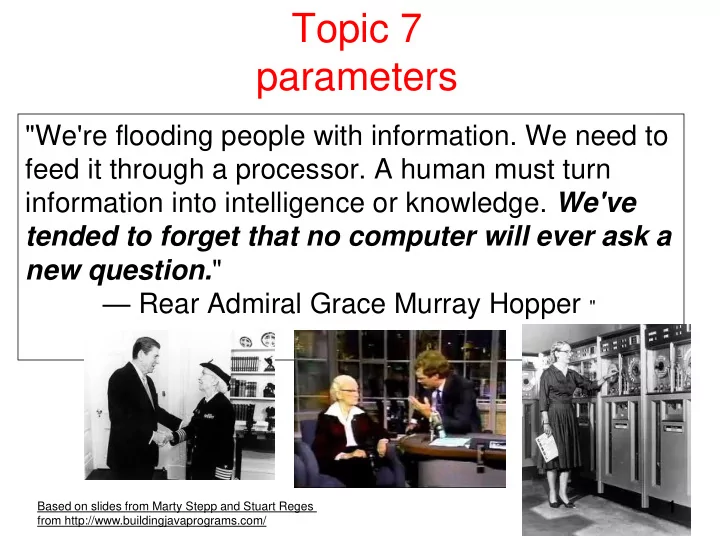
"We're flooding people with information. We need to feed it through a processor. A human must turn information into intelligence or knowledge. We've tended to forget that no computer will ever ask a new question." — Rear Admiral Grace Murray Hopper "

1

slide-2
SLIDE 2

Redundant recipes

Recipe for baking 20 cookies:

– Mix the following ingredients in a bowl:

  • 4 cups flour
  • 1 cup butter
  • 1 cup sugar
  • 2 eggs
  • 40 oz. chocolate chips ...

– Place on sheet and Bake for about 10 minutes.

Recipe for baking 40 cookies:

– Mix the following ingredients in a bowl:

  • 8 cups flour
  • 2 cups butter
  • 2 cups sugar
  • 4 eggs
  • 80 oz. chocolate chips ...

– Place on sheet and Bake for about 10 minutes.

2

slide-3
SLIDE 3

Parameterized recipe

Recipe for baking 20 cookies:

– Mix the following ingredients in a bowl:

  • 4 cups flour
  • 1 cup sugar
  • 2 eggs
  • ...

Recipe for baking N cookies:

– Mix the following ingredients in a bowl:

  • N/5

cups flour

  • N/20 cups butter
  • N/20 cups sugar
  • N/10 eggs
  • 2N oz. chocolate chips ...

– Place on sheet and Bake for about 10 minutes.

parameter: A value that distinguishes similar tasks.

slide-4
SLIDE 4

Redundant figures

Consider the task of printing the following lines/boxes:

************* ******* *********************************** ********** * * ********** ***** * * * * *****

4

slide-5
SLIDE 5

A redundant solution

public class Stars1 { public static void main(String[] args) { lineOf13(); lineOf7(); lineOf35(); box10x3(); box5x4(); } public static void lineOf13() { for (int i = 1; i <= 13; i++) { System.out.print("*"); } System.out.println(); } public static void lineOf7() { for (int i = 1; i <= 7; i++) { System.out.print("*"); } System.out.println(); } public static void lineOf35() { for (int i = 1; i <= 35; i++) { System.out.print("*"); } System.out.println(); } ...

 This code is redundant.  Would variables help?

Would constants help?

 What is a better

solution?

 line - A method to

draw a line of any number of stars.

 box - A method to draw

a box of any size.

5

slide-6
SLIDE 6

Parameterization

parameter: A value passed to a method by its caller.

– Instead of lineOf7, lineOf13, write line to draw any length.

  • When declaring the method, we will state that it

requires a parameter for the number of stars.

  • When calling the method, we will specify how many

stars to draw.

main line ******* 7 line ************* 13

6

slide-7
SLIDE 7

Declaring a parameter

Stating that a method requires a parameter in order to run public static void <name> (<type> <name>) { <statement>(s); }

Example:

public static void sayPassword(int code) { System.out.println("The password is: " + code); }

– When sayPassword is called, the caller must specify the integer code to print.

7

slide-8
SLIDE 8

Passing a parameter

Calling a method and specifying values for its parameters <name>(<expression>);

Example:

public static void main(String[] args) { sayPassword(42); sayPassword(12345); } Output: The password is 42 The password is 12345

8

slide-9
SLIDE 9

Parameters and loops

A parameter can guide the number of repetitions of a loop.

public static void main(String[] args) { chant(3); } public static void chant(int times) { for (int i = 1; i <= times; i++) { System.out.println("Just a salad..."); } } Output: Just a salad... Just a salad... Just a salad...

9

slide-10
SLIDE 10

How parameters are passed

When the method is called:

– The value is stored into the parameter variable. – The method's code executes using that value. public static void main(String[] args) { chant(3); chant(7); } public static void chant(int times) { for (int i = 1; i <= times; i++) { System.out.println("Just a salad..."); } } 7

times

3

times

10

slide-11
SLIDE 11

Common errors

If a method accepts a parameter, it is illegal to call it without passing any value for that parameter.

chant(); // ERROR: parameter value required

The value passed to a method must be of the correct type.

chant(3.7); // ERROR: must be of type int

Exercise: Change the Stars program to use a parameterized method for drawing lines of stars. 11

slide-12
SLIDE 12

Stars solution

// Prints several lines of stars. // Uses a parameterized method to remove redundancy. public class Stars2 { public static void main(String[] args) { line(13); line(7); line(35); } // Prints the given number of stars plus a line break. public static void line(int count) { for (int i = 1; i <= count; i++) { System.out.print("*"); } System.out.println(); } } 12

slide-13
SLIDE 13

Multiple parameters

A method can accept multiple parameters. (separate with , )

– When calling it, you must pass values for each parameter.

Declaration:

public static void <name>(<type> <name>, ..., <type> <name>) { <statement>(s); }

Call:

<name>(<exp>, <exp>, ..., <exp>);

13

slide-14
SLIDE 14

public static void main(String[] args) { printNumber(4, 9); printNumber(17, 6); printNumber(8, 0); printNumber(0, 8); } public static void printNumber(int number, int count) { for (int i = 1; i <= count; i++) { System.out.print(number); } System.out.println(); } Output: 444444444 171717171717 00000000

Modify the Stars program to draw boxes with parameters.

Multiple parameters example

14

slide-15
SLIDE 15

Stars solution

// Prints several lines and boxes made of stars. // Third version with multiple parameterized methods. public class Stars3 { public static void main(String[] args) { line(13); line(7); line(35); System.out.println(); box(10, 3); box(5, 4); box(20, 7); } // Prints the given number of stars plus a line break. public static void line(int count) { for (int i = 1; i <= count; i++) { System.out.print("*"); } System.out.println(); } ... 15

slide-16
SLIDE 16

Stars solution, cont'd.

... // Prints a box of stars of the given size. public static void box(int width, int height) { line(width); for (int line = 1; line <= height - 2; line++) { System.out.print("*"); for (int space = 1; space <= width - 2; space++) { System.out.print(" "); } System.out.println("*"); } line(width); } } 16

slide-17
SLIDE 17

Value semantics

Output:

  • 1. x = 24
  • 2. x = 23

value semantics: When primitive variables (int, double) are passed as parameters, their values are copied.

– Modifying the parameter will not affect the variable passed in.

public static void strange(int x) { x = x + 1; System.out.println("1. x = " + x); } public static void main(String[] args) { int x = 23; strange(x); System.out.println("2. x = " + x); ... } 17

slide-18
SLIDE 18

public class ParameterMystery { public static void main(String[] args) { int x = 9; int y = 2; int z = 5; mystery(z, y, x); mystery(y, x, z); } public static void mystery(int x, int z, int y) { System.out.print(z + " " + (y - x) + " "); } }

Clicker 1 - Output of "Parameter Mystery"

  • A. 5 -7 5 -7
  • B. 9 -3 5 7
  • C. 2 4 9 3
  • D. 9 -3 5 12
  • E. None of A through D

18

slide-19
SLIDE 19

Clicker 2 - What is output by the following code?

int x = 2; int y = 5; mystery2(x, y); System.out.print(x + " " + y + " "); public static void mystery2(int x, int y) { System.out.print(x + " " + y + " "); x *= y + 3; y--; x++; System.out.print(x + " " + y + " "); }

  • A. 2 5 17 4 2 5
  • B. 2 5 17 4 17 4
  • C. 17 4 2 5 17 4
  • D. 2 5 2 5 17 4
  • E. None of A through D

19

slide-20
SLIDE 20

Recall: Strings

string: A sequence of text characters.

String <name> = "<text>"; String <name> = <expression resulting in String>; – Examples: String name = "Marla Singer"; int x = 3; int y = 5; String point = "(" + x + ", " + y + ")";

20

slide-21
SLIDE 21

Clicker 3

Are Strings a primitive data type just like int and double?

  • A. No
  • B. Yes

21

slide-22
SLIDE 22

public class StringParameters { public static void main(String[] args) { sayHello("Marty"); String teacher = "Bictolia"; sayHello(teacher); } public static void sayHello(String name) { System.out.println("Welcome, " + name); } }

Output:

Welcome, Marty Welcome, Bictolia

Modify the Stars program to use string

  • parameters. Use a method named repeat that

prints a string many times.

Strings as parameters

22

slide-23
SLIDE 23

Stars solution

// Prints several lines and boxes made of stars. // Fourth version with String parameters. public class Stars4 { public static void main(String[] args) { line(13); line(7); line(35); System.out.println(); box(10, 3); box(5, 4); box(20, 7); } // Prints the given number of stars plus a line break. public static void line(int count) { repeat("*", count); System.out.println(); } ... 23

slide-24
SLIDE 24

Stars solution, cont'd.

... // Prints a box of stars of the given size. public static void box(int width, int height) { line(width); for (int line = 1; line <= height - 2; line++) { System.out.print("*"); repeat(" ", width - 2); System.out.println("*"); } line(width); } // Prints the given String the given number of times. public static void repeat(String s, int times) { for (int i = 1; i <= times; i++) { System.out.print(s); } } } 24