Topic 4 When Good Programs Go Bad A variety of errors can occur - - PowerPoint PPT Presentation

topic 4 when good programs go bad
SMART_READER_LITE
LIVE PREVIEW

Topic 4 When Good Programs Go Bad A variety of errors can occur - - PowerPoint PPT Presentation

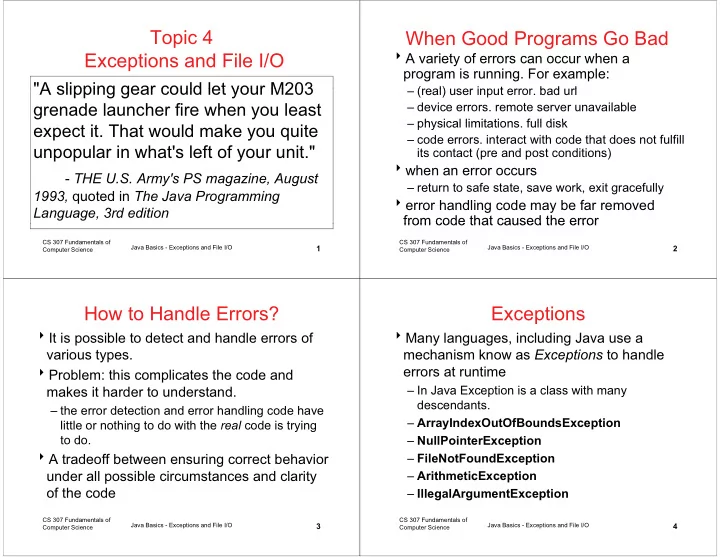
Topic 4 When Good Programs Go Bad A variety of errors can occur when a A E Exceptions and File I/O ti d Fil I/O i t f h program is running. For example: "A slipping gear could let your M203 A slipping gear could let your


slide-1
SLIDE 1

Topic 4 E ti d Fil I/O Exceptions and File I/O

"A slipping gear could let your M203 A slipping gear could let your M203 grenade launcher fire when you least expect it. That would make you quite unpopular in what's left of your unit " unpopular in what s left of your unit.

  • THE U.S. Army's PS magazine, August

1993, quoted in The Java Programming Language, 3rd edition

CS 307 Fundamentals of Computer Science Java Basics - Exceptions and File I/O

1

When Good Programs Go Bad

A i t f h A variety of errors can occur when a program is running. For example:

( l) i t b d l – (real) user input error. bad url – device errors. remote server unavailable physical limitations full disk – physical limitations. full disk – code errors. interact with code that does not fulfill its contact (pre and post conditions) its contact (pre and post conditions)

when an error occurs

– return to safe state save work exit gracefully return to safe state, save work, exit gracefully

error handling code may be far removed from code that caused the error

CS 307 Fundamentals of Computer Science Java Basics - Exceptions and File I/O

2

from code that caused the error

How to Handle Errors?

It is possible to detect and handle errors of various types. Problem: this complicates the code and makes it harder to understand.

– the error detection and error handling code have little or nothing to do with the real code is trying to do.

A tradeoff between ensuring correct behavior under all possible circumstances and clarity

  • f the code

CS 307 Fundamentals of Computer Science Java Basics - Exceptions and File I/O

3

Exceptions

Many languages, including Java use a mechanism know as Exceptions to handle errors at runtime

– In Java Exception is a class with many descendants. – ArrayIndexOutOfBoundsException – NullPointerException – FileNotFoundException – ArithmeticException – IllegalArgumentException

CS 307 Fundamentals of Computer Science Java Basics - Exceptions and File I/O

4

slide-2
SLIDE 2

Partial Exceptions Hierarchy

Th bl Throwable Error E ception IOE ti R ti E ti Error Exception IOException RuntimeException

EOFException FileNotFound Exception

A d

Arithmetic Exception NullPointer Exception IndexOut

  • fBounds

Illegal Argument

And many, many, many more

CS 307 Fundamentals of Computer Science Java Basics - Exceptions and File I/O

5

Exception Exception

more…

Creating Exceptions

As a program runs, if a situation occurs that is handled by exceptions then an Exception is thrown.

– An Exception object of the proper type is created – flow of control is transferred from the current block of code to code that can handle or deal ith th ti with the exception – the normal flow of the program stops and error handling code takes o er (if it e ists ) handling code takes over (if it exists.)

CS 307 Fundamentals of Computer Science Java Basics - Exceptions and File I/O

6

Attendance Question 1

Is it possible for the following method to result in an exception?

// pre: word != null public static void printLength(String word){ String output = "Word length is " + word.length(); S t t i tl ( t t ) System.out.println( output ); }

  • A. Yes
  • A. Yes
  • B. No

CS 307 Fundamentals of Computer Science Java Basics - Exceptions and File I/O

7

Unchecked Exceptions

Exceptions in Java fall into two different categories

– checked (other than Runtime) and unchecked (Runtime)

unchecked exceptions are completely preventable and u c ec ed e cept o s a e co p ete y p e e tab e a d should never occur.

– They are caused by logic errors, created by us, the programmers.

Descendents of the RuntimeException class Descendents of the RuntimeException class Examples: ArrayIndexOutOfBoundsException, NullPointerException, ArithmeticException There does not need to be special error handling code

– just regular error prevention code

If error handling code was required programs would be e o a d g code as equ ed p og a s

  • u d be

unwieldy because so many Java statements have the possibility of generating or causing an unchecked Exception

CS 307 Fundamentals of Computer Science Java Basics - Exceptions and File I/O

8

slide-3
SLIDE 3

Checked Exceptions

"Ch k d ti t diti "Checked exceptions represent conditions that, although exceptional, can reasonably be expected to occur and if they do occur be expected to occur, and if they do occur must be dealt with in some way.[other than the program terminating ]" the program terminating.]

– Java Programming Language third edition

Unchecked exceptions are due to a Unchecked exceptions are due to a programming logic error, our fault and preventable if coded correctly. p y Checked exceptions represent errors that are unpreventable by us!

CS 307 Fundamentals of Computer Science Java Basics - Exceptions and File I/O

9

p y

Required Error Handling Code

If ll th d th t t If you call a method that can generate a checked exception you must choose how to d l ith th t ibl deal with that possible error For example one class for reading from files is the FileReader class public FileReader(String fileName) throws FileNotFoundException

This constructor has the possibility of throwing a p y g FileNotFoundException FileNotFoundException is a checked exception

CS 307 Fundamentals of Computer Science Java Basics - Exceptions and File I/O

10

Checked Exceptions in Code

If we have code that tries to build a FileReader we must deal with the possibility of the exception

import java.io.FileReader; public class Tester { public int countChars(String fileName) { FileReader r = new FileReader(fileName); int total = 0; while( r.ready() ) { r.read(); total++; } r.close(); return total; } }

The code contains a syntax error. "unreported exception java.io.FileNotFoundException; must be caught or declared

}

CS 307 Fundamentals of Computer Science Java Basics - Exceptions and File I/O

11

j p ; g to be thrown."

Handling Checked Exceptions

I th d th i lid th i In the code on the previous slide there are in fact 4 statements that can generate checked exceptions exceptions.

– The FileReader constructor the ready method – the ready method – the read method – the close method – the close method

To deal with the exceptions we can either state this method throws an Exception of the state this method throws an Exception of the proper type or handle the exception within the method itself

CS 307 Fundamentals of Computer Science Java Basics - Exceptions and File I/O

12

slide-4
SLIDE 4

Methods that throw Exceptions

It may be that we don't know how to deal with an error within the method that can generate it In this case we will pass the buck to the method that called us The keyword throws is used to indicate a y method has the possibility of generating an exception of the stated type p yp Now any method calling ours must also throw an exception or handle it

CS 307 Fundamentals of Computer Science Java Basics - Exceptions and File I/O

13

throw an exception or handle it

Using the throws Keyword

bli i t tCh (St i fil N ) public int countChars(String fileName) throws FileNotFoundException, IOException { int total = 0; FileReader r = new FileReader(fileName); while( r.ready() ) { r read(); { r.read(); total++; } l () r.close(); return total; }

Now any method calling ours must also throw an exception or handle it

CS 307 Fundamentals of Computer Science Java Basics - Exceptions and File I/O

14

throw an exception or handle it

Using try-catch Blocks

If you want to handle the a checked exception locally then use use the keywords d try and catch the code that could cause an exception is placed in a block of code preceded by the keyword try the code that will handle the exception if it

  • ccurs is placed in a block of code preceded

p p by the keyword catch

CS 307 Fundamentals of Computer Science Java Basics - Exceptions and File I/O

15

Sample try and catch Blocks

public int countChars(String fileName) { int total = 0; { int total = 0; try { FileReader r = new FileReader(fileName); while( r.ready() ) { d() { r.read(); total++; } r.close(); } catch(FileNotFoundException e) { System.out.println("File named " + fileName + "not found. " + e); ) total = -1; } catch(IOException e) { System out println("IOException occured " + { System.out.println( IOException occured + "while counting chars. " + e); total = -1; } return total;

CS 307 Fundamentals of Computer Science Java Basics - Exceptions and File I/O

16

return total; }

slide-5
SLIDE 5

Mechanics of try and catch

Code that could cause the checked exception is placed in a try block

– note how the statements are included in one try block. – Each statement could be in a separate try block with an associated catch block but that is very unwieldy (see associated catch block, but that is very unwieldy (see next slide)

Each try block must have 1 or more Each try block must have 1 or more associated catch blocks

– code here to handle the error. In this case we just print code here to handle the error. In this case we just print

  • ut the error and set result to -1

CS 307 Fundamentals of Computer Science Java Basics - Exceptions and File I/O

17

Gacky try catch Block

public int countChars3(String fileName) { i t t t l { int total = 0; FileReader r = null; try { r = new FileReader(fileName); } catch(FileNotFoundException e) { System.out.println("File named " + fileName + "not found. " + e); total = -1; } try { while( r.ready() ) { try { r.read(); } { r.read(); } catch(IOException e) { System.out.println("IOException " + "occurred while counting " + "chars. " + e); total = -1; } total++; } } catch(IOException e) { System.out.println("IOException occurred while counting chars. " + e); t t l 1 } total = -1;} try { r.close(); } catch(IOException e) { System.out.println("IOException occurred while counting chars. " + e); CS 307 Fundamentals of Computer Science Java Basics - Exceptions and File I/O

18

y p p g total = -1;} return total; }

More try catch Mechanics

If you decide to handle the possible exception locally in a method with the try bl k t h di block you must have a corresponding catch block the catch blocks have a parameter list of 1 the parameter must be Exception or a p p descendant of Exception Use multiple catch blocks with one try Use multiple catch blocks with one try block in case of multiple types of Exceptions

CS 307 Fundamentals of Computer Science Java Basics - Exceptions and File I/O

19

Exceptions

What Happens When Exceptions Occur Exceptions Occur

If an exception is thrown then the normal flow of control of a program halts control of a program halts Instead of executing the regular statements the Java Runtime System starts to search for a Java Runtime System starts to search for a matching catch block The first matching catch block based on data type is executed When the catch block code is completed the program does not "go back" to where the exception program does not go back to where the exception

  • ccurred.

– It finds the next regular statement after the catch block

CS 307 Fundamentals of Computer Science Java Basics - Exceptions and File I/O

20

g

slide-6
SLIDE 6

Counting Chars Again

public int countChars(String fileName) public int countChars(String fileName) { int total = 0; try { FileReader r = new FileReader(fileName); while( r ready() ) while( r.ready() ) { r.read();// what happens in an exception occurs? total++; } r.close(); (); } catch(FileNotFoundException e) { System.out.println("File named " + fileName + "not found. " + e); total = -1; } catch(IOException e) { System.out.println("IOException occured " + " hil ti h " + ) "while counting chars. " + e); total = -1; } return total; }

CS 307 Fundamentals of Computer Science Java Basics - Exceptions and File I/O

21 }

Throwing Exceptions Yourself

if you wish to throw an exception in your code you if you wish to throw an exception in your code you use the throw keyword Most common would be for an unmet precondition Most common would be for an unmet precondition

public class Circle { private int iMyRadius; /** pre: radius > 0 */ public Circle(int radius) public Circle(int radius) { if (radius <= 0) throw new IllegalArgumentException ("radius must be > 0. " ( + "Value of radius: " + radius); iMyRadius = radius; }

CS 307 Fundamentals of Computer Science Java Basics - Exceptions and File I/O

22

}

Attendance Question 2

What is output by the method badUse if it is called with the following code?

int[] nums = {3, 2, 6, 1}; badUse( nums ); public static void badUse(int[] vals){ int total = 0; try{ for(int i = 0; i < vals.length; i++){ int index = vals[i]; total += vals[index]; } } catch(Exception e){ total = -1; } System.out.println(total); }

A 1 B 0 C 3 D -1 E 5

CS 307 Fundamentals of Computer Science Java Basics - Exceptions and File I/O

23

  • A. 1
  • B. 0
  • C. 3
  • D. 1
  • E. 5

Attendance Question 3

Is the use of a try-catch block on the previous question a proper use of try-catch blocks?

  • A. Yes
  • B. No

CS 307 Fundamentals of Computer Science Java Basics - Exceptions and File I/O

24

slide-7
SLIDE 7

Error Handling, Error Handling Everywhere! Everywhere!

Seems like a lot of choices for error Seems like a lot of choices for error prevention and error handling

– normal program logic e g if’s for loop counters normal program logic, e.g. if s for loop counters – assertions – try – catch block – try – catch block

When is it appropriate to use each kind?

CS 307 Fundamentals of Computer Science Java Basics - Exceptions and File I/O

25

Error Prevention

U l i (if f ) t t l i Us program logic, (ifs , fors) to prevent logic errors and unchecked exceptions

– dereferencing a null pointer, going outside the bounds of dereferencing a null pointer, going outside the bounds of an array, violating the preconditions of a method you are

  • calling. e.g. the charAt method of the String class

use assertions as checks on your logic – use assertions as checks on your logic

  • you checked to ensure the variable index was within the array

bounds with an if 10 lines up in the program and you are SURE you didn’t alter it. you didn t alter it.

  • Use an assert right before you actually access the array

if( inbounds(index) ) { // l t f l t d d { // lots of related code // use an assertion before accessing arrayVar[index] = foo;

CS 307 Fundamentals of Computer Science Java Basics - Exceptions and File I/O

26

}

Error Prevention

i 307 t b d t h k in 307 asserts can be used to check preconditions

St d d J t l i t E ti – Standard Java style is to use Exceptions

Use try/catch blocks on checked exceptions

I l d ’t th t h dl h k d – In general, don’t use them to handle unchecked exceptions like NPE or AIOBE

One place it is reasonable to use try / catch One place it is reasonable to use try / catch is in testing suites.

– put each test in a try / catch If an exception – put each test in a try / catch. If an exception

  • ccurs that test fails, but other tests can still be

run

CS 307 Fundamentals of Computer Science Java Basics - Exceptions and File I/O

27

File Input and Output

P f d f d i fil Programs must often read from and write to files – large amounts of data – data not known at runtime – data that changes over time Each programming language has its own way of handling input and output

– involves dealing with the operating system – if possible try to hide that fact as much as possible

J tt t t t d di i t d t t ith Java attempts to standardize input and output with the notion of a stream, an ordered sequence of data that has a source or destination

CS 307 Fundamentals of Computer Science Java Basics - Exceptions and File I/O

28

data that has a source or destination.

slide-8
SLIDE 8

Streams?

Dr Egon Spengler: Don't cross the streams

  • Dr. Egon Spengler:

Don't cross the streams. Dr: Peter Venkman: Why not?

  • Dr. Egon Spengler:

It would be bad.

  • Dr. Peter Venkman:

I'm fuzzy on the whole good/bad thing. what do you mean by "bad"?

  • Dr. Egon Spengler:

Try to imagine all life as you know it

  • Dr. Egon Spengler:

Try to imagine all life as you know it stopping instantaneously and every molecule in your body exploding at the speed of light the speed of light.

  • Dr. Peter Venkman:

That's bad. Okay. Alright, important safety tip. Thanks Egon.

CS 307 Fundamentals of Computer Science Java Basics - Exceptions and File I/O

29

Streams

A stream serves as a connection between your program and an external source or destination for bytes and bits

– could be standard input or output, files, network connections, or other programs

CS 307 Fundamentals of Computer Science Java Basics - Exceptions and File I/O

30

Lots of Streams

Java has over sixty (60!) different stream types in its java.io package part of the reason input and output are so difficult to understand in Java is the size and diversity of the IO library The type of stream you use depends on e ype o s ea you use depe ds o what you are trying to do

– even then there are multiple options even then there are multiple options

CS 307 Fundamentals of Computer Science Java Basics - Exceptions and File I/O

31

Working with Files in Java

D i d i di i l f 1 d 0 Data is stored in digital form, 1s and 0s Work with these in packages of 8, the byte The IO library creates higher level abstractions so we think we are working with characters, Strings, or whole objects whole objects Some abstract classes

InputStream OutputStream Reader and Writer – InputStream, OutputStream, Reader, and Writer – InputStream and OutputStream represent the flow of data (a stream) ( ) – Reader and Writer are used to read the data from a stream or put the data in a stream

CS 307 Fundamentals of Computer Science Java Basics - Exceptions and File I/O

32

– convenience classes exist to make things a little easier

slide-9
SLIDE 9

The Scanner class

A class to make reading from source of input

  • easier. New in Java 5.0

Constructors

Scanner(InputStream) ( p ) Scanner(File)

Methods to read lines from input Methods to read lines from input

boolean hasNextLine() String nextLine() String nextLine()

Methods to read ints

int readInt() boolean hasNext()

CS 307 Fundamentals of Computer Science Java Basics - Exceptions and File I/O

33

int readInt(), boolean hasNext()

Scanner and Keyboard Input

No exceptions thrown!

– no try – catch block necessary!

Set delimiters with regular expressions, default is whitespace

Scanner s = new Scanner(System.in); Sca e s e Sca e (Syste . ); System.out.print("Enter your name: "); String name s nextLine(); String name = s.nextLine(); System.out.print("Press Enter to continue: ");

CS 307 Fundamentals of Computer Science Java Basics - Exceptions and File I/O

34

s.nextLine();

Hooking a Scanner up to a File

import java.util.Scanner; import java.io.File; import java.io.IOException; public class ReadAndPrintScores { public static void main(String[] args) { try { try { Scanner s = new Scanner( new File("scores.dat") ); while( s.hasNextInt() ) { System.out.println( s.nextInt() ); }

12 35 12

} s.close(); } catch(IOException e) { System out println( e );

12 45 12 12

{ System.out.println( e ); } } }

12 13 57 scores.dat

CS 307 Fundamentals of Computer Science Java Basics - Exceptions and File I/O

35

Writing to a File

//sample code to write 100 random ints to a file, 1 per line import java.io.PrintStream; import java.io.IOException; import java.io.File; import java.util.Random; public class WriteToFile { public static void main(String[] args) { try { try { PrintStream writer = new PrintStream( new File("randInts.txt")); Random r = new Random(); final int LIMIT = 100; for(int i = 0; i < LIMIT; i++) { writer.println( r.nextInt() ); } writer.close(); } catch(IOException e) { System.out.println("An error occurred ” + + “while trying to write to the file"); }

CS 307 Fundamentals of Computer Science Java Basics - Exceptions and File I/O

36

} } }

slide-10
SLIDE 10

Reading From a Web Page

public static void main(String[] args) { public static void main(String[] args) { try { String siteUrl = "http://www.cs.utexas.edu/~scottm/cs307"); URL mySite = new URL(siteURL); y ( ); URLConnection yc = mySite.openConnection(); Scanner in = new Scanner(new InputStreamReader(yc.getInputStream())); int count = 0; while (in.hasNext()) { System.out.println(in.next()); count++; } System.out.println("Number of tokens: " + count); in.close(); } catch (Exception e) { e.printStackTrace();

CS 307 Fundamentals of Computer Science Java Basics - Exceptions and File I/O

37 p } }