Good programs, broken programs? CS 251 Fall 2019 CS 240 Spring 2020 - - PowerPoint PPT Presentation

good programs broken programs cs 251 fall 2019 cs 240
SMART_READER_LITE
LIVE PREVIEW

Good programs, broken programs? CS 251 Fall 2019 CS 240 Spring 2020 - - PowerPoint PPT Presentation

Good programs, broken programs? CS 251 Fall 2019 CS 240 Spring 2020 Principles of Programming Languages Foundations of Computer Systems Ben Wood Ben Wood Goal: program works (does not fail) Need: definition of works/correct : a


slide-1
SLIDE 1

CS 251 Fall 2019 Principles of Programming Languages

Ben Wood

λ

CS 240 Spring 2020

Foundations of Computer Systems

Ben Wood https://cs.wellesley.edu/~cs240/s20/

Reasoning about Programs

(and bugs)

A brief interlude on specifications, assertions, and debugging

Largely based on material from University of Washington CSE 331

Reasoning about Programs 1

Good programs, broken programs?

Goal: program works (does not fail) Need: definition of works/correct: a specification But programs fail all the time. Why?

1. Misuse of your code: caller did not meet assumptions 2. Errors in your code: mistake causes wrong computation 3. Unpredictable external problems:

Out of memory, missing file, network down, … Plan for these problems, fail gracefully.

4. Wrong or ambiguous specification, implemented correctly

Reasoning about Programs 2

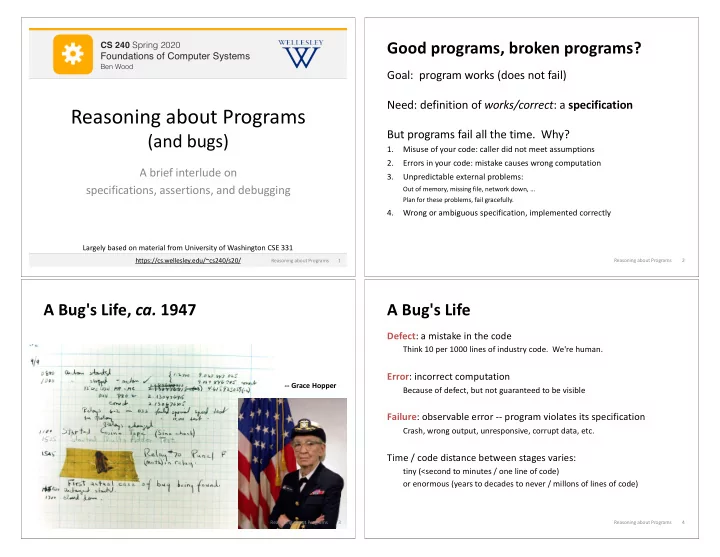
A Bug's Life, ca. 1947

  • - Grace Hopper

Reasoning about Programs 3

A Bug's Life

Defect: a mistake in the code

Think 10 per 1000 lines of industry code. We're human.

Error: incorrect computation

Because of defect, but not guaranteed to be visible

Failure: observable error -- program violates its specification

Crash, wrong output, unresponsive, corrupt data, etc.

Time / code distance between stages varies:

tiny (<second to minutes / one line of code)

  • r enormous (years to decades to never / millons of lines of code)

Reasoning about Programs 4

slide-2
SLIDE 2

"How to build correct code"

  • 1. Design and Verify

Make correctness more likely or provable from the start.

  • 2. Program Defensively

Plan for defects and errors.

make testing more likely to reveal errors as failures make debugging failures easier

  • 3. Test and Validate

Try to cause failures.

provide evidence of defects/errors

  • r increase confidence of their absence
  • 4. Debug

Determine the cause of a failure. (Hard! Slow! Avoid!) Solve inverse problem.

Reasoning about Programs 6

Testing

Can show that a program has an error. Can show a point where an error causes a failure. Cannot show the error that caused the failure. Cannot show the defect that caused the error. Can improve confidence that the sorts of errors/failures targeted by the tests are less likely in programs similar to the tests. Cannot show absence of defects/errors/failures.

Unless you can test all possible behaviors exhaustively. Usually intractable for interesting programs.

Reasoning about Programs 8

Why reason about programs statically?

“Today a usual technique is to make a program and then to test it. While program testing can be a very effective way to show the presence of bugs, it is hopelessly inadequate for showing their absence. The only effective way to raise the confidence level of a program significantly is to give a convincing proof of its correctness. ”

  • - Edsger Dijkstra

(without running them)

Reasoning about Programs 9

Reasoning about programs

Reason about a single program execution.

Concrete, dynamic: be the machine, run the program. Test or debug: important, but "too late."

Reason about all possible executions of a program.

Abstract, static: consider all possible paths at once. Usually to prevent broken programs. Hard for whole programs, easier if program uses clean, modular abstractions.

Many compromises in between.

Reasoning about Programs 10

slide-3
SLIDE 3

Forward Reasoning

Suppose we initially know (or assume) w > 0

// w > 0 x = 17; // w > 0, x == 17 y = 42; // w > 0, x == 17, y == 42 z = w + x + y; // w > 0, x == 17, y == 42, z > 59 …

Then we know various things after, e.g., z > 59

Reasoning about Programs 11

Forward: careful with assignment

// we know: nothing w = x+y; // we know: w == x + y x = 4; // we know: w == old x + y, x == 4 // must update other facts too... y = 3; // we know: w == old x + old y, // x == 4, y == 3 // we do NOT know: w == x + y == 7

Reasoning about Programs 12

Backward Reasoning

If we want z < 0 at the end

// w + 17 + 42 < 0 x = 17; // w + x + 42 < 0 y = 42; // w + x + y < 0 z = w + x + y; // z < 0

Then we need to start with w < -59

Reasoning about Programs 13

Reasoning Forward and Backward

Forward:

Determine what assumptions imply. Ensure an invariant is maintained.

Invariant = property that is always true

Backward:

Determine sufficient conditions.

For a desired result: What assumptions are needed for correctness? For an undesired result: What assumptions will trigger an error/bug?

Reasoning about Programs 14

slide-4
SLIDE 4

Reasoning Forward and Backward

Forward:

Simulate code on many inputs at once. Learn many facts about code's behavior,

some of which may be irrelevant.

Backward:

Show how each part of code affects the end result. More useful in many contexts (research, practice) Closely linked with debugging

Reasoning about Programs 15

Precondition and Postcondition

Precondition: “assumption” before some code // pre: w < -59 x = 17; // post: w + x < -42 Postcondition: “what holds” after some code If you satisfy the precondition, then you are guaranteed the postcondition.

Reasoning about Programs 17

Conditionals, forward.

// pre: initial assumptions if(...) { // pre: && condition true ... // post: X } else { // pre: && condition false ... // post: Y } // either branch could have executed // post: X || Y

Reasoning about Programs 18

Conditionals, backward.

// pre: (C, X) or (!C, Y) if(C) { // pre: X: weakest such that ... // post: Z } else { // pre: Y: weakest such that ... // post: Z } // either branch could have executed // post: need Z Weakest precondition: the minimal assumption under which the postcondition is guaranteed to be true.

Reasoning about Programs 19

slide-5
SLIDE 5

Conditional, backward

// 9. pre: x <= -3 or (3 <= x, x < 5) or 8 <= x // 8. pre: (x <= -3, x < 5) or (3 <= x, x < 5) //

  • r 8 <= x

// 7. pre: (x < 5, (x <= -3 or 3 <= x)) // or 8 <= x // 6. pre: (x < 5, 9 <= x*x) or 8 <= x // 5. pre: (x < 5, 9 <= x*x) or (5 <= x, 8 <= x) if (x < 5) { // 4. pre: 9 <= x*x x = x*x; // 2. post: 9 <= x } else { // 3. pre: 8 <= x x = x+1; // 2. post: 9 <= x } // 1. post: 9 <= x

  • 4 -3 -2 -1

7 2 1 4 6 5 3 8 9

Reasoning about Programs 20

Is static reasoning enough?

Can learn things about the program we have. Basis for human proofs, limited automated reasoning.

Compilers check types, do correct optimizations. Many static program analysis techniques

Proving entire program correct is HARD! Should also write down things we expect to be true

Reasoning about Programs 21

"How to build correct code"

  • 1. Design and Verify

Make correctness more likely or provable from the start.

  • 2. Program Defensively

Plan for defects and errors.

make testing more likely to reveal errors as failures make debugging failures easier

  • 3. Test and Validate

Try to cause failures.

provide evidence of defects/errors

  • r increase confidence of their absence
  • 4. Debug

Determine the cause of a failure. (Hard! Slow! Avoid!) Solve inverse problem.

Reasoning about Programs 22

What to do when things go wrong

Early, informative failures

Goal 1: Give information about the problem To the programmer – descriptive error message To the client code: exception, return value, etc. Goal 2: Prevent harm Whatever you do, do it early: before small error causes big problems Abort: alert human, cleanup, log the error, etc. Re-try if safe: problem might be transient Skip a subcomputation if safe: just keep going Fix the problem? Usually infeasible to repair automatically

Reasoning about Programs 23

slide-6
SLIDE 6

Defend your code

1. Make errors impossible with type safety, memory safety (not C!). 2. Do not introduce defects, make reasoning easy with simple code.

KISS = Keep It Simple, Stupid

3. Make errors immediately visible with assertions. Reduce distance from error to failure 4. Debug (last resort!): find defect starting from failure Easiest in modular programs with good specs, test suites, assertions Use scientific method to gain information.

Analogy to health/medicine: wellness/prevention vs. diagnosis/treatment

Reasoning about Programs 24

There are two ways of constructing a software design: One way is to make it so simple that there are

  • bviously no deficiencies,

and the other way is to make it so complicated that there are no obvious deficiencies. The first method is far more difficult.

  • - Sir Anthony Hoare, Turing Award winner
  • - Brian Kernighan, author of The C Programming Language book, much more

Debugging is twice as hard as writing the code in the first place. Therefore, if you write the code as cleverly as possible, you are, by definition, not smart enough to debug it.

Reasoning about Programs 25

Defensive programming, testing

Check: Precondition and Postcondition Representation invariant Other properties that should be true Check statically via reasoning and tools Check dynamically via assertions

assert(index >= 0); assert(array != null); assert(size % 2 == 0);

Write assertions as you write code Write many tests and run them often

Reasoning about Programs 26

Square root with assertion

// requires: x >= 0 // returns: approximation to square root of x double sqrt(double x) { assert(x >= 0.0); double result; ... compute square root ... assert(absValue(result*result – x) < 0.0001); return result; }

Reasoning about Programs 28

slide-7
SLIDE 7

Don’t go to sea without your lifejacket!

Finally, it is absurd to make elaborate security checks on debugging runs, when no trust is put in the results, and then remove them in production runs, when an erroneous result could be expensive or disastrous. What would we think of a sailing enthusiast who wears his lifejacket when training on dry land, but takes it

  • ff as soon as he goes to sea?

Hints on Programming Language Design

  • - C.A.R. Hoare

Reasoning about Programs 29

When not to use assertions

Don't check for user input errors with assertions. User errors are expected situations that programs must handle.

// assert(!isEmpty(zipCode)); // XX NO XX if (isEmpty(zipCode)) { handleUserError(...); }

Don’t clutter code with useless, distracting repetition

x = y + 1; // assert(x == y + 1); // XX NO XX

Don’t perform side effects, won’t happen if assertions disabled.

// assert(array[i]++ != 42); // XX NO XX array[i]++; // part of the program logic assert(array[i] != 42); printf(array[i]);

Reasoning about Programs 30

Last Resort: Principled Debugging

  • 1. Find small, repeatable test case that produces the failure
  • 2. Narrow down location and proximate cause

Scientific Method: observe, hypothesize, experiment, analyze Keep a record

  • 3. Fix the defect (and test the fix!)

Is it a simple typo, or a design flaw? Does it occur elsewhere?

  • 4. Add #1 as a (regression) test for the future.

Reasoning about Programs 32

Observe Form Hypothesis Design Experiment Run Test Fix Bug!

Principled Debugging

Reasoning about Programs 33

slide-8
SLIDE 8

Example in practice.c

// returns 1 iff needle is a substring of haystack, // otherwise returns 0 int contains_string(char* haystack, char* needle); Failure: can't find "very happy" within: "Fáilte, you are very welcome! Hi Seán! I am very very happy to see you all." Ugly: Accents?! Panic about Unicode!!! Web search wildly, copy random code you don't understand from dubious sources, install new string library, … Bad: Start tracing the execution of this example Good: simplify/clarify the symptom…

Disclaimer: borrowing this reference, have not had time to learn what it is.

Reasoning about Programs 34

Minimize the failing input,

and distance to non-failing input.

Can not find "very happy" within "Fáilte, you are very welcome! Hi Seán! I am very very happy to see you all." Can find "very happy" within "Fáilte, you are very welcome! Hi Seán!" Can not find "very happy" within "I am very very happy to see you all." "very very happy" Can find "very happy" within "very happy" Can not find "ab" within "aab" Can find "ab" within "ab", "abb", "bab"

Reasoning about Programs 35

Minimize the failing code (localize)

Exploit modularity Start with everything, take away pieces until failure goes away Start with nothing, add pieces back in until failure appears Exploit modular reasoning Trace through program, viewing intermediate results Binary search speeds up the process Error happens somewhere between first and last statement Do binary search on that ordered set of statements

Reasoning about Programs 36

Debugging at scale…

Real Systems Large and complex Collection of modules, written by multiple people Complex input Many external interactions Non-deterministic Replication can be an issue Infrequent failure Instrumentation eliminates the failure Defects cross abstraction barriers Large time lag from corruption (defect) to detection (failure)

Reasoning about Programs 37