CS 251 Fall 2019 CS 251 Fall 2019 Topics Principles of - - PowerPoint PPT Presentation

cs 251 fall 2019 cs 251 fall 2019 topics principles of
SMART_READER_LITE
LIVE PREVIEW

CS 251 Fall 2019 CS 251 Fall 2019 Topics Principles of - - PowerPoint PPT Presentation

CS 251 Fall 2019 CS 251 Fall 2019 Topics Principles of Programming Languages Principles of Programming Languages Ben Wood Ben Wood Macros Macros: Design considerations Style considerations User-Extensible Syntax Hygiene


slide-1
SLIDE 1

CS 251 Fall 2019 Principles of Programming Languages

Ben Wood

λ

CS 251 Fall 2019

Principles of Programming Languages

Ben Wood

λ

https://cs.wellesley.edu/~cs251/f19/

Macros: User-Extensible Syntax

Hygienic Macros 1

Topics

Macros

  • Design considerations
  • Style considerations
  • Hygiene

Hygienic Macros 2

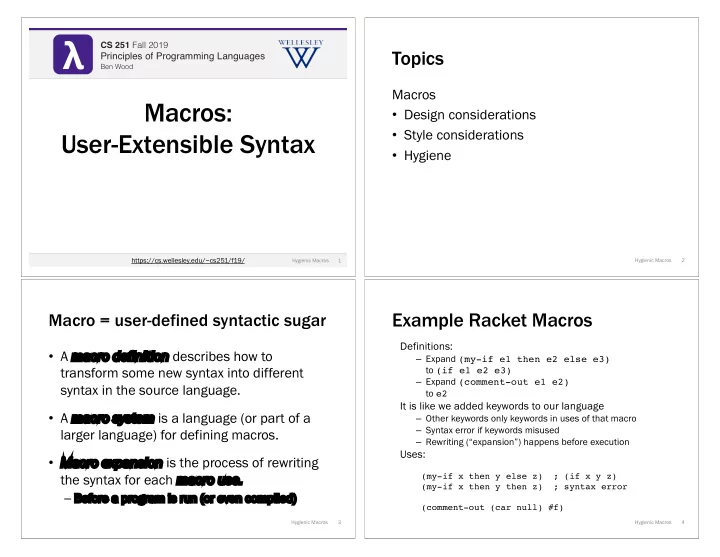
Macro = user-defined syntactic sugar

  • A ma

macro

  • definition
  • n describes how to

transform some new syntax into different syntax in the source language.

  • A ma

macro

  • system is a language (or part of a

larger language) for defining macros.

  • Mac

Macro expan ansi sion is the process of rewriting the syntax for each ma macro

  • use.

– Be Before a a program am is run n (or even n compiled)

Hygienic Macros 3

Example Racket Macros

Definitions:

– Expand (my-if e1 then e2 else e3) to (if e1 e2 e3) – Expand (comment-out e1 e2) to e2

It is like we added keywords to our language

– Other keywords only keywords in uses of that macro – Syntax error if keywords misused – Rewriting (“expansion”) happens before execution

Uses:

(my-if x then y else z) ; (if x y z) (my-if x then y then z) ; syntax error (comment-out (car null) #f)

Hygienic Macros 4

slide-2
SLIDE 2

Overuse

Macros sometimes get a bad wrap for being

  • verused.

Rule of thumb: Use macros only where functions would be awkward or impossible. They can be useful!

Hygienic Macros 5

Macro system design: Tokenization

Macro systems generally work at the level of tokens not sequences of characters

– So must know how programming language tokenizes text

Example: “macro expand head to car”

– Would not rewrite (+ headt foo) to (+ cart foo) – Would not rewrite head-door to car-door

  • But would in C where head-door is subtraction

Hygienic Macros 6

Macro system design: Associativity and Parenthesization

C/C++ preprocessor example: #define ADD(x,y) x+y ADD(1,2/3)*4 means 1 + 2 / 3 * 4 not (1 + 2 / 3) * 4 "Solved" with emphatic parenthesization by the programmer: #define ADD(x,y) ((x)+(y)) Racket S-expression syntax trivially avoids this problem!

Hygienic Macros 7

Macro system design: Local bindings and shadowing

Suppose macros also apply to variable bindings. Then: “macro expand head to car”

(let ([head 0][car 1]) head) ; 0 (let* ([head 0][car 1]) head) ; 0

Would become:

(let ([car 0][car 1]) car) ; error (let* ([car 0][car 1]) car) ; 1

C/C++ "safety by convention": all-caps macros and non- all-caps everything else Racket does not work this way – it gets scope “right”!

Hygienic Macros 8

slide-3
SLIDE 3

Example Racket macro definitions

Two simple macros

(define-syntax my-if ; macro name (syntax-rules (then else) ; other keywords [(my-if e1 then e2 else e3) ; macro use (if e1 e2 e3)])) ; form of expansion (define-syntax comment-out ; macro name (syntax-rules () ; other keywords [(comment-out ignore instead) ; macro use instead])) ; form of expansion If a syntactic form matches, do the corresponding expansion – In these examples, list of possible use forms has length 1 – Else syntax error

Hygienic Macros 9

Macro style

Equivalent functions that double their argument:

(define (dbl x) (+ x x)) (define (dbl x) (* 2 x))

Ba Bad sty style as a macro:

(define-syntax dbl (syntax-rules()[(dbl x)(+ x x)])) (define-syntax dbl (syntax-rules()[(dbl x)(* 2 x)]))

  • 1. If a function works fine, don't use a macro.
  • 2. Avoid surprising reevaluation:

(dbl (begin (print "hi") 42))

Hygienic Macros 10

Macro style

Avoid surprising reevaluation. Use a local binding:

(define-syntax dbl (syntax-rules () [(dbl x) (let ([y x]) (+ y y))]))

Avoid surprising evaluation order, such as:

(define-syntax take (syntax-rules (from) [(take e1 from e2) (- e2 e1)])) Fix with a local binding as above.

Hygienic Macros 11

Hygiene: avoid accidental shadowing

In C/C++, defining local variables inside macros is unwise

– When needed done with hacks like __strange_name34

Example:

Macro: define-syntax dbl (syntax-rules () [(dbl x) (let ([y 1]) (* 2 x y))])) Use: (let ([y 7]) (dbl y)) Naïve expansion: (let ([y 7]) (let ([y 1]) (* 2 y y)))

Racket hygienic macros avoid this problem.

Hygienic Macros 12

slide-4
SLIDE 4

Hygiene: avoid accidental shadowing

Example:

Macro: (define-syntax dbl (syntax-rules () [(dbl x) (* 2 x)])) Use: (let ([* +]) (dbl 42)) Naïve expansion: (let ([* +]) (* 2 42))

Racket hygienic macros avoid this problem.

Hygienic Macros 13

Maintaining macro hygiene

A hygienic macro system: 1. Secretly renames local variables in macros with fresh names 2. Looks up variables used in macros where the macro is defined Neither of these rules are followed by the “naïve expansion” most macro systems use

– Without hygiene, macros are much more brittle (non-modular)

On rare occasions, hygiene is not what you want

– Racket has somewhat complicated support for that

Sound familiar? Analogous to ____________ vs. ____________.

More examples in code: for loop, less parensy lets, let* as sugar.

Hygienic Macros 14